Tag: dealership marketing

  • A Guide to Facebook for Car Dealerships

    A Guide to Facebook for Car Dealerships

    Using Facebook for car dealerships has gone from a "nice-to-have" to an absolute necessity. It’s hands-down the most powerful tool you have to get in front of thousands of local buyers who are actively looking for their next vehicle. We’re not just talking about posting a few pictures of cars; we're talking about building a lead-generating machine that consistently moves metal off your lot.

    Why Facebook Is a Goldmine for Car Dealerships
    A man in a black jacket and white shirt looks at a tablet at a car dealership.

    If you're not all-in on Facebook, you're leaving serious money on the table. It's so much more than a place for people to share vacation photos. For an independent dealer, Facebook is the ultimate competitive equalizer. It gives you access to the same sophisticated marketing tools that the big franchise stores use, letting you punch well above your weight.

    This means you can stop passively waiting for customers to find you and start actively generating leads. Instead of just hoping the right person stumbles across your post, you can pinpoint potential buyers based on their location, what they're interested in, and even their recent web activity—like checking out other car sites. Your dealership's feed becomes a digital showroom that’s open for business 24/7.

    Turning Clicks into Customers

    The real magic happens when you turn that online "like" or "share" into a customer walking through your doors. Facebook's ad platform is specifically designed to guide a potential car buyer from casually scrolling their newsfeed straight to your sales team.

    Here's how it gives you a massive advantage:

    • Hyper-Local Targeting: You can draw a digital circle around your dealership and show your ads only to people within that radius. No more wasted ad spend on shoppers who live too far away.
    • In-Market Audience Identification: Facebook knows who's in the market for a car. You can target users who are actively researching vehicles, visiting competitor websites, and showing all the tell-tale signs of a buyer.
    • Direct Lead Capture: With tools like Lead Ads, a potential customer can send you their name, email, and phone number with just a couple of taps, all without ever leaving the Facebook app. It's frictionless.

    The biggest shift you need to make is in your mindset. Stop thinking of Facebook as a social media chore. Start seeing it as a primary engine for driving website traffic, capturing high-quality leads, and selling more cars, faster.

    The Proof Is in the Performance

    This isn't just a bunch of marketing fluff; the data backs it up. In a pilot program, Meta found that automotive brands using a specific combination of on-Facebook advertising solutions saw a 12% median lift in leads and a 32% median lift in vehicle detail page views compared to their previous strategies.

    How? They used smart, proven tactics like retargeting ads to people who had already visited their website and creating Lookalike Audiences to find new shoppers who behaved just like their best customers.

    Getting a handle on platforms like Facebook is a huge part of a winning local strategy. For a deeper dive, this guide on social media marketing for local businesses is a fantastic resource.

    Building Your Dealership's Digital Showroom
    A smartphone displaying the Facebook app on a table, symbolizing a digital storefront for businesses.

    Think of your Facebook Business Page as the digital version of your physical lot. For a lot of local car shoppers, this is where they’ll meet you for the first time. That first impression has to be professional, trustworthy, and, frankly, impressive.

    Setting up your page isn't just about filling in boxes. It's about making deliberate choices that turn a casual visitor into a genuine lead. Every single piece of your page—from the cover photo to the "About" section—needs to build confidence and make it dead simple for people to see your cars and get in touch. When you get it right, your page stops being a social media chore and starts becoming a lead-gen machine.

    Nailing the Foundational Setup

    Getting the fundamentals right from the start makes everything else easier. First thing's first: make sure your page is categorized correctly. Choose "Car Dealership" or the closest automotive option. This small detail tells Facebook's algorithm who you are, which helps your page show up in front of the right local audience.

    Next up, grab a custom URL for your page (like facebook.com/MainStreetMotors). A clean, branded URL looks far more professional than the random string of numbers Facebook assigns by default. It's also much easier for customers to remember and share.

    Crafting a Profile That Builds Trust

    Your profile picture and cover photo are your digital billboards. Your dealership's logo should be your profile picture, crisp and clear. For the cover photo, you have more room to play. Show off your best inventory, a wide shot of your clean and inviting lot, or even a picture of your smiling team. The goal is to convey quality and personality.

    The "About" section is where you really start to connect with people. Don't just list your hours and phone number. Tell your story.

    • What's your specialty? Are you the go-to lot for dependable work trucks or affordable SUVs for families?
    • Why should they trust you? Mention if you're family-owned or have been part of the community for years.
    • What's the buying experience like? Talk about your no-hassle pricing or your great financing options.

    This is your chance to sound like a real person, not just another faceless dealership. Remember, your Facebook page and your website should work together. A great social presence drives traffic to your main hub, which is why a strong site is so important. You can dig deeper into what makes a great site in our guide to dealership website design.

    Pro Tip: That Call-to-Action (CTA) button at the top of your page is gold. Don't just leave it on the default "Send Message." Change it to something that drives action. "Shop Now" can link straight to your vehicle inventory, and "Call Now" puts potential buyers directly in touch with your sales team with a single tap.

    Mastering Organic Content and Vehicle Listings

    Now that your digital showroom is ready, it's time to stock it with content that actually pulls in buyers—without spending a dime on ads. Your organic content is the daily pulse of your dealership on Facebook. It's how you build trust and keep your local community engaged, even when they aren't actively shopping.

    This isn't about constant sales pitches. It’s about building genuine relationships. When you consistently offer something valuable and show the real people behind your dealership, you become the first name people think of when they finally decide it's time to buy a car.

    Put Your Inventory Where Buyers Are Looking

    Facebook gives you some incredibly powerful, and free, tools designed specifically for selling cars. The two you absolutely must use are Facebook Marketplace and the Vehicle Listings tab (sometimes called Automotive Inventory) on your Business Page.

    Why is this so critical? Research shows that a significant percentage of vehicle sales happen within a short drive of a dealership. These Facebook tools are built to connect you directly with that local, high-intent audience.

    Think of Marketplace as your prime digital real estate. It's where you tap into a huge pool of nearby shoppers. When you list a vehicle, make sure you nail the essentials:

    • Plenty of Good Photos: Don't skimp here. Post at least 10-15 clear, well-lit pictures of every car. Get all the angles—exterior, interior, close-ups on features, even the engine bay.
    • A Compelling Description: Go beyond the standard year, make, and model. Tell a story. Mention the recent service you just did, any unique features, or its history.
    • VIN-Backed Listings: This is non-negotiable. Always include the Vehicle Identification Number (VIN). It's a massive trust signal that tells buyers you're a transparent, professional operation.

    Your page's Vehicle Listings tab serves a different purpose—it's your organized, permanent catalog where shoppers can browse everything you have in stock without leaving Facebook.

    Create a Content Mix That Actually Connects

    A winning organic strategy is about much more than just posting cars for sale. You need a balanced diet of content that entertains, educates, and builds a real connection with people. The goal is to create a feed that your community genuinely wants to follow.

    A great content mix turns your dealership's Facebook page from a constant sales pitch into a valuable local resource. When you give more than you take, you build a loyal following that eventually turns into a reliable sales pipeline.

    A varied content plan also teaches you what your audience really cares about. You can dig deeper into building out your strategy by exploring these social media marketing strategies for small car dealerships.

    Here's a look at what a balanced, effective week of organic posting could look like. This approach keeps your audience engaged and helps you cover all your bases, from showcasing inventory to building your brand's reputation.

    Effective Organic Facebook Content Mix for Dealerships

    Content Type Goal Example Post Frequency
    New Arrival Showcase Generate immediate interest in fresh inventory. A 60-second walk-around video of a new car on the lot. 2-3x per week
    Customer Spotlights Build social proof and trust with real stories. A photo of a happy customer with their new vehicle. 1x per week
    Helpful Tips & Advice Position your dealership as a trusted expert. A short post: "3 Signs Your Tires Need Replacing." 1x per week
    Behind-the-Scenes Humanize your brand and build community connection. A "Meet the Team" Monday or a video of a car detail. 1x per week

    This mix ensures you're not just selling, but also providing value and building a community around your dealership, which pays dividends in the long run.

    Your Playbook for Engaging Posts

    Here are four content pillars you can build your weekly schedule around. Don't worry about posting constantly—aim for 3-5 high-quality posts per week.

    1. New Arrival Showcase: Forget static photos. The minute a new car hits your lot, grab your phone and shoot a quick, 60-second walk-around video. Pop the hood, show off the interior, and point out cool features while you talk directly to the camera. It feels authentic and gets way more attention.

    2. Customer Spotlights: This is your most powerful marketing tool, hands down. When you close a deal, ask your happy customer if you can snap a picture of them with their new ride. Share it (with their permission, of course) and tag them if they're on Facebook. A genuine smile is more convincing than any ad copy you could ever write.

    3. Quick Tips and Advice: Become the local go-to for car knowledge. Share simple, useful maintenance tips that anyone can understand. A post like "How to Check Your Oil in 30 Seconds" or "What That Weird Noise Under the Hood Might Be" provides real value and establishes you as an expert people can trust.

    4. Behind-the-Scenes Glimpses: Show people the heart of your dealership. Post a quick video of your team getting a car ready for sale, introduce your lead mechanic in a "Meet the Crew" feature, or share a photo of the team celebrating a birthday. This stuff humanizes your business and builds a powerful connection with your local community.

    Fueling Sales with Targeted Facebook Ads

    Posting good, organic content is how you build a community and earn trust. But when you need to drive sales right now, paid ads are the high-octane fuel you’re looking for. This is where we switch gears from building relationships to actively generating leads. Facebook Ads Manager is your control center for creating campaigns that actually put people on your lot.

    While you'll see a dozen different campaign objectives, independent dealers get the most bang for their buck by focusing on two: Traffic and Lead Generation.

    A Traffic campaign is your best bet for sending interested buyers straight to your website's Vehicle Detail Pages (VDPs). A Lead Generation campaign, on the other hand, is brilliant because it lets people give you their contact info with a couple of taps, all without ever leaving the Facebook app.

    Defining Your Perfect Customer

    The real magic of Facebook ads for car dealers is the ridiculously precise targeting. You can finally stop throwing money away on ads that hit people who aren't in the market and focus every single dollar on local shoppers who are ready to buy.

    Build your targeting strategy on these three pillars:

    • Location: This is non-negotiable. Most of your customers live nearby, so you have to target a tight radius around your dealership. Industry data consistently shows that the vast majority of vehicle sales happen within a short drive of the lot. Start with a 10-15 mile radius and only expand if necessary.
    • Interests: Go a layer deeper. You can target people who've shown an interest in specific brands like Ford or Honda, checked out your competitors’ pages, or follow publications like Car and Driver.
    • Behaviors: This is where it gets powerful. Target people based on actions they've taken, like those Facebook flags as "likely to move" or who have recently been all over automotive content. The algorithm is surprisingly good at spotting these "in-market" signals.

    A solid content mix is crucial for attracting the right audience before you even spend a dime on ads. Think of it as warming up your audience so they're receptive to your pitch.
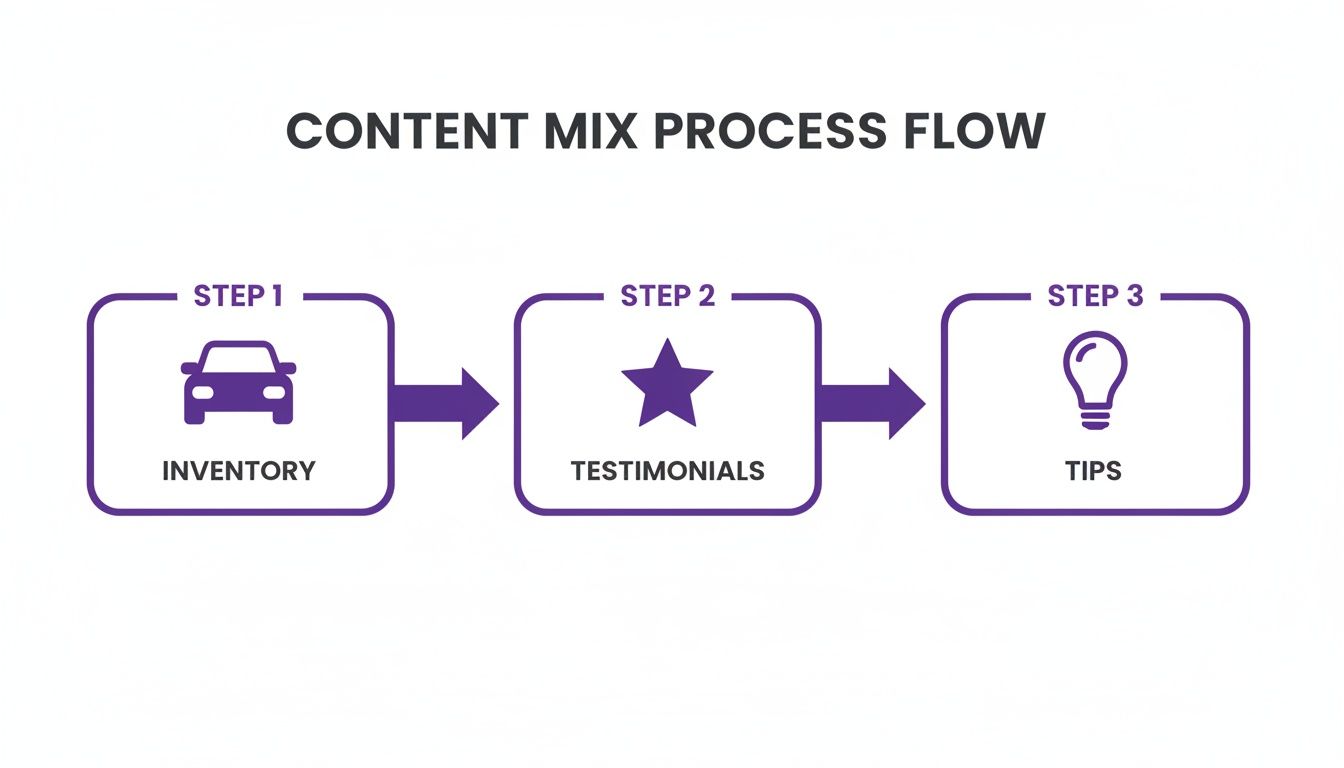
    A content mix process flow diagram with three steps: Inventory (car icon), Testimonials (star icon), and Tips (lightbulb icon).

    As you can see, a steady blend of showing off your inventory, sharing customer success stories, and offering genuinely helpful advice creates a presence that not only attracts people but makes them want to stick around.

    The Power of Retargeting and Lookalike Audiences

    Once you get some traffic flowing to your website, your most profitable ad campaigns will almost always come from retargeting and lookalike audiences. These two strategies let a modest ad budget punch way above its weight.

    Retargeting is simply showing ads to people who have already visited your website. These aren't cold prospects; they're warm leads who already know who you are. You can easily create an audience of everyone who visited your site in the last 30 days and hit them with a reminder of that killer F-150 they were looking at. For a deeper dive on turning web visitors into real opportunities, check out our guide on generating more auto dealership leads.

    Lookalike Audiences are where things get really exciting. You can upload a list of your past customers, and Facebook will go out and find thousands of new people in your area who share similar characteristics. A 1-3% lookalike audience is often the sweet spot, giving you a fresh stream of highly qualified prospects who look just like your best buyers.

    Launching Your First Lead Generation Campaign

    A Lead Generation campaign is designed from the ground up to make getting a person's contact info as easy as possible. When someone clicks your ad, a form pops up that’s already pre-filled with their name and email from their Facebook profile. It’s almost frictionless.

    When you're putting the ad together, your creative has to be on point. I've seen video walk-arounds of a specific vehicle work incredibly well. Crisp, high-quality photos showing off a car's best features are also a must.

    Once the leads start rolling in, remember that your ads are public. To protect your brand's reputation and squeeze every bit of value out of your ad spend, you need a plan for effective Facebook Ads comment moderation. Staying on top of comments lets you answer questions, handle objections, and project a professional image, making sure your investment pays off.

    Measuring Success and Optimizing Your Strategy

    Launching your ad campaigns is really just the starting line. The real magic—and the real money—is in digging into the data to see what’s working, what’s a dud, and then tweaking your approach. This is how you stop throwing money at the wall and start making smart decisions that actually put more cash in your pocket.

    You’ll be spending most of your time in two places: Facebook Insights for your organic page performance and Ads Manager for everything related to your paid campaigns. Your goal is to translate all those charts and numbers into a simple story that answers one question: are our Facebook efforts selling more cars?

    Decoding Your Key Performance Metrics

    It’s incredibly easy to get overwhelmed by all the data Facebook throws at you. Don't fall into that trap. Instead, laser-focus on a handful of key metrics that actually mean something for a car dealership. These will give you the complete picture without the headache.

    Here are the big four you should be tracking religiously:

    • Click-Through Rate (CTR): This is just the percentage of people who saw your ad and bothered to click it. If your CTR is in the gutter, it's a huge red flag that either your ad creative is boring or your targeting is way off. While benchmarks vary, a WordStream analysis found the average CTR for the auto industry on Facebook ads to be 0.80%.
    • Cost Per Lead (CPL): Simple math: how much you spent on a campaign divided by the number of leads it generated. This is your efficiency score. Lower is always better. Knowing your CPL tells you exactly what it costs to get a potential buyer's attention.
    • Engagement Rate: This is all about the likes, comments, and shares. High engagement on your regular, non-paid posts is gold. It tells you exactly what kind of content your local audience actually wants to see from you.
    • Reach: Simply put, this is the total number of individual people who laid eyes on your content. It’s a great, at-a-glance measure of your dealership's visibility in the community.

    The most critical mindset shift is connecting these social media numbers to actual dealership results. A high CTR is nice, but it's meaningless if those clicks don't turn into website leads or phone calls. Always ask, "How did this activity move us closer to selling a car?"

    Connecting Social Activity to Sales

    At the end of the day, it's all about moving metal. While it can sometimes be tough to draw a straight line from a "like" to a sale, you can get a very clear picture by tracking the outcomes that matter. At the end of each month, you should be able to answer questions like, "How many leads came directly from our Facebook lead form?" or "How many people clicked the 'Call Now' button on our page this week?"

    This whole process is about creating a feedback loop.

    Let's say you notice your quick walk-around videos get twice the engagement of your polished, static photos. That’s a loud and clear signal from your audience: double down on video for your next ad campaign.

    Or maybe a lead generation campaign is running, but the CPL is creeping up higher than you'd like. Don't just let it bleed money. Dive in, tweak the audience targeting, swap in a new photo of the car, or rewrite the ad copy. Small, consistent adjustments are what separate the dealerships that just use Facebook from the ones that truly profit from it.

    A Few Common Questions We Hear All the Time

    When dealerships start getting serious about Facebook, a few practical questions always pop up. It makes sense. You're not just playing with a new marketing toy; you're putting real time and money on the line and you need to see a return. Let's tackle the most common questions we hear from dealers just like you.

    How Much Should a Dealership Budget for Facebook Ads?

    There's no single magic number, but a great starting point for most independent lots is somewhere between $300 and $700 per month. That's enough budget to run a solid, always-on retargeting campaign for your website visitors while also testing a couple of different lead generation campaigns to find local buyers.

    The key is to start smart, not big. Pay close attention to your Cost Per Lead (CPL). Once you see a campaign that’s bringing in good, affordable leads, that's your green light to start scaling up the budget. You'd be surprised at the results you can get with a modest, well-aimed budget.

    What’s the Single Most Important Ad I Can Run?

    If you could only run one ad, make it a Dynamic Retargeting Ad for Inventory. Hands down, this is the biggest game-changer. These ads automatically show people the exact cars they just looked at on your website.

    Think about it: a guy clicks on a 2019 Chevy Silverado on your site but gets distracted and leaves. A little later, he's scrolling through Facebook, and boom—there's an ad with that exact same truck, pictures and all. It’s personal, it’s timely, and it targets the hottest leads you have: people who have already raised their hand. That's why it works so well.

    Do I Really Need to Post Organic Content Every Single Day?

    Nope, definitely not. Quality and consistency beat daily frequency every time. A much smarter (and more sustainable) goal is to post three to five really good, engaging pieces of content each week.

    Mix it up to keep people interested. Show off a new arrival, post a quick picture of a happy customer picking up their new ride (get their permission, of course!), share a simple car care tip, or do a quick "meet the team" post. The goal here is to build a little trust and just stay on people's radar. A few high-effort posts are way better than a feed full of rushed, low-quality ones.

    Your organic posts are what build the community and trust that make your paid ads work so much better. They warm up your audience, so when you do ask for their info, they're not hearing from a stranger. A pro tip: Use Facebook's built-in scheduling tool to knock out a week's worth of posts in one sitting. It's a massive time-saver.

    Should I Use Marketplace or Stick to My Business Page?

    You absolutely need to use both. They do different jobs, but they work together perfectly to pull customers in.

    Here's how to think about it:

    • Your Business Page is your digital dealership. It’s your home base for building your brand, running professional ads, sharing updates, and seeing all your stats.
    • Facebook Marketplace is your digital front line. This is where the action is. It's a massive, high-traffic lot where you list individual cars to get in front of thousands of people in your area who are actively looking to buy.

    The winning strategy is to list your inventory on Marketplace with great photos and descriptions. Crucially, make sure those listings point people back to your Business Page and, even better, directly to that vehicle's detail page on your own website. This creates a clean, simple path from a shopper just browsing to becoming a solid lead in your system.


    Ready to turn your inventory into an online lead-generating machine? AutoFire™ delivers modern, mobile-first websites designed specifically for independent dealerships. Our platform makes it easy to showcase your vehicles, capture leads, and get discovered by local buyers on Google. Get your professional dealership site online in minutes.

    Start your free site with AutoFire today!

  • A Modern Playbook for Generating Auto Dealership Leads

    A Modern Playbook for Generating Auto Dealership Leads

    Your website isn't just an online business card anymore. It's your digital showroom, your top salesperson, and by far your most powerful tool for generating real, high-quality auto dealership leads. A sharp, mobile-friendly design isn't just a nice-to-have; it's the absolute foundation for turning casual online browsers into paying customers on your lot.

    The whole game is about creating a smooth digital experience that builds immediate trust and makes it incredibly easy for a shopper to take the next step.

    Building a Digital Showroom That Converts

    Think about it: your website is often the very first handshake with a potential buyer. Long before they smell the new car scent or kick a single tire, they've already sized you up based on their experience online. This is where the modern battle for leads is won or lost.

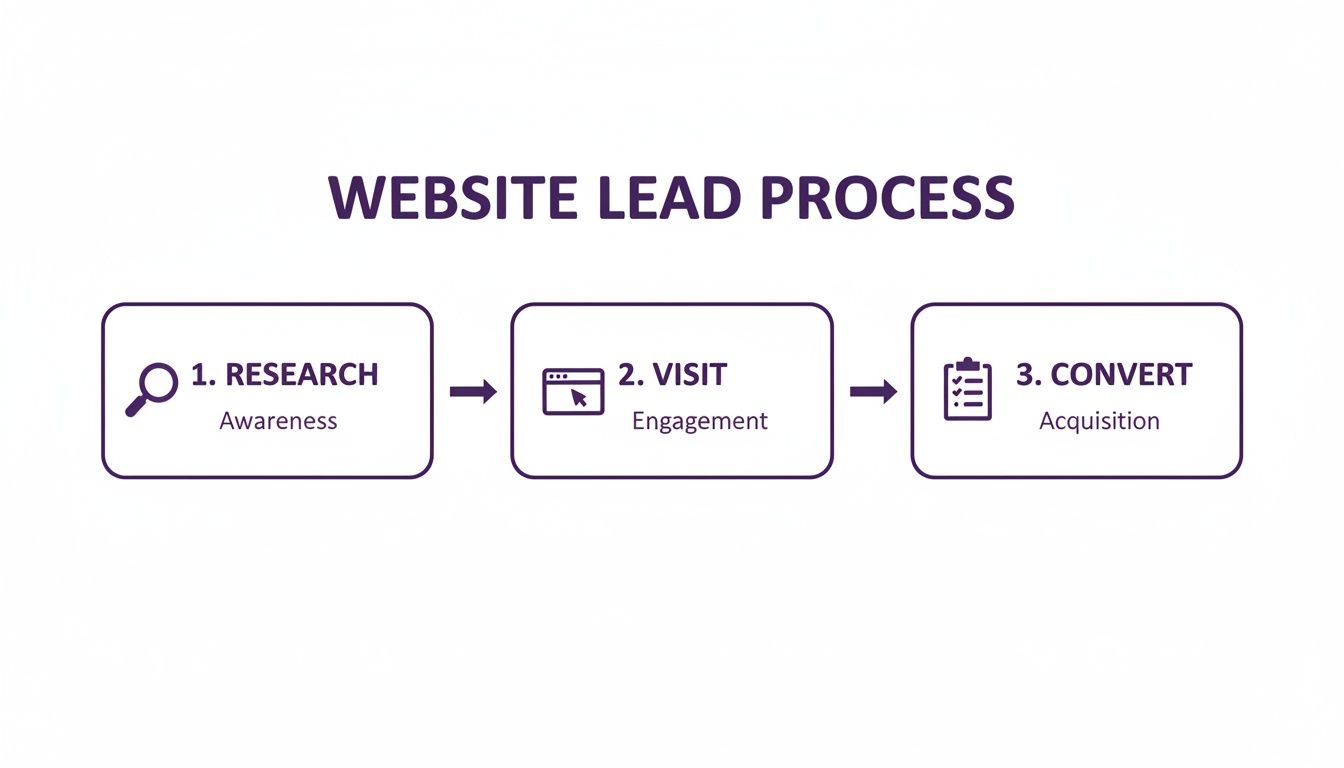
    The journey from a casual Google search to a submitted lead form on your site has to be seamless. This visual breaks down that critical path.

    Flowchart illustrating the website lead process: Research, Visit, Convert, with awareness, engagement, and acquisition stages.

    As you can see, the path is straightforward. Your job is to remove any and all friction between those steps.

    To help visualize how specific website components directly contribute to lead generation, here’s a breakdown of the essentials.

    Essential Website Elements for Lead Conversion

    Website Element Impact on Leads Real-World Example
    Mobile-First Design Captures the majority of traffic from smartphones; prevents high bounce rates. A site where a user can easily browse inventory and fill out a form with one thumb on their phone.
    High-Quality VDPs Builds trust and answers questions upfront, pre-qualifying the lead. Including multiple high-res photos, a walkaround video, and an embedded CarFax report for every vehicle.
    Clear CTAs Guides visitors toward conversion actions instead of letting them wander. Using buttons like "Schedule a Test Drive" or "Get Today's Price" prominently above the fold on every VDP.
    Simple Lead Forms Reduces friction and increases form submissions by only asking for essential info. A contact form that only asks for name, email, and phone number, rather than a 10-field questionnaire.
    Live Chat/Texting Engages hesitant buyers in real-time, capturing leads that might otherwise leave. A chat widget that proactively asks, "Have questions about this Silverado? We can text you the details."

    Ultimately, every single element on your site should be strategically designed with one goal in mind: making it simple and compelling for a visitor to raise their hand and say, "I'm interested."

    The Mobile-First Imperative

    Let's be blunt: "mobile-first" is no longer a buzzword; it's the price of entry. The vast majority of your customers are looking at your cars on their phones, probably while on their lunch break or sitting on the couch. This means your site has to be designed for a small screen from the ground up—not as an afterthought.

    A truly mobile-first experience delivers on a few key promises:

    • It’s fast. Every second a customer waits for a page to load is a chance for them to hit the back button.
    • It’s easy to use. Big, thumb-friendly buttons and simple menus are crucial. No one wants to play tap-the-tiny-link.
    • It’s clean. A cluttered mobile site is a confusing mobile site. Key information like inventory, pricing, and your phone number should be impossible to miss.

    If a potential buyer has to pinch-and-zoom just to read a vehicle description, you've already lost them. It's that simple.

    Crafting High-Conversion Vehicle Detail Pages

    The Vehicle Detail Page (VDP) is where the magic happens. This is the moment a casual looker decides to become a serious lead. Your VDP is the digital equivalent of your best salesperson making a pitch for a specific car on your lot.

    Your VDP should answer every question a buyer might have before they even think to ask it. Transparency is the currency of trust online, and a detailed, honest VDP is your best tool for earning it.

    To make your VDPs work for you, not against you, every single one needs these core components:

    • High-Resolution Photos: Don't skimp here. We're talking a gallery of multiple crystal-clear photos. Show every angle—inside, outside, close-ups on the wheels, the dashboard, and even any minor imperfections.
    • Video Walkarounds: A quick 1-2 minute video tour brings the car to life in a way photos can't. It feels personal and shows you have nothing to hide.
    • Transparent Pricing: Display the price clearly. Even better, include a payment calculator or a link for financing pre-approval. Nothing kills trust faster than hidden fees or "call for price."
    • Detailed Vehicle History: Integrating a CarFax or AutoCheck report directly on the VDP is a massive trust-builder. It removes doubt instantly.
    • Obvious Calls-to-Action (CTAs): Guide the shopper with prominent buttons. "Check Availability," "Schedule Test Drive," and "Get E-Price" are your money-makers.

    Your goal is to build so much confidence and provide so much information that submitting their contact info feels like the natural next step. For a deeper dive into this, explore our comprehensive guide on effective website design for car dealers.

    Driving High-Intent Traffic to Your Inventory

    A world-class website is useless if the right buyers can't find it. Once your digital showroom is built to convert, the real mission begins: opening the floodgates to a steady stream of serious shoppers. We're not talking about random clicks; we're talking about attracting qualified visitors who are ready to become auto dealership leads.

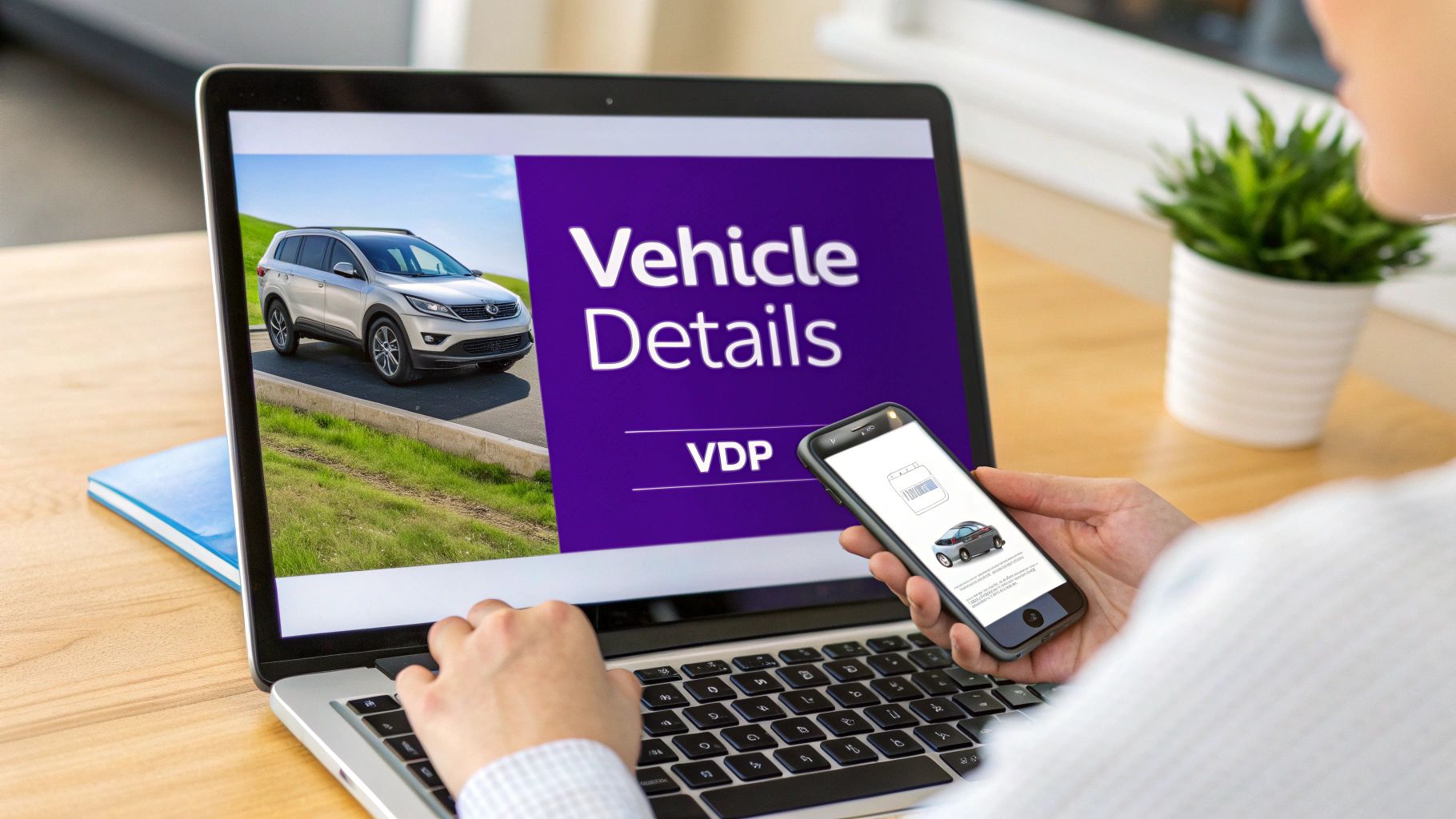
    Person uses laptop and smartphone to view vehicle details, likely for car sales or management.

    The foundation for attracting these buyers is being visible right where they start their search: Google. This calls for a smart, multi-channel approach that blends organic search tactics with sharply targeted paid advertising.

    Dominate Local Search with Automotive SEO

    When someone in your town types "used Ford F-150 near me" into their phone, you have to show up. That’s the entire game of local automotive SEO—optimizing your digital footprint to rank high for the exact location-based and inventory-specific searches your customers are making every day.

    Think of it as digital curb appeal. Just as you want your physical lot to look immaculate to anyone driving by, your website needs to be front and center for digital searchers.

    Here’s where you need to focus your efforts for a strong local SEO strategy:

    • Google Business Profile (GBP) Optimization: Your GBP is your digital storefront on Google. It needs to be perfect. Fill it out completely with accurate hours, your address, phone number, and load it up with high-quality photos of your dealership and your best-looking inventory.
    • Location-Specific Website Content: Don't just be a generic dealership online. Create pages on your website dedicated to the towns and cities you serve. A simple page titled "Quality Used Cars in Springfield" can make all the difference in ranking for searches from that area.
    • Consistent Business Information: Make sure your dealership’s name, address, and phone number (what we call NAP) are identical everywhere online. From Yelp to your own website, any inconsistency can confuse search engines and drag down your rankings.

    A strong local SEO presence ensures you're not just another dealership on the internet, but the local dealership for a customer's specific needs. It’s the most cost-effective way to generate a consistent flow of highly qualified traffic over the long term.

    For a deeper dive, our guide on automotive SEO strategies covers more advanced tactics to help you climb those search rankings.

    Capture Ready-to-Buy Shoppers with Google Ads

    While SEO is your long game, Google Ads lets you jump the line and capture buyers with immediate intent. It's a pay-to-play strategy, but when done right, the ROI is fantastic. You’re essentially bidding on specific keywords to get your dealership right at the top of the search results page.

    The trick is to zero in on high-intent keywords. These are the search terms people use when they're done researching and are ready to pull the trigger.

    Keyword Type Example Buyer Intent
    Low Intent "best family SUVs" Just browsing, not ready to buy.
    High Intent "Honda CR-V for sale near me" Actively looking for a specific vehicle to purchase now.
    High Intent "used truck dealership Springfield" Searching for a specific type of dealership in their area.

    By targeting these bottom-of-the-funnel keywords, you ensure your ad budget goes toward clicks that are far more likely to turn into real leads. Your campaigns should always send users directly to a relevant VDP or a pre-filtered inventory search page, making it dead simple for them to go from search to lead.

    Tap into Social Marketplaces

    Don't sleep on the platforms where your local community already hangs out. Facebook Marketplace, in particular, has exploded into a massive hub for used vehicle searches. Listing your inventory there puts your cars directly in front of a local, engaged audience that trusts the platform.

    This channel lets you connect with buyers in a more direct, conversational way. To really make this work for you, check out this guide on Generating Auto Dealership Leads with Facebook Ads. By combining your organic visibility, targeted ads, and social selling, you build a powerful system for driving a continuous flow of great traffic right to your inventory pages.

    Turning Website Visitors into Qualified Prospects

    Getting people to your dealership’s website is a great start, but it's just half the battle. The real goal is turning those anonymous clicks into actual auto dealership leads. If someone browses your inventory and leaves without giving you their information, it’s a lost opportunity—no matter how great your cars are.

    You have to make it incredibly simple and genuinely compelling for a potential buyer to raise their hand. It's all about understanding what a car shopper is thinking and doing on your site. They're looking for answers, and your job is to guide them toward actions that help you both. This means ditching the generic buttons and getting strategic.

    Crafting Calls-to-Action That Actually Work

    Let's be honest: the "Contact Us" button is probably the most passive and least effective call-to-action (CTA) out there. It puts all the work on the customer and offers them nothing of value in return. A CTA that truly works meets the shopper exactly where they are in their buying journey with a specific, compelling offer.

    Instead of vague requests, your Vehicle Detail Pages (VDPs) need prominent, action-oriented buttons that align with what a buyer actually wants to do.

    • "Check Availability": This creates a little urgency and is a super low-commitment way for a shopper to start a conversation.
    • "Get E-Price": Perfect for the price-conscious buyer who wants instant, valuable information without having to ask.
    • "Schedule a Test Drive": This one targets visitors who are much further down the funnel and are ready for the in-person experience.
    • "Hold This Vehicle": A seriously powerful option for in-demand models that creates a feeling of exclusivity.

    By tailoring your CTAs like this, you provide clear, helpful next steps that don't feel demanding. This simple shift can make a massive difference in the number of leads you capture from the exact same amount of website traffic.

    Engaging Visitors Instantly with Chat and AI

    Not every visitor is ready to fill out a long form or pick up the phone. Many people browse inventory after hours or on a quick lunch break when they can't talk. This is where live chat and AI-powered chatbots become absolute game-changers for lead capture.

    A chat widget lets you engage with visitors in real-time, answering questions and building rapport the moment they're most interested. More importantly, it gives them a low-pressure way to share their contact info. A simple prompt like, "Have a question about this F-150? I can text you the answer," can instantly turn a silent browser into a warm lead.

    Today's AI chatbots can handle initial questions 24/7, qualify leads by asking a few basic questions, and even book appointments for your team. This means you never miss an opportunity, even if it comes in at 2 a.m.

    To take it a step further, many successful dealers are using text messaging to generate leads, engaging potential buyers directly on the device they use most.

    Prioritizing Your Hottest Leads with Lead Scoring

    Let's face it: not all leads are created equal. A visitor who downloaded a brochure is in a very different place than someone who viewed the same VDP three times and played with your payment calculator. Without a system to tell them apart, your sales team wastes precious time chasing cold leads while the hot ones go stale. This is where a simple lead scoring system comes in.

    Lead scoring is just a way of assigning points to leads based on their actions and attributes, allowing you to automatically see who is most likely to buy right now.

    Here’s a basic scoring model you can adapt for your dealership:

    Action Taken by Visitor Points Awarded Lead Temperature
    Visited 1 VDP +5 Lukewarm
    Viewed 3+ VDPs +15 Warming Up
    Used Payment Calculator +20 Hot
    Submitted a "Get E-Price" Form +25 On Fire
    Opened a Follow-Up Email +5 Lukewarm

    By adding up the points, your CRM can automatically flag the highest-value prospects for your team. A lead with a high score needs an immediate phone call. A lead with a score of just 5? They can be placed into an automated email nurture campaign. This data-driven approach ensures your team focuses its energy where it will have the biggest impact, turning more prospects into sales.

    Mastering the Follow-Up to Close More Car Deals

    Getting a lead is just the starting line. The real race is won in the follow-up. Those first few moments after a potential buyer sends you their information are the most critical part of the entire sales process. If you're slow to respond, you're practically handing that sale over to a competitor who was just a little bit faster.

    A person holds a tablet displaying a 'GET E-PRICE' button and an input field, tapping the screen.

    In this business, speed is everything. When someone requests an e-price or asks about a specific vehicle, their interest is at an absolute peak. Your ability to connect with them in that crucial window is what separates the top performers from everyone else.

    The goal here isn't just to be fast; it's to build a follow-up system that is rapid, persistent, and feels personal. You need a process that ensures no opportunity ever slips through the cracks.

    The Undeniable Power of Speed

    The difference between getting back to a lead in five minutes versus five hours is staggering. Think about it: in the car business, a rapid response to an online inquiry significantly increases your chances of having a meaningful conversation with that lead.

    A quick response does more than just answer a question. It sends a powerful message that you’re professional, you're on top of your game, and you value their time. That's how you start building the trust needed to make a big-ticket sale.

    Building Automated, Yet Personal, Follow-Up Sequences

    Let’s be realistic—you can't manually follow up with every single lead the second it comes in, especially after hours. This is where automated SMS and email sequences become your secret weapon. They let you deliver immediate and consistent communication without chaining your sales team to their desks.

    The trick is to make your automation feel human. Your sequences shouldn't sound like they came from a robot. They need to be helpful, timely, and offer real value with every message.

    Your follow-up automation should feel less like a machine and more like a helpful concierge guiding the customer through their next steps. The goal is to stay top-of-mind by providing value, not by being intrusive.

    A well-designed sequence can handle that initial, time-sensitive outreach, warming up the lead so your salespeople can focus their energy on conversations with people who are ready to talk.

    A High-Impact Lead Follow-Up Cadence

    To give you a clearer picture, here’s a sample multi-touch follow-up schedule designed to maximize engagement in those critical first few days. This is a great starting point you can adapt for your own dealership.

    A High-Impact Lead Follow-Up Cadence
    Timeline Action to Take Communication Channel
    First 5 Minutes Send an automated text confirming you got their request. Ask a simple qualifying question, like, "Thanks for your interest in the F-150! Are you looking to trade in a vehicle?" SMS Text
    First 15 Minutes A personalized email from a salesperson follows, with more vehicle details and a clear call-to-action to schedule a call or test drive. Email
    2 Hours Later The assigned salesperson makes their first call. No answer? Leave a short, friendly voicemail. Phone Call
    Day 2 Send another email, this time offering more value. Link to similar vehicles in your inventory or a helpful guide like "Top 5 Features of the Honda CR-V." Email
    Day 3 Fire off a quick, casual text: "Hi Alex, just wanted to see if you had any other questions about the CR-V. Let me know!" SMS Text
    Day 5 Make a final follow-up call to offer assistance one last time before moving the lead into a long-term nurture campaign. Phone Call

    This persistent, multi-channel approach meets customers where they are, dramatically increasing your chances of getting a response.

    Creating a Seamless Workflow with CRM Integration

    Your follow-up strategy is only as good as the system running it. A lead that gets forgotten or goes stale is pure lost profit—and it's completely avoidable with the right tech. That’s why integrating your website's lead forms directly with your Customer Relationship Management (CRM) system is non-negotiable.

    When a customer fills out a form on your site, this integration should instantly and automatically:

    • Create a new lead profile in your CRM.
    • Assign that lead to the right salesperson.
    • Kick off the appropriate automated follow-up sequence.

    This seamless connection gets rid of manual data entry, stops leads from getting lost in a cluttered inbox, and gives you a clear, time-stamped record of every interaction. It creates total accountability for your team and guarantees every lead gets the immediate attention it deserves. If you're exploring options, our guide on the best CRM for car dealers can help you find the right fit.

    Using Data to Fine-Tune Your Lead Generation Engine

    Throwing money at marketing and just hoping for the best is a fast way to go broke. Real, sustainable growth comes from making smart decisions based on hard data. To build a reliable engine for generating high-quality auto dealership leads, you have to measure what’s working, understand what the numbers are telling you, and constantly tweak your strategy.

    This data-first approach is what separates the dealerships that thrive from those that just survive. It ensures every single marketing dollar you spend is pulling its weight to bring real buyers to your lot.

    A person working at a desk with a laptop displaying charts, holding a smartphone, with "Quick Follow Up" banner.

    Identifying the KPIs That Actually Matter

    Don't get bogged down in a sea of vanity metrics. Key Performance Indicators (KPIs) are the vital signs of your marketing health, and you only need to focus on a handful that tie directly to your sales goals. These are the numbers you should be looking at every single week.

    • Cost Per Lead (CPL): This is your bottom line. Simply divide your total ad spend for a channel (like Google Ads) by the number of leads it generated. A low CPL means you're getting leads efficiently.
    • Lead Source ROI: Forget about which channels bring you the most leads—which ones bring you the most sales? You need to track leads from SEO, Facebook Marketplace, and third-party sites all the way to a closed deal. This tells you where your best customers are really coming from.
    • VDP Conversion Rate: What percentage of people looking at a specific car on your website actually fill out a form or start a chat? This KPI is crucial because it tells you how well your vehicle pages turn casual browsers into active leads.

    This is how you move from just spending money to making strategic investments. When you know your Cost Per Lead from Google Ads is lower than your CPL from another channel, you know exactly where to put your next marketing dollar for the best return.

    Using Analytics to See What Your Customers Do

    Tools like Google Analytics are a goldmine, and they're free. Think of it as putting a security camera in your digital showroom. It lets you watch exactly how shoppers move through your site, what they click on, and—most importantly—where they get frustrated and leave.

    By looking at user behavior flows, you can spot the leaks in your sales funnel. For example, maybe you see that a high percentage of visitors who start your credit application abandon it on the second page. That’s a massive red flag. It’s a clear sign that the form is too long, confusing, or asking for too much sensitive information too soon. Armed with that knowledge, you can simplify the form and likely see an immediate jump in your lead volume.

    Boosting Conversions with Simple A/B Tests

    You don't need a team of data scientists to start improving your site. A/B testing is a straightforward way to find out what really works. All you do is show two different versions of an element—like a button or a headline—to different visitors and see which one gets more clicks or conversions.

    The key is to change only one thing at a time. It’s these small, data-backed adjustments that compound over time to create huge gains in your lead count.

    Here are a few dead-simple A/B tests you can run on your site right away:

    Element to Test Version A (Control) Version B (Variation) Goal of the Test
    CTA Button Text "Submit" "Get My E-Price" Find out if a benefit-driven CTA increases form fills.
    Form Layout Two-column layout Single-column layout See if a simpler, mobile-friendly design reduces drop-offs.
    Hero Image Photo of your dealership Photo of a happy family with their new car Test whether a relatable, human image builds more trust.

    When you start testing and measuring, you replace guesswork with certainty. You stop wondering what works and you start knowing what works. This creates a powerful feedback loop of continuous improvement that will keep your lead generation engine tuned up and running at peak performance.

    Your Top Auto Lead Generation Questions, Answered

    As you start dialing in your strategy to get more high-quality auto dealership leads, you're going to have questions. It's totally normal. Buyer habits are always shifting, new tech pops up constantly, and it's tough to keep up.

    This section cuts right to the chase, giving you straight answers to the questions we hear all the time from dealership managers. Think of it as a quick guide to help you tackle those daily challenges and make smarter decisions.

    How Much Should I Be Paying for a Lead?

    This is the big one, right? The honest answer is, "it depends." The right Cost Per Lead (CPL) for your dealership is a moving target, influenced by your local market, the cars you sell, and where the lead came from. You can obviously afford to pay more for a lead on a high-margin luxury SUV than you can for someone kicking the tires on an older, budget-friendly sedan.

    But you're not flying blind. You can set a solid baseline by working backward from your numbers. Let's say your average gross profit on a vehicle is $2,500. If your sales team closes about 10% of the qualified leads they get, you know it takes ten leads to make one sale.

    Doing the math, that means you could spend up to $250 per lead just to break even on that one deal. Your real goal, of course, is to push that CPL way lower to make every sale as profitable as possible.

    The key is to track your CPL from every single source—Google Ads, Facebook Marketplace, third-party listing sites, you name it. That data is gold. It will show you exactly which channels are your most efficient performers and where your marketing dollars should be going.

    Should My Dealership Really Be Using AI for Leads?

    Yes, without a doubt. Artificial intelligence isn't some sci-fi concept anymore; it's a real-world tool that gives you a serious leg up on the competition. AI can make a huge difference in how you handle and qualify auto dealership leads, freeing up your team to do what they do best: sell cars. In fact, a recent CDK Global study found that 68% of dealerships already using AI are seeing a positive impact.

    Here’s how you can put it to work right away:

    • Round-the-Clock Lead Response: AI-powered chatbots can chat with your website visitors 24/7. They can answer common questions, grab contact info, and even book test drives long after your team has gone home for the night.
    • Instant Lead Qualification: Smart AI algorithms can analyze what a visitor does on your site—which VDPs they looked at, if they used the payment calculator—and score their buying intent on the spot. This instantly flags the hottest prospects for your team to jump on.
    • Smarter Follow-Up: AI can help automate personalized emails and texts based on the specific vehicles a customer showed interest in. It makes your outreach feel less robotic and a lot more relevant.

    Using these tools means you're faster and smarter with your response, which is everything in this market.

    What's More Important: Lead Quality or Quantity?

    It’s easy to get caught up in the numbers game, but the hands-down winner here is quality. A list of 100 random names and phone numbers is just going to frustrate your sales team and lead to a lot of dead ends. On the other hand, ten genuinely qualified leads who are actively showing they're ready to buy? That's where the money is.

    Focusing on quality forces you to be more precise with your marketing. Instead of casting a wide, generic net, you’re zeroing in on high-intent keywords for your ads or creating website content that speaks directly to someone deep in the buying cycle.

    A high-quality lead isn't just a name and number. It's someone who has signaled real interest through their actions online. When you prioritize these people, you ensure your sales team is spending their time on conversations that actually turn into sales.

    At the end of the day, your goal isn't just to cram your CRM with contacts—it's to sell cars. A strategy built around attracting better, more qualified auto dealership leads will always win. It creates a more efficient sales process, keeps your team motivated, and drives a healthier bottom line for your dealership.


    Ready to turn your website into a lead generation powerhouse? AutoFire™ provides independent dealerships with modern, mobile-first websites designed to convert browsers into buyers. Get online in minutes and start capturing more high-quality leads today. Explore AutoFire plans and start for free.

  • Automotive Reputation Management A Modern Dealer’s Guide

    Automotive Reputation Management A Modern Dealer’s Guide

    Automotive reputation management is all about actively shaping how your dealership is seen online. It means taking charge of the story being told about you, from Google reviews and social media chatter to what people are saying on auto-specific sites. It’s your chance to build trust with potential car buyers before they even think about stepping onto your lot.

    Your Reputation Is Your Dealership's Engine

    In the car business, your online reputation isn't just a number on a screen; it's the engine driving your entire sales pipeline. Long before a customer comes in for a test drive, they’ve already taken your dealership for a "digital test drive." They’ve sifted through your reviews, glanced at your star ratings, and made a judgment call based on the online breadcrumbs you've left behind.

    This is why proactive automotive reputation management is non-negotiable, especially for independent dealers. A solid online reputation is how you build the credibility you need to go toe-to-toe with the big-name franchise stores and their massive advertising budgets.

    The Crisis of Trust Creates Opportunity

    Let's be honest: the auto industry as a whole has a bit of a trust problem. Recent data shows the industry's Trust & Like Score (TLS) has sunk to a grim 63, the lowest of any consumer-facing business sector. But for an independent dealership, this is a massive opportunity.

    By focusing on building a genuine, local reputation, you can become the trustworthy alternative buyers are desperately searching for. The numbers don't lie. Data from Reputation.com shows that businesses with strong scores get 7x more engagement on Google—a game-changer for attracting local shoppers. To learn more about how trust is reshaping the industry, check out the insights from Group Caliber.

    To really get a handle on this, it helps to understand what Online Reputation Management is at its core.

    The Core Pillars of a Winning Strategy

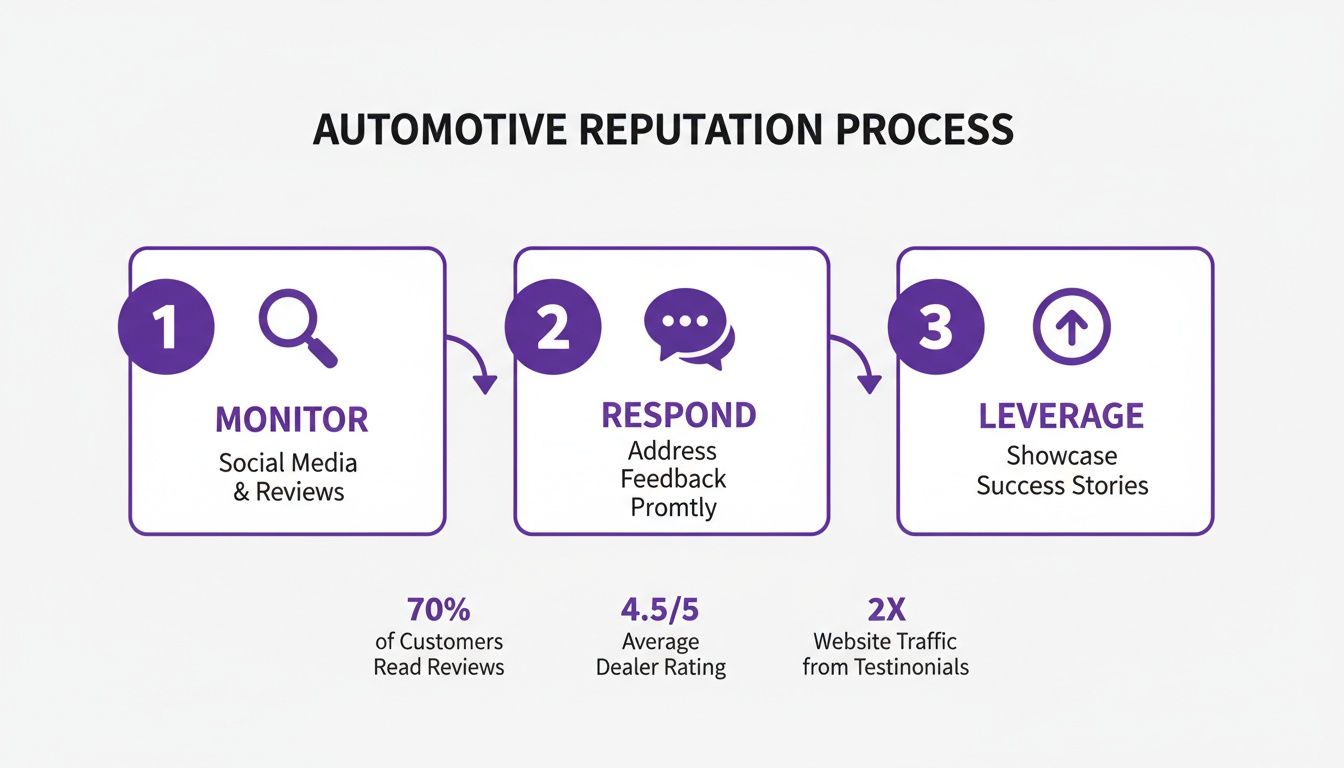
    A winning reputation strategy doesn't need to be overly complex. It really comes down to three key pillars that create a powerful cycle of trust and feedback.

    • Monitoring: You have to know what people are saying. This means keeping a close eye on everything from Google and Facebook to industry-specific sites like DealerRater and Cars.com.
    • Responding: Engage with every piece of feedback, good or bad. A timely and professional response shows you're listening and that you genuinely care about the customer experience.
    • Leveraging: Take those great reviews and put them to work! Use them as social proof on your website, feature them in your ads, and sprinkle them across your marketing to build confidence in new buyers.

    Your response to a negative review is often more important than the review itself. It's a public demonstration of your commitment to customer service, and it shows potential buyers how you handle problems when they arise.

    Modern tools, like the platform we've built here at AutoFire™, can turn your website into a reputation-building machine by weaving these pillars right into your sales process. When you get this right, your online reputation becomes a critical part of your overall digital marketing strategy for automotive dealers, attracting better leads and helping you move more metal.

    Building Your Reputation Monitoring Workflow

    You can't manage what you don't measure. The first step in any solid automotive reputation management plan is simply listening—creating a system to hear what customers are saying about your dealership across the web. If you're not actively monitoring, you're always playing catch-up, reacting to problems days or even weeks late instead of getting out in front of them.

    The goal isn't to add another complicated task to your plate. For a lean independent dealership, efficiency is the name of the game. It’s about building a simple, repeatable process that funnels crucial feedback directly to you, so you're always the first to know when a new review or comment drops.

    Think of this workflow as your dealership's early warning system. It helps you catch potential issues before they fester, celebrate the wins with your team, and maintain a consistent, professional presence where it matters most.

    This simple infographic really nails the core cycle.

    Infographic illustrating the 3-step automotive reputation process: monitor, respond, and leverage, with key statistics.

    The big takeaway here? Reputation management isn't a "set it and forget it" task. It's a continuous loop: you monitor what's said, you respond thoughtfully, and then you use that interaction to build a stronger brand.

    Cast a Wide Net Beyond the Obvious Platforms

    While Google is undeniably king—it's where nearly 87% of all automotive reviews live—your customers are talking about you in plenty of other places. A truly comprehensive strategy means looking beyond just the big G. Your workflow needs to include regular check-ins on a mix of general social sites and industry-specific ones.

    It’s like checking all the gauges on your dashboard. Google might be the speedometer everyone watches, but platforms like Facebook or DealerRater are your oil pressure and engine temp—ignore them, and you might not see a problem until it's too late.

    A nasty comment left in a local community Facebook group can spread just as fast as a one-star Google review. If you're not looking, you're missing a huge piece of the puzzle.

    Key Review Platforms for Independent Dealers

    To build an effective monitoring routine, you need to know exactly where to look. I've seen dealers waste a ton of time on platforms that just don't move the needle. You want to focus your energy where it has the most impact on car buyers.

    Here’s a quick breakdown of the most critical online platforms where your attention should be focused.

    Platform Primary Audience Key Action for Dealers
    Google Business Profile Nearly all local car shoppers Monitor daily for new reviews and questions. This is non-negotiable.
    Facebook Local community and referrals Watch for page reviews, post comments, and mentions in local groups.
    DealerRater Serious, in-market car buyers Check weekly for detailed, long-form feedback on sales and service.
    Cars.com Buyers actively comparing inventory Keep an eye on dealership ratings tied directly to your vehicle listings.

    These platforms represent the digital "word of mouth" for your dealership. Keeping them healthy is essential for attracting your next customer.

    Setting up a monitoring system isn't about creating more work; it's about making the work you're already doing smarter. A simple 15-minute daily check-in is far more powerful than a frantic, disorganized scramble once a month.

    Creating Your Daily Monitoring Routine

    Consistency is everything. A daily habit, even a short one, beats sporadic, lengthy checks every time. Here's a simple, no-cost workflow you can put into practice today.

    • Set Up Google Alerts: This is a free and surprisingly powerful tool. Create alerts for your dealership's name, your own name, and maybe even the names of your top competitors. Google will shoot you an email whenever these terms pop up online.
    • Create a "Review Links" Bookmark Folder: This is a low-tech game-changer. Bookmark the direct review pages for your dealership on Google, Facebook, DealerRater, and Cars.com. Start your morning by opening this folder and quickly scanning for anything new.
    • Assign a "Reputation Captain": Make one person on your team the owner of this process. It doesn't have to be a manager. This person is responsible for the daily 15-minute check and for flagging any reviews—good or bad—that need a response from leadership.

    This proactive process ensures no customer feedback ever slips through the cracks. It empowers you to amplify positive comments right away and, more importantly, de-escalate negative experiences before they spiral out of control and tarnish your hard-earned reputation.

    How to Generate a Steady Stream of Positive Reviews

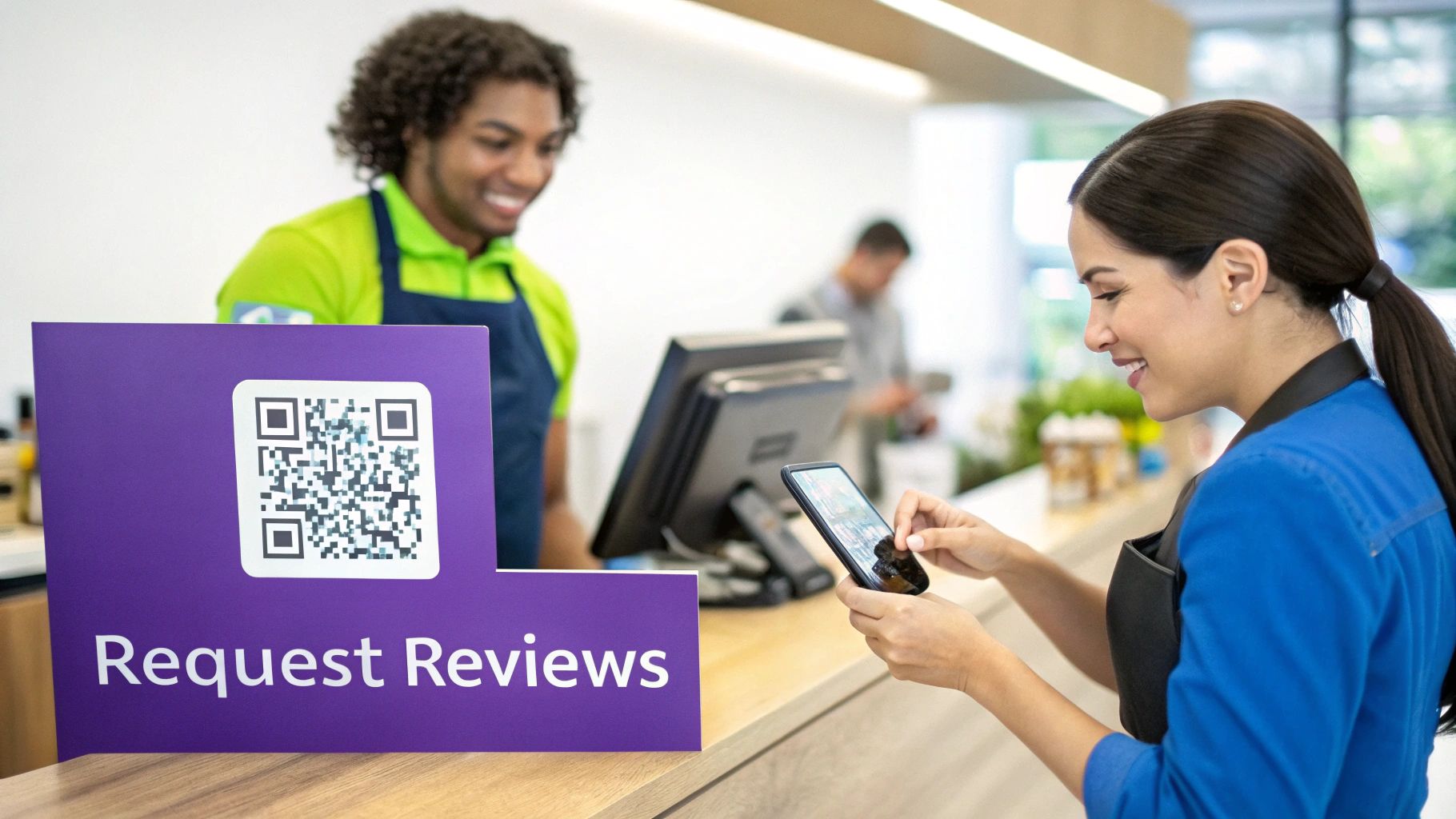
    A smiling employee scans a QR code for 'Request Reviews' with a smartphone while a colleague smiles behind.

    A few great reviews from last year just won't cut it. When it comes to automotive reputation management, what really moves the needle is a consistent, fresh stream of positive feedback. Today's buyers are looking for what's new; a review from last week carries so much more weight than one from last winter.

    This constant flow of recent praise does more than just build trust. It signals to search engines that your dealership is active and relevant, keeping you top-of-mind when local buyers start their search.

    The trick is to build a reliable system for asking. You can't just cross your fingers and hope customers remember to leave feedback on their own. You need an active strategy that makes it incredibly easy for happy buyers to share their five-star experience. This isn't about being pushy—it's about weaving the "ask" into your customer journey so smoothly that it feels natural.

    Look at it this way: if you provide a fantastic service, you’ve earned the right to ask for a review. The secret is making that request at the absolute peak of their satisfaction and removing every single hurdle that might stop them.

    Make the Ask Effortless

    The biggest killer of five-star reviews is friction. If a happy customer has to manually search for your Google Business Profile, try to remember their password, and then figure out where to click, you've already lost them. Your job is to shrink that entire process down to a single tap on their phone.

    This is where a few simple, modern tools make all the difference. You can turn the review process from a chore into a quick, satisfying action that takes less than 60 seconds.

    • QR Codes in the Wild: Put QR codes everywhere—on key fobs, at the service desk counter, or on the back of a business card. A customer can scan it with their phone while waiting and land directly on your Google review page. It's incredibly effective, and you can learn how to create a QR code for Google reviews in just a few minutes.
    • The Power of a Text: A text message has an open rate that email can only dream of. Sending a simple, friendly message with a direct review link shortly after a sale or service is one of the most powerful things you can do.

    By making it this easy, you're not just getting more reviews. You're showing respect for your customer's time, which dramatically increases the chances their good feelings will turn into public praise.

    Train Your Team to Spot the Perfect Moment

    Your people are your single greatest asset in generating reviews. They're the ones on the front lines, building rapport and seeing those moments of pure customer happiness firsthand. Training them to recognize and act on these moments is the cornerstone of any great reputation strategy.

    The "perfect moment" isn't a hard sales pitch. It's just a natural, conversational part of providing great service.

    A Real-World Sales Scenario:
    Imagine a customer just finalized their purchase. They're buzzing with excitement, holding the keys to their new car, and genuinely thanking the salesperson for a smooth process.

    • What not to say: "Could you please leave us a review?" It’s impersonal, generic, and feels like a chore.
    • What to say: "I'm so glad we found the perfect car for you! It was a real pleasure working together. You'll get a quick text from us later today, and if you have 30 seconds to share your experience, it would mean the world to me and help other folks find us."

    This approach works because it's personal, it sets a clear expectation, and it connects the review directly to the positive experience they just had with a specific team member.

    The most powerful review requests feel personal and happen right on time. They should come across as the natural end to a great conversation, not a robotic marketing task.

    Automate the Process for Consistency

    While personal timing is critical, automation is what guarantees that no opportunity slips through the cracks. A reliable system ensures every single customer gets a request, creating the steady volume you need to build and maintain a stellar reputation. You can't just rely on your team "remembering" to ask every single time.

    Here's how to build a simple but powerful automated workflow:

    1. Connect to Your CRM: First, integrate your review request system with your dealership's CRM. This allows you to automatically trigger a text or email the moment a deal is marked "complete" or a service ticket is closed.
    2. Use Smart Timing: Don't blast out requests at midnight. Schedule your messages to go out during normal business hours when people are actually on their phones. The sweet spot is often 1-3 hours after the customer leaves the dealership.
    3. Follow Up (Gently): If someone doesn't respond to the first request, a single, friendly follow-up message 2-3 days later can often capture those who were simply busy at the moment. Don't overdo it, though.

    Automation turns every sale into a potential five-star review. It’s the engine that powers your review generation machine. By focusing on enhancing customer experiences, you naturally create more happy buyers who are excited to tell their stories.

    Mastering the Art of Responding to Reviews

    Let's be honest: your response to a customer's review is often more important than the review itself. Whether it’s a five-star rave or a one-star rant, potential buyers are watching. They’re scrolling through your replies to see what you’re really like—how you handle praise, how you deal with problems, and whether you genuinely care about your customers.

    Think of every reply as a mini-advertisement for your dealership's character. A warm, personalized thank-you can turn a happy customer into a vocal advocate. On the flip side, a calm, professional response to a negative review can defuse a bad situation and prove to onlookers that you take service seriously.

    And speed is everything. A quick reply shows you’re paying attention and that you value customer feedback. It’s a simple act, but it builds a public story of trust, one interaction at a time.

    Man in blue shirt uses a tablet at a desk with a plant, showing 'Respond Quickly' text.

    Acknowledging the Positive to Amplify Loyalty

    It’s easy to see a five-star review and think, "Great, job done." But ignoring it is a huge missed opportunity. A simple "thanks" is okay, but a personalized response does so much more. It makes that customer feel seen and appreciated, deepening their loyalty and turning their good review into powerful social proof.

    The goal is to show you actually read what they wrote. Mention a specific detail from their comment. This little touch separates a genuine, human reply from a robotic, copy-paste job.

    For example, if a customer gives a shout-out to your salesperson, "John," for being patient, make sure your response highlights that. Not only does it make the customer feel validated, but it’s also a fantastic public morale booster for your team.

    Good Response Example (Positive Review):

    Original Review: "Had a great experience buying my F-150. John was super helpful and never pushy. The financing process was also surprisingly fast. Highly recommend!"

    Your Response: "Thank you so much for the fantastic review! We're thrilled to hear that John provided such a great, no-pressure experience for you. We work hard to make financing as smooth as possible, and we're so glad you're loving your new F-150. We appreciate your business and hope to see you again for your first service!"

    See how that works? It’s personal, it reinforces your dealership’s best qualities (no-pressure sales, easy financing), and it even plants a seed for future service business.

    A Framework for Handling Negative Reviews

    Negative reviews are going to happen. It's just a part of doing business. But they don't have to sink your reputation. In fact, handling a bad review the right way can build more trust than a perfect five-star record. It shows you're human, you're accountable, and you’re committed to fixing problems.

    The moment you see a negative review, your gut reaction might be to fight back. Don't. Your reply isn't just for that one unhappy customer; it's for every potential buyer watching how you react.

    Here’s a simple, three-part framework to de-escalate the situation:

    1. Acknowledge and Empathize: Always start by thanking them for the feedback and showing you understand their frustration. Simple phrases work best: "We're very sorry to hear your experience didn't meet your expectations," or "Thank you for bringing this to our attention."
    2. State Your Commitment to Service: Briefly and without making excuses, reaffirm your standards. Something like, "We pride ourselves on providing excellent service, and it's clear we fell short in this case," demonstrates ownership of the problem.
    3. Take It Offline: This is the most important step. Offer a direct line to solve the problem privately. Provide a specific name, phone number, or email address. This moves the sensitive conversation out of the public square and proves you’re serious about finding a real solution.

    This strategy stops a public argument before it starts and shows everyone you handle complaints with professionalism.

    A thoughtful response to a bad review can build more trust than a generic five-star rating. It’s your chance to turn a public problem into a public display of professionalism and accountability.

    Bad Response Example (Negative Review):

    Original Review: "The car I bought had an issue with the check engine light the day after I drove it off the lot. Feel like I was ripped off."

    Bad Response: "All our cars are inspected, and you signed the paperwork saying you accepted the vehicle as-is. The light wasn't on when you left."

    This response is a disaster. It’s defensive, it blames the customer, and it scares off anyone else reading it.

    Good Response Example (Negative Review):

    Good Response: "Thank you for making us aware of this issue. We are very sorry to hear about the trouble with the check engine light—that is certainly not the experience we want for our customers. Please contact our service manager, David, directly at [phone number] so we can investigate this and find a solution for you. We appreciate your business and want to make this right."

    This reply is professional, empathetic, and moves toward a real fix. It signals to future customers that even if something goes wrong, your dealership will be there to make it right.

    This commitment has a real impact. Research shows that boosting your Reputation Score by just 150 points can increase sales by up to 10%. The top dealerships consistently maintain high scores, generating seven times more actions—from calls to direction requests—on their Google Business Profiles. You can learn more about how reputation drives growth from CBT News's annual dealership report.

    Turning Your Great Reputation into SEO and Sales

    A five-star reputation is more than just a feel-good metric; it’s one of the most powerful marketing assets you have. Once you've got a steady flow of positive customer feedback coming in, it's time to put that social proof to work. This is where you flip the script from playing defense to going on offense with your automotive reputation management.

    The goal here is to create a virtuous cycle. A stellar reputation makes you more visible in search results, which brings more car buyers to your door. Those happy customers then leave more great reviews, and the engine just keeps running. It’s a self-sustaining formula for growth, and it all starts by showing off the trust you’ve worked so hard to build.

    Weave Social Proof Directly into Your Website

    Your website is your digital showroom, and nothing decorates it better than trust. When a potential buyer lands on your site, they're looking for a quick gut check—a reason to believe they're in the right place. Embedding review snippets and star ratings provides that instant validation.

    Try adding a live feed of your latest Google reviews right on your homepage. Or, place your overall star rating right next to your contact forms or finance applications. It’s a simple move, but it can dramatically boost conversions by erasing that last-minute hesitation people feel before they commit.

    Don't make customers leave your website to find out how great you are. Bring your best reviews directly to them to build immediate confidence and keep them engaged with your inventory.

    Think of these on-site reviews as a silent sales team, working 24/7 to reassure visitors that they’re making a smart, safe decision by choosing your dealership. It's about making your reputation an active part of the sale.

    Fuel Your Local SEO with Positive Reviews

    A high volume of recent, positive reviews sends a massive signal to search engines, directly feeding into your local SEO performance. Google’s whole job is to recommend the most trustworthy and relevant local businesses, and it uses reviews as a primary yardstick for measuring that trust.

    When your dealership consistently earns great feedback, Google notices. This can push you higher in the standard search results and—more importantly—help you crack the local "Map Pack." That’s the trio of businesses featured at the top of the map for high-intent searches like "used trucks near me." Our comprehensive guide on local SEO for car dealerships gets into the nitty-gritty of how this works.

    Here are the key reputation factors that Google's algorithm is watching:

    • Review Quantity: The total number of reviews you've collected.
    • Review Velocity: How frequently you're getting new reviews.
    • Review Diversity: Getting feedback across different platforms (Google, DealerRater, Cars.com).
    • Owner Responses: Proving you're engaged by actively responding to customers.

    Every positive review acts like a vote of confidence, helping you climb the local search rankings and making you far more visible than competitors with a spotty reputation.

    Make Your Google Vehicle Listings More Attractive

    A strong reputation also makes a huge difference in how shoppers see your cars on Google Vehicle Listings. While the individual listings don't show star ratings, your dealership's profile—just one click away—certainly does. A shopper who likes your car will almost always check out the seller.

    When they click and see a high rating, it builds instant credibility. That star rating can easily be the deciding factor that convinces them to click for directions or call your showroom instead of scrolling to the next dealer. In a crowded digital lot, your reputation is what makes your inventory pop.

    Let's be real: today's car buyer is guided by peer reviews. According to industry data, businesses with the highest reputation scores can see up to 6.9 times more leads from their Google Business Profile. In a competitive market, broadcasting trustworthiness is exactly what buyers are looking for.

    A Few Common Reputation Questions We Hear

    Even with the best game plan, some questions always pop up when you're in the trenches. Let's tackle a few of the most common ones we get from dealers about the day-to-day realities of managing your dealership's name online.

    How Long Does This Actually Take? Am I Going to See Results?

    This is a marathon, not a sprint, but you can absolutely see a real shift in just 3-6 months if you stick with it. The whole game is about getting a steady stream of new, positive reviews to bury the old, negative ones. Google and other sites care most about what's recent, so a focused effort pays off faster than you might think.

    Here's how it usually plays out:

    • Month 1: This is all about getting your house in order. You're creating QR codes, getting your team on board with asking for reviews, and setting up your monitoring rhythm.
    • Month 3: By now, your review pipeline should be flowing. You'll start seeing a noticeable increase in fresh, positive feedback hitting your profiles.
    • Month 6: The payoff. The combined effect of your hard work should be obvious in your star ratings and, more importantly, in the quality and quantity of your leads.

    Do I Really Need to Pay for a Reputation Management Service?

    Honestly, for most independent dealers, it’s not necessary. The strategies we've laid out here are powerful and can be done with free tools and a commitment to the process. The stuff that really moves the needle—personally asking for reviews and writing thoughtful responses—is all about human effort, not expensive software.

    Before you sink money into a subscription, try this: give one person on your team the responsibility for a few hours a week. Let them own it. Once you've got a solid system running and you've maxed out what one person can do, then you can see if a paid service actually makes sense for your bottom line.

    Your best investment is in a solid process, not just a fancy platform. A dedicated team member with a simple checklist will run circles around expensive, unused software nearly every time.

    Help! Can I Get a Fake or Unfair Negative Review Taken Down?

    Getting a review zapped is tough. Platforms like Google and Yelp are pretty protective of user-generated content. But you’re not helpless.

    Your first move, always, is to respond publicly and professionally using the framework we talked about. Stick to the facts. If you have no record of the person ever being a customer, it's perfectly fine to say so politely. "We've searched our records and can't seem to find a customer matching your name or situation. Could you please contact our manager, Dave, at [phone number] so we can sort this out?"

    Next, flag the review. You can't just say you don't like it; you have to point to a specific rule they broke in their terms of service. This could be:

    • Spam or obviously fake content
    • A clear conflict of interest (like a review from a disgruntled ex-employee)
    • Off-topic rants or hateful language

    Removal is never a sure thing. That's why your best defense is a killer offense. Drown out the occasional bogus review with an avalanche of genuine, positive ones. A single one-star review loses its sting when it's surrounded by dozens of five-star raves from your real, happy customers. That’s how you make sure your true reputation is what people see first.


    Ready to build a dealership website that turns your stellar reputation into sales? AutoFire delivers SEO-optimized, mobile-first sites designed to capture leads and showcase your inventory on Google. Launch your professional site in minutes and start building trust today.

  • Proven Strategies to Generate More Car Dealer Leads

    Proven Strategies to Generate More Car Dealer Leads

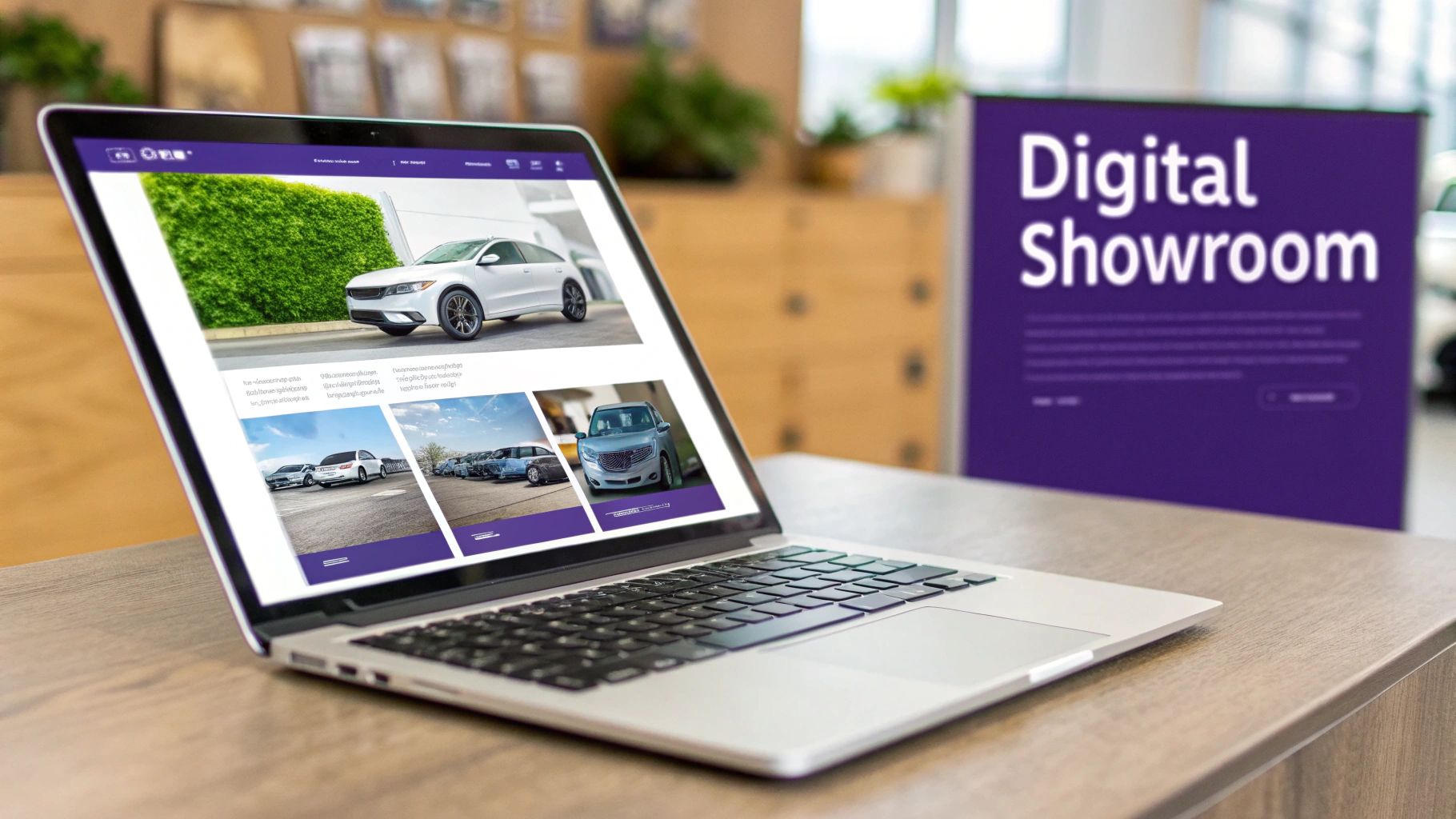
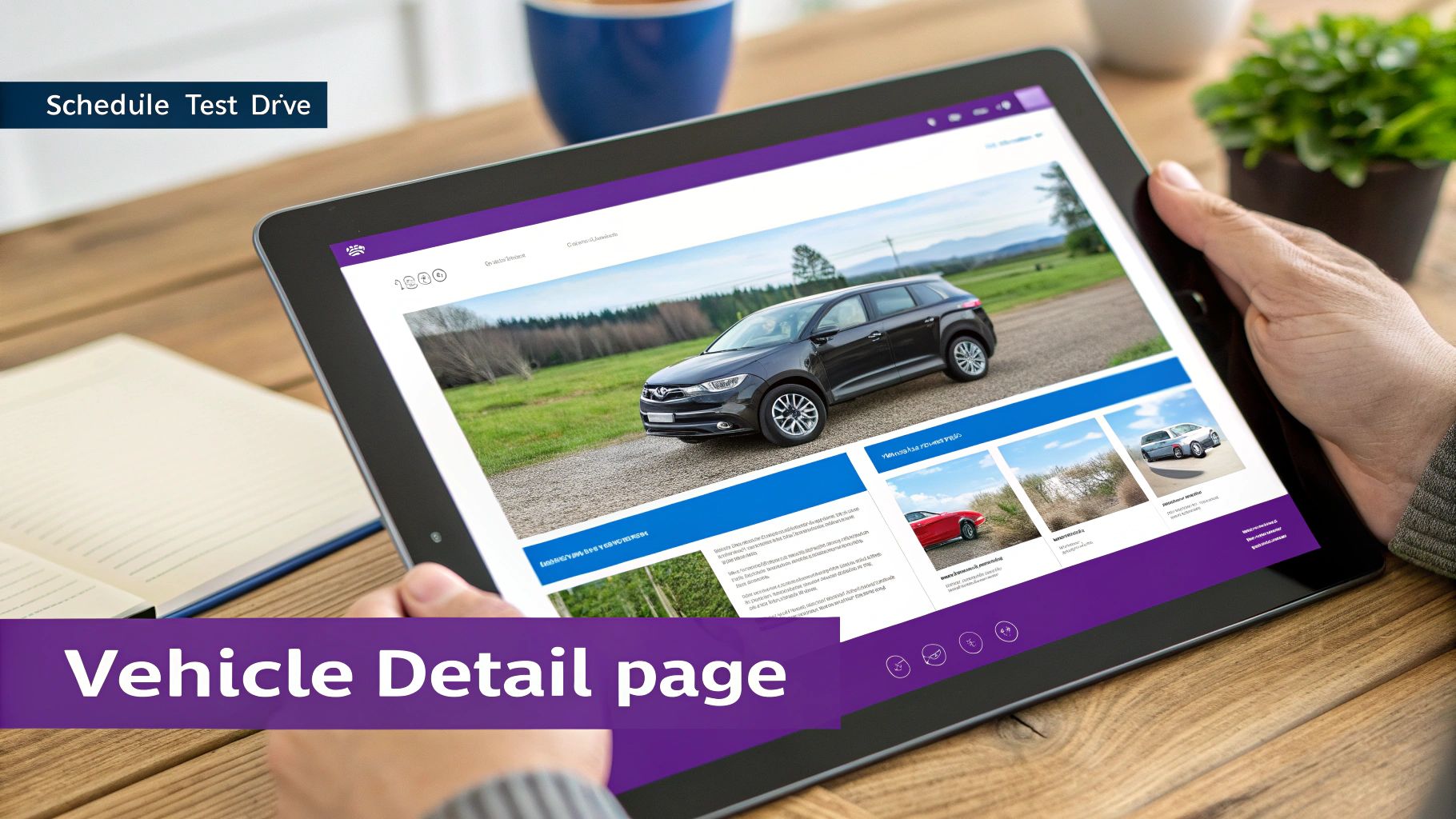
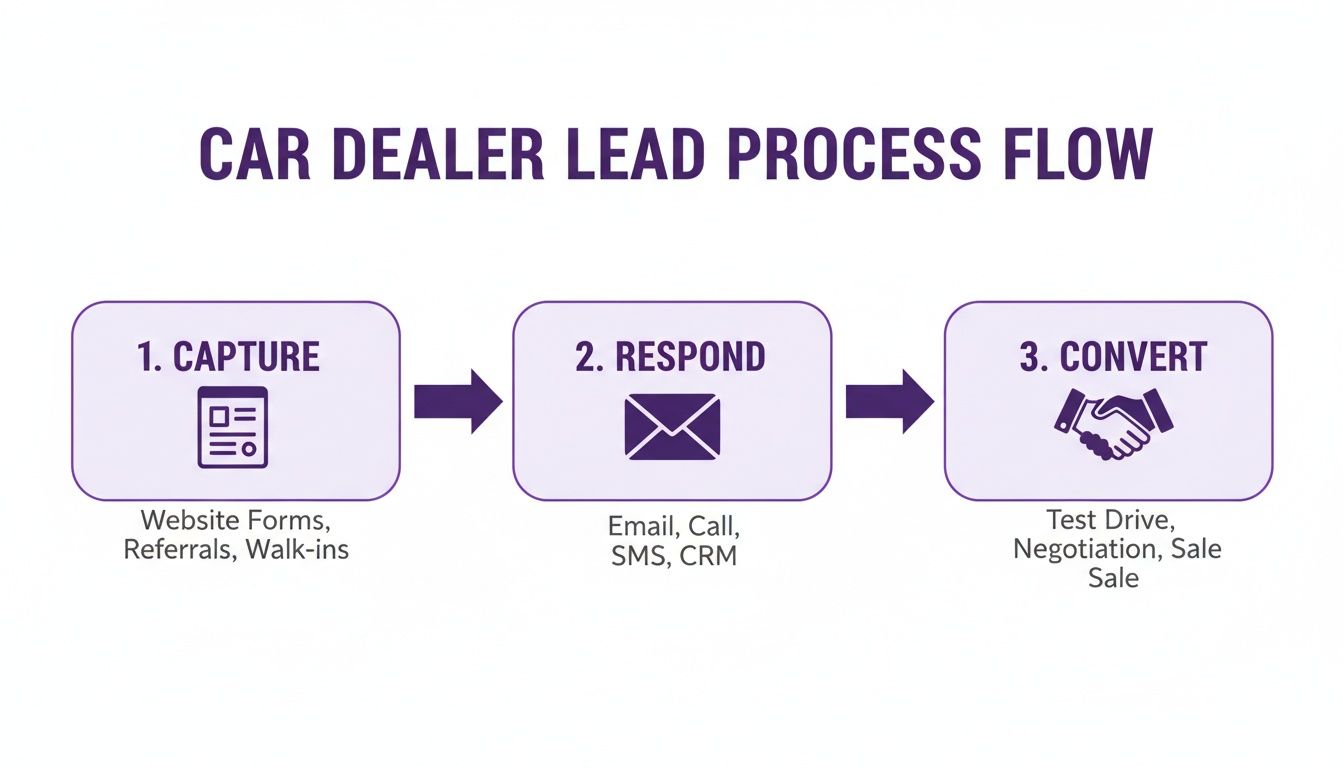
    Generating quality car dealer leads all starts with one fundamental asset: your website. It’s easy to think of it as just a digital business card, but that's selling it short. Your website is your primary showroom—the one that’s open 24/7, pulling in and engaging potential buyers long before they ever step onto your physical lot.

    Your Digital Showroom Is Your Best Salesperson

    A laptop displaying a website with various cars, alongside a 'Digital Showroom' sign in a modern office.

    Let's face it, the car buying journey has changed. It almost always begins online now. According to Cox Automotive's 2023 Car Buyer Journey Study, a significant majority of buyers use digital sources to gather information. For most of them, that search starts on a computer or smartphone, not at a dealership. This shift makes your website the single most critical tool in your entire sales process.

    A slow, clunky, or outdated site doesn't just look bad; it actively pushes customers away. If a potential buyer lands on your site and it takes more than a few seconds to load, they're gone. They’ll just click back and head straight to a competitor with a faster, more modern online presence.

    Building Trust Through Professional Design

    Your website's design is the very first impression a customer has of your dealership. A clean, modern layout instantly communicates that you're a professional and trustworthy operation. It signals to a visitor that you're a serious business that cares about the customer experience, which is absolutely crucial for turning a casual browser into a real, qualified lead.

    To nail this first impression, your site needs a few key things:

    • A Mobile-First Approach: The vast majority of web traffic comes from mobile devices. Your site has to look great and work perfectly on a smartphone. No exceptions.
    • Strong Visual Appeal: High-quality photos and an intuitive design make your inventory pop and encourage people to stick around and explore.
    • Simple Navigation: Customers need to find what they're looking for—your inventory, contact info, or financing options—without having to think. A few clicks should get them anywhere they need to go.

    Building a great digital showroom isn't just about listing cars; it’s about creating a frictionless path from online discovery to an in-person test drive. Every element, from photo quality to page speed, either helps or hurts that journey.

    The Need for Speed and Simplicity

    Looks aren't everything. Your site's technical performance is a huge factor in generating car dealer leads. A fast-loading site keeps impatient buyers engaged and sends a powerful signal to search engines like Google that you offer a quality user experience. This can directly boost your search rankings, making it that much easier for local customers to find you.

    You can dive deeper into creating an effective online presence in our detailed guide on website design for car dealers.

    For an independent dealer without a dedicated tech team, all this can sound a bit daunting. The good news is that modern platforms like AutoFire™ are built to handle the heavy lifting. They offer pre-optimized, mobile-first templates that ensure your digital showroom is fast, secure, and professional right out of the box. This lets you focus on what you do best—sourcing great cars and closing deals—while your website works around the clock to bring you the leads you need to grow.

    Win Your Local Market with SEO and Google Vehicle Listings

    For an independent dealer, the real battle for car dealer leads is won right in your own backyard. Your website might be a fantastic digital showroom, but local search is what actually guides motivated buyers to your lot. This is where a sharp local SEO strategy becomes one of the most effective tools in your arsenal.

    Most dealers get the basics right—they have a Google Business Profile. But that's just scratching the surface. The real magic happens with a feature built specifically for dealerships: Google Vehicle Listings (GVL).

    This is a total game-changer. GVL puts your actual, live inventory directly into Google search results. We're talking photos, pricing, mileage, the whole nine yards—all without paying a dime per click.

    Just imagine it from the customer's point of view. Someone in your town searches for a "used Ford F-150," and your specific truck pops up instantly on the results page. You've just put your vehicle in front of a high-intent shopper at the exact moment they’re ready to make a move.

    Tapping Into Google Vehicle Listings

    Getting your inventory listed on GVL used to be a technical headache, but modern dealership platforms can handle it for you automatically. When you add a vehicle to your inventory management system, a tool like AutoFire creates the data feed Google needs and sends it over.

    This means your cars are consistently visible in local search without you having to do any extra work. It’s a massive source of free, high-quality traffic. You’re earning organic placements that build trust and drive shoppers directly to your Vehicle Detail Pages, skipping the costly pay-per-click route.

    The goal is to make your dealership the most helpful and visible answer to a local car shopper's search. Integrating your live inventory with Google Vehicle Listings is the fastest way to achieve that.

    In our business, generating leads is a numbers game, and every single click matters. Conversion rates for auto dealer leads can swing wildly, from as low as 2% to over 10% for high-quality sources. Leads from organic search almost always land on the higher end of that spectrum because they come from people who are actively hunting for a vehicle.

    This is where site performance becomes crucial. A faster website can lead to significantly better conversion rates, especially with mobile shoppers. Tools like AutoFire, with built-in GVL integration and lead capture forms, are designed for high performance, which is a huge deal for converting traffic into leads.

    Beyond GVL: Local SEO Essentials

    While GVL is incredibly powerful, it works best when it's part of a complete local SEO strategy. First, learning how to optimize Google Business Profile to dominate transactional searches is non-negotiable for boosting your dealership's visibility. But don't stop there.

    Here are a few other practical things you can do right now:

    • Think Local with Keywords: Weave the names of your city, county, and nearby towns naturally into your website copy. Think phrases like "Used SUVs in Springfield" or "Affordable Sedans near Glendale."
    • Answer Local Questions: Create content that solves real problems for your community. A blog post comparing the best family cars for local road trips is far more likely to attract relevant traffic than a generic article.
    • Go All-In on Reviews: A consistent stream of new, positive Google reviews is one of the strongest signals you can send to both customers and search engines that you’re a business they can trust.

    By combining an optimized Google Business Profile with automated GVL syndication and content that speaks to your local community, you can turn search engines into a reliable, lead-generating machine. For a deeper dive, check out our guide on developing an effective automotive SEO service.

    Turn Vehicle Detail Pages Into Lead Magnets

    Hands holding a tablet displaying a car dealership website with a grey SUV and a 'Schedule Test Drive' button.

    Your Vehicle Detail Pages (VDPs) are the most valuable real estate on your entire website. No question about it. This is the moment a casual browser leans in and starts getting serious. I like to think of a VDP as the digital test drive—it’s where a customer really connects with a specific car and decides if they want to take that next step.

    A great VDP isn't just a spec sheet with a price. It’s a sales pitch, a photo gallery, and a lead-capture machine all in one. If your pages are light on details or filled with grainy photos, you're absolutely losing leads before you even know you had them.

    Crafting the Perfect VDP

    It all starts with the visuals. You absolutely have to get this right. Today's buyers expect to see everything, and blurry, dark photos taken from your phone just won’t fly anymore. Your goal is to make them feel like they're walking around the car on your lot, right from their couch.

    To build a VDP that actually converts, make sure you nail these visual elements:

    • High-Quality, Multi-Angle Photos: Don’t stop at five or ten pictures. Aim for at least 20-30 clear, well-lit photos. Get every angle: exterior shots, detailed interior views, the engine bay, the trunk, and even close-ups of the infotainment screen or any minor imperfections. Transparency builds trust.
    • A Simple Walkaround Video: A quick, one-to-two-minute video tour is a game-changer. It brings the car to life in a way static photos can't. You don't need a Hollywood production crew—just a steady hand and good lighting can build a massive amount of confidence with a potential buyer.
    • Fast-Loading Images: Huge photo files will crush your page speed, especially on mobile, sending impatient shoppers straight to your competitor. For a rundown on how to keep quality high without slowing things down, check out our guide on how to optimize images for your website.

    Every VDP is a closing opportunity. Its job is to answer every question a buyer might have and make it incredibly easy for them to say, "I'm interested."

    Once your visuals are dialed in, it's time to tell the car's story. Don't just rely on the standard feature list from a VIN decoder. Does it have a rare trim package? Was it a one-owner, garage-kept gem? Highlighting these unique selling points makes your inventory stand out and helps justify the price you're asking.

    To help you visualize the shift from a basic page to a lead-generating machine, here's a quick checklist.

    Optimizing Your Vehicle Detail Pages for More Leads

    VDP Element Standard Approach Optimized for Leads
    Photos 5-10 low-res images 20+ high-res, multi-angle photos and a walkaround video.
    Description Basic VIN-decoded feature list A unique story, key selling points, and a full feature list.
    Calls-to-Action One "Contact Us" button Multiple, targeted CTAs like "Check Availability" & "Schedule Test Drive."
    Pricing Just the list price List price plus financing estimates and a "Get Pre-Approved" CTA.
    Trust Signals None CARFAX report, customer reviews, and transparent condition details.

    This table shows how a few strategic tweaks can completely transform your VDP from a simple listing into a powerful conversion tool.

    Driving Action with Clear CTAs

    Even the most beautiful, detailed VDP will fall flat if you don't ask for the lead. You need clear, compelling calls-to-action (CTAs) that make it dead simple for a shopper to raise their hand. A single "Contact Us" button buried at the bottom of the page is a recipe for missed opportunities.

    Instead, think about the different questions a buyer has and place CTAs where they make sense.

    • Near the Top: Use "Check Availability" or "Confirm Price" to grab those high-intent shoppers right away.
    • After the Photos: A "Schedule Test Drive" button is perfect here, when they're visually sold on the car.
    • Next to the Price: This is the ideal spot for "Get Pre-Approved" or "Calculate Payments" to capture leads thinking about their budget.

    By turning your VDPs from static listings into engaging, comprehensive sales pages, you create powerful magnets that consistently pull in high-quality car dealer leads. Every piece, from the first photo to the final button, works together to build buyer confidence and get them to start a conversation.

    Get Smart with Onsite Lead Capture and Follow-Up

    Getting people to your website is one thing, but turning that traffic into real, actionable car dealer leads is where the money is made. This is where your onsite strategy really has to shine. It's all about making it dead simple for a shopper to start a conversation, turning your digital showroom into a lead-generating machine that works for you 24/7.

    You can't just slap a "Contact Us" page on your site and call it a day. That's old-school thinking. Instead, you need to be strategic, placing lead capture forms right where a buyer's interest is at its peak.

    High-Intent Forms That Actually Convert

    Look, not all lead forms are created equal. If you want to grab the attention of the most motivated buyers, you have to offer them something that makes sense for the next step in their journey.

    Here are the forms you absolutely must have:

    • Value Your Trade: Nine times out of ten, a buyer has a car they need to offload before they can buy yours. A simple, clear trade-in valuation form is a magnet for serious leads.
    • Get Pre-Approved: For shoppers who are thinking about financing, a pre-approval form is the most direct path to a sale. You're capturing highly qualified leads who are already past the "just browsing" stage.
    • Schedule a Test Drive: This is the big one. It's the ultimate goal for anyone looking at a specific vehicle. Having a prominent test drive CTA on every single vehicle detail page isn't just a good idea—it's essential.

    A great website doesn't just show off cars. It anticipates what a buyer is thinking and gives them an immediate way to get an answer. Forms for trade-ins and financing aren't just data-entry fields; they're the start of a real sales conversation.

    We all know the market has its ups and downs. When sales are hot, inquiries tend to rise. But when things cool off, you feel the pressure to convert every single lead that comes in. This is where having the right tools built into your website makes all the difference. Integrated forms and comparison tools can significantly boost your lead quality, helping push your conversion rate from the typical 2% toward 10%. For a small team, a website that can adapt like this isn't a luxury—it's a survival tool.

    Why Following Up Immediately is Non-Negotiable

    Capturing the lead is only half the job. The real work starts now. Many studies have shown that a significant percentage of sales go to the very first dealership that responds to a lead. Speed is everything. If you wait a few hours—or worse, until the next day—that hot lead has already called two other dealers.

    This is where a little bit of automation can be your secret weapon.

    Setting up an instant, automated email or text message is a game-changer. It immediately confirms you got their inquiry and keeps your dealership top-of-mind while they're still in shopping mode. It doesn't have to be fancy, either. A simple message like, "Thanks for your interest in the Ford F-150! A member of our team will be in touch shortly to confirm availability" is all it takes to keep the momentum going.

    That instant acknowledgment makes the customer feel heard and sets a professional tone right from the get-go. Really understanding what CRM lead management involves is the key to turning these website visitors into paying customers. When you combine smart lead capture with lightning-fast follow-up, you build a powerful system that keeps your sales pipeline full.

    Measure What Matters to Refine Your Strategy

    Getting a steady flow of car dealer leads is one thing, but if you don't know what’s actually working, you're just guessing. Tracking your performance is the final, crucial piece of the puzzle for building a predictable sales pipeline. This isn't about getting lost in spreadsheets; it's about zeroing in on a few key numbers that tell you the real story of your dealership's online health.

    Think of the entire process as a journey from that first click to a closed deal.

    A car dealer lead process flow diagram illustrating capture, respond, and convert stages.

    This simple flow shows that your success hinges on how well you capture interest, respond to it, and ultimately convert that person into a buyer. If any link in this chain is weak, you’re leaving money on the table. It's as simple as that.

    Identifying Your Core Metrics

    So, where do you start? You need to figure out which numbers actually matter. A handful of data points can give you a surprisingly clear picture of how your digital showroom is performing. Tools like Google Analytics are free and incredibly powerful for this.

    Here are the essential metrics every dealer should be watching:

    • Website Traffic Sources: Where are people coming from? Knowing if they found you through a Google search, a Facebook ad, or a link from another site tells you which channels are actually pulling their weight.
    • VDP Views: This is a direct measure of shopper interest. Tracking which cars get the most eyeballs helps you stock the inventory your local market is hungry for.
    • Conversion Rate by Form: Are more people filling out your "Value Your Trade" form or clicking the "Schedule a Test Drive" button? This tells you exactly which offers are resonating most with your site visitors.
    • Cost Per Lead (CPL): If you're running paid ads on Google or Facebook, you absolutely must know how much you're spending to get each lead. This is the only way to figure out your return on investment and decide where your ad budget is best spent.

    Measuring performance isn't just about looking back at what happened. It’s about gathering the intelligence you need to make smarter, more profitable decisions tomorrow.

    Using Data to Make Smarter Decisions

    Once you start tracking these numbers, you can begin to connect the dots and see the bigger picture.

    For instance, you might discover your Google Vehicle Listings are driving a ton of traffic to your site, but most of those visitors are bouncing right off your financing page. That's a huge red flag. It’s a clear signal that something on that page needs fixing—maybe the form is too long, the page loads slowly, or the information is just plain confusing.

    On the flip side, what if you see that a blog post you wrote six months ago about "the best family SUVs under $15k" is still bringing in consistent local traffic? That's your cue to create more content just like it.

    This data-driven approach takes the guesswork out of your marketing. You can confidently double down on what’s working and systematically fix what isn’t, creating a cycle of continuous improvement that brings in more—and better—car dealer leads over time.

    Answering Your Top Questions About Car Dealer Leads

    Trying to get a handle on online lead generation can feel like a lot, especially when you’re busy with the day-to-day of running your dealership. We get a ton of questions from independent dealers trying to make sense of it all, so let’s tackle some of the most common ones right now.

    These answers should help clear things up and give you a solid starting point.

    How Many Leads Should a Small Dealership Realistically Expect Each Month?

    This is the question on every dealer's mind, and the honest answer is: it depends. Your market, the size of your inventory, and how much you're marketing all play a huge role. That said, a small dealership with a good website and solid local SEO should aim for 25-50 qualified leads per month. That's a strong, achievable goal.

    The real key here is to focus on the quality of the leads, not just the raw number. Think about it—one lead from a local buyer who searched for the exact F-150 you have on your lot is worth more than a dozen random clicks from a generic ad. Once you build a strong digital foundation, you'll find that quality lead volume starts to grow naturally.

    Your goal isn't just to get clicks; it's to start real conversations. A smaller number of high-intent leads will always outperform a large volume of unqualified traffic, leading to better conversion rates and a healthier sales pipeline.

    What's the Most Cost-Effective Way to Get Car Dealer Leads?

    For the long haul, nothing beats the combination of organic search traffic from a well-built website and Google Vehicle Listings (GVL). Sure, paid ads on platforms like Facebook or Google can get you leads fast, but they come with a catch: the moment you stop paying, the leads dry up.

    On the other hand, when you invest in your website’s SEO and make sure your inventory is automatically sent to GVL, you're building a sustainable asset. This approach brings in a steady stream of free, high-intent traffic from shoppers who are actively looking for the cars you sell. It’s a strategy that generates car dealer leads without a constant per-click cost, delivering a much better return over time.

    Do I Need a Custom Website, or Is a Template Platform a Better Idea?

    For almost every independent dealer out there, a specialized dealership platform is the smarter, more practical choice. A fully custom website sounds nice, but they are incredibly expensive, often take months to build, and require constant technical maintenance that you just don't have the time or budget for.

    Platforms built specifically for dealers, like AutoFire, come with all the critical features you need, ready to go from day one.

    • Inventory Management: You can add and update your vehicle listings in minutes.

    • VIN Decoding: It automatically pulls in all the vehicle's features and specs for you.
    • GVL Integration: This ensures your cars show up right in Google's search results where people are looking.

    With these tools already built-in, you can focus your energy on selling cars instead of wrestling with web developers and technical glitches. It's simply a faster, more affordable, and more effective way to get online and start generating leads.


    Ready to turn your website into a lead-generating machine without the technical headaches? AutoFire delivers fast, mobile-first websites with built-in tools designed to capture high-quality car dealer leads from day one. Get started for free and see how it works.

  • What Is SEO and How Does It Work for Car Dealerships

    What Is SEO and How Does It Work for Car Dealerships

    Let’s get straight to it. SEO, or Search Engine Optimization, is simply the practice of making sure your dealership shows up first when a local customer searches for a car online. It’s how you get your inventory in front of people who are actively looking to buy, turning your website into your most effective lead-generation machine.

    Your Dealership's Guide to Winning Online

    A vibrant street scene outside a car dealership with parked cars, featuring a purple banner promoting 'WIN LOCAL SEARCH'.

    Think of your website as a digital storefront. Without SEO, it’s like being tucked away on a quiet side street—only people who already know your exact address can find you. A solid SEO strategy moves your dealership to the busiest intersection on the internet's main highway: Google.

    This isn’t about luck. It's a deliberate process. When a potential buyer types "used Honda Civic near me" into their phone, SEO is what makes your dealership appear at the top of the search results. You're sending clear signals to search engines that you have the most relevant and trustworthy answer to that person's query.

    Why SEO Is No Longer Optional for Modern Dealerships

    The days of relying solely on foot traffic are over. The modern car-buying journey almost always starts with a Google search. A high percentage of car buyers research online before they ever set foot on a lot.

    Your online visibility isn't just a nice-to-have; it's the very foundation of your sales funnel.

    Good SEO does more than just bring in website visitors. It builds a steady, predictable stream of high-quality leads. These aren't just random browsers; they are local buyers who have raised their hand and are actively looking for a vehicle you have in stock.

    The Core Pillars of Automotive SEO

    To really get a handle on what SEO is and how it works, it’s best to break it down into its core pillars. Each one plays a critical role in boosting your online presence and connecting you with local buyers.

    Here’s a look at the essential SEO terms every dealership needs to understand. This table breaks down the core concepts and explains exactly what they mean for your business.

    SEO at a Glance Key Concepts for Dealerships

    Concept What It Means for Your Dealership
    Technical SEO This is the engine of your website. It’s all about site speed, mobile-friendliness, and a secure connection. A technically sound site is easy for Google to crawl and understand, which is the first step to ranking well.
    On-Page SEO This is everything a customer sees—from your homepage to your vehicle detail pages (VDPs). It involves using the right keywords and providing detailed, helpful information about your inventory and services.
    Off-Page SEO Think of this as your dealership's reputation around the web. It’s built through positive reviews on Google, local business listings, and getting mentioned by other reputable websites in your community.
    Local SEO This is your secret weapon for winning the neighborhood. It focuses on optimizing your Google Business Profile to capture every important "near me" search in your area, driving real customers to your physical lot.

    Understanding these pillars is the key to a successful strategy. They're not separate tasks but interconnected parts of a system designed to attract the right kind of attention online.

    A well-executed SEO strategy doesn't just attract more visitors; it attracts the right visitors. By aligning your website with what local car shoppers are actively searching for, you turn your online presence into your most valuable salesperson.

    Each of these elements works together to create a powerful system that drives traffic, generates qualified leads, and ultimately sells more cars. For an even deeper look tailored to the auto industry, this comprehensive Car Dealer SEO Guide is an excellent resource. And of course, platforms like AutoFire™ are built from the ground up to handle these complexities for you.

    How Search Engines Rank Your Dealership

    A laptop displaying toy cars on a desk, with 'Crawl Index Rank' text in the background.

    Ever wondered how Google decides which dealership website gets the top spot when a customer searches for a car? It’s definitely not random. Search engines use a methodical, three-step process to find, understand, and organize every page on the internet.

    Let's simplify it. Imagine Google has a fleet of tiny, automated shoppers. Their job is to visit every single dealership website out there. These shoppers—officially called crawlers or "spiders"—follow a very specific mission that boils down to three key tasks.

    This entire process, from discovery to display, is what ultimately determines where your dealership shows up online. Getting a handle on how it works is the first step toward influencing your own rankings.

    Step 1: Crawling — The Discovery Phase

    The first job for these automated shoppers is crawling. This is all about discovery. Search engines send out their crawlers to find new and updated web pages, and they do this by following links from one page to the next, constantly mapping the web.

    For your dealership, this means they’re discovering your homepage, your service center page, and, most critically, every single one of your Vehicle Detail Pages (VDPs). If a page isn't properly linked from somewhere else on your site, these crawlers might never find it.

    This is exactly why a well-organized website is so important. A clean site structure acts like a clear map, guiding crawlers to every vehicle in your inventory and making sure nothing gets overlooked.

    Step 2: Indexing — The Filing Phase

    Once a crawler finds a page, it moves on to step two: indexing. Think of this like the crawler returning to Google’s headquarters—a massive digital library—to file away all the information it just gathered.

    During the indexing stage, the search engine analyzes the page's content—the text, images, and videos—to figure out what it's all about. It categorizes the VDP for that “2022 Ford F-150” alongside other similar pages, taking note of all its key details.

    A page can only rank in search results if it has been successfully indexed. If Google’s crawlers can't access or understand your page, it's as if that vehicle doesn't even exist online.

    Proper indexing depends on a lot of things, from how fast your page loads to the way you describe your vehicles. For example, giving your photos descriptive file names helps crawlers understand what’s in the picture, which is why it's so important to learn how to optimize images for the web.

    Step 3: Ranking — The Final Decision

    The last and most crucial step is ranking. This is the magic that happens the moment a customer types a search like "used SUVs for sale in Austin." In a split second, Google combs through its enormous index to pull up the most relevant and trustworthy results.

    To decide the final order, Google’s algorithm looks at hundreds of different signals. The big ones include:

    • Relevance: How well does the content on your page match what the person searched for?
    • Authority: How many other reputable websites link back to your site?
    • User Experience: Is your site fast, mobile-friendly, and a breeze to navigate?

    This idea of using links to measure authority isn't new. The game really changed back in 1998 when Google rolled out its PageRank algorithm, which analyzed the web's link structure instead of just counting how many times a keyword appeared. Each link to a page acted like a vote of confidence.

    This was a revolutionary concept, and it worked so well that by 2000, even Yahoo partnered with Google to power its search results, introducing millions of people to the platform.

    In the end, it’s simple: a website that’s easy to crawl, straightforward to index, and meets all the criteria for quality and relevance is the one that will win the top spot.

    The Four Pillars of Automotive SEO

    A laptop screen displays 'Four Seo Pillars' with icons, surrounded by office supplies on a wooden desk.

    To build an online presence that actually brings customers to your lot, you need a solid foundation. In the world of SEO, that foundation rests on four core pillars. A winning strategy doesn't just pick one; it masters all four at the same time.

    Think of it like building a top-tier vehicle. You need a finely-tuned engine, a functional and attractive body, a five-star reputation, and a flawless GPS to guide local buyers straight to you. If any piece is missing, you’re not going to get very far.

    Let's pop the hood and look at how each of these pillars works together to drive your dealership’s success.

    Pillar 1: Technical SEO

    Technical SEO is the high-performance engine running your website. It’s all the crucial work done behind the scenes to make sure your site is fast, secure, and dead simple for search engine crawlers to read. If your technical foundation is shaky, it doesn't matter how great your inventory or content is—Google might struggle to index your pages, or customers will just click away in frustration.

    Key parts of a solid technical SEO setup include:

    • Site Speed: A slow website is a deal-breaker. Car shoppers, especially those on their phones, won't wait around for your inventory pages to load. Every second truly counts.
    • Mobile-First Design: The vast majority of car searches start on a smartphone. Your site absolutely must look and work perfectly on a small screen. That's exactly why platforms like AutoFire are designed from the ground up to be mobile-first.
    • Site Security (HTTPS): A secure site (one with https in the URL) protects customer data and is a direct ranking signal for Google. It’s a clear sign that you run a professional and trustworthy operation.
    • Clean URL Structure: Simple, logical URLs like yourdealership.com/inventory/2023-ford-bronco help both people and search engines understand what a page is about at a glance.

    Getting the technical side right is the non-negotiable first step. It ensures all your other hard work has a fighting chance to be seen.

    Pillar 2: On-Page SEO

    If technical SEO is the engine, then on-page SEO is everything your customers see, touch, and interact with—the body, the interior, the features. This pillar is all about optimizing the content and structure of each individual page on your site to be the perfect match for what a customer is searching for.

    For any dealership, your Vehicle Detail Pages (VDPs) are your most valuable on-page assets. Every single VDP is a golden opportunity to rank for super-specific, high-intent searches like “used blue Toyota RAV4 XLE near me.”

    Every element on the page—from the title and vehicle description to the image file names—is an opportunity to send a clear signal to Google about what that page is about.

    Here's what great on-page SEO looks like in practice:

    1. Keyword Optimization: Weaving relevant keywords naturally into your page titles, headings, and descriptions. For a VDP, this means always including the make, model, year, and trim.
    2. High-Quality Content: Writing unique, detailed vehicle descriptions is huge. Go beyond the boring manufacturer specs and highlight the special features, the condition of the car, and why it’s a great deal.
    3. Compelling Visuals: Using high-resolution photos and walk-around videos is a must. Don't forget to optimize image file names and alt text (e.g., 2022-Honda-CRV-EXL-front-view.jpg) to help you show up in image searches.

    When you nail your on-page SEO, you make it incredibly easy for Google to see that your VDP is the best answer for a car buyer's search.

    Pillar 3: Off-Page SEO

    Off-page SEO covers everything you do outside of your website to build its authority and reputation. Simply put, it’s what other credible sources on the internet are saying about your dealership. When another trusted website links to yours, Google sees it as a vote of confidence.

    These "votes" are called backlinks, and they are a massive ranking factor. They signal to search engines that your dealership isn't just another website, but a legitimate, respected business in the community.

    You can build this kind of off-page authority by:

    • Earning Local Backlinks: Get a link from a local news site for sponsoring a charity event, a mention from a business partner, or a feature on a community blog. These are pure gold.
    • Managing Online Reviews: Actively encourage happy buyers to leave positive reviews on Google, Yelp, and other key sites. Great reviews build trust with both people and search engines.
    • Building Citations: Make sure your dealership’s name, address, and phone number (NAP) are listed consistently across all the major online business directories.

    A strong off-page presence confirms to Google what your website already claims: that you are an authoritative and trustworthy place to buy a car.

    Pillar 4: Local SEO

    Finally, local SEO is the pillar that brings it all home, helping you dominate your specific market. For a physical business like a car dealership, this is arguably the most important pillar of all. It’s the art of optimizing your entire online presence to show up in relevant local searches.

    The absolute cornerstone of local SEO is your Google Business Profile (GBP). This free tool is often a customer's first interaction with your business, appearing in Google Maps and the "Local Pack" at the top of search results. A fully optimized GBP is your ticket to showing up for all those critical "car dealership near me" searches. For a deeper look, our guide to local SEO for car dealerships offers more targeted strategies to help you win your neighborhood.

    Mastering these four pillars creates a powerful cycle. Your technically sound site allows Google to find your perfectly optimized pages, while your strong off-page reputation and local signals boost their rankings, ultimately driving more real customers right to your lot.

    Creating Content That Builds Customer Trust

    SEO used to be a game of outsmarting the system. It was all about finding loopholes and technical tricks to claw your way up the search rankings. But the internet has grown up, and so has the answer to the question, "what is SEO and how does it work?"

    These days, modern SEO is far more about helping people than it is about tricking computers. At the end of the day, search engines like Google have one main job: give people the most useful, relevant, and trustworthy answers to their questions. The websites that genuinely help users are the ones that get rewarded with those coveted top spots.

    This move away from sneaky tactics didn't just happen on its own. It was a direct response to a real problem. Back in the early 2010s, search results were getting clogged with junk from "content farms"—sites built just to rank for a ton of keywords without actually providing any real value.

    A Turning Point for Quality Content

    To clean things up, Google rolled out two massive updates that changed the rules for good. Between 2011 and 2012, the Panda and Penguin updates came down hard on sites with thin content, keyword stuffing, and shady link-building schemes. This shake-up forced everyone to focus on creating high-quality, authentic content that puts the user first. You can get the full story on how these algorithm changes reshaped SEO history on Search Engine Journal.

    This fundamental shift is fantastic news for legitimate dealerships. It means the best way to win at SEO is simply to be the most helpful, knowledgeable resource for your local car buyers.

    Moving Beyond Basic Vehicle Specs

    For a dealership, creating helpful content means going way beyond just listing a car's basic specifications. Sure, specs are important, but they don't answer a customer's real-world questions or start building a relationship. The magic happens when you create content that solves their problems, addresses their concerns, and showcases your expertise.

    This kind of content doesn't just pull in website visitors; it builds a rock-solid foundation of trust. It positions your dealership as more than just a place to buy a car—it makes you a knowledgeable local authority.

    When a customer sees you as a trusted resource, they are far more likely to do business with you. This trust is also a powerful signal to search engines that your website deserves a top spot in the search results.

    Content Ideas That Build Trust and Drive Traffic

    So, what does this look like in the real world? It's about putting yourself in your customer's shoes and thinking about the questions they have at every stage of their journey.

    Here are a few proven content ideas any dealership can use:

    • Model Comparisons: A blog post or video breaking down two popular models, like a "Honda CR-V vs. Toyota RAV4" head-to-head, is perfect for attracting buyers who are deep in the research phase.
    • How-To Guides: Create a simple guide to "Financing Your First Car" or "What to Look for When Test Driving a Used Truck." This type of content answers common questions and helps calm a buyer's nerves.
    • Video Walkarounds: Grab your phone and film a detailed tour of a new model that just hit your lot. Highlighting its best features gives incredible value to shoppers who can't make it in right away.
    • Answering Local Questions: Write a post about the "Best Family SUVs for Navigating [Your City's] Winters." This shows you understand the unique needs of your community and aren't just a faceless business.

    Think of every piece of content you create as a new asset for your dealership. It’s another chance for a potential customer to find you, another opportunity to prove you know your stuff, and another reason for Google to see you as the best answer in town.

    Your Dealership's SEO Action Plan

    A desktop calendar displays an 'SEO Action Plan' next to a smartphone showing an article with a white car.

    Alright, you understand the theory. You know what SEO is and how Google crawls, indexes, and ranks your site. Now comes the fun part: putting that knowledge to work with a practical game plan for your dealership.

    These five steps are where the rubber meets the road. They’re the high-impact moves that will get you in front of more local buyers and start building a real online presence. You don’t need to be a technical whiz overnight—just focus on these core tasks to start seeing results.

    1. Master Your Google Business Profile

    Think of your Google Business Profile (GBP) as your digital storefront. It’s often the very first thing a potential customer sees when they search for you, showing up right in Google Maps and the local results. A neglected profile is a huge missed opportunity.

    First things first, make sure every detail is 100% complete and correct. We’re talking name, address, phone number, and hours. Once that’s handled, it’s time to beef it up:

    • High-Quality Photos: Don't be shy. Regularly upload crystal-clear pictures of your lot, your showroom, the service bays, and—most importantly—your current cars.
    • Service Details: List everything you do. From sales and financing to specific oil changes and brake jobs, spell it out for your customers.
    • Google Posts: This is your free billboard. Use it to announce special offers, highlight new arrivals, and share dealership news directly on your profile.

    2. Find Your Customer's Keywords

    To connect with buyers, you have to speak their language. That means figuring out the exact words and phrases they’re typing into Google when they’re on the hunt for a vehicle. This whole process is called keyword research, and it’s less intimidating than it sounds.

    Put yourself in your customer's shoes. What would they search for? It's probably not just "used cars." They’re getting specific, searching for things like "used Ford F-150 under $20,000" or "best family SUV in [Your City]." Use these real-world searches to guide the way you write everything from vehicle descriptions to blog posts.

    The goal of keyword research has shifted from simple word matching to understanding user intent. A well-optimized site anticipates the customer's needs and provides the best possible answer to their query.

    This move toward understanding meaning really took off with Google updates like Hummingbird, RankBrain, and BERT. Search engines can now grasp the context behind a search, not just the words. For a dealership, this is a game-changer. A customer searching "best affordable used trucks near me" can now be matched with your relevant inventory, even if you don't use those exact words.

    3. Perfect Your Vehicle Detail Pages

    Your Vehicle Detail Pages (VDPs) are your digital sales floor. Every single one is a golden opportunity to rank for a super-specific, high-intent search. Turning these pages into SEO powerhouses is one of the most effective things you can do.

    Start with the basics: every VDP needs a unique title that includes the car’s year, make, model, and trim. From there, write detailed, compelling descriptions that go beyond the boring manufacturer specs. Talk about the special features, the vehicle's condition, and what makes it a great buy.

    An AutoFire website does a lot of the heavy lifting for you, automatically creating clean, SEO-friendly inventory pages for every car you list. This handles the technical stuff so you can focus on writing descriptions that sell. To get the full picture, check out the benefits of professional automotive SEO services in our detailed guide.

    4. Generate Reviews and Local Mentions

    What other people say about your dealership carries a ton of weight—with both customers and Google. A steady stream of positive reviews on your Google Business Profile is a massive signal of trust and quality.

    Make it a habit to actively encourage happy customers to leave a review. A simple follow-up email or a quick text can make all the difference. Beyond reviews, start building local citations, which are just mentions of your dealership's name, address, and phone number on other local websites. Sponsoring a little league team or partnering with another local business can often land you valuable mentions that boost your local authority.

    5. Dominate with Google Vehicle Listings

    Finally, let’s talk about a true game-changer: Google Vehicle Listings (what used to be called Vehicle Ads). This feature puts your live inventory directly in Google search results—complete with photos, pricing, and mileage—before a user even has to click to your website.

    It’s an incredibly direct way to showcase your cars to people who are actively shopping. Platforms like AutoFire are built to integrate seamlessly with this program, automatically pushing your inventory to Google so your vehicles get seen. As you start putting your strategy together, a guide on how to do SEO yourself can be a great resource for keeping your efforts organized.

    Common Questions About Dealership SEO

    Even with a good grasp of the basics, it's completely normal to have a few questions about how SEO really works for a dealership. Let's be honest, the world of digital marketing can feel like a maze. Getting straight answers is the key to making smart decisions for your business.

    Let’s clear up some of the most common questions we hear from dealers. My goal here is to cut through the jargon, set some realistic expectations, and help you feel confident about your online strategy.

    How Long Does SEO Take to Show Results for a Car Dealership?

    This is probably the number one question, and the answer is crucial: SEO is a marathon, not a sprint. Unlike paid ads that give you instant (but temporary) visibility, SEO is about building a rock-solid reputation with Google that pays off for years.

    You can usually expect to see some encouraging signs—what we call "positive movement"—within 3 to 6 months of consistent work. This might be ranking for a few more specific search terms, like "used Ford F-150 near me," or noticing a small but steady climb in website visitors from organic search.

    But the results that really move the needle—the kind that bring in qualified leads and sell cars—often take 6 to 12 months to really kick in. Why? Because you're building trust. The timeline depends on things like how fierce your local competition is, the current state of your website, and how consistently you're making improvements. Think of it as an investment that compounds over time, delivering value long after you've put in the work.

    Can I Do SEO Myself or Do I Need to Hire an Agency?

    You can absolutely tackle a lot of the foundational SEO tasks on your own, especially if you have the right tools. You don't need to be a coding wizard to get started; you just need to focus on what matters.

    For example, optimizing your Google Business Profile with high-quality photos, updated hours, and accurate information is a huge win you can achieve this afternoon. The same goes for writing unique, detailed descriptions for your vehicle detail pages (VDPs). These are high-impact activities any dealer can and should be doing.

    A lot of dealers hit a sweet spot with a hybrid approach. They handle the customer-facing stuff they know best—like getting reviews and describing their cars—and let a specialized platform manage the complex technical side.

    This is exactly where a solution like AutoFire shines. It's built to handle the heavy lifting of technical SEO and inventory optimization automatically. That frees you up to do what you do best: sell cars. It gives you professional-level SEO results without the high cost and steep learning curve of hiring an agency.

    What Is the Difference Between SEO and Paid Google Ads?

    The easiest way to think about SEO versus paid ads is "renting" versus "owning." Both are great ways to get in front of local car shoppers, but they operate on completely different models.

    • Paid Google Ads: This is like renting a billboard on the busiest highway in town. Your dealership gets a prime spot at the very top of Google, and you get traffic almost immediately. The catch? You pay for every single click. The second you stop paying, your billboard comes down, and your visibility vanishes.

    • SEO (Organic Search): This is the process of earning your spot in the search results. It’s about convincing Google that you're the most relevant, trustworthy dealership for a customer's search. It takes more time and effort, but once you earn a top organic ranking, you get a sustainable stream of "free" traffic. It’s like owning the land your dealership is built on—it's a long-term asset.

    Ultimately, the smartest digital strategy uses a bit of both. Paid ads are great for a quick boost or a specific sales event, while SEO builds the powerful, long-term foundation for predictable growth.


    Ready to put a powerful, automated SEO engine to work for your dealership? AutoFire builds you a fast, mobile-first website with optimized inventory pages designed to rank on Google and attract local buyers. See how it works at https://goautofire.com.

  • How to Start a Used Car Dealership From Scratch

    How to Start a Used Car Dealership From Scratch

    Starting a used car dealership is about more than just a passion for cars; it’s about building a real business from the ground up. The foundation you lay in the beginning—covering everything from legal licensing and securing financing to building that first batch of inventory—will make or break your success.

    Your Roadmap to a Profitable Dealership

    Jumping into the used car market is a big move, but it's a move into a massive, thriving industry. The global used car market was valued at USD 1.66 trillion in 2022 and is projected to grow significantly. Forecasts show it could reach USD 2.67 trillion by 2030.

    Right now, North America is a major player in that market, signaling a massive opportunity for anyone ready to get started. If you're a numbers person, you can review the full research on the global used car market to see the trends for yourself.

    To get your piece of the pie, you need to think beyond a simple to-do list. It's about building a solid framework around the core pillars of the business. We've broken down the entire journey into a clear, actionable roadmap to guide you from a great idea to your very first sale.

    A three-step infographic illustrating the dealership startup process with Legal, Inventory, and Marketing stages.

    This visual shows you how everything connects. Notice that a solid legal and financial foundation comes first—it’s the non-negotiable step before you can even think about buying cars or marketing your new business.

    To give you a clearer picture of the road ahead, here's a quick summary of the main stages you'll navigate.

    Startup Phases at a Glance

    Phase Key Activities Primary Goal
    Phase 1: Planning & Legal Business plan, entity formation, licensing, surety bond, financing. Establish a legally compliant and financially sound business entity.
    Phase 2: Location & Inventory Secure a physical lot or online setup, source initial vehicles. Create the physical or digital "storefront" and stock it with sellable cars.
    Phase 3: Operations & Marketing Set up sales process, staffing, website, online listings, launch plan. Build the systems to attract customers, manage sales, and generate revenue.

    This table provides a bird's-eye view, but we'll dive deep into each component. We'll tackle real-world challenges head-on, from navigating your state's complex licensing rules to overcoming those early funding hurdles. For instance, knowing when to use personal capital versus a specialized floor plan financing solution can be the difference between staying small and scaling fast.

    The goal here is to replace uncertainty with a confident, manageable plan. You don't need to be an expert in everything at once, but you absolutely need a clear map of the road ahead.

    By the time you're done with this guide, you’ll see the entire process not as one giant, intimidating task, but as a series of achievable steps. That clarity will empower you to tackle each stage with purpose and get your dealership off the ground.

    Building Your Legal and Financial Foundation

    An office desk with a laptop, calculator, documents, and plants, with a 'Legal & Finance' banner.

    Before you even think about buying your first car or signing a lease, you need to turn your idea into a real, bankable business. This is the foundation. It’s the behind-the-scenes work that gives you the legal right to operate and the financial runway to actually succeed.

    Too many aspiring dealers jump straight to the fun stuff—inventory and marketing—but the ones who last are masters of their business plan and financials first. Think of this stage as building the blueprint for your entire operation. It's what will guide your decisions and, more importantly, convince lenders that you're a safe bet.

    Crafting a Business Plan That Works

    Your business plan isn't just a document to satisfy a bank. It's your North Star. It's what keeps you on track when things get chaotic, and it's absolutely critical for securing any kind of funding. Lenders want to see more than your passion for cars; they need a clear, logical path to profitability.

    Your plan needs to be rooted in reality, not just wishful thinking. It should cover:

    • Executive Summary: A quick, powerful snapshot of your dealership’s mission, your legal structure (LLC, sole proprietorship, etc.), and what makes you different from the lot down the street.
    • Market Analysis: Who are you selling to? Get specific. What's the competition look like in your area? What kinds of cars are people actually buying?
    • Operational Strategy: The nitty-gritty. How will you source inventory? What’s your sales process from "hello" to "here are the keys"? Who handles the title work?
    • Financial Projections: Be honest and conservative here. Map out your startup costs, monthly overhead, inventory expenses, and projected revenue for the first one to three years.

    This process forces you to confront the tough questions early, saving you from costly mistakes down the road.

    Demystifying Licenses and Legal Requirements

    Let's be clear: navigating the world of dealer licensing can be a headache. The rules change dramatically from state to state, but this is a step you absolutely cannot skip. Trying to operate without the right licenses is a fast track to hefty fines and getting your business shut down before it even starts.

    Your state's Department of Motor Vehicles (DMV) or an equivalent agency is usually in charge. While the details vary, the core requirements are fairly standard.

    Common Dealer Licensing Requirements Checklist:

    1. Completed Application: The official state form to get the ball rolling.
    2. Business Registration: Proof that your company legally exists in your state.
    3. Surety Bond: This is basically insurance that protects your customers if you do something shady. The bond amount can be anywhere from $10,000 to over $50,000, depending on your state. California, for example, requires a $50,000 bond.
    4. Liability Insurance: You’ll need proof of insurance to cover your inventory and general business operations.
    5. Physical Location Approval: Many states require a dedicated commercial spot with proper signage and room to display cars. Some are becoming more flexible with online-only models, but you have to check.
    6. Background Check: Standard procedure for all owners.

    Don’t just get licensed and forget about it. Your license and bond have to be renewed regularly. Plug these dates and costs into your calendar from day one to avoid any compliance gaps that could shut you down.

    You'll also need ironclad sales contracts to protect your dealership. For a solid overview of what these documents should include, check out a comprehensive guide to UK car sale contracts—the principles are valuable no matter where you operate.

    Securing Smart Financing for Your Dealership

    Once your business plan is solid and you know what the law requires, it's time to get the money to make it all happen. Startup costs add up fast, covering everything from that surety bond to the first few cars on your lot.

    A standard small business loan is one route, but the auto industry has its own specialized financial tools. The most important one to understand is floor plan financing. Think of it as a credit card just for buying inventory. You use this revolving line of credit to purchase cars, and then you pay back the loan for each specific vehicle as it sells.

    This is a game-changer. A floor plan lets you stock a much larger and more diverse inventory than you could ever afford with cash alone, which is key to growing your business. Of course, there are other avenues, and we explore them in our article on financing options for small dealerships. A smart funding strategy often combines personal capital, a traditional loan, and an industry-specific credit line like a floor plan.

    Sourcing Profitable Inventory and Choosing Your Location

    A car dealership parking lot with multiple vehicles, an 'Inventory & Location' banner, and a checklist.

    Let's get down to the two things that truly define your dealership: the cars you sell and where you sell them. Nail these two from day one, and you’re building a foundation for profit. A misstep here, however, can burn through your starting capital before you’ve even handed over a set of keys.

    These aren't just line items in your business plan. They're strategic decisions that will shape your brand, your customer base, and your entire operation.

    The "where" isn't as simple as it used to be. The biggest fork in the road is deciding between a traditional physical lot and a more modern, online-first business. Each has its own playbook.

    Physical Lot vs. Online-First Model

    There’s a reason the classic car lot has been around forever. It works. Having a physical presence gives you visibility and the advantage of natural foot traffic. It lets customers kick the tires, smell the interior, and take a car for a spin—a huge part of the buying process for many people. The downside? It comes with a hefty price tag: rent or mortgage payments, property taxes, insurance, and utilities all add up fast.

    Going with an online-first model flips the script. You slash those massive overhead costs, freeing up cash to pour directly into buying better inventory. Your "showroom" is your website, and you might operate out of a small office or even a home-based setup (if your state laws allow it). This is a fantastic way to start lean, but be prepared to invest heavily in top-notch digital marketing. You have to bring the customers to you, since they can't just drive by.

    Key Takeaway: This decision really comes down to your target market. Are you planning to sell unique classics or hard-to-find enthusiast cars? An online model with a nationwide reach makes a lot of sense. Focusing on reliable, affordable daily drivers for your local community? A visible physical lot might give you the edge.

    Master the Art of Acquiring Inventory

    Once you’ve figured out where you’ll sell, your entire focus shifts to what you'll sell. Sourcing profitable inventory is the single most important skill you'll develop. It's a relentless hunt for the right cars at the right prices, and it’s what separates the dealers who thrive from those who barely survive.

    The good news is that there are cars out there. For example, recent data showed U.S. used-vehicle stockpiles hitting 2.31 million—a 6% increase from the previous year. That translated to a 50 days' supply, which is a healthy, balanced market for buyers. With Americans buying millions of used cars every month, the demand is definitely there.

    So, where do the pros find their cars?

    • Dealer-Only Auctions: This is the bread and butter for most independent dealers. Places like Manheim and ADESA are massive marketplaces with thousands of vehicles cycling through every week. You’ll find everything from fleet vehicles to customer trade-ins. The key here is discipline. It's incredibly easy to get swept up in a bidding war and overpay, killing your profit margin on the spot.
    • Trade-Ins: As soon as you open for business, accepting trades becomes one of your best inventory streams. The seller is right in front of you and motivated, and you can often acquire these vehicles for less than you'd pay at auction.
    • Private Sellers: Don't sleep on local sources like Facebook Marketplace or Craigslist. It takes more legwork—a lot more—but you can unearth some high-margin gems that other dealers have overlooked.

    Inspect and Calculate Before You Buy

    Here’s a rule to live by: never buy a car without doing a deep-dive inspection and running the numbers on reconditioning costs. What looks like a steal on the block can quickly become a nightmare in the shop.

    Develop a meticulous inspection checklist and treat it like gospel. Go over the engine, transmission, frame, and electronics. Look for any hint of hidden damage or lingering mechanical problems. After you’ve sized up the car, you need to calculate your "recon" cost—that’s everything it will take to get it front-line ready, from new tires and brake pads to a professional detail.

    Here’s how the math breaks down on a typical purchase:

    • Auction Price: $8,000
    • Auction Fees: $300
    • Transportation: $150
    • Reconditioning (New tires, brake pads, deep clean): $750
    • Total Cost into Inventory: $9,200

    If you know you can retail that car for $11,500 in your market, you’re looking at a potential gross profit of $2,300. But if you underestimated the recon and it ends up costing $1,500, that profit shrinks to just $1,500. Doing this math on every single car isn’t optional; it’s essential.

    Making your acquisition and delivery process as smooth as possible is crucial. Using some smart dealership car shipping tips can help you manage logistics without eating into your profits. As your inventory grows, keeping track of all these numbers gets complicated. That’s when many dealers turn to dedicated automotive inventory management software to stay organized and protect their margins.

    Launching Your Digital Showroom and Marketing Engine

    Digital car showroom website displayed on a tablet and smartphone on a wooden desk, showcasing various car models.

    Your physical lot might close at 5 PM, but your digital showroom needs to be open 24/7. In reality, your website isn’t just an add-on; it’s your single most powerful lead-generation tool. It’s out there attracting buyers while you’re at home, asleep, or out buying more inventory.

    A professional, mobile-friendly website is no longer optional. It's the essential foundation for any dealership that wants to grow.

    Thankfully, you don't need to hire an expensive web developer and wait months for a site to get built. Modern dealership platforms are designed so you can launch a polished, search-engine-optimized website in minutes, with zero coding required. This frees you up to focus on what you do best: selling cars.

    Building A Website That Actually Sells Cars

    Think of your website as more than just an online brochure—it’s an interactive sales floor. To convert a casual browser into a serious lead, your site needs specific features that build trust and make the buying process feel easy and secure for your customers.

    Here are the absolute must-haves for any dealership site:

    • High-Resolution Photo Galleries: Crystal-clear, well-lit photos are your #1 sales tool. Show every angle of the car—interior, exterior, engine bay, and don't be afraid to show close-ups of any minor flaws. Transparency builds instant trust.
    • Compelling Vehicle Descriptions: Go beyond the spec sheet. Tell the car's story. Highlight its best features and explain why it’s a solid value for the asking price.
    • Integrated Financing Applications: Let potential buyers get pre-qualified right on your website. This simple feature captures high-intent leads and cuts down the time it takes to close a deal later on.
    • Automatic VIN Decoders: A good VIN decoder tool will instantly populate a listing with all the vehicle's factory options and specifications. It saves you a ton of time and ensures your listings are accurate.

    These elements form the backbone of a high-performing site. To go even deeper, our guide on website design for car dealers breaks down everything you need to know.

    Your website is your best salesperson. It should be clean, fast, easy to navigate, and packed with useful information that helps a customer feel confident in their decision. If it’s slow or confusing, they’ll just click over to your competitor’s site without a second thought.

    Getting Your Inventory Seen Everywhere

    A great website is just the first piece of the puzzle. It won’t do you any good if nobody can find it. The next step is getting your vehicles listed on the big, high-traffic platforms where buyers are already looking. Your goal is maximum exposure.

    This means pushing your inventory to key online marketplaces. A modern dealership platform should handle this for you automatically, syndicating your listings to giants like Google Vehicle Listings and Facebook Marketplace. This kind of automation saves you dozens of hours of manual data entry and prevents costly mistakes.

    Choosing the right website solution is a critical first step. You have options ranging from quick-and-easy DIY builders to fully custom designs.

    Online Presence Model Comparison

    Website Solution Initial Cost Monthly Cost Key Features & Benefits Best For
    DIY Site Builder (Wix/Squarespace) $0 – $300 $20 – $50 Low cost, total creative control. Requires manual inventory management. Very small dealers with 1-5 cars and plenty of time.
    Dealership SaaS Platform (e.g., AutoFire) $0 – $500 $99 – $500+ Fast setup, automatic inventory syndication, VIN decoding, built-in marketing. Most new and growing independent dealerships.
    Custom WordPress Site $3,000 – $10,000+ $50 – $200 Highly customizable, requires a developer and ongoing maintenance. Established dealers with specific branding needs.
    Full Custom Development $15,000+ Varies Completely unique design and functionality, long development time. Large dealer groups with in-house tech teams.

    For most new dealers, a dedicated SaaS platform offers the best balance of professional features, speed to launch, and cost-effectiveness, letting you compete with bigger players from day one.

    Creating Listings That Get A Response

    A powerful listing does more than just show off a car; it convinces a buyer to pick up the phone. Whether it's on your own website or a third-party marketplace, every listing needs to be clear, complete, and persuasive.

    Follow this simple but incredibly effective formula for every vehicle you list:

    1. The Headline: Always include the year, make, model, and trim, plus a key selling point. Think: "Low Miles," "One Owner," or "New Tires." For example: 2018 Honda CR-V EX-L – One Owner, Low Miles, Pristine Condition.
    2. The Summary: Write a short, engaging paragraph about the vehicle's condition, its key features, and who it's perfect for.
    3. The Features (Bulleted): Make a scannable list of the most desirable options—leather seats, sunroof, navigation, Apple CarPlay, advanced safety features, etc.
    4. The Call to Action: End with a clear, direct next step. Tell them exactly what to do: "Call or text us at [Your Number] to schedule a test drive today!"

    This structured approach gives buyers the information they need quickly and dramatically increases the odds they'll reach out to you.

    Master Your Local Search and Social Presence

    Finally, you need to make sure local buyers can find you online. This starts with basic Local Search Engine Optimization (SEO), and the single most important thing you can do is create and completely optimize your Google Business Profile.

    Fill out every single section. Add high-quality photos of your location (even if it's small) and your inventory. Most importantly, make it a habit to ask every happy customer to leave you a review. Those stars are gold.

    Social media is your tool for building a community and earning trust. You don't need to be on every platform. Start with a solid Facebook Business Page. Post your new inventory, share helpful car care tips, and engage with every comment. It's a free and simple way to build a local following and establish your dealership as a trustworthy name in town.

    Mastering Daily Operations for Sustainable Growth

    Alright, you’ve got a location and cars are starting to roll in. This is where the rubber really meets the road. Getting your dealership off the ground was the first hurdle; now it's all about building a smooth, profitable operation that can last.

    This is the phase where you move from just selling cars to actually running a business. We're talking about nailing down the day-to-day mechanics—from handling crucial paperwork to making smart hires and tracking the numbers that matter.

    Streamlining Title and Registration Processes

    Every single car you sell comes with a heap of paperwork. How you handle it says a lot about your dealership and can directly impact your reputation and your bottom line. Dropping the ball on titles or registrations creates massive headaches for everyone, looks unprofessional, and can even get you fined.

    Your process for managing paperwork has to be rock-solid from day one. When you buy a car, that title needs to be signed over correctly and locked down. After you sell it, getting that title transferred to the new owner accurately and without delay is absolutely non-negotiable.

    A few tips from the trenches:

    • Use a "Deal Jacket": Whether it's a physical folder or a digital one, every car you sell needs a deal jacket. This is where you keep everything: the bill of sale, the title, any financing paperwork, and proof of insurance.
    • Partner with a Pro: Don’t be afraid to outsource your title and registration work to a third-party service. Seriously, it can be a lifesaver. They know the ins and outs of your state's DMV rules, which saves you an incredible amount of time and ensures you stay compliant.
    • Set Clear Expectations: Be upfront with your customers about how long it will take to get their permanent plates and registration. A little communication goes a long way in preventing a flood of anxious "where's my stuff?" calls.

    A clean, efficient paperwork process gives customers confidence and frees you up to find and sell the next car.

    Making Your First Strategic Hires

    You might be a one-person show right now, but you can't juggle everything forever if you want to grow. Your first few hires are game-changing decisions that will define your culture and your capacity to scale. Don’t just hire someone because you're drowning; think strategically about who can provide the biggest immediate impact.

    For most new dealers, the first key roles to fill usually look something like this:

    1. A Detailer/Lot Porter: This person is your secret weapon for making inventory look "front-line ready." A sparkling clean car sells faster and for more money, period. They'll also keep the lot organized and handle basic vehicle prep.
    2. A Salesperson: Once leads are coming in consistently, you need someone dedicated to handling test drives, answering questions, and closing deals. This frees you up to focus on sourcing more great inventory, which is the lifeblood of your business.
    3. An Office Manager/Title Clerk: As you sell more cars, the administrative burden grows exponentially. This person becomes the backbone of your operation, managing paperwork, following up with customers, and handling basic bookkeeping.

    When you make that first hire, look for attitude and a willingness to learn over deep industry experience. You can teach someone your sales process, but you can't teach a strong work ethic or a positive attitude.

    Tracking KPIs for Informed Decisions

    To grow, you have to know your numbers. Flying blind is the fastest way to crash and burn in this business. By tracking just a few Key Performance Indicators (KPIs), you get a clear, data-backed picture of your dealership's health. It tells you what’s working and, just as importantly, what isn’t.

    Start by obsessing over these essentials:

    • Inventory Turn Rate: How fast are you selling cars? A high turn rate means your cash isn't just sitting on the lot collecting dust.
    • Gross Profit Per Unit (GPU): This is your bread and butter—the raw profit on each vehicle after you subtract what you paid for it and what you spent getting it ready for sale.
    • Average Days in Inventory: Knowing how long each car sits on your lot is critical. It helps you spot the slow-movers that might need a price drop or a different marketing push.

    Profits in the used car game can be consistent, but they don't just fall into your lap. Efficiency is what separates the winners from the rest in an industry with hundreds of thousands of businesses worldwide. You can dig into the numbers in this global used cars market report.

    Proven Strategies for Long-Term Growth

    Once you’ve found a good rhythm, it's time to think bigger. Sustainable growth isn't about giant leaps; it's about making smart, consistent moves that build on your success.

    Focus on reinvesting your profits wisely. Instead of pulling all the cash out, funnel a good portion back into the business. Use it to expand your floor plan so you can carry more inventory. Another huge growth lever is your reputation. Go all-in on encouraging customer reviews and referrals—it’s the most powerful (and free) marketing engine you'll ever have.

    Your Top Questions Answered

    If you're thinking about jumping into the used car business, you've probably got a million questions swirling around. Let's tackle some of the most common ones I hear from aspiring dealers. Getting these answers straight is the first step toward building a business that lasts.

    How Much Money Do I Actually Need to Start?

    There’s no one-size-fits-all answer, but a realistic starting point for a small, properly licensed dealership is somewhere between $50,000 and $100,000. That might sound like a lot, but it gets eaten up faster than you'd think.

    So, where does that money go? A good chunk is for essentials like your dealer license and the required surety bond—the cost of which depends heavily on your state and credit score. The real meat of your investment, though, should be your initial inventory. You need enough cash to buy at least three to five solid, sellable cars right out of the gate. The rest covers things like first month's rent on a small lot or office, insurance, and a bit of cash for marketing to get the phone ringing.

    Going with an online-first model can definitely bring that initial number down. By cutting out the expense of a physical lot, you can pour more of your capital directly into what makes you money: the cars themselves.

    Can I Really Run This Business From My House?

    This is one of the most popular questions, and the answer is a classic "it depends." Your ability to run a dealership from home hinges entirely on your state and local zoning laws.

    Some states are catching up and now offer specific licenses for online-only or home-based dealers. Even then, they usually have rules, like requiring a separate, dedicated office space that isn't just your kitchen table.

    On the other hand, many states are still old-school. They have strict regulations demanding a commercial location with a display lot of a specific size and visible business signage. Before you even think about signing a lease or printing business cards, you absolutely must check with your state’s DMV (or its equivalent licensing body). Get the official rules straight from the source.

    What Are the Biggest Mistakes New Dealers Make?

    I see new dealers make the same handful of costly mistakes over and over. If you can sidestep these common pitfalls, you'll be miles ahead of the competition.

    Here are the top three business-killers:

    • Paying too much for cars. It's so easy to get swept up in the heat of an auction. A bidding war feels exciting in the moment, but paying even a few hundred dollars over your limit kills your profit margin before the car ever hits your website.
    • Ignoring online marketing. Simply parking cars on a lot and waiting for people to drive by is a recipe for disaster. If customers can't find you online with a quick search, you're practically invisible in today's market.
    • Sloppy financial management. This is a big one. It includes everything from not having enough cash reserves to float your floor plan payments during a slow month to forgetting to track every single reconditioning cost, which throws off your profit-per-vehicle calculation.

    The dealers who make it are always disciplined buyers, smart online marketers, and incredibly meticulous with their finances. Getting these three things right isn't optional—it's the key to survival and growth.

    What Exactly Is a Floor Plan, and Do I Need One?

    Think of floor plan financing as a credit card specifically for buying inventory. It's a revolving line of credit that lets you purchase cars from auctions and other sources without paying cash for every single one.

    Here’s how it works: you use the floor plan to acquire a car, and you pay back the loan for that specific car once it sells. It’s the single most important tool for scaling your dealership. It frees up your cash and allows you to carry a much larger and more diverse selection of vehicles than you could ever afford on your own.

    You might start out by paying cash for your first few cars, and that's perfectly fine. But if you have any ambition to grow beyond a tiny side-hustle, securing a floor plan is essential. It's what separates the hobbyists from the real business owners.


    Ready to launch your dealership's professional online presence in minutes? With AutoFire™, you can create a stunning, SEO-optimized website that showcases your inventory and captures leads 24/7—no coding required. Get started for free and see how easy it is to compete with the big players.

  • Proven Strategies to Generate More Car Sales Leads

    Proven Strategies to Generate More Car Sales Leads

    Let's be honest, car sales leads are just people—potential customers who've raised their hand, showing they’re interested in a car on your lot. The real game isn't just about getting a flood of names and numbers. It's about building a smart, automated system that attracts genuinely qualified buyers and makes it ridiculously easy for them to connect with you. Think of your website as your dealership's 24/7 sales engine.

    Turn Your Website Into a High-Converting Digital Showroom

    Your website is your single most important salesperson. It works tirelessly, day and night, to grab a buyer's attention and turn that initial click into a solid lead. In an era where almost every car buying journey starts on Google, your site can't just be a static digital brochure. It has to be a well-oiled machine, engineered from the ground up to attract, engage, and convert.

    This is what that machine looks like in its simplest form.

    Flowchart illustrating three steps to build a digital showroom: responsive design, inventory sync, and lead forms.

    It all boils down to three things: a flawless mobile experience, live inventory updates, and smart lead forms that capture interest at the right moment.

    It All Starts with a Mobile-First Foundation

    Most of your customers are scrolling through your inventory on their phones, often while standing in line for coffee or sitting on their couch. A clunky, slow-loading mobile site is the fastest way to lose them forever. Chasing high PageSpeed scores isn't just for the tech nerds; it's a business decision that directly impacts your bottom line. An impatient buyer won't wait for your site to load—they'll just leave.

    If you want to dive deeper into what makes a great site, we've covered it all in our guide on modern dealership website design.

    The market is heating up. S&P Global is forecasting 91.7 million light-vehicle sales for 2025, which will blow past pre-pandemic numbers. With the majority of auto buyers starting their hunt online, you have to be ready. A site that’s built for performance can significantly boost your inquiries, helping you grab your piece of that growing pie.

    The biggest wins come from making it incredibly simple for a buyer to express interest the moment they find a car they love. Your website should remove friction, not create it.

    Automate Your Inventory and Never Miss an Opportunity

    Stop wasting time manually updating your online inventory. It's a recipe for mistakes and missed sales. Setting up automatic inventory syncing is a game-changer. It ensures that the moment you add a car to your management system, it’s live on your website—accurate and ready to sell. This saves you countless hours and prevents that dreaded "Sorry, that one just sold" conversation.

    Finally, place simple, clear lead capture forms on every single vehicle detail page (VDP). Don't force a potential buyer to go searching for a "Contact Us" page. Put buttons like "Check Availability" or "Schedule Test Drive" right there, next to the photos of the car they're looking at. For those looking to get even more proactive, exploring some chatbot lead generation tactics can be a great way to engage visitors and turn casual browsers into qualified prospects.

    To pull this all together, here's a quick checklist of the must-have features your website needs to become a lead-generating powerhouse.

    Key Website Features for Generating Leads

    Feature Why It Drives Leads AutoFire Solution
    Responsive, Mobile-First Design Ensures a perfect browsing experience on any device, especially smartphones where most car shoppers start their search. All AutoFire websites are built with a mobile-first philosophy, ensuring fast load times and a seamless user experience.
    Automatic Inventory Sync Keeps your online listings 100% accurate without manual work, building trust and preventing customer frustration. Our platform syncs directly with your DMS, pushing real-time inventory updates to your site, Google, and Facebook.
    High-Quality VDPs Detailed Vehicle Detail Pages with large photos, videos, and key specs keep buyers engaged and on your site longer. We create compelling VDPs with unlimited photos, video integration, and clear feature lists to showcase every vehicle.
    Strategic Lead Forms & CTAs Simple forms placed on every VDP make it easy for shoppers to take the next step the moment they're interested. Customizable lead forms ("Check Availability," "Get ePrice") are placed strategically to maximize conversion opportunities.
    Online Credit Application Lets serious buyers start the financing process immediately, qualifying them and moving them down the funnel. Our secure, built-in credit applications help you capture high-intent leads and streamline the F&I process.
    Trade-In Valuation Tool Engages potential sellers and provides a valuable lead by capturing details about their current vehicle. Integrated trade-in forms powered by trusted valuation sources give you a steady stream of local inventory leads.

    Making sure these components are in place and working together is the first, most crucial step in building a predictable pipeline of car sales leads from your own website.

    Own Your Backyard: How to Dominate Local Search and Attract Buyers

    If you want a steady flow of high-quality car sales leads, you absolutely have to be visible the moment a local shopper starts looking for a car you have on your lot. This isn't about blanketing the internet with ads; it’s about being in the right place at the right time. That place is local search.

    A hand holds a smartphone displaying a car sales app and a map, with a 'LOCAL VISIBILITY' sign nearby.

    When someone down the street pulls out their phone and searches "used Ford F-150 near me," you need your dealership to pop up first. This kind of traffic is pure gold. These aren't just tire-kickers; they have intent and are often ready to make a move. The entire game hinges on mastering your presence on Google.

    Your Google Business Profile: The New Front Door

    Forget your physical storefront for a second. Your Google Business Profile (GBP) is the real front door to your dealership today. It’s the first impression you make on nearly every local customer, so it needs to be sharp. Just claiming it is the bare minimum. You need to treat it like an active, information-rich hub for your business.

    First things first, get the basics right. Your address, phone number, and hours must be 100% accurate. Nothing kills a lead faster than sending them to the wrong address. Next, load it up with high-quality photos. Go beyond a simple picture of the building—show off your best inventory, your friendly sales team, and even your clean service area. These visuals give people a feel for your dealership and start building trust before they even visit.

    Think of it this way: A complete and active Google Business Profile is the single most powerful free marketing tool you have for generating local leads. It’s what gets you on the map—literally—and connects you with shoppers who are ready to buy now.

    Finally, you need a game plan for customer reviews. They are a massive factor in how Google ranks you and are the ultimate social proof. Make it easy for happy customers to leave you a review, and be sure to respond to all of them, good and bad. It shows Google (and future buyers) that you’re engaged and stand behind your business. For a deep dive, our complete guide to local SEO for car dealerships has more advanced tactics you can put to work.

    Put Your Actual Cars Directly on Google

    A well-oiled GBP is crucial, but the real magic happens with Google Vehicle Listings. This is where you can push your live inventory feed directly into Google's search results.

    Imagine a potential buyer searching for a specific car. Instead of just seeing your dealership's name, Google shows them the exact 2019 Toyota Camry on your lot—complete with photos, your listed price, and the mileage. This is a game-changer.

    • Unbeatable Visibility: It puts your specific cars in front of motivated buyers, leapfrogging competitors who are still relying on just their website.
    • Highly Qualified Clicks: The people clicking these listings aren't just browsing; they are interested in that specific car. The lead quality is off the charts.
    • Instant Credibility: Having your inventory listed officially on Google lends a huge amount of trust to your dealership.

    The key is making sure your inventory management system or website provider can generate and send a compatible feed to Google. When you get this set up, you start turning casual searchers into motivated shoppers looking at your VDPs, which is how you generate some of the best car sales leads possible.

    Expand Your Reach with Smart Acquisition Channels

    While a solid SEO foundation is your long game, you can’t just wait for customers to find you. You need a mix of marketing channels working together to bring in a steady flow of car sales leads right now. Putting all your eggs in one basket is a recipe for disaster. A smart, multi-channel system means you're always connecting with potential buyers, no matter where they're looking.

    The trick is to go where the buyers already are. For used cars, that’s social media and the big online marketplaces. These are goldmines for independent dealers because you can run highly targeted, budget-friendly campaigns that put your best metal in front of local shoppers who are ready to buy.

    Dominate Social Media Advertising

    For dealers, Facebook and Instagram are still absolute powerhouses. The real magic isn't just posting pictures of your cars; it's the incredibly detailed targeting. Imagine showcasing that F-150 you just got in directly to people in your zip code who have been browsing truck forums or visiting competitor sites. That's the level of precision we're talking about.

    This goes way beyond just "boosting" a post. A real social ad strategy that moves cars involves:

    • Dynamic Inventory Ads: These are brilliant. They automatically show cars from your live inventory feed to people who have already visited your website. It’s like a personalized, digital follow-up.
    • Lead Generation Forms: Use Meta’s built-in lead forms. A potential buyer can show interest and send you their info without ever leaving Facebook or Instagram. This simple step can dramatically increase how many leads you get.
    • Video Walkarounds: Forget slick, overly-produced ads. A quick, authentic video walkaround of a hot car on your lot grabs attention and builds trust way faster than a static photo ever could.

    These platforms are visual. They’re perfect for showing off what you do best—selling great cars. If you feel like your marketing could use a shot in the arm, check out our guide on modern car dealership marketing strategies for more proven ideas.

    Tap Into High-Intent Marketplaces

    Let's not forget the old standbys. Platforms like Facebook Marketplace and Craigslist are still the first stop for a huge chunk of used car shoppers. Listing your inventory here puts you directly in the path of people who are actively hunting for their next vehicle.

    The name of the game on these sites is standing out and being lightning-fast. Your listings need high-quality photos (from every angle!) and detailed, honest descriptions. When an inquiry hits your inbox, you need to be on it immediately. Seriously. The first dealer to respond often gets the appointment. It’s a hands-on approach, but it builds momentum and shows customers you're serious. To make sure your team is chasing the right opportunities, it's worth brushing up on these 10 essential sales prospecting best practices.

    Looking at the bigger picture, the demand is definitely there. From January to November 2025, global new vehicle sales hit 14.8 million units—a 2.4% jump from the previous year. What's really interesting is the 5.1% surge in light trucks like SUVs and pickups. This trend is a massive opportunity for dealers who stock the right inventory and have a smart plan to reach these buyers. You can find more insights about the 2025 global car market trends at accio.com.

    Convert More Visitors with Engaging Onsite Tools

    Getting a shopper to your website is a huge win, but let’s be honest, it’s only half the battle. Now, you’ve got to convince them to actually talk to you. The trick is to turn your website from a passive digital brochure into an active tool that makes it incredibly easy for visitors to raise their hand and become a real car sales lead.

    Laptop displaying car sales website to boost conversions on a wooden desk with coffee.

    This all comes down to the user experience (UX). You need to remove friction and add genuine value. When a shopper feels like your website is actually helping them make a smart decision, they're far more likely to hand over their contact info.

    Make Lead Forms Effortless

    The single biggest mistake I see dealerships make is creating long, complicated lead forms. Think about it: modern car buyers spend a significant amount of time researching online. They don't have the patience for clunky forms that feel like an interrogation.

    Keep your forms short, simple, and place them where they feel natural. A simple "Check Availability" button on a vehicle detail page is a perfect, low-commitment entry point. It feels less like a hard sell and more like a helpful next step. You want to make it an easy, almost thoughtless, choice for a visitor to show they're interested.

    By removing friction and adding value, you make it an easy choice for a visitor to become a lead. Don't make them hunt for a way to contact you; put the opportunity right in front of them.

    Add Value with Smart Conversion Tools

    Beyond just a basic contact form, you can dramatically boost engagement by giving shoppers tools they actually want to use. These tools turn your site into a valuable resource, which keeps them from clicking away to a competitor’s site to finish their research.

    A few high-impact tools I've seen work wonders include:

    • A VIN Decoder: This is a fantastic way to offer instant value. If a customer is thinking about a trade-in, letting them enter their VIN to get detailed vehicle info builds trust and captures a lead from someone with high intent.
    • A Vehicle Comparison Tool: Shoppers are always comparing models. A tool like AutoFire's FireCompare lets them see specs for two or three cars side-by-side without ever leaving your website. This keeps them on your page and moves them closer to a decision.
    • High-Quality Photo Galleries: This isn't just a feature; it's a necessity. Today, the vast majority of vehicle buyers use digital sources for information. Your photos are your digital showroom. Invest in high-resolution, multi-angle shots that give people a true sense of the car's condition.

    At the end of the day, every single element on your site should work toward one goal: building enough trust and providing enough value that a visitor wants to connect. Transparent pricing, clear calls-to-action like "Schedule Test Drive," and helpful tools are what transform casual browsers into the high-quality car sales leads that actually grow your business.

    A Follow-Up System That Actually Closes Deals

    Getting a lead is just the starting gun. The real race is won in the follow-up. A name and a number in your CRM are pretty much worthless until you engage that person with a smart, persistent, and helpful communication plan. Honestly, this is where most dealerships completely drop the ball, and it's your single biggest opportunity to blow past the competition.

    Man using a smartphone and tablet simultaneously to manage sales leads and close deals.

    The key to all of this? Speed. The data is clear: leads contacted within the first five minutes are significantly more likely to convert. Every single minute you wait, the odds of that person buying from you plummet. A structured, multi-touch system is your insurance policy against lost opportunities.

    This isn't about being pushy. It’s about being present and genuinely helpful. When you combine immediate automated messages with timely personal calls, you start building real rapport and stay top-of-mind while they're making their decision.

    Design a Multi-Touch Follow-Up Sequence

    A solid follow-up plan has to hit prospects from multiple angles. Not everyone answers their phone on the first try, and plenty of people ignore emails. A blended approach is the only way to reliably generate and convert car sales leads.

    Here's a simple, effective sequence you can put into action today:

    • The Instant Response (Within 5 Minutes): The second a lead form hits your system, an automated text and email should fire off. This instantly confirms you got their message and sets the right expectation. Something simple like, "Hi [Name], thanks for your interest in the [Car Model]! This is [Salesperson Name] from [Dealership]. I'm confirming the vehicle is here and will call you in a few minutes to answer any questions. You can see it here: [Link to VDP]" is perfect.

    • The First Personal Call (Within 15-30 Minutes): This isn't a hard sell. The goal here is to build a connection, answer their initial questions, and set the next step. And that next step should always be scheduling a test drive.

    • Day 2 Follow-Up (Email & Text): If you couldn't connect, send another message. This time, add a little value. Try something like: "Hi [Name], just following up. Here’s a link to the CARFAX report for the [Car Model] you were looking at. Let me know if a quick test drive this afternoon works for you."

    This kind of structured workflow ensures you're persistent without being annoying. As the market heats up, this efficiency is everything. In the first half of 2025, global car registrations climbed 5% to 37.4 million units, and the full year is projected to hit 91.7 million. To grab your piece of that pie, a disciplined follow-up system is non-negotiable. You can learn more about these 2025 auto industry market trends.

    Prioritize Your Hottest Leads with Simple Scoring

    Let's be real—not all leads are created equal. The person who downloaded a brochure is in a very different place than the person who just submitted a full credit app. Lead scoring is a straightforward way to help your team focus their time on the prospects who are ready to buy now.

    Lead scoring isn't about some complex algorithm. It's just about paying attention to a lead's digital body language and using that info to point your sales team toward the easiest wins.

    You can start by simply assigning points to leads based on the actions they take on your website. This creates an instant priority list for your team.

    Action Taken Points Awarded Why It Matters
    Submitted Credit Application +25 The highest-intent action a buyer can take online. This is a five-alarm fire.
    Used Trade-In Tool +15 Shows they are serious about their budget and making a move soon.
    Scheduled a Test Drive +10 A clear signal they are ready to come in and kick the tires.
    Viewed VDP 3+ Times +5 Indicates strong interest in a specific vehicle on your lot.

    With a system like this, your team can immediately spot the leads most likely to close, making them more efficient and driving more sales. It's that simple.

    Your Top Questions About Car Sales Leads Answered

    When you're running an independent dealership, figuring out the best way to get—and handle—car sales leads can feel like a moving target. I get asked about this stuff all the time, so let's clear up a few of the most common questions.

    What's The Best Channel For Car Sales Leads?

    Everyone wants to know the "one best place" to get leads, but the honest answer is there isn't one. The real magic happens when you build a smart mix of different channels.

    Think of it like this: your own website, powered by good SEO and a dialed-in Google Business Profile, is your long-term powerhouse. It's fantastic for pulling in local buyers who are actively searching for what you sell. The catch? It takes time to get that momentum going.

    For results you can see this week, targeted social media ads are your best friend. Running a campaign on Facebook can put your best inventory right in front of people in your town who match your ideal buyer profile.

    A healthy lead pipeline combines both:

    • Long-term anchors: Your website and a strong local search presence.
    • Quick wins: Paid social ads and listings on busy online marketplaces.

    This way, you're not putting all your eggs in one basket. You get a steady stream of car sales leads from multiple places, which makes your business a lot more stable.

    How Can A Small Team Manage All These Leads?

    This is a huge one. It doesn't matter how many leads you get if you can't follow up with them properly. For a small team, the secret isn't hiring more people—it's working smarter with the right tools and a solid process.

    Automation and prioritization are your best friends here.

    First, you need a simple way to score your leads. A customer who submits a full credit application is obviously a hotter prospect than someone who just downloaded a PDF of a vehicle's specs. A basic scoring system helps your team instantly see who to call first.

    Next, set up automated first-touch responses. An immediate text or email that says "Thanks for your inquiry, we'll be in touch shortly!" works wonders. It acknowledges the customer right away, even if you're out on the lot with another buyer.

    A well-known study from the Harvard Business Review found that getting in touch with a new lead within the first hour makes you seven times more likely to have a meaningful conversation. Automation makes this speed possible without burning out your team.

    How Do I Measure The ROI Of My Lead Generation Efforts?

    You have to know if your marketing dollars are actually working. Don't get lost in a sea of complicated analytics. To start, just focus on two key numbers for every channel you're using: Cost Per Lead (CPL) and Cost Per Acquisition (CPA).

    • Cost Per Lead (CPL): Take the total you spent on a channel (like your monthly Facebook ad budget) and divide it by the number of leads you got from it. This tells you what you paid for each opportunity.

    • Cost Per Acquisition (CPA): Now, take that same ad spend and divide it by the number of cars you actually sold from those leads. This is the bottom line—what it cost you to sell a car.

    Tracking just these two numbers will tell you a story. You'll quickly see which channels are bringing you profitable customers and which ones are just wasting your money. It's the difference between guessing and having a real, data-driven strategy.


    Ready to turn your website into a lead-generating machine? AutoFire™ provides independent dealers with modern, mobile-first websites that automatically sync inventory and capture leads from day one. Get started in minutes at https://goautofire.com.

  • A Modern Guide to Automotive Digital Marketing

    A Modern Guide to Automotive Digital Marketing

    So, what exactly is automotive digital marketing? It’s how you promote and sell vehicles online—using everything from search engines and social media to your own dealership website. Think of it as shifting the focus from your physical car lot to all the digital places where modern buyers start their journey. This is absolutely critical for grabbing the attention of today's customers, who do nearly all their research online long before they ever think about stepping onto a lot.

    The Modern Showroom Is Digital

    For a moment, imagine your dealership’s most valuable real estate isn’t that front row of cars glistening under the sun. Instead, it’s the top spot on a Google search results page. That’s the reality now. The traditional car-buying process, which used to start with a weekend trip to browse different lots, has been completely flipped on its head. Today, that journey begins quietly, usually on a smartphone during a lunch break or a tablet on the couch after dinner.

    This fundamental change means your first, and most important, showroom is now a digital one.

    Laptop on 'Digital Showroom' sign with large display showing cars in a modern car dealership.

    This "digital showroom" isn't just one single place; it's the sum of all your online interactions. It includes your website, your Google Business Profile, customer reviews on sites like Yelp or DealerRater, your social media accounts, and even how your inventory shows up in search results. Each piece works together to shape a buyer's opinion and guide their decisions long before they even consider visiting you in person.

    Why Your Digital Presence Comes First

    The numbers don't lie. According to recent industry data, a staggering percentage of car shoppers use online resources as their main source of information, completely bypassing the dealership as their first stop. At the same time, many buyers don't know the exact vehicle they want when they start their search. This means a large portion of shoppers are wide open to influence, which is a massive opportunity for dealerships that show up online with the right information at the right time. You can dig into more of these modern car shopping trends from Invoca.

    This trend flips the old problem of declining foot traffic into a powerful opportunity. Instead of just waiting for customers to find you, automotive digital marketing lets you go out and meet them where they're already spending their time.

    Your digital showroom is your 24/7 salesperson. It's always on, answering questions, showing off your inventory, and building trust, even when your physical lot is closed for the night. It's the engine that drives modern lead generation.

    Turning Clicks Into Customers

    For an independent used-car dealer, getting this right isn’t just an option—it’s the single most important driver of growth. A strong online presence makes sure you’re visible and credible when a potential buyer in your area searches for "used trucks near me" or a specific make and model you have in stock.

    Your digital marketing efforts are really doing three main jobs:

    • Building Awareness: Simply making sure local buyers know you exist.
    • Demonstrating Credibility: Using professional photos, detailed vehicle descriptions, and positive customer reviews to build trust.
    • Capturing Leads: Guiding interested shoppers to call you, send a message, or fill out a finance application on your website.

    When it all comes together, a well-executed strategy means that by the time a customer finally steps onto your lot, they're already sold on the idea of doing business with you.

    Your Digital Foundation: A High-Performance Website

    Think of all your online marketing efforts—your social media posts, your Google ads, your email blasts—as roads. Where do they all lead? Straight to your dealership's website. It's the main building, your digital showroom, open 24/7 and working around the clock to turn clicks into customers.

    A cheap, slow, or confusing website is the digital version of a poorly lit lot with messy cars and no one at the front desk. It doesn't matter how great your inventory is; if the online experience is a headache, people will just leave. That's why your website isn't an expense—it's the single most important investment you can make in your digital strategy.

    Core Elements of a Website That Sells Cars

    A dealership website really only has one job: to turn visitors into leads. To do that well, it has to be built on a few non-negotiable principles. These pieces work together to build trust, answer questions, and make it dead simple for a shopper to take the next step.

    Three pillars support every great dealership website:

    • Mobile-First Design: Let's face it, nearly everyone starts their car search on a smartphone. Your site has to look and work perfectly on a small screen, with big, easy-to-tap buttons and clear text.
    • Lightning-Fast Page Speed: Every extra second a page takes to load is another chance for a potential buyer to give up and go elsewhere. Speed keeps people engaged and is a huge factor in how Google ranks you.
    • Intuitive User Experience (UX): A visitor should find what they're looking for—your inventory, phone number, or financing application—in just a few seconds. A clean, logical layout keeps them from getting frustrated and guides them right where you want them to go.

    For a deeper dive, our guide on dealership website design breaks these principles down even further with tips for creating an experience that wins over today's car buyers.

    From Anonymous Visitor to Qualified Lead

    A great-looking site is only half the battle. It also has to be a machine for capturing leads. This is where you transform passive browsing into active, measurable interest.

    With online competition getting fiercer by the day, a website that converts well gives you a direct lever on your marketing ROI. The average cost to get a single automotive lead can be significant, according to industry data from platforms like Demand Local. Squeezing more leads out of the traffic you’re already getting is one of the smartest ways to boost your bottom line.

    A high-performance website doesn't just display your inventory; it actively persuades visitors to engage. It systematically turns "just looking" into "I'm interested."

    To make that happen, your site needs obvious calls-to-action (CTAs). These are clear prompts—like "Test Drive This Car," "Get Pre-Approved," or "Check Availability"—that tell the user exactly what to do next. When you combine strong CTAs with simple lead forms and trust signals like customer reviews, you build the confidence a buyer needs to hand over their contact info.

    Driving Traffic with Core Marketing Channels

    Once your high-performance website is up and running, it's time to flip the switch and start bringing customers in the door. A great website is a must, but without traffic, it’s basically a digital showroom with the lights off. This is where your marketing channels come in—they’re the roads that bring ready-to-buy local car shoppers right to your inventory.

    Think of your marketing strategy like a well-tuned engine. Each channel is a different cylinder, and when they all fire together, they generate the power you need for steady growth. For an independent dealer, the most effective and wallet-friendly cylinders are Search Engine Optimization (SEO), Google Vehicle Listings, Paid Search (PPC), and Social Media Marketing.

    Comparing Key Automotive Marketing Channels

    To make sense of it all, it helps to see how these channels stack up against each other. Each one plays a different role, and understanding their costs, effort, and timelines will help you decide where to put your focus first.

    Channel Primary Goal Typical Cost Time to Results
    Automotive SEO Build long-term, free organic traffic from search. Low to Medium (Sweat equity or agency fees) 3-9 Months
    Google Vehicle Listings Showcase specific inventory directly on Google. Free (Cost for feed management is possible) 1-2 Weeks
    Paid Search (PPC) Drive immediate, high-intent traffic for specific keywords. Medium to High (Pay-per-click ad spend) Immediate
    Social Media Build community, brand loyalty, and leverage platforms like Marketplace. Low (Ad spend is optional) Varies

    This table gives you a bird's-eye view, but remember, the best strategies don't just pick one—they blend them together for maximum impact. A paid ad can bring in a lead today, while your SEO work is quietly building a foundation for free leads tomorrow.

    Capture Long-Term Growth with Automotive SEO

    Search Engine Optimization, better known as SEO, is all about getting your website to show up organically—meaning for free—on search engines like Google. When a local customer types in "used Honda Civic for sale" or "affordable pickup trucks near me," good SEO is what puts your dealership at the top of that list.

    This isn't about quick tricks or loopholes; it's about methodically building a trustworthy online presence. Think of it like earning a solid reputation in your community. You do it by consistently providing value, making sure your site is easy for both people and search engines to navigate, and proving you're a legitimate authority on used cars in your area. The payoff is huge: a steady flow of high-intent traffic that you don't have to pay for with every single click.

    A website that's optimized to pull in organic traffic nails three key areas, all of which roll up into a fantastic user experience.

    Diagram showing User Experience as the central hub for a high-performance website, connecting speed, trust, and mobile responsiveness.

    As you can see, a great user experience isn't just one thing. It’s built on the pillars of speed, mobile-friendliness, and trust—and it just so happens these are the exact things that lead to strong SEO performance.

    Showcase Your Inventory with Google Vehicle Listings

    While SEO is the long game, Google Vehicle Listings (often called Vehicle Ads or VAs) offer a much faster way to get your cars in front of active shoppers. You know what these are—they’re the image-heavy listings that pop up right at the top of Google when someone searches for a specific car. They show a picture, price, mileage, and your dealership's name.

    Here's the best part: Google Vehicle Listings are often free. Seriously. By setting up a Google Business Profile and uploading your inventory feed, your vehicles can start appearing in these prime spots without you spending a dime on ads. This is easily one of the most powerful and overlooked tools in automotive digital marketing for independent dealers.

    Think of Vehicle Listings as putting your best cars right in the digital front row of the world's biggest car lot—the Google search results page. It’s a direct line to buyers who are done researching and are actively looking to buy.

    This channel works so well because it cuts out a step. Shoppers see your actual cars immediately, dramatically shortening the path from their search query to becoming a lead for your dealership.

    Target High-Intent Buyers with Paid Search

    Paid Search, also known as Pay-Per-Click (PPC), is like renting a digital billboard on the busiest highway in town. Using a platform like Google Ads, you can bid on specific keywords—like "used Ford F-150 in Columbus"—and have your ad appear at the very top of the results, but only for people searching in your area.

    You only pay when someone actually clicks on your ad, making it a super-efficient way to target buyers who mean business. Unlike SEO, which can take months to gain traction, a PPC campaign can start driving traffic to your Vehicle Detail Pages (VDPs) within hours of going live.

    For an independent dealer, a smart PPC strategy boils down to a few key things:

    • Hyper-Local Targeting: Focus your ad budget only on the cities and zip codes you actually serve. This stops you from wasting money on clicks from people who will never visit your lot.
    • Specific Keyword Bidding: Go after long-tail keywords (e.g., "2018 Toyota Camry XLE under $20k"). These longer, more detailed searches show a buyer is much closer to making a decision.
    • Compelling Ad Copy: Write ads that call out your key selling points. Mention warranties, special financing, or your dealership's great reputation to give people a reason to click your ad over a competitor's.

    This laser-focused approach ensures your marketing dollars are spent reaching the people most likely to walk onto your lot.

    Build Community with Social Media Marketing

    Finally, don't forget about social media. Platforms like Facebook are another powerful way to connect with local buyers. While regular posts are great for building your brand and keeping in touch with past customers, the real game-changer for independent dealers is Facebook Marketplace.

    Listing your inventory on Marketplace puts your vehicles smack-dab in front of a massive, local audience that is already in a buying mindset. It functions like a supercharged version of the old classifieds section, giving you a low-cost, high-visibility sales channel.

    Beyond Marketplace, just having a consistent social media presence helps you stay top-of-mind. Sharing new arrivals, customer testimonials, and helpful car-buying tips builds a community around your dealership. It reinforces trust and makes your business feel more personal and approachable than a faceless franchise store—and that's how you create a loyal following that brings in both repeat business and referrals.

    Winning Your Neighborhood: Local SEO and Reviews

    For an independent used-car dealership, the most important customers are often the ones right around the corner. While it's tempting to cast a wide net, your highest-value buyers are usually searching for vehicles just a few miles from home. Winning them over means getting hyper-local with your marketing, combining sharp search visibility with a rock-solid online reputation. This is where your automotive digital marketing strategy gets personal and gives you a real edge over the big guys.

    Miniature business, map, and star ratings illustrating local SEO strategies for small businesses.

    It all starts with your Google Business Profile (GBP). Honestly, this is probably the most powerful local marketing tool you have, and it's free. Think of it as your digital storefront on Google Maps and in those "Local Pack" search results. Keeping it in top shape isn't just a good idea—it's essential for getting local feet on your lot.

    Turn Your Google Business Profile Into a Customer Magnet

    A half-finished or outdated GBP profile is a huge missed opportunity. To make it work for you, every single section needs to be complete, accurate, and interesting. This tells both Google and your potential customers that you're a professional, active, and trustworthy dealership.

    Here's a quick checklist to get your profile humming:

    • Consistent and Correct Info: Your dealership name, address, phone number, and hours must be 100% identical everywhere they appear online. No variations.
    • Real Photos and Videos: Ditch the generic stock photos. Get high-quality pictures of your lot, your team, and your actual cars. A quick walk-around video of the dealership can build a ton of trust before they even visit.
    • Use GBP Posts: Get in the habit of using the "Posts" feature. Announce new arrivals, share a weekend special, or highlight a great customer review. It keeps your profile looking fresh and active.
    • Answer Questions Fast: The Q&A section is a public space. When people ask questions, jump on them quickly and professionally. It shows you're responsive and helps other shoppers at the same time.

    Your Google Business Profile is your digital handshake with the local community. A well-maintained profile tells customers you're open for business and care about the details, making them far more likely to visit.

    For a much deeper dive, check out our complete guide on local SEO for car dealerships. It’s packed with more step-by-step tactics to help you own your local search results.
    https://goautofire.com/blog/local-seo-for-car-dealerships

    The Make-or-Break Power of Reputation Management

    So, a shopper finds you online. What's the very next thing they do? They look for reviews. Your online reputation is the new word-of-mouth, and it can seal the deal—or kill it—before you ever get a chance to talk to someone. A steady flow of positive reviews is social proof that tells new buyers they're making a safe choice with your dealership.

    The trick is to make it incredibly easy for your happy customers to leave a review. Don't be shy about asking! A simple follow-up email or text after a sale with a direct link to your Google review page can do wonders.

    But reputation management isn't just about chasing five-star ratings. It’s about how you handle all the feedback. Responding to a negative review with professionalism and empathy can be more powerful than a dozen glowing ones. It shows everyone watching that you listen, you care, and you’re committed to making things right. You just can't buy that kind of trust. For more on this, it's worth exploring the automotive industry's specific digital marketing challenges to see how this approach builds a powerful, authentic brand.

    Bringing Buyers Back with Lead Nurturing

    Getting a phone number or an email from a car shopper isn't the finish line—it's the starting gun. So many potential buyers need a little more time or information before they're ready to pull the trigger, and this is exactly where a lot of dealerships drop the ball. In fact, some studies show that a significant portion of dealer leads aren't followed up with promptly. That's a huge opportunity just left to go cold.

    Smart automotive digital marketing is about more than just getting the lead; it’s about nurturing it. Lead nurturing is simply the process of building a relationship with potential customers who've shown interest but aren't quite ready to buy. It's about staying top-of-mind by being helpful, not by hitting them with aggressive sales pitches.

    This ongoing conversation keeps your dealership in the running while they do their homework. Before we get into the "how," it helps to understand what lead generation marketing entails to see how these two pieces fit together perfectly.

    Keep the Conversation Going with Email Marketing

    Email is one of the most powerful and cost-effective tools in your nurturing toolbox. It lets you automate your follow-up and send targeted messages right to a shopper's inbox, keeping your brand and your inventory front and center.

    Think of it as a friendly salesperson who checks in once in a while without being pushy. A solid email strategy can make a massive difference in whether a past website visitor comes back to your lot when they're finally ready to sign the papers.

    Here are a few simple but incredibly effective email campaigns you can set up:

    • New Inventory Alerts: If someone was looking at Ford F-150s on your site, send them an automated heads-up the second a similar truck rolls onto your lot.
    • Price Drop Notifications: Immediately let interested buyers know when a car they looked at gets a price cut. It’s a powerful trigger.
    • Helpful Content: Send out a quick guide like "5 Things to Check During a Test Drive." This builds trust and shows you're an expert who's there to help, not just sell.

    Remind and Re-Engage with Remarketing

    Have you ever browsed for a product online, and then suddenly started seeing ads for it on Facebook, news sites, and everywhere else you go? That’s remarketing (sometimes called retargeting), and it’s a game-changer for car dealers. It works by showing your ads only to people who have already visited your website.

    This is so effective because you're not shouting into the void. You're talking to a warm audience, reminding them of the exact cars they already expressed interest in. It's the digital version of a customer leaving your lot, and you being able to gently tap them on the shoulder a few days later to say, "Hey, remember that beautiful sedan you loved? It's still here."

    If you want to see how this fits into the bigger picture, check out our complete guide on lead generation for car dealerships.

    Remarketing keeps your inventory in front of buyers during the most critical part of their journey—the consideration phase. It closes the gap between their first visit and their final decision, dramatically increasing the odds they come back to you.

    When you combine consistent email nurturing with strategic remarketing, you build a system that automatically brings interested buyers back to your website and your lot. This approach ensures you get the maximum value out of every single visitor, making your marketing dollars work for you long after that first click.

    Your 90-Day Digital Marketing Action Plan

    Staring at a long list of marketing tactics can feel like a chore. The secret is knowing you don't have to do it all at once. A solid marketing plan builds momentum, with one step naturally leading to the next.

    This 90-day roadmap is designed specifically for independent dealers. It helps you build a strong foundation and get real results without needing a massive budget right out of the gate. Think of it like reconditioning a car for the front line: you start with the deep clean and mechanical check before moving on to the buff and polish. Each stage builds on the last to create a car that sells itself.

    Month 1: Laying the Foundation

    The first 30 days are all about building your digital storefront. The goal is simple: create a professional, trustworthy online space where people can find you, browse your cars, and easily reach out. If you skip this, any money you spend on ads later is like pouring water into a leaky bucket.

    • Week 1-2: Get Your Professional Website Live. This is priority number one. You need a clean, fast website that looks great on a phone. This is your home base. A platform like AutoFire can get you up and running in minutes, and it automatically creates SEO-friendly pages for every car you add to your inventory.
    • Week 3-4: Dial In Your Google Business Profile. Claim your free Google Business Profile and fill out everything. Seriously. Upload at least 10 high-quality photos of your dealership, your team, and your best-looking cars. Make sure your name, address, phone number, and hours are perfect, and write a business description that tells people why they should buy from you.

    Month 2: Driving The First Wave of Traffic

    With your digital foundation solid, it's time to unlock the doors and invite people in. This month is all about turning on the channels that bring local car shoppers to your new website and your vehicle detail pages (VDPs). The key here is to start small, see what works, and then scale up.

    This is the part where you connect your actual cars with active, local buyers. The goal isn't just random clicks; it's about getting the right set of eyes on the right inventory.

    • Week 5-6: Turn On Your Free Listings. Make absolutely sure your inventory feed is hooked up to your Google Business Profile. This is what allows your cars to show up in the free Google Vehicle Listings. It’s one of the most powerful, zero-cost moves you can make.
    • Week 7-8: Launch a Hyper-Local Ad Campaign. You don't need a huge budget. Start with a test of just $10-$15 per day for a Google Ads campaign. Target a tight radius around your lot (say, 10-15 miles) and bid on specific, ready-to-buy keywords like "used Honda CR-V in [Your City]."

    Month 3: Optimizing and Following Up

    The final 30 days are about sharpening your strategy and making sure no opportunity is missed. You'll have some real data now, which means you can make smarter decisions and start reaching back out to shoppers who showed interest but haven't pulled the trigger yet.

    • Week 9-10: Analyze and Adjust. Dive into your website's analytics and your Google Ads dashboard. Which cars are getting the most attention? Which ads are performing best? Do more of what's working and cut what isn't. It's that simple.
    • Week 11-12: Start Your Nurture Campaigns. Set up a basic automated email that goes out to new leads, thanking them for their interest and offering to answer questions. At the same time, launch a simple remarketing campaign on Google or Facebook to show ads for the specific cars people already viewed on your site.

    A Few Final Questions

    Even with a solid plan, a few questions always pop up. Let's tackle some of the most common ones we hear from dealers so you can move forward with confidence.

    What’s a Realistic Marketing Budget for a Small Dealership?

    This is the big one, right? A common rule of thumb you'll hear is to allocate a percentage of your gross revenue, but honestly, that's not the best way to start when you're independent. You don't need a massive budget to get results.

    Start lean and prove what works. Your first dollars should go into the absolute must-haves: a professional website platform and a locked-in Google Business Profile. These are your foundational, low-cost power tools. From there, think small and targeted. Set aside $300-$500 a month for a local Google Ads campaign and watch it like a hawk. The goal isn't just to spend money; it's to figure out your cost per lead and double down on what's actually bringing you buyers.

    With All the Data Available, What Metrics Actually Matter?

    It's incredibly easy to get buried in data and lose sight of what's important. For an independent dealer, you can cut through the noise by focusing on just three core numbers. These three tell you 90% of the story.

    • Website Traffic: Are more people walking through your digital front door this month than last month?
    • Leads Generated: How many real people are reaching out via phone calls, contact forms, or text messages?
    • Cost Per Lead: This is the ultimate bottom line. Divide your total ad spend by your total leads. Is that number profitable?

    Keeping your eyes on these three metrics keeps your marketing honest. They show you in black and white what’s working and what’s a waste of money, letting you make smart decisions without needing a data science degree.

    Can I Handle This Myself, or Do I Need to Hire an Agency?

    You can absolutely get the ball rolling on your own. In fact, you should. The essential groundwork for your automotive digital marketing is more straightforward than ever, thanks to modern tools.

    The secret is to lean on a platform that does the heavy lifting for you. This frees you up to focus on what you do best—sourcing great cars, taking killer photos, and building relationships with customers.

    A purpose-built dealership website platform will handle the SEO basics automatically. Managing your Google Business Profile and posting inventory to Facebook Marketplace are things you can definitely do yourself. Down the road, as you grow, maybe you bring in a specialist to manage your paid ads. But the most important first steps? They’re completely in your control.


    Ready to lay that digital foundation? With AutoFire™, you can get a professional, mobile-first dealership website live in minutes and start turning online shoppers into real leads. Get your inventory online, make it look incredible, and connect with more local buyers—no coding or long-term contracts required. Get started for free on goautofire.com.

  • Choosing The Best Dealer Website Builder For Your Dealership

    Choosing The Best Dealer Website Builder For Your Dealership

    Think of a dealer website builder as a purpose-built platform, designed from the ground up specifically for selling cars online. It's not like a generic website builder. Instead, it comes packed with essential tools for managing inventory, generating leads, and handling sales processes unique to the auto industry.

    The Foundation Of Your Digital Showroom

    Imagine trying to build a race car engine with a basic wrench set from the hardware store. You might get something to turn over, but it would be clunky, inefficient, and definitely not winning any races. Using a standard website builder for your dealership is the exact same problem—it’s simply the wrong tool for a highly specialized job.

    A dealer website builder is your professional mechanic's toolbox, filled with precision instruments. It's not just for putting up a page with your logo and phone number. It’s for launching a high-octane digital showroom that pulls in qualified buyers and makes the entire sales funnel, from the first click to the final handshake, run smoothly.

    More Than Just A Website

    The real difference is in the purpose-built features. A generic site might let you create a photo gallery, but a dealer website builder gives you dynamic Vehicle Detail Pages (VDPs). These pages automatically pull in vehicle specs and display everything in a way that turns casual browsers into hot leads. That's what separates a simple online brochure from a true sales machine.

    This specialized approach solves core industry problems that generic builders can't touch:

    • Real-time Inventory Sync: Your website updates automatically when you buy or sell a car. It connects right to your Dealer Management System (DMS), so you're never advertising a sold vehicle or failing to show off a new arrival.
    • Automotive-Specific SEO: This ensures your cars pop up in search results when a local buyer is looking for the exact make and model you have on the lot. A generic platform just can't do this without a ton of manual, complex work.
    • Integrated Financing Tools: It comes with built-in loan calculators and secure credit applications, allowing a customer to take the next step right from the VDP.

    The right platform doesn’t just display your cars; it actively works to sell them. It turns every single vehicle in your inventory into its own 24/7 marketing asset, perfectly optimized to capture a buyer's attention.

    A Growing Market For Specialized Tools

    The need for these focused solutions is exploding as more dealers hit the wall with generic tools. The global market for website builders, which includes the platforms dealers rely on, highlights this shift. Recent market analyses project significant growth in the coming years.

    According to Fortune Business Insights™, the global website builder software market is projected to grow from $2.14 billion in 2023 to $4.65 billion by 2030. A huge part of this growth comes from small and medium-sized businesses building out their e-commerce storefronts—a trend that directly mirrors independent dealers needing powerful inventory and sales features to compete.

    If you want to dig deeper, you can learn more about the growing demand for SMB-focused website solutions. This strong, steady growth points to one clear fact: for any dealership serious about winning online, a specialized builder is no longer a luxury, it’s the standard.

    What Every Successful Dealership Website Needs

    A great dealership website is more than just a digital version of your business card. It's your 24/7 sales engine, working tirelessly even when you're off the clock. So, what makes one website a powerful sales tool and another just an online placeholder? It all comes down to a handful of features designed specifically for selling cars.

    Think about it like this: a generic website builder is like a basic car chassis. It’s a start, but it won’t win any races. To get on the track, you need a high-performance engine, racing slicks, and a wind-tunnel-tested body. For a dealership, these are the critical features that convert a casual browser into a serious buyer.

    Automated Inventory Management and DMS Sync

    Let’s be honest, the biggest headache for any dealership is keeping the online inventory up-to-date. Manually adding, editing, and removing cars is a huge time-sink and a recipe for mistakes. A modern dealer website builder eliminates this problem with automated inventory management.

    This feature is a game-changer. It hooks directly into your Dealer Management System (DMS), so when you add a car to your system, it instantly pops up on your website. Sell a vehicle on the lot? It’s gone from the site in a flash. This real-time sync means your customers are always seeing what’s actually available, which builds trust right from their first click.

    High-Impact Vehicle Detail Pages

    The Vehicle Detail Page (VDP) is where the magic happens. This is your digital sales pitch, the moment a shopper decides if a car is worth coming to see. A generic site might just throw up a few photos, but a purpose-built builder delivers an experience that builds confidence and gets people excited.

    A compelling VDP absolutely must have:

    • High-Resolution Photo Galleries: Grainy, low-quality pictures are a deal-breaker. You need crystal-clear shots from every angle.
    • 360-Degree Views: Immersive walkarounds for both the interior and exterior let shoppers kick the virtual tires from their own couch. It makes the car feel real and tangible.
    • Integrated Vehicle History Reports: Putting a CARFAX report right on the page answers a buyer's biggest questions upfront and tackles purchase anxiety head-on.

    This diagram shows why a specialized builder is set up to deliver these features in a way a general tool just can't.

    Hierarchy diagram showing a general website builder leading to industry-specific builders like dealer and real estate.

    As you can see, a dealer website builder isn't just a generic tool with a few car-related add-ons. It's a refined product where general technology has been filtered through the specific needs of a dealership to deliver exactly what you need.

    Must-Have vs. Nice-to-Have Website Builder Features

    When you're shopping for a website provider, it's easy to get overwhelmed by long lists of features. The key is to separate the absolute essentials from the "bells and whistles." The table below breaks down the core features every dealership needs to compete versus the advanced tools that can give you an extra edge.

    Feature Category Must-Have Feature Why It's Essential Nice-to-Have Feature
    Inventory Automated DMS Sync Ensures your online stock is always accurate, saving time and preventing customer frustration. AI-Generated Vehicle Descriptions
    VDPs High-Res Photo/Video Galleries Visuals sell cars. Shoppers expect to see every detail of a vehicle before visiting. Integrated Video Walkarounds
    Lead Generation Vehicle-Specific Lead Forms Captures buyer intent directly on the VDP with forms for test drives and price quotes. Trade-In Value Estimator
    Financing Secure Online Credit Application Allows serious buyers to take the next step and get pre-approved directly on your site. Payment Calculator
    SEO SEO-Friendly VDPs Helps your individual vehicle listings rank in local search results when people look for specific models. Automated Local SEO Reporting
    Design Mobile-First Design The majority of car shoppers use their phones. Your site must work perfectly on small screens. Advanced Design Customization

    Focusing on the "Must-Have" column ensures your website has a solid foundation for generating leads and sales. Once those are in place, the "Nice-to-Have" features can take your digital presence to the next level.

    Specialized Lead Capture and Financing Tools

    How you ask for a customer’s information makes all the difference. A simple "Contact Us" form just doesn't cut it anymore—it's too passive. A true dealer website builder comes equipped with smart, specialized forms that match the steps of a real car-buying journey.

    These tools are built for specific actions that move a customer forward:

    1. Test Drive Scheduling: A simple, dedicated form that lets a user pick a time and date to see a specific car.
    2. "Get ePrice" Requests: This captures lead info from highly motivated buyers in exchange for your best, no-haggle price.
    3. Secure Finance Applications: Integrated, secure credit apps allow customers to get pre-qualified for a loan without ever leaving the VDP.

    By placing clear calls-to-action on every vehicle page, you're not just showing cars—you're guiding the customer smoothly through your sales funnel. This approach generates far higher-quality leads than a generic contact form ever could.

    These features are the bedrock of a website that doesn't just sit there looking pretty but actively works to grow your business. They are what separate a static brochure from a dynamic digital showroom. To see how these pieces all fit together in a clean, intuitive layout, take a look at our guide on effective car dealer website templates. It really shows how the right features and a smart design can make all the difference in turning website traffic into showroom traffic.

    How A Specialized Builder Puts Your SEO And Marketing On Autopilot

    Let's be blunt: a dealership website is completely useless if local car buyers can't find it. You could have the best cars on the lot and the most competitive prices in town, but if you're not showing up on Google, you're invisible. This is where a dealer website builder becomes your secret weapon, working around the clock to turn your inventory into a homing beacon for search traffic.

    A desk setup with a computer and tablet displaying car dealership websites, highlighting automated SEO.

    Trying to jury-rig a generic website for the unique demands of the auto industry is a technical nightmare. It’s like trying to race at Daytona with a city map—you just don't have the right tools for the job. A purpose-built platform, on the other hand, has automotive SEO baked right in, automating the heavy lifting that would otherwise take an expert and countless hours of tedious work.

    Automated VDP Optimization For Every Single Car

    Every time you add a vehicle to your inventory, a specialized builder does more than just create a new webpage. It creates a new, powerful SEO asset. Each Vehicle Detail Page (VDP) is automatically fine-tuned to rank for the exact phrases real customers are typing into Google, like "used Ford F-150 in Dallas" or "2019 Honda Civic for sale near me."

    This hands-off process typically includes:

    • Creating clean, SEO-friendly URLs that feature the make, model, and year.
    • Writing optimized title tags and meta descriptions pulled directly from vehicle data.
    • Adding descriptive alt text to images so search engines understand what's in your photos.

    What this really means is that every car on your lot gets its own shot at being discovered by a motivated local buyer. You simply can't achieve this on a generic platform without an insane amount of manual effort for every vehicle.

    Speaking Google's Language With Structured Data

    One of the most powerful, yet often overlooked, tools in automotive SEO is structured data (also known as schema markup). Think of it as a special translator that allows your website to whisper all the important details about your cars directly to search engines in a language they perfectly understand.

    For a car dealer, this is a game-changer. A specialized builder automatically wraps your VDPs in vehicle-specific schema, which can unlock "rich snippets" in search results. These are the eye-catching listings that show extra details like price, mileage, and availability right on the Google search page. They make your listing pop, setting you apart from competitors and seriously boosting the chances someone will click.

    A generic builder leaves this complex coding puzzle for you to solve. A dealer-focused platform handles it automatically, ensuring your inventory isn't just listed—it's showcased in the most compelling way on the world's biggest search engine.

    Owning The Local Search Scene

    The vast majority of your customers are searching for cars within a specific city or region. A proper dealer website builder is built from the ground up with local SEO as a core priority. It ensures your dealership's name, address, and phone number (NAP) are consistent and properly formatted for local search crawlers.

    These platforms also frequently integrate with your Google Business Profile, keeping your entire online presence in sync. When a potential customer searches for "car dealerships near me," these built-in optimizations give you a massive advantage, helping you climb the rankings in the local map pack and drive real foot traffic to your lot. For a deeper look at this, our guide on SEO for the automotive industry is packed with strategies for winning over nearby buyers.

    Trying to bolt these auto-specific SEO features onto a generic website is a losing battle. You'll spend more time fighting with plugins and code than you will selling cars. A specialized builder flips the script, transforming the technical headaches of SEO into a powerful, automated engine that works for you 24/7.

    How To Choose The Right Dealer Website Builder

    Choosing a dealer website builder is a massive decision for your business, almost as critical as picking the physical location for your lot. The platform you land on becomes the very foundation of your digital sales operation. To make the right call, you have to look past the slick designs and start asking the tough questions that directly connect a builder's features to what you actually need to do every day.

    This isn't about finding some mythical "one-size-fits-all" solution—it simply doesn't exist. It’s all about finding the right fit for your budget, the size of your inventory, and how your dealership runs. A small independent lot with 15 cars on the ground has entirely different needs than a dealer with multiple locations managing hundreds of vehicles. The goal is to match the platform to your business, not the other way around.

    Define Your Core Needs First

    Before you even sit through a single demo, take a good, hard look at your own operations. Getting that clarity will be your compass, pointing you toward a partner that helps you grow instead of just creating new headaches. If you skip this step, you risk paying a fortune for features you’ll never touch or, even worse, getting stuck with a system that can't keep up when you start to scale.

    Start by asking yourself these basic questions:

    • What's my realistic budget? Figure out a monthly number you’re comfortable with for a platform that should be actively making you money.
    • How many cars am I actually managing? Find a plan that handles your current inventory easily but still gives you room to expand.
    • What integrations are absolute deal-breakers? Make a list of your must-have tools, like your Dealer Management System (DMS), CRM, or specific financing partners.

    Answering these questions first gives you a solid framework for evaluating your options. It lets you immediately weed out any providers that just aren't going to work for you.

    Your website builder should solve your problems, not create new ones. A platform that doesn’t integrate with your essential day-to-day software will lead to frustrating manual workarounds and lost productivity.

    Template-Based Versus Fully Custom Solutions

    One of the first big forks in the road is deciding between a template-based system and a fully custom build. Each path has its own clear advantages, and the right choice really depends on your goals and resources.

    Think of a template-based dealer website builder like buying a high-quality prefabricated home. It’s built on a proven, optimized structure that gets you moved in quickly and is way more affordable. You can still pick the paint colors and furniture, but the core layout is already set. This is the perfect route for most independent dealers who need a professional, high-performing website without the huge price tag and long timeline of a custom project.

    On the other hand, a fully custom solution is like hiring an architect to design a home from the ground up. You get unlimited flexibility, but it comes with a much bigger bill and a far longer development process. For the vast majority of dealerships, the speed and cost-effectiveness of a template-based platform deliver a much better return on investment.

    This trend is backed by what’s happening in the global market. Small and medium-sized businesses (SMEs)—which includes most independent dealers—are the main force driving the growth of website builders. Market analyses show that in regions like North America and Asia-Pacific, SMEs are specifically demanding easy-to-use platforms with strong catalog features that can be launched fast. This confirms that template-driven solutions are filling a critical need for dealers who value speed and efficiency. You can learn more about the market forces shaping website builder demand in recent industry reports.

    Look For A Partner, Not Just A Provider

    At the end of the day, remember that you aren't just buying a piece of software; you're entering into a partnership. The level of customer support a company provides can absolutely make or break your entire experience.

    Before you sign anything, find out what their support system really looks like. Is it just an email address, or can you actually get a human on the phone when something goes wrong? A great dealer website builder is always backed by a team that’s genuinely invested in seeing you succeed.

    See How AutoFire Powers The Modern Dealership Website

    Okay, enough with the theory. Let's get down to brass tacks and look at how a purpose-built dealer website builder like AutoFire™ actually solves the headaches independent dealers deal with every single day. It’s one thing to talk about features, but it’s another to see how they help you move more metal off the lot.

    Man interacting with a digital kiosk featuring an "AutoFire DEMO" sign in a car dealership.

    Picture this: you're running an independent lot, going toe-to-toe with big franchise stores that have massive marketing budgets and in-house tech gurus. You need a website that's fast, looks professional, and turns online lookers into showroom visitors—all without forcing you to become a coding expert overnight. That's precisely why AutoFire was built: to level the playing field.

    Eliminating Manual Work And Human Error

    We all know the grind. One of the most tedious, mind-numbing jobs at any dealership is making sure the online inventory perfectly matches what’s actually on the ground. A single typo or forgotten update—leaving a sold car online or failing to post a new arrival—is all it takes to frustrate a potential buyer and lose a sale. This is where AutoFire's instant inventory sync becomes your best friend.

    Instead of burning hours manually updating your site, our platform handles it all for you automatically. The moment you add a vehicle to your system, it’s live on your website with every detail. This seamless connection means you can stop wrestling with your website and start focusing on selling.

    Think about the time you get back:

    • No more double data entry: Add a car once. That's it.
    • Instantaneous updates: The second a vehicle is marked sold in your system, it’s gone from the site.
    • Consistent accuracy: Buyers see exactly what you have, building trust from their very first click.

    This isn't just about making life easier; it's a huge operational advantage that gives a small team the power and efficiency of a much larger dealership.

    Engineering VDPs That Win In Search

    A generic website builder just creates a webpage. AutoFire engineers a sales machine. Every single Vehicle Detail Page (VDP) is built from the ground up with search engines in mind. So, when a local buyer Googles "2018 Toyota Camry for sale," our VDPs are designed to show up.

    How? It all happens behind the scenes. AutoFire automatically creates clean, SEO-friendly URLs, writes optimized page titles, and embeds the correct schema markup. That's a bit of special code that tells Google everything it needs to know about your car—price, mileage, VIN, you name it. This helps your listings stand out in search results, catching the buyer's eye.

    The platform transforms every car in your inventory into its own targeted marketing campaign. You’re not just hoping customers find your homepage; you’re actively capturing buyers searching for the exact vehicles you have for sale.

    Converting Visitors Into Qualified Leads

    Getting people to your site is only half the job. A great dealership website has to make it incredibly simple for an interested shopper to take the next step. AutoFire integrates lead generation tools right where they count the most: on the VDP.

    Instead of a generic "contact us" page, your visitors will find clear calls-to-action that make sense. "Schedule a Test Drive" and "Request More Info" forms are right there on the page, capturing high-intent leads that your sales team can jump on right away.

    Imagine a potential customer browsing a specific car on their phone at 9 PM. With an AutoFire site, they can book a test drive for the next day right then and there. When you walk in the next morning, a qualified lead is already sitting in your inbox. That frictionless experience is what turns casual browsers into real buyers.

    This is just a small look at how a specialized dealer website builder turns features into real-world results. By automating tedious work, making you more visible in search, and making lead capture effortless, AutoFire gives you the tools you need to compete and win. To see it for yourself, you can schedule a personalized demo of the AutoFire platform and find out how it can empower your dealership.

    A Few Common Questions About Dealer Website Builders

    Jumping into new automotive technology can feel like a big step, and it's smart to have questions. If you're thinking about moving to a modern dealer website builder, you probably have a few things you're wondering about. This section tackles the most common questions we hear from dealers just like you.

    My goal here is to cut through the noise and give you straight answers, so you can feel confident choosing a platform that actually helps grow your business, instead of just being an online brochure.

    Can't I Just Use A Generic Builder Like Wix For My Dealership?

    Technically, yes, you can. But it's almost always a bad idea that ends in frustration. Think of it like trying to use a standard family sedan to haul a load of lumber—it might work for a tiny bit, but it's the wrong tool for the job and you're likely to do more harm than good.

    Generic website builders are missing the fundamental, out-of-the-box features a car dealership absolutely needs to function online.

    You'd be missing critical pieces like:

    • Automated DMS Inventory Feeds: Without this, get ready to spend your days manually adding and deleting every single vehicle.
    • Optimized Vehicle Detail Pages (VDPs): Building compelling, search-engine-friendly listings for every car from scratch is a huge time-sink.
    • Integrated Financing Tools: You'll be forced to find third-party apps and hope they play nicely together, which they rarely do.

    Trying to rig a generic site to do all this requires expensive custom coding and a messy collection of plugins. That patchwork approach slows your site down, opens up security holes, and becomes a maintenance nightmare. A proper dealer website builder is built to handle these jobs from day one, saving you an incredible amount of time, money, and headaches.

    What Does A Dealer Website Builder Usually Cost?

    The price for a specialized dealer website builder can really run the gamut, but they almost all operate on a monthly subscription. What you end up paying usually depends on three main things: how big your inventory is, which specific features you need, and how much custom design work you want.

    For smaller independent lots, you can often find solid entry-level plans starting in the low hundreds of dollars per month. On the other end, larger dealership groups needing advanced marketing tools, custom integrations, and dedicated support could be looking at costs in the thousands.

    It's so important to see this as an investment in your sales engine, not just another monthly bill. A website that performs well should be generating more than enough high-quality leads and sales to deliver a strong return, making its cost a no-brainer.

    How Big A Deal Is Mobile Design For A Dealership Website?

    It’s not just a big deal—it's everything. The simple truth is that nearly every one of your potential customers is starting their car search on their phone. They’re scrolling through inventory on their lunch break, from the sidelines of their kid's soccer game, or while watching TV on the couch.

    If your site is slow, clunky, or just plain hard to read on a smartphone, you've lost that customer. They will click away in seconds and they will not be back.

    On top of that, Google now uses what it calls "mobile-first" indexing. This means the mobile version of your site is the one that really counts for search rankings. A bad mobile experience will actively hurt your SEO, making you invisible to local buyers searching on their phones. Any dealer website builder you even consider has to be fully responsive, delivering a perfect experience on every screen, from the smallest phone to the biggest desktop. Your bottom line truly depends on it.


    Ready to see how a platform built specifically for dealers can boost your sales? AutoFire provides a blazing-fast, mobile-first website designed for independent dealers, complete with automated inventory sync and the SEO tools you need to get found. Get your professional dealership website online today.

  • Choosing a Car Dealer Website Builder That Drives Sales

    Choosing a Car Dealer Website Builder That Drives Sales

    A car dealer website builder is a platform built specifically for one job: creating websites that sell cars. Unlike generic tools, it comes packed with features essential for automotive sales, like automated inventory management and VIN decoding. It’s designed from the ground up to help dealerships get their vehicles seen, capture buyer leads, and climb the ranks in local search results.

    Why Generic Website Builders Fall Short for Dealerships

    Trying to run a car dealership's website on a generic platform like Wix or Squarespace is like trying to build a high-performance engine with a standard home toolkit. Sure, you have a hammer and a wrench, but you're missing the specialized machinery needed to handle the complex moving parts of automotive sales.

    For a dealership, this approach leads to a frustrating cycle of manual work, missed opportunities, and a clunky experience for potential buyers. Staff waste hours manually updating inventory, a tedious task ripe for errors. You might end up advertising a car you sold yesterday or listing the wrong features. Worse yet, leads from various forms get scattered across inboxes instead of funneling into a system built to manage them. It’s a recipe for chaos.

    The Digital Showroom Dilemma

    Let’s face it: the car buying journey no longer starts on the lot. It starts on a screen. Modern car shoppers overwhelmingly turn to online resources before they ever set foot in a dealership.

    These buyers aren't just browsing; they're deep in research, often visiting multiple websites and spending a significant amount of that time on their phones. A seamless digital experience isn't a "nice-to-have" anymore—it's absolutely essential. You can dig deeper into these automotive digital marketing trends and see how they're reshaping the industry.

    This is where a purpose-built car dealer website builder stops being an upgrade and becomes a necessity. It’s not just a different tool; it’s an entirely different machine designed for one thing: selling cars online.

    Think of it as your dealership's digital command center. It’s an all-in-one system engineered to sync inventory automatically, capture high-quality leads with car-specific forms, and dominate the local search results where your customers are actually looking.

    Built for a Specific Purpose

    The core issue is that generic builders weren't designed to handle the unique demands of the car business. It's not in their DNA. Trying to force them to work often exposes critical gaps.

    For example, they don't have:

    • Automated Inventory Sync: There are no built-in connections to your Dealer Management System (DMS) for real-time stock updates.
    • VIN Decoding: The ability to instantly pull vehicle specs from a VIN is a feature you simply won't find out of the box.
    • Automotive SEO: They lack the specialized tools needed to get your inventory showing up in Google Vehicle Listings, which is crucial for attracting ready-to-buy shoppers.

    To really illustrate the difference, let’s compare a generic builder to a platform designed for dealerships.

    Generic Builder vs. Specialized Automotive Platform

    Key Function Generic Website Builder (e.g., Wix) Car Dealer Website Builder
    Inventory Management Manual data entry for each car. Prone to errors and delays. Automatically syncs with your DMS. Real-time updates.
    VIN Decoding Not available. All vehicle details must be entered by hand. Instant VIN lookup populates specs, features, and history.
    Lead Capture Forms Basic contact forms. Not tailored to auto sales inquiries. Custom forms for test drives, trade-ins, and financing apps.
    SEO for Cars General SEO tools. No specific features for vehicle listings. Optimized for Google Vehicle Listings and local auto searches.
    Integrations Limited to general apps (e.g., email, calendars). Connects to DMS, CRM, and auto marketing platforms.
    Mobile Experience Mobile-responsive, but not designed for vehicle browsing. Mobile-first design for easy inventory search and viewing.

    The table makes it clear: while a generic builder can put you online, a specialized platform is what gives you the power to actually compete.

    Ultimately, a solution built for dealers is the key to turning online browsers into showroom visitors. It provides the powerful, integrated framework you need to build a stronger, more efficient sales pipeline from the ground up.

    So, What Exactly Is a Car Dealer Website Builder?

    Let’s get straight to it. A car dealer website builder isn't just another tool like Squarespace or Wix with a car-themed template slapped on top. It’s a complete, purpose-built platform designed specifically for the business of selling cars online.

    Think of it like this: a generic website builder gives you an empty garage. You have the space, but you still have to source all the tools, build the car lifts, and figure out how to run the diagnostics yourself. A specialized dealer platform, on the other hand, is a fully-equipped, turn-key service bay. Everything you need is already there, integrated, and ready to go from day one.

    The Engine Room: Automated Inventory Management

    The absolute heart of any dealer website builder is its inventory management system. This is the engine that drives your entire online operation. It’s not just a gallery to upload photos; it’s a living, breathing system that syncs directly with your dealership's reality.

    It hooks into your Dealer Management System (DMS), creating a seamless connection between your physical lot and your digital showroom. When a car sells, it automatically disappears from the website. No more awkward phone calls explaining that the "2019 Civic they just saw online is already gone."

    A key part of this engine is the VIN decoder. You just plug in the vehicle's VIN, and the system instantly pulls in all the critical details—trim level, engine size, factory options, the works. This saves you countless hours of mind-numbing data entry and, more importantly, ensures your listings are accurate. Accuracy builds trust, and trust sells cars.

    The flowchart below shows what happens when this engine sputters. Manual updates, a clunky mobile site, and confusing navigation don't just create headaches for you; they actively drive potential buyers away.

    Flowchart illustrating car dealer website challenges, including manual updates, bad mobile experience, and resulting lost leads.

    As you can see, a weak foundation leads to a domino effect of problems that ultimately costs you real leads and sales.

    The Framework: Built for Mobile Shoppers and Sales

    Next, let's talk about the chassis—the underlying structure of the website itself. For any car dealership today, this has to be mobile-first. Period. The vast majority of your customers start their car search on their phone, often while standing on another dealer's lot. If your site is a pinch-and-zoom nightmare on a small screen, you’ve already lost them.

    A proper dealer platform is designed from the ground up to give mobile users a smooth, intuitive experience. Browsing inventory, filtering by make or price, and viewing vehicle details should feel effortless. The entire layout is engineered to guide visitors from a casual search toward taking the next step, whether that's getting a trade-in value or scheduling a time to come in.

    A purpose-built platform isn't just a passive online brochure. It's an active sales assistant. Every button, every form, and every photo gallery is strategically placed to do one thing: turn a curious browser into a qualified lead in your CRM.

    The Showroom Floor: Tools That Engage and Convert

    Finally, you have the customer-facing features—the digital equivalent of your showroom floor. These are the interactive tools that let shoppers kick the virtual tires and get genuinely engaged with your inventory.

    These aren't just fancy add-ons; they are essential for modern car sales:

    • High-Resolution Photo Galleries: Crystal-clear images from every angle are non-negotiable. Shoppers want to see it all before they even think about visiting.
    • Walk-Around Video: A simple video tour gives a much better sense of a car's condition and presence than static photos ever could.
    • Payment & Financing Calculators: Empowering buyers to crunch the numbers and see what they can afford makes them far more likely to take the next step.
    • Integrated Lead Forms: Smart, simple forms for everything from test drive requests to credit applications, placed right where the customer needs them.

    When the engine, framework, and showroom all work together seamlessly, your website transforms from a simple online listing into a powerful, 24/7 sales machine. Your inventory is always up-to-date, customers have a great experience on any device, and the site actively works to bring them through your dealership's door.

    Features That Turn Online Traffic Into Test Drives

    A specialized car dealer website builder isn't just a digital business card; it's an active sales machine humming in the background 24/7. The right features don't just look good—they create a straight line from a casual online search to a scheduled test drive. These are the non-negotiable tools that transform your website from a passive online brochure into an engine for serious growth.

    A smartphone displays a white car on a website, next to a purple sign that reads 'CONVERT VISITORS'.

    Automated Inventory and VIN Decoding

    First things first: imagine never having to manually update your online inventory again. This is the single biggest time-saver a dedicated platform can offer. Automated inventory synchronization plugs directly into your Dealer Management System (DMS), making sure your website always shows what’s actually on your lot.

    When a car sells, it's gone from the site automatically. When you get a new vehicle, it pops up online within minutes. This simple feature is huge for customer trust—no more angry calls about a car you sold yesterday.
    Tied directly to this is VIN decoding. Instead of painstakingly typing out every single feature and spec, you just enter the VIN. The system instantly fills in the listing with the correct trim level, engine type, and factory options. This not only saves you hours of tedious work but also prevents costly mistakes in your listings.

    A Mobile-First Design for Today's Buyers

    Let’s be honest, modern car shoppers aren’t waiting to get home to their desktops. They’re browsing for their next car on their phone during a lunch break, on the couch, or even while standing on a competitor's lot. If your website is a clunky, slow-loading mess on a small screen, you've already lost them.

    This is why a mobile-first design is non-negotiable. It means your website was built for a phone from the ground up, not just a shrunken-down version of your desktop site. A great mobile experience boils down to a few key things:

    • Large, Tappable Buttons: No fat-fingering tiny links. Controls for filtering cars and viewing details should be easy to use.
    • Blazing-Fast Load Times: People are impatient. Pages and photos need to load instantly to keep them engaged.
    • Simple Navigation: A clear, intuitive menu helps shoppers find exactly what they're looking for without getting frustrated.
    • Click-to-Call Functionality: A potential buyer should be able to call you with a single tap.

    Focusing on the mobile journey is just smart business. As the automotive retail landscape evolves, buyers expect everything from payment calculators to vehicle history reports at their fingertips, and a solid website builder is what makes that possible.

    A website that works flawlessly on a phone isn't just a nice-to-have; it's a powerful lead-gen tool that meets customers where they are. It respects their time and gives them the confidence to take the next step.

    Automotive SEO and Google Vehicle Ads Integration

    Having a website is one thing, but getting found is another. Generic website builders offer basic SEO tools, but they’re completely outgunned in the competitive car sales market. A specialized platform comes with automotive SEO baked right in, specifically designed to help your inventory show up for high-intent local searches like "used Honda CR-V near me."

    A big part of this is handling the technical stuff, like schema markup for vehicles, which helps Google understand your listings. Even better, a good builder integrates directly with Google Vehicle Ads. This lets your cars appear at the very top of Google's search results with photos, pricing, and mileage—placing your inventory right in front of motivated buyers at the exact moment they're looking. It’s one of the best ways to get free, highly qualified traffic to your site.

    Advanced Lead Forms and CRM Integration

    Okay, so a shopper is interested. Now what? You need a smooth, easy way to capture their info. A proper car dealer website builder knows a generic "contact us" form won't cut it. You need specialized forms that match exactly what the buyer wants to do next.

    These are the essential lead capture tools you should look for:

    1. Test Drive Request Forms: Simple forms that let a user quickly book an appointment to see a specific car.
    2. Trade-In Valuation Forms: Allows a potential customer to submit details on their current vehicle to get a trade-in estimate, starting a crucial conversation.
    3. Financing Applications: Secure forms that capture the info needed to get the credit approval process started.

    And here’s the most important part: those leads shouldn't just die in a cluttered email inbox. They need to flow directly into your Customer Relationship Management (CRM) system. This CRM integration ensures every single lead is tracked, assigned to the right salesperson, and followed up on quickly, so potential sales don't fall through the cracks. Exploring the full range of available features shows just how deeply these tools can tie into your existing sales process.

    Your Framework for Evaluating Website Builder Providers

    Picking the right partner for your dealership’s website is a huge decision, maybe just as important as the technology itself. The platform gives you the tools, sure, but the company behind it is what really dictates your long-term success through support, updates, and genuine guidance.

    To make the right call, you need a smart way to cut through the sales pitches and evaluate providers on what actually matters to your business. This simple framework will help you ask the right questions and compare your options head-to-head. By zeroing in on four critical areas, you'll get a crystal-clear picture of who will be a real growth partner for your dealership.

    Inventory and DMS Integration

    Let's be honest, your inventory is the heart and soul of your dealership. That means a seamless connection to your Dealer Management System (DMS) is absolutely non-negotiable. A clunky or unreliable integration creates a domino effect of problems: inaccurate listings, hours of wasted time, and seriously frustrated customers.

    So, when you’re looking at a car dealer website builder, start by digging into how their inventory system really works.

    Don't just ask, "Do you integrate with my DMS?" Ask how they do it. Is it a real-time, two-way sync, or just a lazy data dump that happens once a night? A delay of even a few hours could mean you’re still advertising a car you sold that morning.

    Here are the essential questions you need answered:

    • Does your platform support my specific DMS? You need a firm "yes" for your exact system, not a vague "we support most of them."
    • How often does the inventory sync run? You should be looking for real-time or, at the very least, updates every few minutes to keep everything accurate.
    • Is the VIN decoder built-in, and how accurate is it? Make them prove that it automatically pulls the correct trim levels and factory options. This saves you a massive amount of manual work.

    Marketing and SEO Tools

    A beautiful website that nobody can find is just a very expensive digital brochure. Your website platform has to come loaded with marketing and search engine optimization (SEO) tools built specifically for dealers. Generic SEO plugins from WordPress just won’t cut it when you’re fighting for local car buyers.

    The absolute must-have feature here is built-in support for Google Vehicle Listings. This is what gets your inventory to pop up directly in Google's search results when someone is looking for a specific make and model near you. It’s one of the single most powerful ways to get in front of shoppers who are ready to buy right now.

    A provider that treats automotive SEO as an afterthought is setting you up for failure. The platform should be engineered from the ground up to make your vehicles as visible as possible on search engines where your customers are actively looking.

    Lead Management and Customization

    Once you get shoppers to your site, its primary job is to turn those clicks into leads. The lead management tools a provider offers will have a direct impact on your sales pipeline. Basic "contact us" forms aren't enough—you need tools designed for the car buying journey.

    Check out how customizable their lead forms are. Can you easily create forms for test drive requests, trade-in appraisals, or financing pre-approvals? And just as important, where do those leads end up? The system needs to plug right into your dealership’s CRM so every single lead is tracked and followed up on immediately. A good provider can show you exactly how this works—and you can see it for yourself by requesting a personalized demo to understand the lead flow.

    Support and Onboarding

    Finally, you have to think about the people behind the product. When something inevitably goes wrong or you need a hand making a change, what’s their support like? A fantastic product with terrible support will become a major headache, fast.

    Ask about their onboarding process. Will they hold your hand through migrating all your data and getting your team comfortable with the new system? Get a clear understanding of their support channels (phone, email, chat) and their typical response times. A company that invests in quality support is a partner that's invested in your success, making sure you have the help you need, right when you need it.
    Provider Comparison Scorecard

    Choosing a partner is a big commitment. Use this checklist to score potential website builder providers across the most important features and services for your dealership. It's a simple way to keep your evaluation objective and focused on what truly matters for your bottom line.

    Evaluation Criteria Provider A Score (1-5) Provider B Score (1-5) Notes
    DMS Integration Quality Real-time sync? Accurate data?
    VIN Decoder Accuracy Pulls correct trims/options?
    Google Vehicle Listings Is it built-in and automated?
    Automotive SEO Tools VDP optimization, local SEO, etc.
    Lead Form Customization Can you build specific forms easily?
    CRM Integration Does it connect to your system?
    Onboarding Process Do they handle migration? Training?
    Support Quality & Speed Phone support? Fast response?
    Mobile-First Design How does it look/work on a phone?
    Overall Value for Price Is the cost justified by features?

    After scoring each potential partner, the right choice should become much clearer. The provider with the highest score in the areas most critical to your dealership is likely the best long-term fit.

    How to Navigate Pricing and Avoid Hidden Fees

    A great website platform shouldn't come with financial surprises. Investing in a car dealer website builder is a smart move, but you need to get a firm handle on the costs to budget properly and avoid getting hit with unexpected bills later on. The first step is understanding how these services are typically priced.
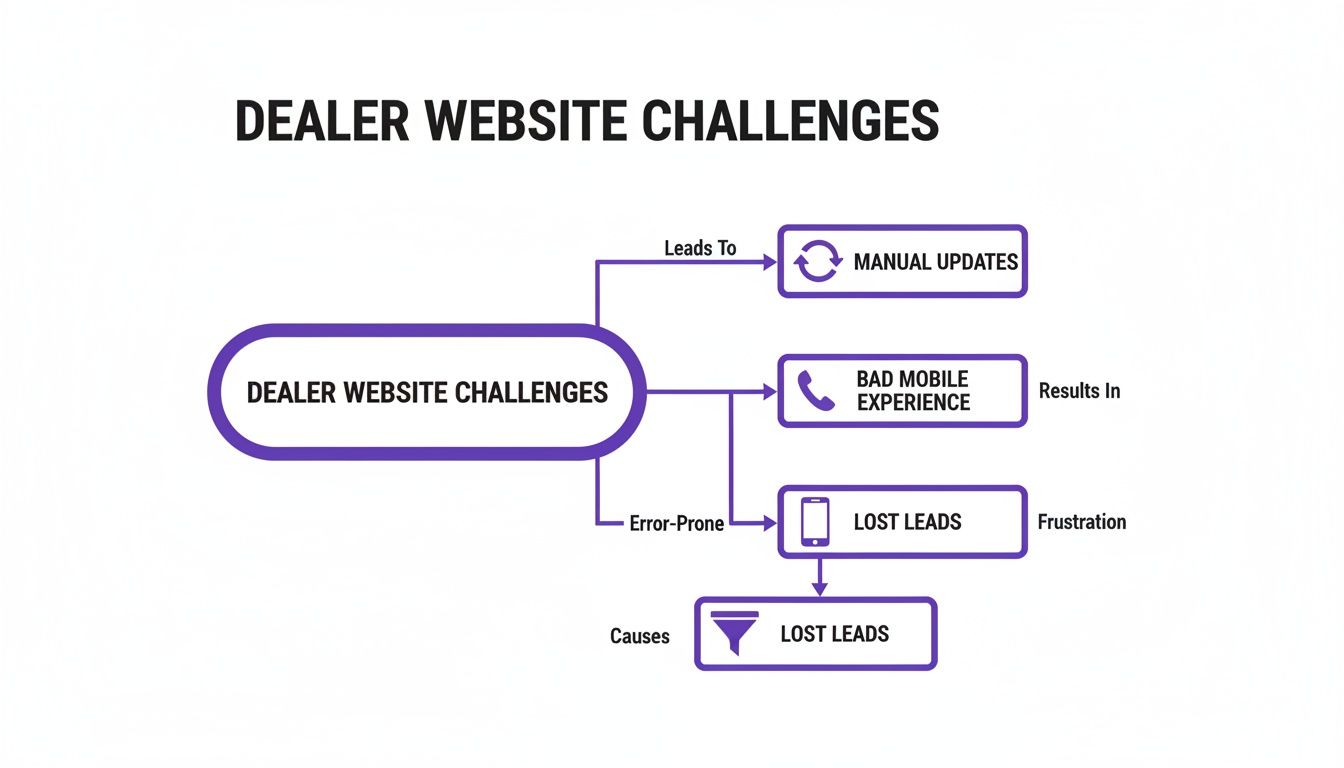
    The online car market is on fire right now. Recent data from IBISWorld shows the online car dealer industry in the U.S. has grown to a significant market size and has been expanding steadily for the past five years. This incredible growth proves that a powerful, cost-effective online presence isn't just nice to have—it's essential for any dealership that wants to compete. You can find more data on the online car dealer market on ibisworld.com.

    Decoding Common Pricing Structures

    As you start looking at different providers, you'll run into a few common pricing models. Each one is structured a bit differently, so knowing what you're looking at will help you compare your options apples-to-apples.

    Most modern platforms run on a monthly subscription model. This is a predictable, recurring fee that usually covers hosting, security updates, and basic customer support. It makes budgeting simple.

    You might also see a one-time setup fee. This usually covers the initial legwork of building your site, pulling in inventory from your old system, or setting up your DMS integration. It’s less common with today's SaaS platforms, but it’s always something to ask about.

    Finally, many plans are tiered based on your inventory size. A small, independent lot with 20 cars on the ground will pay less than a larger dealership managing over 100 vehicles. This approach makes sense—you only pay for what you actually use.

    Exposing the Hidden Costs

    Be careful, because the price on the sales page isn't always the final price. Hidden fees can quickly inflate what you thought was a good deal, turning it into a real budget-buster.

    A transparent provider will be upfront about all potential costs. If you have to dig for information on pricing for essential features, consider it a red flag. True partners want you to succeed, not to surprise you with invoices.

    Keep an eye out for these common extra charges:

    • Third-Party Integration Fees: Will they charge you extra to connect to your specific DMS or CRM? This is one of the first questions you should ask.
    • Advanced Feature Add-Ons: Sometimes, critical tools like a VIN decoder or advanced SEO features are locked behind a pricier plan or sold separately.
    • Premium Support Charges: Basic email support might be included, but what if you need to talk to someone on the phone? Or want a dedicated account manager? Find out what level of help your plan includes.
    • Data Migration Costs: Moving your current inventory and customer data over to the new platform might come with its own service charge.

    The best way to protect yourself is to ask the right questions before you commit. Before signing anything, get in touch with the provider and get the total cost in writing, including any add-ons you might need down the road. A simple conversation today can save you from a major headache tomorrow.

    A Smooth Launch Plan for Your New Dealership Website

    Three diverse professionals collaborate on project planning, reviewing documents and making notes at a white table.

    Switching to a new website can feel like trying to swap out an engine while the car is still running. But it doesn't have to be that chaotic. With a solid plan, the entire process becomes much more manageable, moving from a source of stress to a straightforward project.

    A smart launch is all about breaking it down into clear, logical steps. Think of it in three key stages: what you do before you flip the switch, what happens on launch day, and how you fine-tune everything afterward. This approach helps you sidestep common headaches like your site going down, your Google rankings tanking, or your inventory data getting scrambled.

    The Pre-Launch Preparation Phase

    This is where all the important groundwork happens. Before anyone sees your new site, your website provider should be deep in the details, getting everything just right. This stage is all about gathering your assets, moving your data, and locking in the final look of your new digital showroom.

    Your main job here is to provide the raw materials:

    • Content and Asset Gathering: You'll need to hand over high-quality logos, photos of your team, the "About Us" story that makes your dealership unique, and any other brand content.
    • Design Finalization: This is your chance to review and approve the site’s layout, colors, and overall vibe. Does it feel like your dealership? Now's the time to say so.
    • Data Migration Review: You'll work with your provider to double-check that all your existing inventory specs, customer info, and other essential data are mapped correctly for a clean transfer.

    Think of this phase as the final walk-around before a customer takes delivery. It’s your chance to check every detail, confirm all the features are in place, and give the final sign-off before the keys are handed over.

    The Go-Live Process

    Once all the prep work is done, it's time for the technical launch. This part is almost entirely handled by your car dealer website builder partner—they do the heavy lifting behind the scenes. The goal is a seamless switchover with zero disruption to your business.

    Here’s what’s typically happening on their end:

    1. Final Technical Setup: They'll be configuring the server, installing security certificates, and making sure the site is rock-solid and ready for visitors.
    2. DMS Integration Activation: The live connection to your Dealer Management System gets turned on, ensuring your inventory is syncing perfectly in real time.
    3. Quality Assurance Checks: One last, thorough sweep of the live site is done to catch any broken links, weird formatting, or bugs on mobile devices.

    Post-Launch Optimization and Success

    Congratulations, your new website is live! But the job isn't quite finished. The first few weeks are critical for making sure the site is performing as it should and that your team is comfortable using it. Now is the time to watch your analytics, get your people trained up, and hit the gas on your marketing.

    Your focus should shift to these key activities:

    • Staff Training: Make sure your sales team and office staff know their way around the new system. Can they easily manage leads? Can they update a vehicle description?
    • Performance Monitoring: Keep a close eye on your website analytics. You’ll want to track traffic, how many lead forms are being filled out, and whether people are sticking around or bouncing right off the site.
    • Marketing Campaign Activation: It's time to drive traffic. Launch those new marketing campaigns you've been planning and start taking advantage of your site's new SEO power and better lead-gen tools.

    Got Questions? Here Are the Answers

    Moving to a new website platform is a big step, and it's smart to have questions. To give you some extra clarity, we've pulled together the most common things we hear from dealers who are thinking about a car dealer website builder. Getting good, honest answers is the only way to feel confident you're making the right move for your lot.

    Let's tackle these questions head-on so you know exactly what to expect.

    How Long Does It Take to Get My New Site Online?

    This is usually the first thing dealers ask. The timeline really depends on the provider you choose and how complex your setup is, but a modern platform should have you up and running quickly. We’re talking weeks, not months.

    The launch process generally breaks down into a few simple stages:

    • Discovery and Design: Nailing down the look and feel you want.
    • Data Integration: Hooking up your DMS so your inventory syncs perfectly.
    • Adding Your Content: This is where you add your dealership’s story, staff photos, and other custom pages.
    • Final Look-Over and Launch: One last check before you hit the big green button.

    Can I Keep My Current Domain Name?

    Of course. In fact, you absolutely should. Your domain name is a huge part of your brand and holds all the SEO value you've worked hard to build. Starting over is the last thing you want to do.

    The switch is straightforward. When your new website is ready, you'll just need to update your domain's settings to point to the new hosting servers. Any good website partner will give you clear instructions or even handle this part for you to make sure everything goes off without a hitch.

    A professional car dealer website builder will never ask you to change your domain. Their job is to make the switch seamless, protecting the online reputation and search engine trust you've already earned.

    What Kind of Support Can I Expect?

    Support levels can be all over the map, so this is a big one to dig into. Most providers offer different tiers of support to fit what your dealership needs and can afford.

    Typically, a standard plan will get you email or ticket-based help for any technical hiccups. If you go with a more premium plan, you might get perks like direct phone support, a dedicated person to call, or faster help when something urgent comes up. Make sure you ask exactly what's included so there are no surprises when you need a hand.

    How Does a New Website Actually Help Me Sell More Cars?

    At the end of the day, this is what it’s all about. A great website builder helps you sell more cars by smoothing out all the bumps in the online car-shopping process. It’s not just about having a prettier site; it's about having one that works smarter.

    A platform built for dealers connects all its features to real-world results:

    • It gets you better leads. Optimized forms for test drives, financing, and trade-ins capture buyers who are serious, not just kicking tires.
    • It makes you more visible. With built-in automotive SEO and integrations like Google Vehicle Ads, your cars show up right when local shoppers are searching for them.
    • It converts mobile shoppers. So many customers browse on their phones. A fast, easy-to-use mobile experience keeps them on your site and turns that interest into an appointment.

    Ready to see how a modern, purpose-built website can drive more leads and simplify your operations? With AutoFire™, you can launch a professional, mobile-first website in minutes and start showcasing your inventory where buyers are searching. Get started for free today.