Tag: automotive seo

  • What Is Mobile Responsive Design and Why It Matters for Your Dealership

    What Is Mobile Responsive Design and Why It Matters for Your Dealership

    Mobile responsive design is an approach where a single website automatically adjusts its layout to fit whatever screen it's on. Think of it like a liquid—it perfectly fills any container, whether that's a huge desktop monitor, a mid-sized tablet, or the smartphone in your pocket.

    Why Your Website Must Be a Shape-Shifter
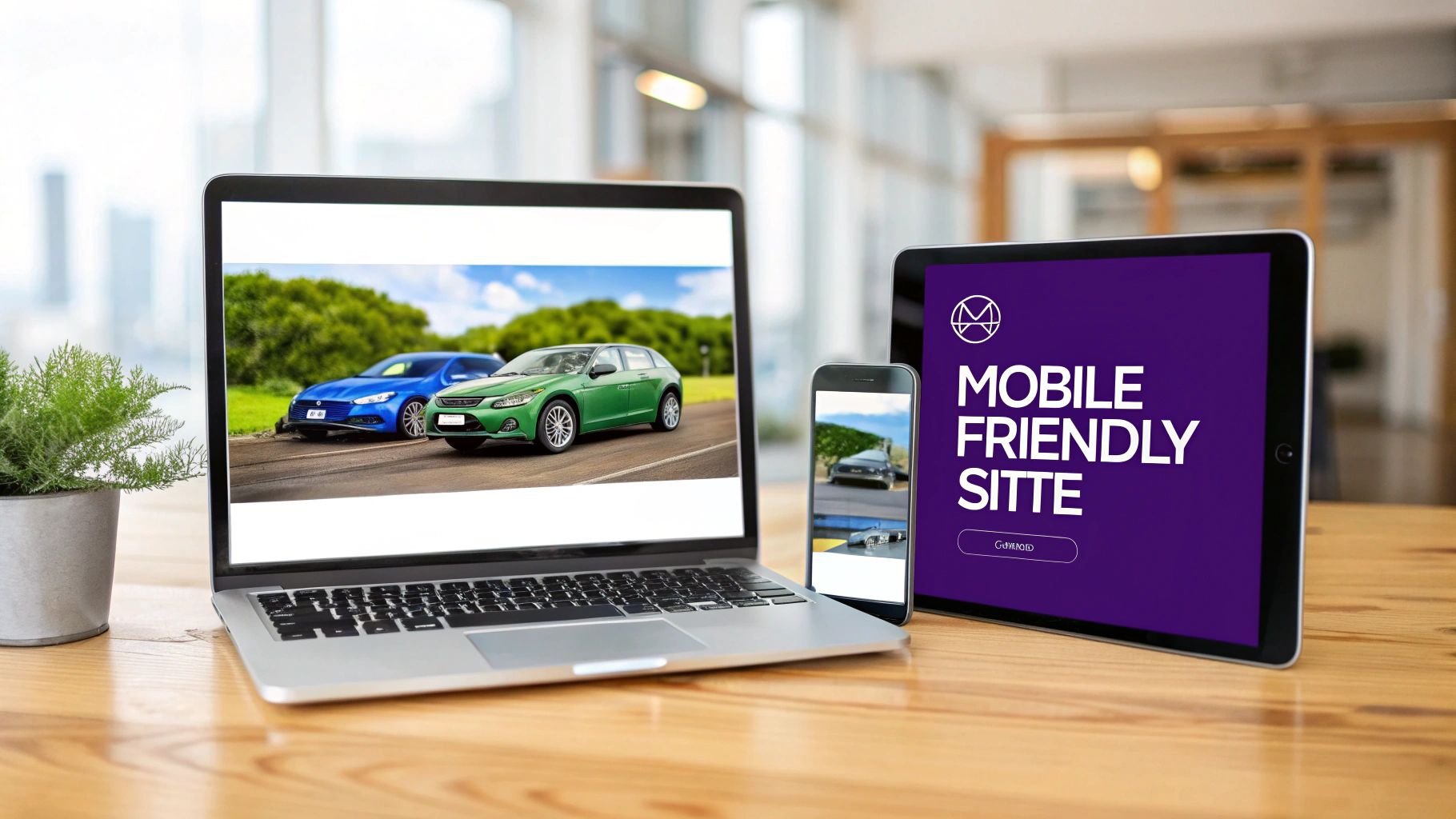
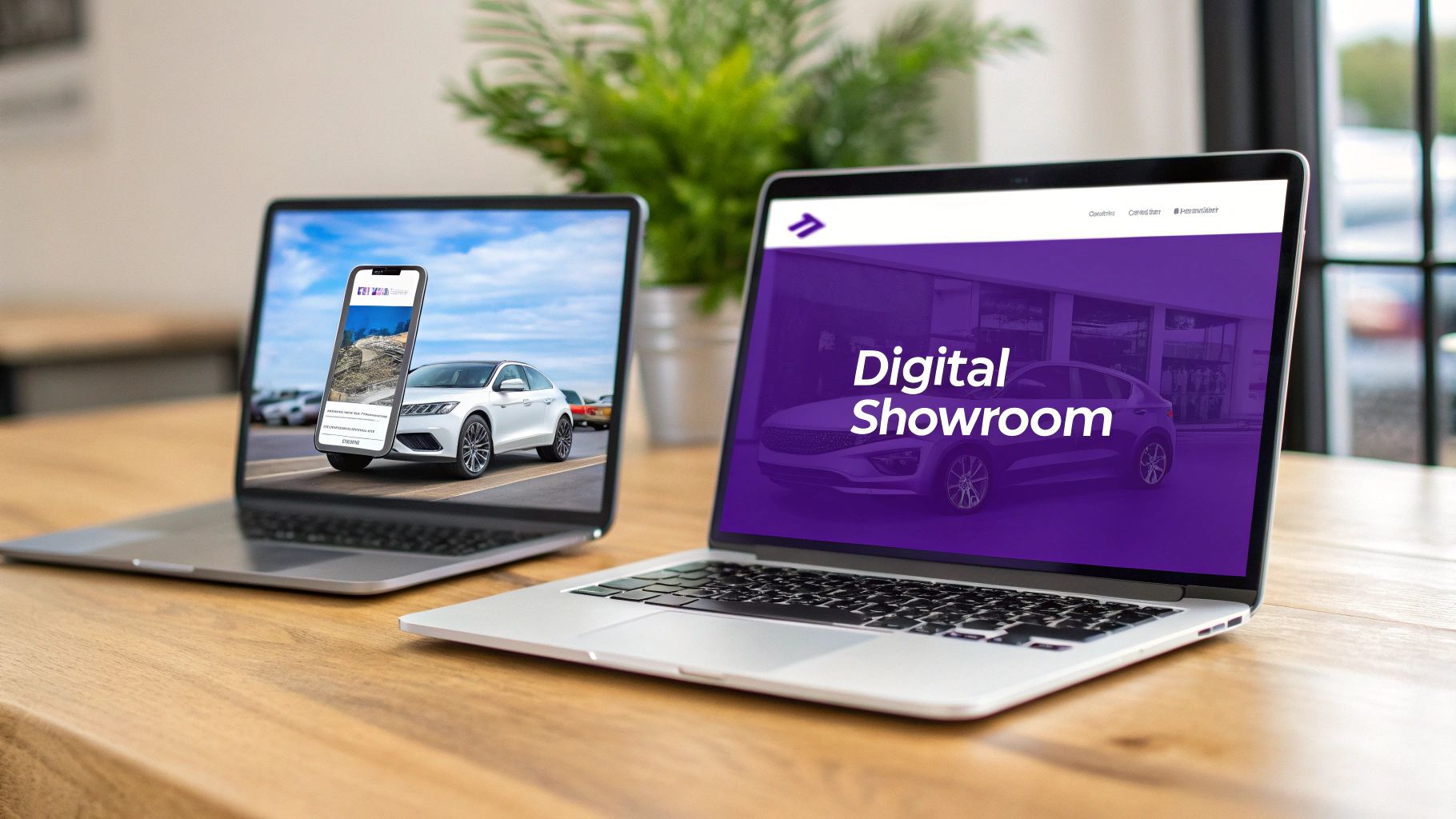
    A laptop, smartphone, and tablet display a website, demonstrating mobile-friendly design and responsiveness.

    So, what is mobile responsive design in simple terms? It’s a smart way of building your site so that the content—images, text, buttons, and forms—automatically rearranges itself to look and work great for every visitor. For a car dealer, this means your vehicle photos, spec sheets, and lead forms are just as clear and easy to use on a phone as they are on a computer.

    This completely gets rid of the frustrating pinching, zooming, and side-scrolling that makes people leave a website. Instead of juggling separate sites for mobile and desktop, you have one flexible website that does the job everywhere.

    The Problem With Old-Fashioned Websites

    Not too long ago, it was common for businesses to have two different websites: the main desktop site and a clunky, scaled-down "m-dot" version for mobile users. This was a nightmare for keeping content updated and almost always gave mobile visitors a second-rate experience. Trying to use a non-responsive site on a phone is a recipe for tiny text, broken layouts, and lost customers.

    A mobile-responsive website isn't just about looks. It directly impacts your search rankings, how fast your pages load, and how many leads you get. If your site isn't built for mobile, you're leaving money on the table.

    This is more critical than ever, as Google now primarily uses the mobile version of your site to determine its search rankings. A bad mobile experience will actively tank your visibility.

    The Benefits For Car Dealerships

    A responsive website ensures every potential car buyer has a smooth, hassle-free experience, which is the key to turning an online browser into a showroom visitor. The advantages are crystal clear:

    • Improved User Engagement: A clean, intuitive site encourages shoppers to stick around and browse your inventory longer, without getting annoyed.
    • Stronger SEO Performance: Google prioritizes mobile-friendly sites, giving you a major boost in local search results so buyers can find you first.
    • Higher Lead Conversion: With simple, easy-to-tap forms and click-to-call buttons, shoppers can reach out the moment they're interested, right from their phone.

    At the end of the day, a responsive website is no longer a "nice-to-have" feature. It's an absolute necessity for any modern dealership's digital strategy.

    The Pillars of a Truly Responsive Website

    So, what’s actually going on behind the scenes of a responsive website? It’s helpful to peek under the hood at the core components that make it all click. These are the principles that let a single website deliver a perfect viewing experience on everything from a tiny smartphone to a huge desktop monitor. This whole approach is built on three key pillars working in concert.

    This entire philosophy became the industry standard after a web designer named Ethan Marcotte laid it all out in a now-famous 2010 article. He made a compelling case for a more fluid, adaptable web, and it clearly stuck. Today, responsive design is the standard for new website development.

    Fluid Grids: The Flexible Foundation

    The first pillar is the fluid grid. Imagine your website's layout is made of super-stretchy, flexible shelving. When you have a wide wall (a desktop screen), those shelves can expand to fill the entire space. But if you move them to a narrow hallway (a phone screen), they intelligently stack one on top of the other, keeping everything neat and tidy.

    Technically, a fluid grid uses relative units like percentages instead of fixed units like pixels. This just means your website elements—like your vehicle inventory grid or your finance application form—aren't locked into rigid widths. They simply resize in proportion to whatever screen they’re on, making sure your content is always well-organized and easy to navigate.

    Flexible Images: The Visual Shifters

    Next up, we have flexible images. As a car dealer, your site is all about the visuals. You rely on high-quality vehicle photos to make a sale. On an old, non-responsive site, those big, beautiful images would either get awkwardly cut off on a small screen or force users into that dreaded horizontal scroll.

    Flexible images fix this by automatically scaling down to fit the container they're in. This keeps your car photos looking sharp and professional on a phone without distorting the picture or breaking the page layout. Even better, it helps keep your page load times fast, which is absolutely critical for holding onto impatient mobile visitors and for good SEO. For more tips on this, check out our complete guide on website design for car dealers.

    Media Queries: The Intelligent Director

    The final pillar is the media query, and you can think of it as the "brain" of the operation. It's a snippet of CSS code that detects the specific characteristics of the device viewing your site—most importantly, the width of its screen.

    A media query is really just a set of "if-then" rules. For instance, a rule might say: "If the screen is less than 768 pixels wide, then stack the navigation links vertically and make the font bigger so it's easier to read."

    Based on the screen size it detects, the media query applies a specific set of styles to optimize the layout on the fly. It’s the part that tells the fluid grid and flexible images how to adjust, ensuring the user experience feels like it was custom-made for their exact device. When these three pillars work together, you get the seamless, adaptable experience that defines modern web design.

    Responsive vs. Adaptive vs. Mobile-First Explained

    When you start looking at website options for your dealership, you’ll run into a few different design philosophies. They might sound interchangeable, but understanding the difference between responsive, adaptive, and mobile-first design is key to making the right choice for your business.

    Responsive Design

    Think of Responsive Design like a single, ultra-flexible outfit that can stretch or shrink to fit anyone perfectly. It uses one fluid layout that automatically adjusts to whatever screen it's on, from a huge desktop monitor to a tiny smartphone. It’s one website built to be versatile.

    Adaptive Design

    Adaptive Design is a bit different. Imagine having a closet with a few specific outfits—one small, one medium, and one large. Instead of one fluid layout, an adaptive site has several pre-built, fixed layouts. When someone visits your site, the server figures out their screen size and serves up the best-fitting version. It adapts, but only to a handful of set sizes.

    Mobile-First Design

    Then there's Mobile-First Design, which flips the whole process on its head. This approach is like designing a sleek, functional race suit before even thinking about the casual wear. You start by perfecting the experience on the smallest screen—the smartphone—and then progressively add features and expand the layout for tablets and desktops.

    This has become the gold standard for a very simple reason: the vast majority of your customers start their car search on their phones.

    By designing for the mobile experience from the very beginning, you ensure that these users get the fastest, cleanest, and most streamlined version of your site possible. It prioritizes what mobile users need most, rather than trying to cram a desktop site onto a small screen.

    To help you visualize the differences, here’s a quick breakdown of these three approaches.

    Comparing Website Design Approaches

    Approach How It Works Best For
    Responsive One fluid layout that automatically adjusts to any screen size. Businesses that need a consistent, flexible experience across all devices without a complex back-end.
    Adaptive Multiple fixed layouts designed for specific screen sizes. The server sends the best fit. Complex, feature-heavy websites where tailoring the experience for specific devices is a top priority.
    Mobile-First Starts with the design for the smallest screen (mobile) and progressively enhances it for larger screens. Virtually all modern businesses, especially those like dealerships where mobile traffic is dominant.

    Each method has its place, but for a car dealership in today's market, a mobile-first strategy built on a responsive framework is the winning combination. It ensures you're serving your largest audience segment first and foremost.

    This diagram shows the technical pillars that make it all work.
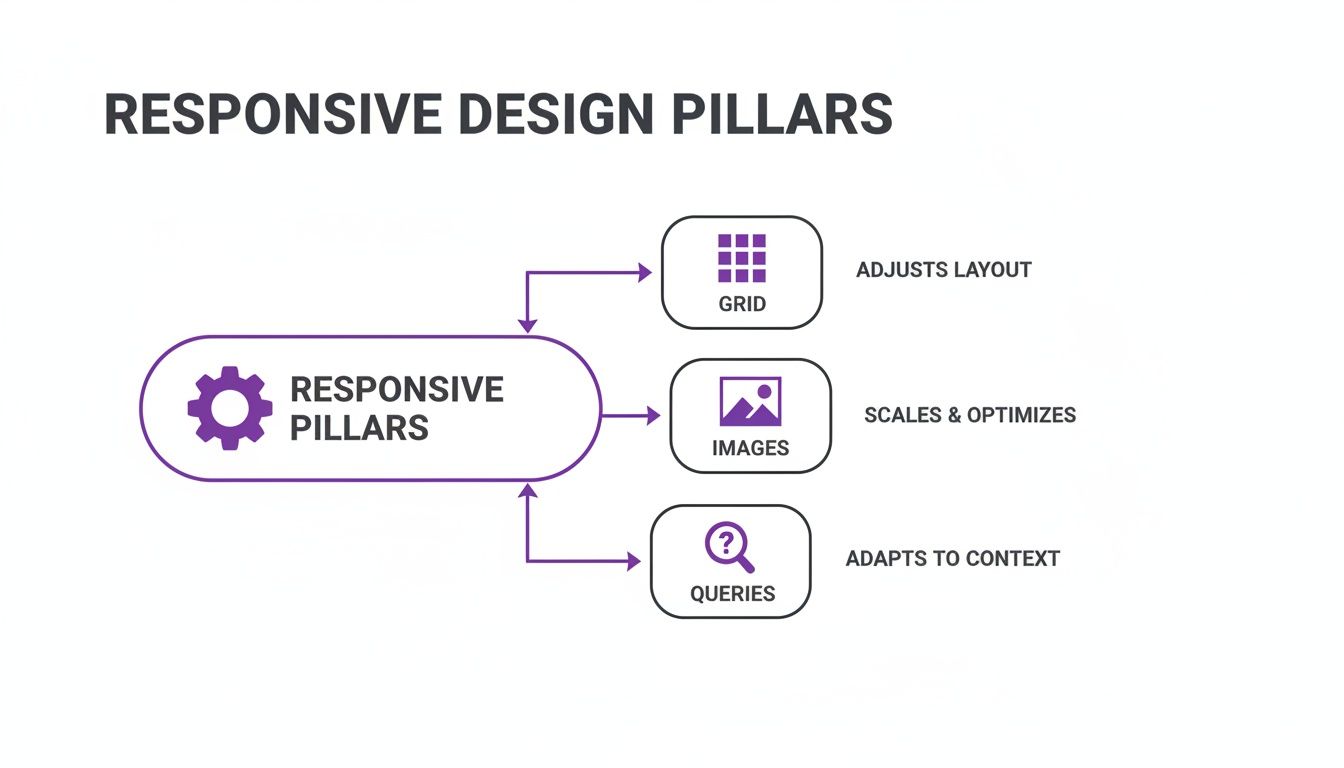
    Diagram illustrating the three pillars of responsive design: Grid for layout, Images for optimization, and Queries for context adaptation.

    These three elements—fluid grids, flexible images, and media queries—are the engine behind a truly seamless experience on any device.

    Diving into Mobile-First Design Principles can give you a deeper appreciation for why starting small is such a big deal. To see how these concepts come together specifically for car dealers, check out our complete guide on dealership website design.

    Why a Mobile-Friendly Site is Your Dealership's Best Salesperson

    Think of your website as more than just a digital brochure. It’s a powerful tool that directly impacts your sales numbers, and in today's market, how it performs on a smartphone is what separates the winners from the losers.

    Why? Because search engines like Google have completely shifted their focus. They now use a mobile-first indexing approach, which is just a technical way of saying they judge and rank your website based on its mobile version. If your site is clunky and broken on a phone, Google notices, and you’ll get buried in search results—especially for crucial spots like Google Vehicle Listings.

    The Real Cost of a Bad First Impression

    Let's face it, the modern car-buying journey almost always starts on a phone. Your customers are scrolling through inventory on their lunch break, comparing prices from the couch, and looking up directions to your lot while on the go.

    If they land on your site and have to pinch and zoom just to read a vehicle description, they’re not going to stick around. They’ll hit the back button in frustration and head straight to your competitor. This quick exit is called a "bounce," and a high bounce rate tells search engines your site isn’t giving people what they want.

    In fact, a non-responsive design is one of the top reasons people abandon a website. According to one study, 73.1% of web designers believe that a non-responsive design is a key reason why visitors leave a website. That number alone shows just how critical a smooth experience is for keeping potential buyers on your page.

    This isn't just a theory; it's backed by how people behave. Research indicates that users are far more likely to engage with a business that offers a great experience across the devices they own. You can dive deeper into these findings by checking out the latest responsive design best practices.

    Turning Mobile Browsers Into Showroom Visitors

    A well-built responsive site doesn't just stop people from leaving—it actively guides them toward becoming a lead. When you make it effortless for someone to use your site on a small screen, you see immediate improvements in the metrics that matter most.

    Here’s how that translates into real growth for your dealership:

    • Lower Bounce Rates: When visitors can easily navigate your inventory and find information, they stay longer. They explore more VDPs and get a better feel for your dealership.
    • Increased Engagement: A clean, intuitive design makes browsing photo galleries and comparing specs a genuinely good experience, which keeps shoppers invested and interested.
    • Higher Conversion Rates: This is the big one. A responsive site makes it dead simple for a user to take action. Big, easy-to-tap "Call Us" buttons, simple contact forms, and clear directions to your dealership remove all the friction, turning a casual browser into a qualified lead.

    Ultimately, understanding what is mobile responsive design comes down to recognizing it as a fundamental sales strategy. It ensures that every single visitor, no matter what device they’re using, has a clear and easy path to becoming your next customer.

    Essential Responsive Features for Your Car Dealer Website

    Knowing the theory behind responsive design is one thing, but putting it into practice is what actually sells cars. A great dealership website isn't just flexible—it's packed with specific features that turn a casual mobile browser into a real showroom visitor. These elements are all about making the car buying journey completely seamless on a small screen.
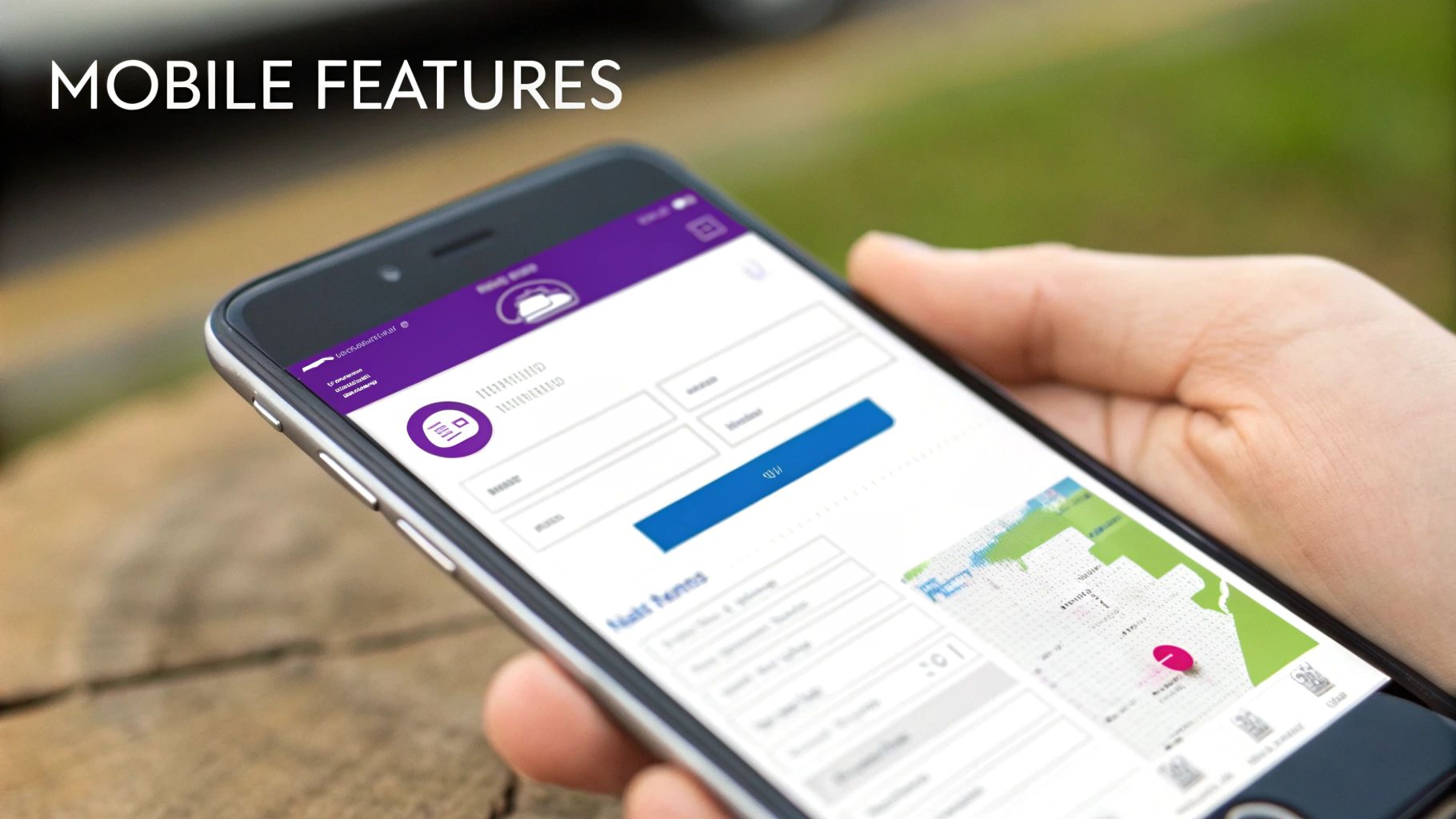
    A close-up of a hand holding a smartphone displaying an app with various mobile features and a map.

    It’s about turning your site from a passive online listing into an active sales machine. Every feature needs to solve a problem for a customer on the move, removing friction from start to finish.

    Making Every Tap Count

    On a phone, every interaction happens with a fingertip, not a precise mouse cursor. That simple fact demands a totally different way of thinking about navigation and calls to action.

    Your website must have:

    • Touch-Friendly Navigation: Buttons and menus need to be big enough to tap easily without hitting the wrong link by mistake. Think clear, chunky buttons, not tiny, crowded text.
    • Prominent Click-to-Call Buttons: When a shopper wants to talk, they shouldn't have to hunt for your phone number. A sticky header with a "Call Now" button keeps your sales team just one tap away at all times.
    • Integrated Maps: Listing your address is fine, but a one-tap link that opens Google Maps or Apple Maps for instant directions is infinitely better. This little feature can be the nudge that gets a buyer onto your lot.

    These small details add up to a huge difference in the user's experience, turning someone who's "just looking" into a genuine lead. You can dig into more strategies like these in our guide on how to optimize your dealership website for mobile.

    Streamlining the User Journey

    Beyond basic navigation, the most important parts of your site—your vehicle inventory and lead forms—need special attention. Mobile users crave speed and simplicity above all else.

    A mobile-responsive website provides a smoother, more intuitive user experience. Websites that prioritize UX for mobile users often experience lower bounce rates and higher conversions, making responsive design a critical business asset.

    Fast-loading vehicle image galleries are an absolute must. Customers expect to swipe through high-quality photos instantly, without waiting for them to load or burning through their data plan. This is where image optimization becomes crucial; choosing the right image formats for web performance can make a night-and-day difference for your mobile visitors.

    Finally, you have to simplify your lead forms for small screens. Instead of asking for ten different pieces of information, stick to the absolute essentials: name, email, and phone number. Shorter forms dramatically increase the odds that a mobile user will actually fill one out, which directly boosts your conversion rates.

    When all these features work in harmony, your website becomes a 24/7 sales assistant that never sleeps.

    Got Questions About Responsive Design? We've Got Answers.

    Jumping into the world of dealership websites can feel a bit overwhelming. Let's clear up some of the most common questions we hear from independent dealers about responsive design and what it really means for your business.

    How Can I Tell if My Current Dealership Website Is Responsive?

    There are a couple of quick ways to check. The most definitive is to use Google's free Mobile-Friendly Test tool. Just pop in your website address, and it'll tell you straight up if your site is up to snuff for mobile users.

    Want a more hands-on method? Open your website on a desktop computer and just grab the corner of the browser window. Start shrinking it down. If your inventory photos, text, and buttons all neatly reflow and resize to fit the smaller space, you're looking at a responsive site. If things start getting cut off or you have to scroll side-to-side, your site isn't responsive.

    Will a Responsive Website Really Help My Google Ranking?

    Yes, and it's not a small difference—it's huge. Google now uses what's called "mobile-first indexing." This just means Google primarily looks at the mobile version of your site to decide how to rank you in search results.

    If your site is a mess on a phone, people will leave immediately. That tells Google your site isn't very helpful, which hurts your ranking. A fast, clean, responsive site is no longer a "nice-to-have" for SEO; it's a foundational piece, especially for getting into powerful features like Google Vehicle Listings.

    A mobile-responsive website isn't just a technical box to check. It creates a smooth, intuitive experience for your customers. Better experiences lead to lower bounce rates and more leads, turning your website into a genuine business asset.

    Is It Going to Be Expensive to Make My Website Responsive?

    If you go the route of a completely custom, from-scratch redesign, it can definitely be a big investment. We're talking potentially thousands of dollars and weeks or even months of work. But that's not the only option anymore.

    Modern dealership website platforms have changed the game. Instead of a massive one-time cost, you can get a professional, mobile-first website as part of an affordable subscription. You get all the powerful benefits—better SEO, more leads, a great-looking VDP—without the upfront sticker shock or the technical headaches. It lets you get online quickly and get back to what you do best: selling cars.


    At AutoFire™, we handle all the technical stuff so you don't have to. Our platform gives you a clean, fast, and mobile-first website that puts your inventory right in front of buyers, no matter what device they're using. Launch your professional dealership site today.
  • What is a custom domain name and its impact on your dealership

    What is a custom domain name and its impact on your dealership

    A custom domain name is your dealership's unique, branded web address on the internet—think MiamiBestMotors.com. It swaps out a generic, shared address for something that's truly yours. This simple change acts as your permanent digital storefront, making your business look professional and trustworthy from the first click.

    What Is a Custom Domain Name?

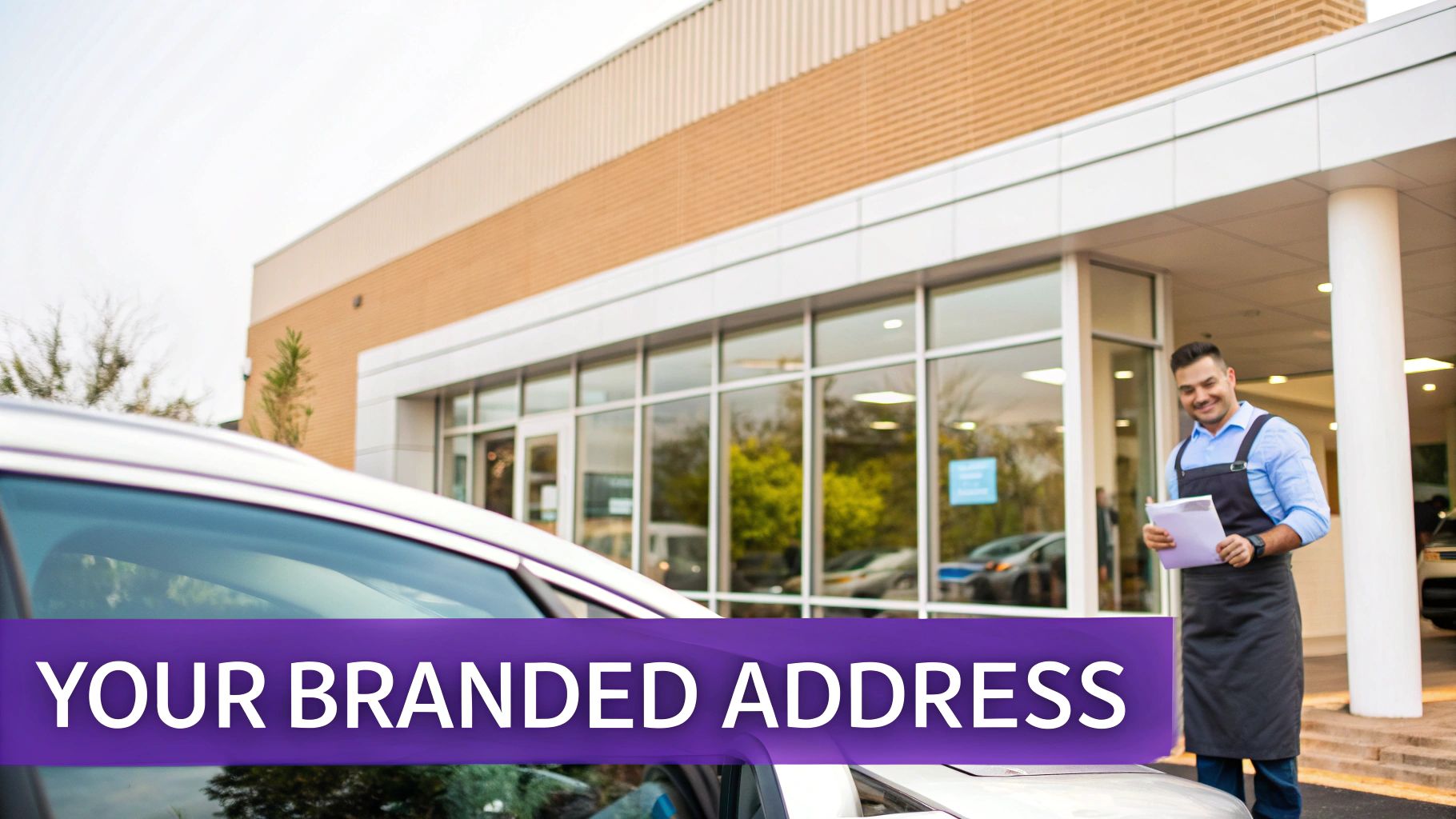
    A smiling male service professional in an apron stands outside a modern business building, holding documents next to a white car.

    Think about your dealership's online presence in the same way you think about its physical location. A custom domain is like owning the building at a prime, easy-to-remember street address. On the other hand, a generic subdomain, like miamibestmotors.autofireapp.com, is like renting a small stall in a crowded, shared market.

    While a subdomain is a decent place to start, a custom domain sends a clear signal: you're a serious, established business. It's a foundational asset that builds brand recognition every time a customer sees it on a business card, a social media profile, or even the back of a car you just sold.

    Your Digital Identity

    At its core, a custom domain gives you complete ownership over your corner of the internet. It provides a stable, memorable hub for all your marketing efforts, from online ads to email campaigns. To really get a handle on this, it's helpful to understand domain name registration and what goes on behind the scenes.

    Having this unique digital identity is more important than ever. The number of registered domains has exploded, with the classic .com extension still dominating the market. Snagging a unique name in this busy space is a critical first move for any dealership looking to stand out.

    A custom domain isn't just a technical detail; it's your brand's first handshake with a potential buyer. It communicates professionalism and permanence, which are crucial for earning trust in the auto industry.

    In short, a custom domain offers several key advantages for a dealership:

    • Builds Credibility: It shows customers you have invested in your brand and are here to stay.
    • Improves Memorability: A simple name like YourCityAuto.com is far easier for customers to remember and share.
    • Enhances Branding: It reinforces your dealership’s name consistently across every marketing channel.

    Why a Custom Domain Is a Must-Have for Modern Dealerships

    Let's move beyond the technical definition. A custom domain name makes a powerful first impression. Think of it as your dealership’s digital handshake—it’s often the first thing a potential buyer sees, and it immediately signals that you're a professional, established business. That initial trust is what gets a car shopper to click, fill out a lead form, or schedule a test drive.

    A simple, memorable domain like SmithMotors.com is also a branding workhorse. It reinforces who you are every time it’s seen, whether it's on a license plate frame, a business card, or a Facebook post. This kind of consistency is crucial for building name recognition in your local market, making it easy for both past customers and new prospects to find you online.

    Owning Your Digital Storefront

    Here's the most important part: a custom domain means you truly own your digital storefront. Every dollar you pour into marketing—from local SEO to paid social ads—builds value in an asset that belongs to you and you alone. This is a huge shift from being just a "tenant" on someone else's platform.

    When you invest in marketing your own domain, you are building long-term equity. Your online reputation, customer base, and search engine rankings belong to you, not a platform that could change its rules or disappear tomorrow.

    This ownership translates into real-world advantages:

    • Brand Authority: It tells customers and search engines like Google that your dealership is a legitimate, stable business they can count on.
    • Marketing Control: You get to decide everything about your branding and messaging, without being stuck with another company's naming rules.
    • Long-Term Asset: As you build up content, positive reviews, and links, your domain becomes more and more valuable over time.

    A custom domain is the foundation of a strong online presence. For more on creating a site that converts, take a look at our guide to outstanding car dealership website design.

    How a Custom Domain Drives Your Dealership’s SEO

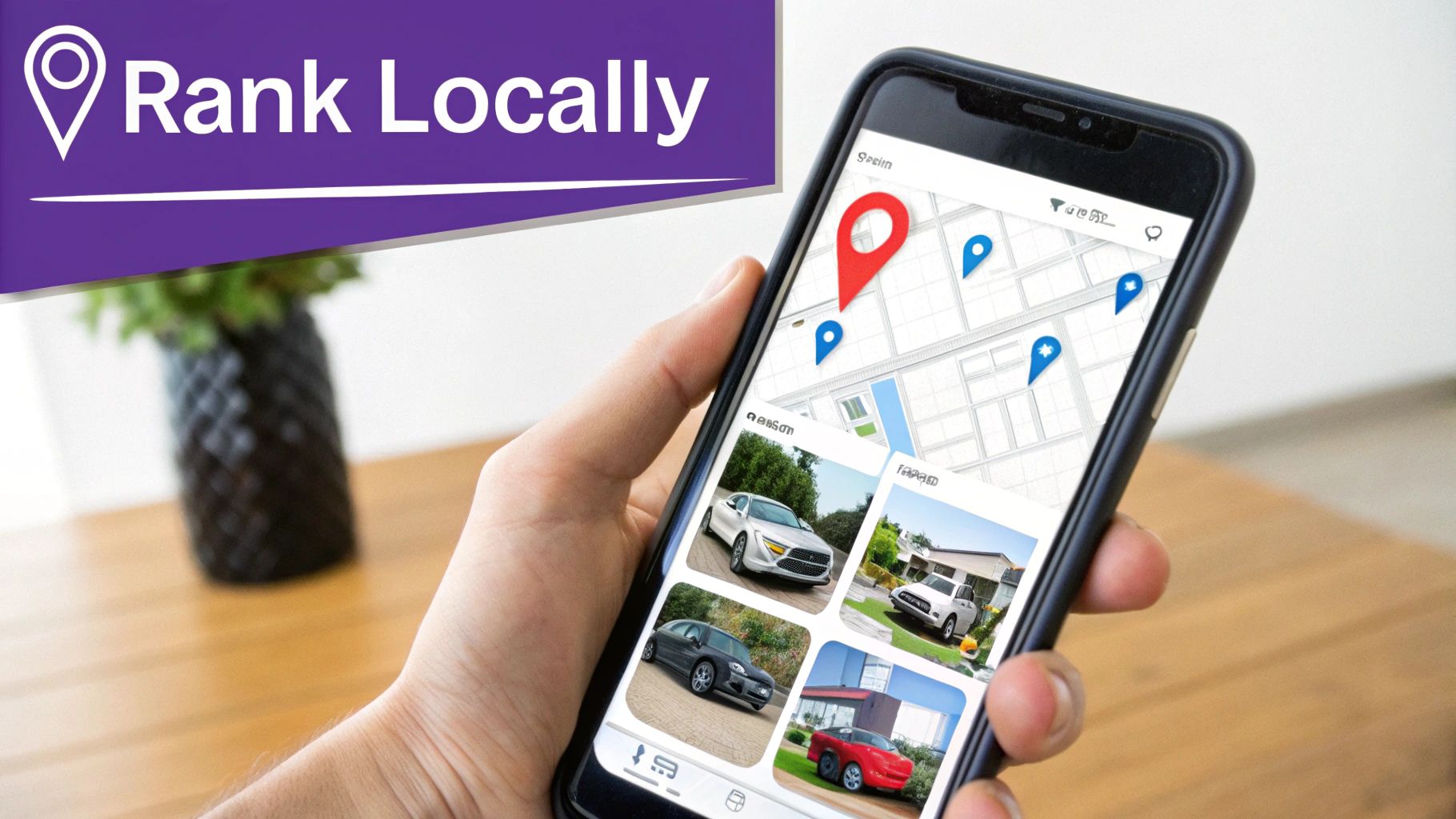
    Hand holding a smartphone displaying a local map app with car listings and location pins, next to 'Rank Locally' text.

    For any car dealership, winning the online game comes down to one thing: showing up when a local customer searches for "used cars near me." A custom domain is one of your strongest assets in making that happen. Why? Because search engines like Google view a custom domain as a massive signal of credibility and authority, which directly boosts your ability to outrank competitors stuck on generic subdomains.

    This goes way beyond just looking professional. It’s about how Google’s algorithms see your business. A custom domain gives your online reputation a permanent home. Every link you earn, every positive review you get, and every local business listing you create all build upon your domain authority—think of it as an SEO "credit score" for your website that gets stronger over time.

    Building a Long-Term SEO Asset

    Imagine your domain authority is like your dealership's real-world reputation. The longer you’ve been at the same physical address, building trust in the community, the more people rely on you. It works the same way online. The longer your custom domain is active and collecting these positive signals, the more Google trusts it enough to show it to car shoppers.

    A custom domain turns your website from a rented spot on the internet into a permanent digital asset that you own. Every bit of marketing you do adds to its value, helping you lock in better search rankings and pull in more local buyers for years.

    This authority is the engine that drives your most important goals:

    • Rank Higher in Local Search: A strong domain is key to appearing in the all-important local map pack on Google.
    • Get More Eyes on Your Cars: Better rankings mean more shoppers clicking on your vehicle detail pages.
    • Beat the Competition: As your domain authority increases, it gets much harder for other dealers to knock you out of the top spots.

    The market for domains is constantly growing, and good, memorable names are becoming a rare commodity. Securing a unique custom domain isn't just a small step—it’s a major move to solidify your online presence and gain a serious competitive advantage.

    To really see how a custom domain can lift your rankings, it helps to understand the basics of What Is Search Engine Optimization. For a guide built specifically for dealers, check out our article on what SEO is and how it works.

    Choosing the Perfect Domain Name for Your Car Lot

    A wooden desk in a car dealership with a 'Short Memorable Name' sign and a clipboard.

    Think of your domain name as the giant sign out in front of your dealership. It’s the very first thing people see online, and it needs to be clear, professional, and easy to remember. The best ones are short enough that customers can say them out loud or type them into their browser without getting confused.

    Your dealership's brand name should always be the starting point. If your lot is called "Apex Motors," then your first and best option is ApexMotors.com. It’s a straight line from your brand to your website, making it incredibly simple for your loyal customers to find your online inventory.

    Make It Memorable and Local

    If you want to give your local search ranking a little extra juice, think about adding your city or region right into the domain. Something like DallasQualityCars.com tells both search engines and potential buyers exactly where you are, helping you pop up when someone in the area is looking for a vehicle. The trick is to find that sweet spot between branding and location without making the name a mouthful.

    Here are a few pointers to keep in mind:

    • Keep It Short: The shorter it is, the easier it is to remember and the less likely someone is to make a typo.
    • Prioritize Your Brand: Your dealership name is your most valuable asset. Use it to build recognition.
    • Think Local: Including your city can be a magnet for nearby car shoppers.
    • Avoid Complexity: Steer clear of hyphens, numbers, or words that are tough to spell. They just create confusion.

    Stick with the Gold Standard

    When you get to the end of the name—the part after the dot—there’s really only one choice that matters for a serious business: .com. It's the extension people instinctively type and trust. It signals that you’re a professional and established dealership.

    While you might see other flashy extensions out there, .com is still king. It accounts for a massive share of the overall market. For building a credible brand, it’s the safest and smartest bet you can make.

    With more domains being registered every day, grabbing a short, memorable one is more critical than ever. You can discover more insights about domain name statistics to see just how the market is trending.

    Connecting Your Custom Domain with AutoFire

    Alright, you've picked the perfect name for your dealership's online home. Now, let's get it connected. Bringing your custom domain to your AutoFire™ website is a lot simpler than you might think—no tech wizardry required. We’ve made sure the process is quick and painless so you can get back to what you do best: selling cars.

    First things first, you need to buy your domain. You can grab one from popular domain registrars like GoDaddy, Namecheap, or Google Domains. Think of them as the county clerk's office for the internet, where you officially register your address. The purchase is just like any other online checkout.

    Pointing Your Domain to Your Dealership Site

    Once that domain is yours, the next step is to point it to your AutoFire site. This doesn't involve any coding. It’s really just about tweaking a couple of settings in your registrar's account so it knows where to send visitors. It's the digital equivalent of filing a change-of-address form with the post office.

    We have easy-to-follow, step-by-step guides that walk you through the whole thing. All you'll be doing is updating a few DNS (Domain Name System) settings, which basically act as the internet's phone book.

    You're not on your own here. At AutoFire, we handle the technical heavy lifting for you. If you get stuck, our support team is on standby to guide you through the process or even help you get it connected.

    This feature is a key part of our Pro plan, designed for dealers who are serious about building a powerful brand. By using a custom domain name, you're not just getting a website; you're building a more professional, trustworthy, and effective online showroom.

    Your Next Steps to a Professional Online Presence

    Getting a custom domain is so much more than just checking a box. Think of it as laying the cornerstone for your dealership's entire digital presence—a valuable asset that will pay dividends for years to come. It’s your investment in brand recognition, customer trust, and long-term Google ranking.

    When you own your domain, you're taking control of your online identity. It's the difference between renting a booth at a weekend market and owning the title to a prime piece of commercial real estate. Every piece of marketing you do builds equity in your property, not someone else's.

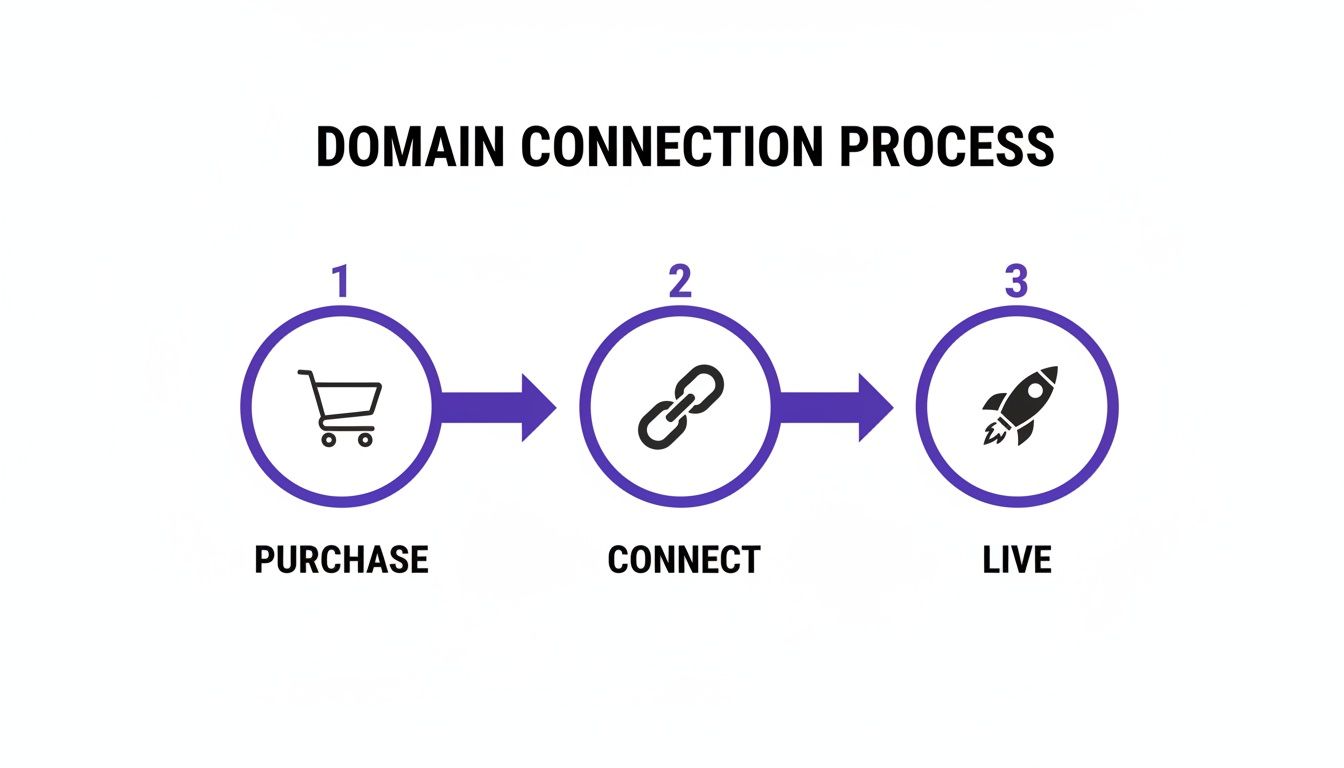
    From Purchase to Live Website

    Getting your custom domain up and running is simpler than you might think. We've broken it down into three clear, manageable stages to get you from concept to a live, professional website.

    Infographic illustrating the domain connection process, including purchase, connect, and live stages with icons.

    This straightforward process—Purchase, Connect, and Go Live—takes the mystery out of the technical side of things. That final step is where the magic happens, and your dealership really starts building authority and pulling in new customers.

    A custom domain transforms your website from a simple marketing tool into the central hub for your brand. It enhances brand recall, solidifies your professional image, and gives you a permanent address for all future customer interactions.

    Taking this step puts your dealership in a powerful position to compete and win. To see how the right website platform can amplify your brand even further, check out our guide on choosing the best car dealership website builder for your goals. The right tools, paired with your own domain, create an unbeatable combination for attracting local car buyers.

    Common Questions About Custom Domains

    Jumping into the world of custom domains can feel a bit technical, but it's usually simpler than you think. Let's tackle some of the most common questions dealership owners have so you can feel confident taking the next step.

    What's This Going to Cost Me?

    You'd be surprised. A lot of people assume getting a professional domain name is expensive, but it's one of the most affordable marketing investments you can make.

    For most standard .com domains, you’re looking at around $10 to $20 per year. That's it. For less than the cost of a few car washes, you secure a permanent, professional address for your dealership online, which pays for itself many times over in credibility and customer trust.

    Is It a Hassle to Manage?

    Not at all. Once you've bought your domain from a registrar like GoDaddy or Namecheap, the day-to-day management is pretty much zero.

    Your main job is just to renew it every year—and most services can handle that automatically so you don't forget. Pointing it to a website builder like AutoFire is a straightforward, one-time task. You don't need to be a tech wizard; you just update a couple of settings and you're done. Your website platform takes care of all the heavy lifting like server maintenance and security.

    Think of it this way: You own the street address, but your website platform owns and maintains the building. You get all the brand recognition and curb appeal without ever having to fix the plumbing.

    What If the Domain Name I Want Is Already Taken?

    This happens all the time, so don't get discouraged if your first choice is unavailable. You've still got plenty of great options. The trick is to get a little creative while keeping it memorable.

    Here are a few ideas to get you started:

    • Add Your Location: Try tacking on your city or state, like ApexMotorsDallas.com. This is great for local SEO, too.
    • Try an Action Verb: Something like DriveApex.com or GetApexMotors.com can be catchy and effective.
    • Specify Your Business: Adding "auto" or "sales" can do the trick. For example, ApexAutoSales.com is clear, professional, and available.

    The goal is to land on a name that’s still easy for customers to remember and type. A slight variation can often work just as well, if not better.


    Ready to build a professional online presence with your own custom domain? AutoFire provides the tools you need to launch a fast, modern, and SEO-optimized website that turns online shoppers into buyers. Get started today at goautofire.com.

  • How to Optimize Website for Mobile a Guide for Car Dealers

    How to Optimize Website for Mobile a Guide for Car Dealers

    When it comes to your dealership's website, mobile optimization is about much more than just shrinking everything to fit a smaller screen. It's a complete shift in thinking. You need to prioritize speed, responsive design, and an effortless user experience right from the start.

    For any dealership, this means your vehicle pages have to load instantly. It means lead forms must be simple enough to fill out with one thumb. The goal is to turn casual mobile browsers into actual showroom visitors, and that all starts with a rock-solid mobile site.

    Why Your Dealership’s Future Is on a Smartphone Screen

    The car buying journey has fundamentally changed. It doesn't start on the lot anymore; it begins on a phone. Your customers are scrolling through your inventory from their couch, on their lunch break, or while waiting for their coffee.

    This isn't just a trend—it's the new reality. Your website's mobile experience is your digital showroom. It’s your first handshake with your next customer.

    The numbers don't lie. By 2025, smartphones are projected to account for a staggering 64.35% of all global web traffic. That’s a significant jump from 60.61% in early 2024. For an independent dealership, a mobile-first website isn't just a "nice-to-have" feature; it's the core of your lead generation strategy.

    The Mobile Experience Is the Customer Experience

    Think of it this way: a slow, clunky mobile site is the digital version of a locked front door. It creates instant friction. A frustrated user won't stick around—they'll just bounce over to your competitor's site that actually works on their phone.

    A seamless mobile experience builds trust from the very first tap. When a customer can effortlessly browse your inventory, view high-quality photos, and contact you without pinching or zooming, you’re not just selling a car—you're providing a convenient and professional service.

    This guide is built to give you practical, actionable steps to make sure your digital showroom is always open, always fast, and always converting. We'll walk through everything you need to know.

    Here's a quick look at what we'll cover:

    • Performance and Speed: How to get your site loading in the blink of an eye.
    • Intuitive UX Design: Creating a layout that guides customers right where they need to go.
    • Inventory Optimization: Making your vehicle detail pages look incredible on any device.
    • Mobile SEO Strategies: Getting your cars seen in local searches and Google Vehicle Listings.

    You can also find a great high-level overview of these topics in this guide on how to optimize your website for mobile. By focusing on these critical areas, you'll turn your website into a powerful tool that meets customers right where they are—on their phones.

    Getting Your Mobile Site Up to Speed

    When it comes to selling cars online, speed is everything. A car shopper scrolling through your inventory on their phone isn't going to wait around. Every extra second a vehicle detail page takes to load is a chance for them to get frustrated and jump over to a competitor's site that works better.

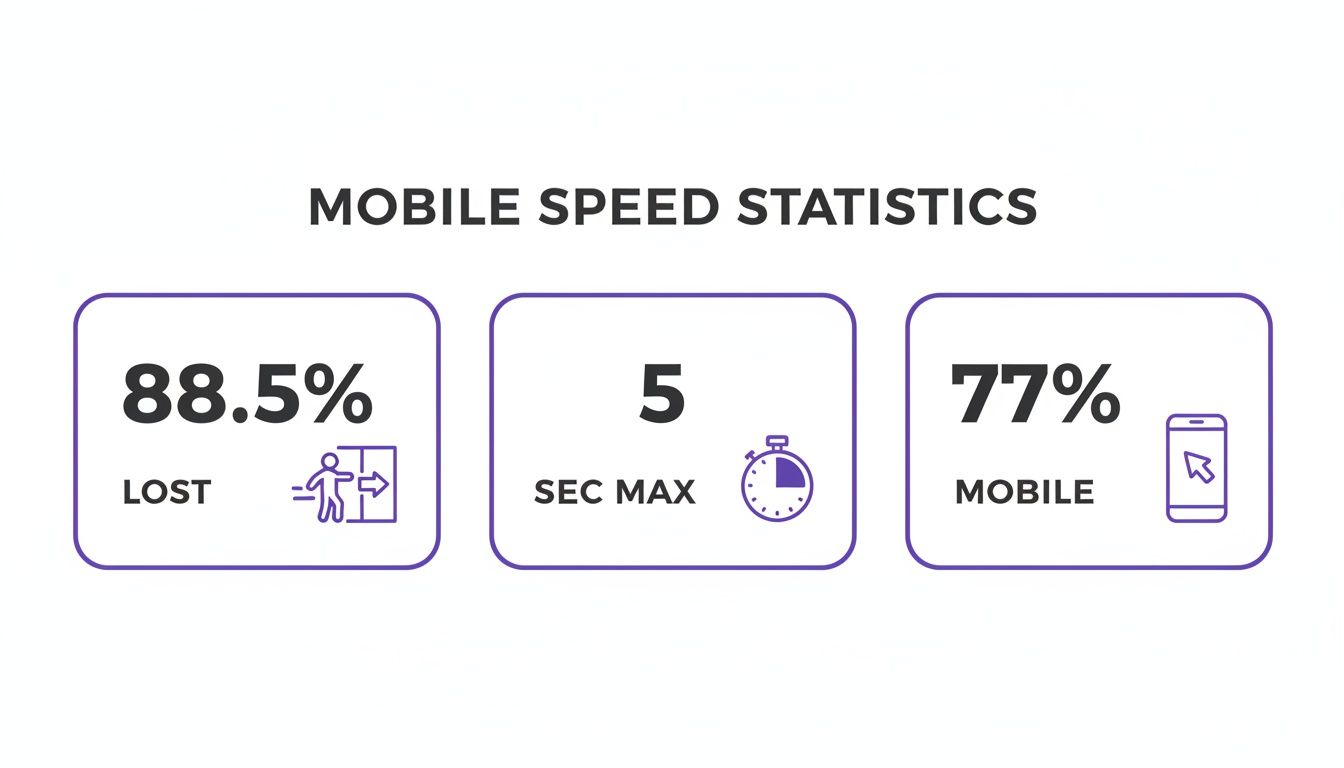
    The numbers don't lie. A staggering 88.5% of people will leave a website if it loads too slowly. On a smartphone, that patience wears even thinner—28% are gone after just five seconds. And with over 75% of all dealership website traffic now coming from mobile devices, a sluggish site isn't just an annoyance; it's a hole in your sales funnel.

    You don't need to be a coding whiz to understand the basics. Just knowing what makes a site fast or slow will empower you to make smarter decisions for your dealership's online showroom.

    What Google’s Core Web Vitals Mean for You

    Google has a specific report card for your website's user experience called Core Web Vitals. Getting these right is a huge piece of the puzzle for mobile SEO and directly impacts how easily customers can find you.

    Think of them this way:

    • Largest Contentful Paint (LCP): How fast does the main hero shot of that F-150 pop up on the screen? If a buyer is staring at a white screen for too long, they’ll assume your site is broken. You need this to happen in under 2.5 seconds.

    • First Input Delay (FID): When a customer taps the "View Photos" button, how quickly does the site react? A noticeable lag feels clunky and unresponsive. The goal is to get that response time to less than 100 milliseconds—basically, instantaneous.

    • Cumulative Layout Shift (CLS): Ever try to tap a button, only to have a banner load and shove everything down, making you tap the wrong thing? That's a layout shift, and it’s incredibly annoying. A good CLS score means your page is stable and predictable as it loads.

    To help you keep these straight, here’s a quick-reference table that breaks down what each metric means for the real-world experience of a car shopper on your site.

    Key Mobile Performance Metrics and Their Impact

    Metric (Core Web Vital) What It Measures Why It Matters for Your Dealership
    Largest Contentful Paint (LCP) Loading performance—how quickly the main content (like a hero image) is visible. A fast LCP immediately shows the customer the car they clicked on, building confidence and engagement.
    First Input Delay (FID) Interactivity—how quickly the page responds to a user's first click or tap. A low FID makes your search filters, buttons, and contact forms feel responsive and reliable, not frozen.
    Cumulative Layout Shift (CLS) Visual stability—whether page elements jump around as the page loads. A low CLS prevents accidental clicks and ensures a smooth, frustration-free browsing experience.

    Ultimately, a site that scores well on Core Web Vitals isn't just for Google's benefit. It’s about delivering a smooth, fast, and professional experience that keeps buyers on your site and engaged with your inventory.

    Practical Steps for a Faster Mobile Site

    Improving your site speed sounds technical, but some of the biggest wins come from pretty straightforward fixes. The name of the game is reducing the amount of "stuff" a user's phone has to download and process to show them your cars.

    Start With Your Images

    The number one speed killer on dealership websites? Huge, unoptimized vehicle photos. A gallery with 20 high-resolution images can bring a mobile connection to its knees.

    The fix is image compression. This process shrinks the file size of your photos without any noticeable loss in quality. Using modern formats like WebP can make a massive difference, ensuring your inventory looks sharp without slowing things down.

    If you want to go deeper on this, check out our complete guide on how to optimize images for the web.

    Put Browser Caching to Work

    Another powerful tool is browser caching. This clever trick tells a visitor's web browser to "remember" parts of your site, like your logo, navigation, and other common files.

    When that customer comes back a day later to look at another car, their phone doesn't have to re-download everything from scratch. This makes return visits feel almost instant.

    Clean Up Your Code

    Finally, there’s code minification. This is essentially a digital cleanup for your website's underlying code (the CSS and JavaScript files). The process automatically removes all the extra spaces, comments, and characters that developers use but browsers don't need.

    The end user never sees the difference, but the smaller files download and run faster, shaving precious milliseconds off your load time. Getting these things right ensures your digital showroom is always open for business and running at full throttle.

    Nail the Mobile User Experience

    So, your site loads in a flash. That's a huge win, but it's only half the battle. A blazing-fast website that’s a nightmare to navigate is like a souped-up engine in a car with no steering wheel—all that power is useless. The real goal is to create a mobile experience so simple and intuitive that customers can find what they need without even thinking about it.

    This is where user experience (UX) becomes your secret weapon. You have to get inside your customers' heads. Think about how they really use their phones. Are they scrolling through your inventory with one thumb while waiting for their coffee? Trying to find your phone number with one hand while they're out and about? Your mobile design has to work for them, in their world.

    A huge piece of this puzzle is having a site that adapts to any screen size. To get the full picture, it's worth learning everything you can about responsive web design.

    Design for Thumbs, Not Cursors

    On a phone, the thumb does all the work. Most people—especially if they're right-handed—are navigating with their dominant thumb. This creates a natural "easy-to-reach" zone at the bottom and center of the screen. Your most important buttons, like "Call Now," "View Inventory," or "Get Directions," need to live in that prime real estate.

    Look at your main menu. The classic "hamburger" icon (those three little lines) is a fantastic, space-saving solution. It neatly tucks away less critical links, keeping the interface clean and focusing the user's attention on the key actions you want them to take.

    Make Buttons Big and Obvious

    Fingers are clumsy. They aren't pixel-perfect like a mouse cursor. One of the biggest frustrations for any mobile user is trying to tap a tiny button and hitting the wrong one. It's an instant turn-off.

    Keep these simple rules in mind for your buttons:

    • Size It Right: Make your buttons and other tappable elements at least 44×44 pixels. This gives a thumb a solid target to hit without frustrating misses.
    • Make Them Pop: Your main calls-to-action (CTAs) should stand out. Use a color that contrasts sharply with the background so they're impossible to ignore.
    • Give 'Em Space: Don't cram your buttons together. A little bit of "white space" or breathing room around each one makes the whole design feel cleaner and prevents accidental taps.

    Getting these little details right makes your site feel polished and easy to control. That builds trust. It tells the customer you care about their experience, which reflects well on your entire dealership. You can see more examples of how these elements work together in our deep dive on car dealership website design.

    Simplify Your Lead Forms

    Let's be honest: nobody enjoys filling out forms, especially on a phone. Whether it's for a test drive, financing, or a trade-in quote, your forms need to be dead simple. Every single field you add is another reason for a potential customer to give up and leave.

    Cut it down to the absolute essentials. All you really need to start a conversation is a name, email, and phone number. You can always get more information later. Simple tweaks, like making the form fields larger and automatically pulling up the number pad for the phone field, make a world of difference.

    The golden rule of mobile UX is to eliminate friction. Every tap, scroll, and form should be designed for someone who is on the move. Your job is to make it easier for them to do business with you than with the dealership down the street.

    A clunky mobile experience is a sales killer. It sends your bounce rate through the roof and tanks your conversions—which already hover at a low 2.89% for eCommerce on a good day. Overcrowded pages are a common mistake for 84.6% of websites, but this is easily avoided with a clean, mobile-first design like the one we've built at AutoFire™.

    Mobile speed statistics showing 88.5% lost, 5 seconds maximum load time, and 77% mobile traffic.

    The stakes couldn't be higher. With most of your traffic coming from smartphones, you have just a few seconds to make a great impression before that lead is gone for good.

    Optimizing Vehicle Detail Pages for Mobile Search

    Think of your Vehicle Detail Pages (VDPs) as the final handshake before a test drive. They're the digital equivalent of a customer walking right up to a specific car on your lot. This is, without a doubt, the most critical part of your dealership’s website. When a shopper lands on a VDP, they’re done casually browsing; they’re seriously considering that car.

    This is where all your hard work pays off. A fast, intuitive, and information-packed VDP can seal the deal. A clunky, slow, or confusing one? It'll send that same motivated buyer straight to your competitor down the street. The mission is to make these pages an absolute magnet for both mobile users and search engines like Google.

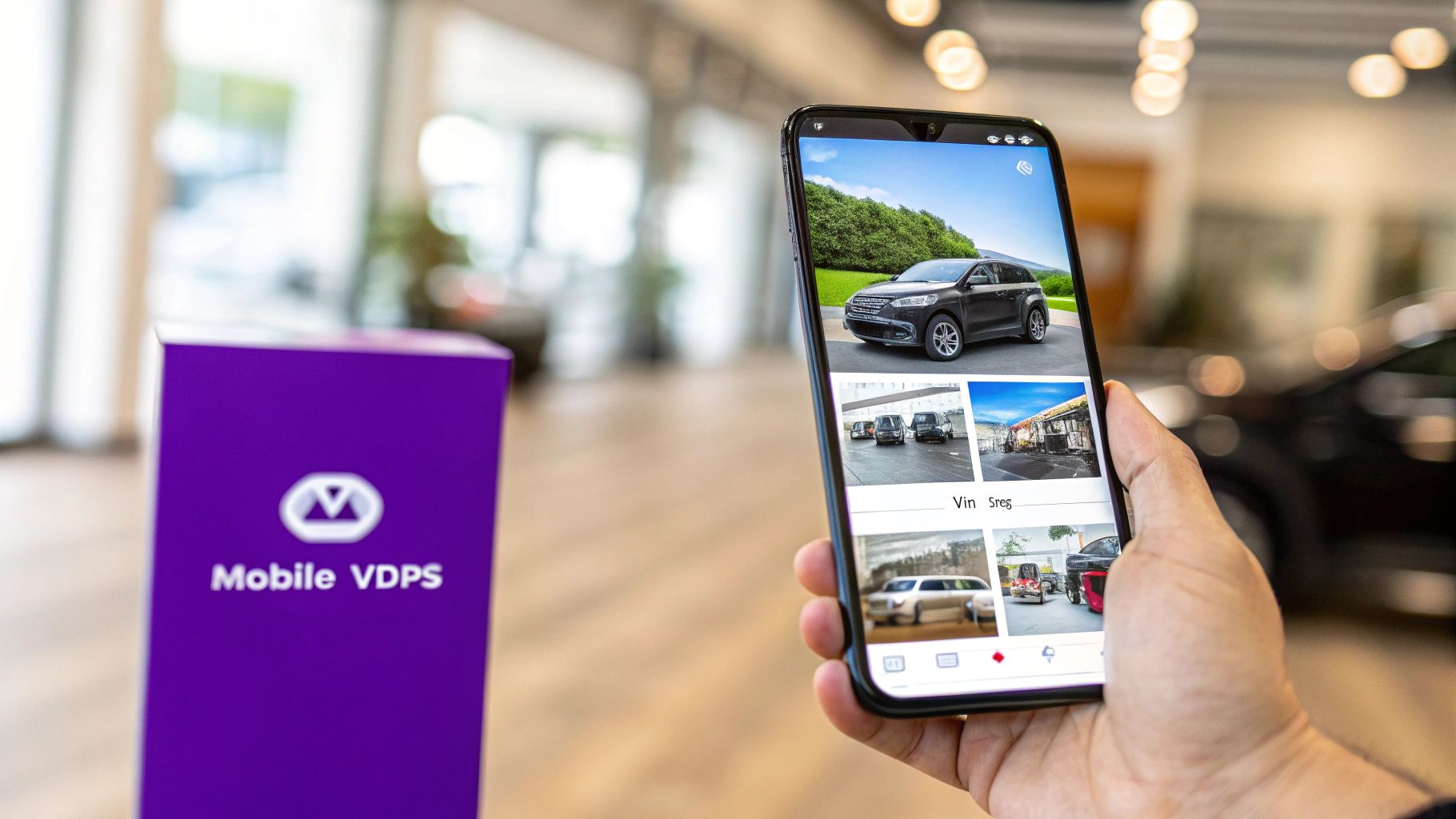
    A hand holds a smartphone displaying a car inventory app in a dealership, with a Mobile VDPS stand nearby.

    Create a Perfect Mobile Image Gallery

    On a smartphone, photos sell cars. Period. Shoppers expect to see it all—the dashboard, the tread on the tires, the engine, even minor imperfections—long before they think about setting foot on your lot. Your image gallery absolutely must be built for a thumb, not a mouse cursor.

    This means you need a swipeable gallery. Users should be able to effortlessly flick through high-resolution photos with a natural, fluid swipe. Get rid of those tiny, hard-to-tap navigation arrows or galleries that force people to pinch and zoom. Every image needs to load instantly and fill the screen, giving the customer an immersive, up-close look at their potential new vehicle.

    Write Scannable Vehicle Descriptions

    Let's be real: mobile users don’t read, they scan. Hitting them with a dense wall of text is the fastest way to lose their interest. Your vehicle descriptions have to be broken down into bite-sized, easy-to-digest chunks of information.

    Structure your descriptions to put the most important details front and center.

    • Use Bullet Points: This is your best friend for mobile. List key specs like mileage, engine type, transmission, and desirable features (e.g., leather seats, sunroof, navigation) in a clean, bulleted list. It's perfect for a quick scan.
    • Bold Key Terms: Make the good stuff pop. Bolding phrases like “One Owner,” “Accident-Free,” or “New Tires” grabs the eye and communicates value in a split second.
    • Keep Paragraphs Short: If you write a narrative intro, keep it to one or two punchy sentences. Tell a quick story about the car, but get right to the point.

    This simple approach makes your VDPs so much more effective. A customer can absorb all the critical info in seconds, helping them make a faster, more confident decision.

    Use a VIN Decoder for Instant Accuracy

    Manually typing in vehicle specs is not only a massive time-sink, but it's also a recipe for costly mistakes. One typo in the trim level or a forgotten feature can mislead a customer and instantly erode their trust. This is exactly why a VIN Decoder is a non-negotiable tool.

    Just by plugging in the Vehicle Identification Number, a VIN decoder automatically populates the VDP with accurate, factory-provided data. We’re talking everything from the exact model and engine specs to the original color and optional equipment. It guarantees consistency across your entire inventory and builds incredible trust with buyers who see you’re providing precise, reliable information.

    For an independent dealer, a good VIN decoder is a force multiplier. It saves countless hours of manual work, flat-out eliminates data entry errors, and helps you present your inventory with the kind of polish that rivals the big franchise stores. It's so crucial that AutoFire’s Pro plan includes this feature right out of the box.

    Get Your Cars on Google with Structured Data

    Having a great-looking VDP is only half the battle. Google has to actually understand what's on the page. That's where structured data, specifically Vehicle schema, comes in. Think of it as a special label you add to your site's code that tells search engines, "Hey, this page is about a specific car for sale, and here are all its vitals."

    This is absolutely essential for modern dealership SEO. Properly implemented Vehicle schema is what makes your inventory eligible for Google Vehicle Listings—that free, swipeable carousel of cars that shows up right at the top of search results. Showing up there puts your car directly in front of a customer at the exact moment they're looking for it.

    Your schema needs to include key details like:

    • Make and Model
    • Year
    • Price and currency
    • VIN
    • Mileage
    • Vehicle location

    Remember, ever since Google switched completely to mobile-first indexing in 2019, it judges and ranks your entire website based on its mobile version. If your VDPs aren't responsive or lack proper schema, you'll be penalized in search rankings and will miss out on those all-important listings. You can see more about the effects of mobile-first indexing in these website statistics. Platforms like AutoFire handle this automatically, making sure every car you add is perfectly coded for maximum visibility without you ever having to look at a line of code.

    Turning Mobile Searches into Foot Traffic on Your Lot

    A slick mobile site isn't just about looking good; it's about turning a local search into a customer walking onto your lot. For an independent dealer, the link between your mobile presence and local search performance is where the real money is made. When a potential buyer pulls out their phone and searches "used trucks near me," your dealership needs to be the first one they see.

    It's that simple.

    This all comes down to Google's mobile-first index. In a nutshell, Google now ranks your site based on its mobile version. If that experience is slow, clunky, or just plain frustrating on a phone, you're going to get buried in local search results. It makes you practically invisible to nearby customers ready to buy.

    The data here tells a story of huge opportunity—and a massive risk. We've seen that strong mobile traffic can bring in a significant increase in visitors. But the flip side is a 59.74% bounce rate on mobile. You have just a few seconds to make an impression before they're gone.

    Your Google Business Profile is Your Digital Storefront

    Think of your Google Business Profile (GBP) as the new front door to your dealership. It's often the very first interaction a mobile user has with your business. When they're on the move, they need your hours, phone number, and directions right now.

    Optimizing your GBP is non-negotiable for any serious local SEO plan.

    • Nail the Basics: Your business Name, Address, and Phone number (NAP) must be 100% consistent between your website and your GBP. Even a small difference like "St." vs. "Street" can confuse search engines and hurt your rankings.
    • Lean into Reviews: Positive reviews are pure gold. They're a massive trust signal for both customers and Google. Don't be shy about asking happy buyers to leave you a review on Google.
    • Show, Don't Just Tell: Keep a fresh stream of high-quality photos flowing. Snap pictures of your lot, your team, and your sharpest-looking inventory. Use Google Posts to feature new arrivals, weekend specials, or financing deals.

    The Critical Role of NAP Consistency

    That Name, Address, and Phone number (NAP) I just mentioned is your digital fingerprint. It absolutely must be identical everywhere it appears online, from your website's footer to directories like Yelp or your local Chamber of Commerce site.

    When search engines find conflicting information, it creates doubt. That doubt can weaken your business's authority and push you further down in the local search results. A clean, consistent NAP is the foundation of good local SEO because it constantly reinforces your dealership's physical location.

    Think of it this way: every time Google finds your correct NAP on a reputable site, it’s like getting a vote of confidence that you are a legitimate, local business located exactly where you say you are. This is especially important for customers relying on their phone’s map app to get directions to your lot.

    Create Content for Local Buyers

    Beyond your GBP, your website's content needs to speak directly to the questions local buyers are asking. This is your chance to go beyond just listing cars and become a local authority.

    For example, why not write a blog post about "The Best Used SUVs for Navigating Chicago Winters"? Or maybe "Finding a Reliable Commuter Car Under $10,000 in Phoenix." This kind of content doesn't just establish you as a helpful expert; it also captures the exact long-tail keywords that people are typing into their phones.

    For a much deeper look at this strategy, check out our complete guide on local SEO for car dealerships.

    Make Your Inventory Easy to Share

    Finally, let's talk social media. The vast majority of social media users are on their phones, and you need to make it incredibly easy for them to share your inventory.

    When someone sends a link to one of your cars on Facebook, you want it to look sharp and professional, not like a broken link. This is where OpenGraph tags come in. These little snippets of code tell social media platforms what image, title, and price to show when a URL is shared.

    A properly configured site will automatically pull the vehicle's best photo and key details, turning a simple share into a powerful mini-advertisement that drives more mobile shoppers right back to your website.

    A Few Common Questions About Mobile Optimization

    When dealerships start thinking seriously about their mobile site, a lot of the same questions tend to pop up. Let's tackle some of the most common ones I hear, so you can move forward with confidence.

    What’s the Real Difference Between “Mobile-Friendly” and “Mobile-First”?

    This one comes up all the time. A mobile-friendly site is basically your desktop website squeezed down to fit a smaller screen. It works, sort of, but it often leaves visitors pinching and zooming to read anything, which is a frustrating experience for most of your customers.

    A mobile-first website is the complete opposite. It’s designed from the very beginning for a smartphone, and only then is the design adapted for bigger screens like tablets and desktops. This approach naturally puts the focus on what mobile shoppers need most, leading to a much faster, cleaner, and more intuitive experience on the devices they're actually using to find you.

    The big idea with mobile-first is to design for the smallest screen first. This forces you to prioritize what a car shopper on the go really needs: your inventory, your phone number, and directions to your lot. Everything else is secondary.

    How Can I Check How My Current Site Performs on Mobile?

    You don't need to be a web developer to get a solid read on your site's mobile health. There are some excellent, free tools that will give you an instant report card.

    Your first stop should always be Google's own PageSpeed Insights. Just plug in your dealership's URL, and it spits out a detailed performance score for both mobile and desktop. More importantly, it tells you exactly what's slowing things down and gives you actionable tips. Make sure you look closely at the mobile report and the Core Web Vitals scores—this is precisely what Google sees when it evaluates your site.

    Should My Dealership Have Its Own Mobile App?

    Honestly, for almost every independent dealership, a dedicated mobile app is just not a good investment. It’s expensive to build and a major hassle for your customers. Let's be real: how many people are going to take the time to find, download, and install an app just to look at your cars?

    A well-built, high-performance mobile website that feels as quick and smooth as an app gives you all the benefits without any of the friction. It’s right there in their browser, no installation needed, and it's infinitely easier and cheaper for you to maintain.

    How Much Does Mobile Performance Really Affect My Google Vehicle Listings?

    It’s not just important for your ranking in Google Vehicle Listings; it is absolutely critical. A few years ago, Google switched to mobile-first indexing, which means they now rank your entire website based on how well the mobile version performs.

    If your vehicle detail pages (VDPs) are slow, a pain to navigate on a phone, or don't have the right structured data, Google simply won't show them to shoppers. This directly impacts your ability to appear in the free vehicle listings carousel—the one that sends highly motivated local buyers straight to your inventory. In today's market, a fast, mobile-first VDP isn't a "nice-to-have," it's a non-negotiable for getting seen.


    Ready to launch a dealership website that’s built from the ground up to convert mobile shoppers into showroom visitors? With AutoFire, you can get a fast, SEO-optimized, and mobile-first site running in minutes. See how easy it is to get started at goautofire.com.

  • Mastering Car Dealership Website Design to Boost Sales

    Mastering Car Dealership Website Design to Boost Sales

    Your website is your dealership's most powerful salesperson. It's the one that works 24/7, never calls in sick, and makes the first impression on almost every single one of your customers. The goal is to design a site that effortlessly turns those online lookers into real-life test drivers.

    It all comes down to a smart mix of intuitive design, blazing-fast mobile speed, and a vehicle showcase that builds trust before anyone even thinks about stepping onto your lot.

    Your Website Is Your Most Important Showroom

    Think about what happens when a customer walks onto your physical lot. You want the entrance to be immaculate, the cars gleaming, and the whole place easy to get around. A salesperson is right there, ready to help, not hiding in some back office.

    That's exactly what your website should be. For the vast majority of car buyers today, the journey begins with a Google search, and your site is that crucial first handshake.

    This digital showroom never closes. It’s making an impression at 10 PM on a Tuesday just as much as it is on a Saturday afternoon. A slow, cluttered, or confusing website is the digital version of a dirty lot with cars parked haphazardly—it screams unprofessionalism and sends potential buyers straight to your competition.

    Building Trust Before the Test Drive

    A well-designed dealership website does more than just display your inventory; it builds genuine credibility. The aim is to create an online experience that mirrors the confidence and trust you want customers to feel when they're talking to you in person.

    You get there with a few key, non-negotiable elements:

    • Effortless Navigation: Shoppers need to find what they're looking for, fast. If they can't filter for "used SUVs under $25,000" in a couple of clicks, they're gone.
    • Transparent Information: Pricing, vehicle history, and contact info should be crystal clear. Hiding details or making them hard to find just breeds suspicion.
    • Professional Visuals: High-quality photos and videos are essential. Grainy, poorly-lit images make it seem like you have something to hide.

    Your website isn't just a gallery of cars. It's an environment carefully engineered to answer questions, eliminate doubts, and guide a visitor confidently toward taking that next step—be it a test drive, a finance application, or a phone call.

    Every single piece of your site, from how fast it loads on a phone to how simple your contact forms are, plays a critical role. A high-performance website isn't just a nice-to-have; it's the engine that drives qualified buyers to your door, setting the stage for every sale that follows.

    7. The Blueprint for a High-Converting Website

    Think of your website as your best salesperson—the one who works 24/7. A great site doesn't just display cars; it guides every visitor from the moment they land on your homepage toward the perfect vehicle for them. This all starts with a clean user interface (UI) and dead-simple navigation.

    Your navigation menu is like the signage in your physical showroom. It needs to be crystal clear, pointing people to "Used Cars," "Financing," and "Contact Us" without a second thought. When people can find what they want effortlessly, they stick around, look at more of your inventory, and are way more likely to become a lead. A cluttered, confusing site just creates friction, sending potential buyers clicking away in frustration.

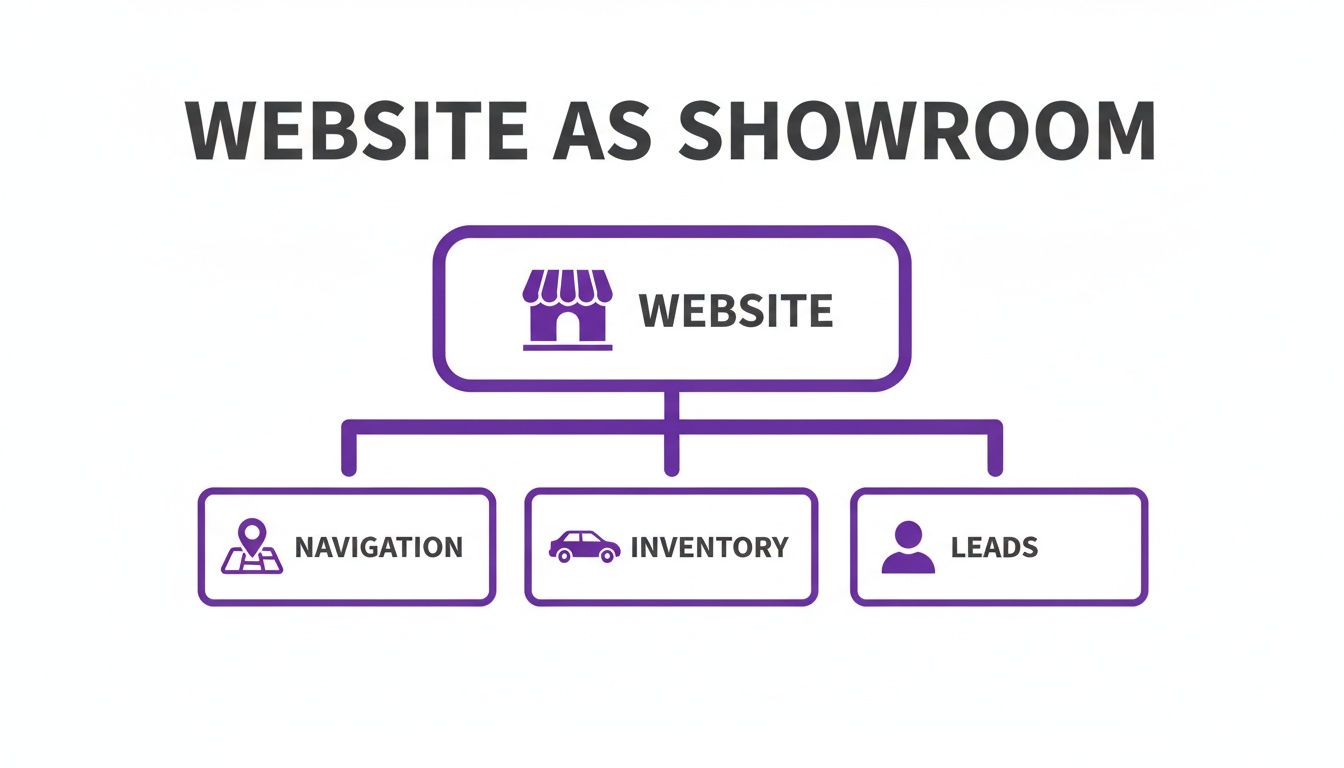
    This diagram breaks down how the key pieces of your digital showroom—navigation, inventory, and lead capture—all fit together to create a smooth path for your customers.

    Diagram illustrating a website as a digital showroom, detailing navigation, inventory, and lead generation.

    As you can see, a solid, user-friendly navigation system is the foundation that holds up everything else, from powerful inventory tools to effective lead funnels.

    To really nail this, let's look at the essential features every modern dealership site needs. Think of this as your pre-flight checklist before you build or redesign your website.

    Essential Features of a Modern Dealership Website

    Feature Category Must-Have Element Why It Matters
    User Experience (UX) Clean, intuitive navigation and mobile-first design Makes it easy for visitors to find what they need on any device, reducing bounce rates.
    Inventory Management Powerful search with multiple filters (make, model, price, etc.) Connects buyers with the right car quickly, turning browsing into a serious shopping experience.
    Vehicle Pages (VDPs) High-res photos/videos, 360° views, and detailed specs Builds trust and confidence in the vehicle, mimicking an in-person inspection.
    Lead Generation Clear Calls-to-Action (CTAs) and simple contact forms Guides the visitor to take the next step, like scheduling a test drive or asking a question.
    Trust Building Customer testimonials, vehicle history reports, and transparent pricing Overcomes buyer skepticism and establishes your dealership as a credible, honest business.

    Getting these core elements right isn't just about having a pretty website; it's about building a machine that consistently turns website traffic into real-world customers.

    The Heart of the Website: Powerful Inventory Search

    Let's be honest: the main reason people come to your site is to look at cars. Your vehicle search tool is the absolute centerpiece. Shoppers show up with a mission, and your job is to help them find their target as fast as possible. A powerful search function isn't a perk; it's the engine that drives your entire online operation.

    At a minimum, your search filters must include:

    • Make and Model: The absolute basics. Non-negotiable.
    • Price Range: Lets shoppers instantly filter for cars they can actually afford.
    • Body Style: Crucial for helping someone find that SUV, sedan, or truck they have in mind.
    • Mileage: A top consideration for any used car buyer trying to gauge a vehicle's remaining life.
    • Features: Allows shoppers to zero in on their "must-haves," like leather seats, a sunroof, or a specific tech package.

    The easier you make it for someone to find a "blue used SUV under $20,000 with less than 50,000 miles," the closer you are to making a sale. This is where a great user experience directly impacts your bottom line.

    Anatomy of the Perfect Vehicle Detail Page (VDP)

    When a shopper clicks on a car, they land on the Vehicle Detail Page (VDP). This is your make-or-break moment. It’s your digital sales pitch for that one specific vehicle, and it has to be perfect. A VDP that converts is designed to build trust and push the visitor to take action.

    Every single element on your VDP should do one of two things: build the customer's confidence in the car, or make it ridiculously easy for them to take the next step. This is the most important conversion point on your entire website.

    To get it right, your VDP needs a few key ingredients:

    • High-Resolution Photo Gallery: I'm talking at least 20-30 crystal-clear photos. Show every angle—inside, outside, even the dings and scratches. Lousy, blurry photos are the quickest way to kill a buyer's trust.

    • 360-Degree Views: An interactive view of the interior and exterior lets people "sit" in the car from their couch. It's an immersive experience that gets them excited and builds serious confidence.

    • Transparent Pricing: Put the price front and center. No hiding it. Include a simple breakdown of any fees and add a payment calculator so shoppers can see what their monthly payment might look like.

    • Detailed Vehicle Information: List all the important specs, features, and the VIN. Embedding a vehicle history report right on the page is a massive trust signal.

    • Clear Calls-to-Action (CTAs): Your VDP needs big, obvious buttons like "Schedule Test Drive," "Check Availability," or "Get Pre-Approved." These CTAs are what turn a casual browser into a hot lead.

    On top of a great layout, adding chat widgets for websites can be a game-changer. It lets you have a real-time conversation with a shopper while they’re looking at a car, answering their questions on the spot before they get distracted and leave. By mastering these core pieces, you transform your website from a simple online brochure into a powerful machine that generates high-quality leads around the clock.

    Winning with Mobile-First Design and Page Speed

    Picture this: a customer walks onto your lot, eager to see a specific car. Would you show it to them in a dark, cramped garage where they can't even open the doors? Of course not. You'd bring them into a brightly lit showroom where the car shines.

    Your website's mobile experience is that digital showroom. For the vast majority of your customers, it's the first impression they'll ever have of your dealership.

    Today's car shoppers live on their phones. A clunky website that’s slow to load is the digital equivalent of that dark, messy garage—it’s an instant turn-off that sends potential buyers running to your competitor's site. That's why a mobile-first design isn't just a nice-to-have; it's a core business strategy. It means you build the website experience for the smallest screen first, then scale it up for desktops.

    A hand holds a smartphone displaying 'MOBILE FIRST' with a car icon, blurred car dealership in background.

    This isn't just about making things look good. Google now primarily uses the mobile version of your site to determine its search rankings. A bad mobile site doesn't just frustrate users; it makes you invisible to local buyers searching for their next vehicle.

    Why Speed Is Your Ultimate Conversion Tool

    Beyond just looking good, your site needs to be fast. Lightning fast. Every single second a customer waits for a page to load is another reason for them to give up and leave. Modern buyers expect things to be instant, and their patience is incredibly thin.

    This has a very real impact on your sales. According to industry data, over half of all traffic to dealership websites comes from a mobile device. Bounce rates can skyrocket on slow mobile sites because shoppers simply refuse to wait for vehicle photos and payment calculators to load. For an independent dealer, that's a massive chunk of potential business vanishing before they've even seen a single car.

    Page speed isn't some technical jargon for your IT guy. It’s a direct measure of how much you respect your customer's time. A fast website builds trust instantly, while a slow one shatters it.

    Think about it: a fast, snappy site keeps people browsing your inventory. They look at more cars, they engage with your content, and they are far more likely to fill out a credit application or give you a call. Speed is one of the most powerful conversion tools you have.

    Practical Steps for a Faster Mobile Site

    You don't need a team of Silicon Valley engineers to make your site faster. It really comes down to a few key things that make the biggest difference. A great car dealership website design is all about being efficient without cutting corners on quality.

    Here are a few actionable tips to get you started:

    • Optimize Your Images: Great photos sell cars, but massive, uncompressed image files are the #1 killer of website speed. You need to shrink those file sizes down without sacrificing quality. We have a whole guide on how to optimize images for the web that walks you through the process.
    • Minimize Complex Scripts: All those third-party widgets for chat, analytics, or ads can really bog down your site. Take a hard look at what you’re running and cut anything that isn't absolutely essential. Every script is another thing a customer’s phone has to download.
    • Keep the Design Clean and Focused: A cluttered design with flashy animations and constant pop-ups might look cool, but it often slows performance to a crawl. The best designs are clean, simple, and guide the user straight to what they’re looking for: your cars.

    By adopting a mobile-first mindset and obsessing over page speed, you ensure your digital showroom is always open, welcoming, and ready to turn browsers into buyers.

    Driving Traffic with Automotive SEO

    So you've built a brilliant website. That's a huge step, but how do you make sure local car shoppers find it before they find your competition? The answer lies in a smart, targeted approach to automotive search engine optimization (SEO).

    Think of SEO as the digital equivalent of a sign-spinner on the busiest intersection of the internet. Its job is to grab the attention of high-intent shoppers and point them directly to your online showroom. A great dealership website has SEO baked in from the very beginning—it’s not just an add-on, it’s the engine that powers your online visibility.

    Without a solid SEO strategy, even the most stunning website will sit empty, like a dealership built on a dead-end road with no signs. For car dealers, this goes way beyond generic advice. It's about fine-tuning every single part of your site to answer the exact questions local buyers are typing into Google, whether it's "used Honda CR-V near me" or "best family SUVs under $30,000."

    Optimizing Your Vehicle Detail Pages

    Your Vehicle Detail Pages (VDPs) are absolute goldmines for SEO. Each VDP is a unique chance to rank for those super-specific, long-tail keywords that signal a customer is ready to buy. Simply using the generic, manufacturer-supplied descriptions just won't cut it anymore.

    To really stand out, every VDP needs a unique, hand-written description. Don't just list features—tell a story. Mentioning the "spacious cargo area perfect for weekend camping trips" or the "advanced safety features ideal for a growing family" does two things: it connects with buyers on an emotional level and helps you rank for more natural, conversational search terms.

    Another critical piece of the puzzle is structured data, also known as schema markup. This is basically a snippet of code that acts as a translator, telling Google exactly what your page is about. It clarifies that this is a specific vehicle for sale, along with its price, mileage, and location. This is the secret sauce for getting your inventory featured in Google's special vehicle listings, putting your cars front and center for motivated shoppers.

    Mastering Local SEO for Your Dealership

    For any dealership, winning the local search battle is everything. Your most valuable customers are the ones right in your own backyard. Local SEO is what ensures that when someone in your town searches for a car, your dealership is the first one they see.

    Here's how to start dominating your local market:

    • Google Business Profile (GBP): Think of your GBP as your digital storefront on Google Search and Maps. It needs to be perfect. Keep it meticulously updated with your correct address, hours, phone number, and a link to your website.
    • Generate Positive Reviews: Reviews are incredibly powerful social proof. Make it a habit to actively encourage happy customers to leave reviews on Google. It's also vital to respond to all feedback—both positive and negative—to show you're an engaged and trustworthy business.
    • Build Local Citations: Make sure your dealership's name, address, and phone number (what we call "NAP") are perfectly consistent across all online directories, like Yelp, and other local business listings.

    Your local SEO strategy is what connects your digital presence to your physical lot. It builds a foundation of trust and authority within your community, making your dealership the obvious choice for nearby buyers.

    Attracting Buyers with Helpful Content

    Beyond just optimizing your inventory pages, you can draw in buyers much earlier in their journey by creating genuinely helpful content. Think about the common questions you get from customers every single day, and turn the answers into blog posts or guides.

    Creating content like "Comparing the Top SUVs for Families" or "What to Look for When Buying a Used Truck" establishes your dealership as a trusted local expert. This strategy pulls in shoppers who are still in the research phase, letting you build a relationship long before they're ready for a test drive. When you provide real value upfront, your dealership will be the first one they think of when it's time to buy.

    For a deeper dive into these strategies, check out our comprehensive guide on SEO for automobile dealerships.

    Finally, don't overlook site speed—it's a critical, non-negotiable part of modern SEO. Site speed is the silent killer, or savior, of car dealership websites, especially as Google leans even more heavily on Core Web Vitals for its rankings. Industry leaders have shown that every second of delay can slash conversions by a staggering 7%. A slow site causes bounce rates to spike and trust to evaporate before a shopper even gets a chance to see your inventory. For independent dealers, where every single lead is precious, this metric is pure revenue gold.

    As search evolves, staying ahead of the curve is key. Understanding the principles of A Guide to AI Search Engine Optimization (AEO) is quickly becoming essential for driving traffic effectively.

    Designing Your Website to Generate Leads

    Getting traffic to your site is just the first step. The real goal? Turning those anonymous clicks into qualified leads that actually grow your dealership. A great website doesn't just look good; it's a finely-tuned machine designed to guide visitors from casual browsing to taking that next step with you.

    Think of your website not as a digital brochure, but as your best salesperson, working 24/7. It's all about building rock-solid trust and making it incredibly easy for a shopper to move forward—whether that’s scheduling a test drive, getting a trade-in value, or starting a finance application. Every button, image, and line of text has to work together to gently nudge them in the right direction.

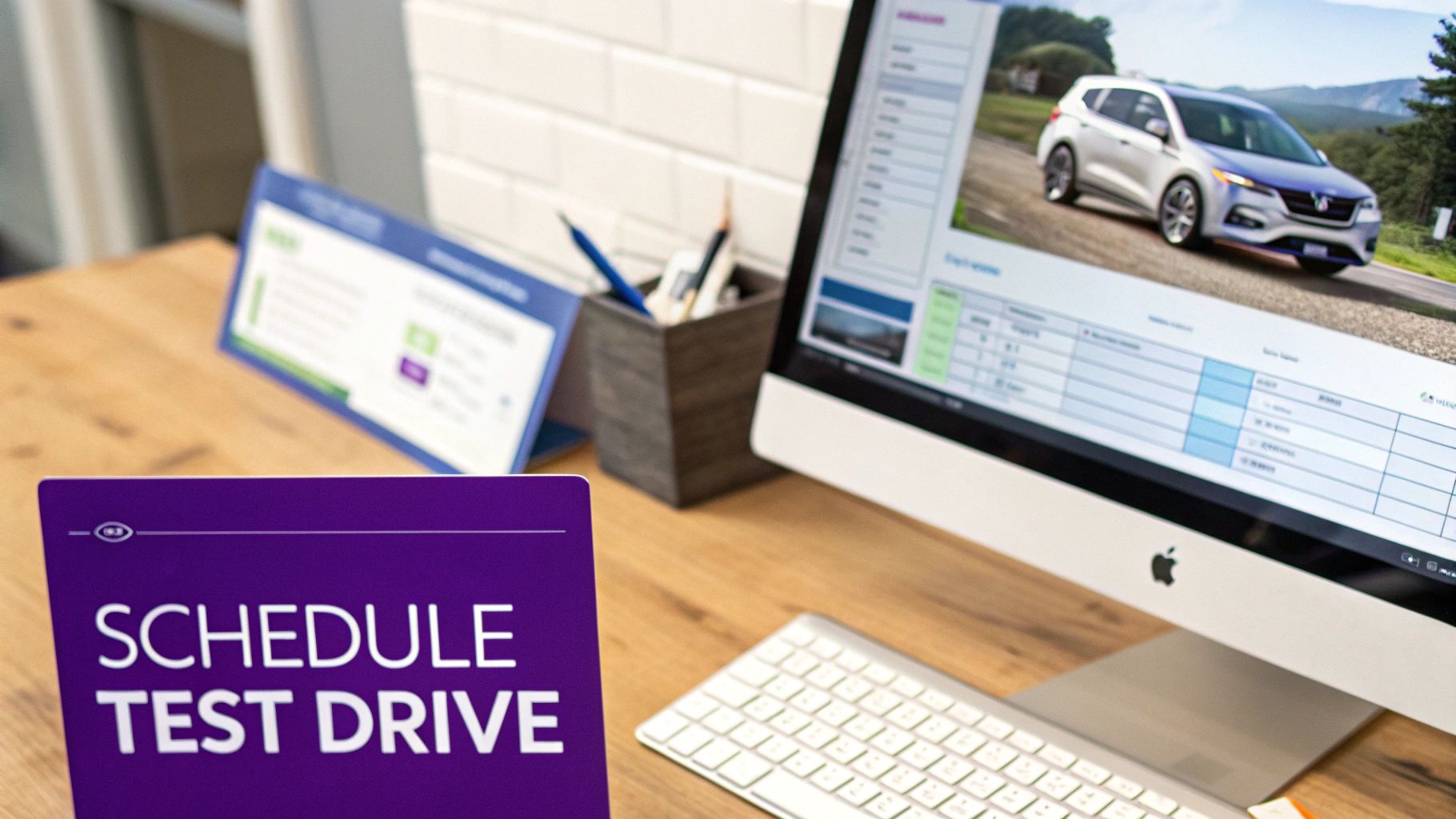
    Modern car dealership office with a computer displaying a car and a 'Schedule Test Drive' sign.

    This all comes down to placing clear, compelling calls-to-action (CTAs) where people expect to see them and making your lead forms so simple they’re a breeze to fill out.

    Optimizing Your Lead Capture Forms

    Your lead forms are the handshake that seals the deal online. A clunky, confusing form is like shoving a mountain of paperwork at a customer the second they walk onto the lot—it’s an instant turn-off. The secret is to keep each form short, intuitive, and focused on one specific job.

    • Contact Forms: Keep it simple. All you really need is a name, email or phone, and a message box. Anything more is just a reason for them to click away.
    • Test Drive Forms: Add fields for the specific vehicle and a preferred date and time. This gives your team actionable information to follow up on immediately.
    • Trade-in Estimators: These are absolute gold for lead generation. Ask for the vehicle basics (VIN, make, model, mileage) and their contact info so you can send them the estimate.
    • Credit Applications: This one is naturally longer, so break it into smaller, manageable chunks. Guiding them through step-by-step makes the process feel far less intimidating and dramatically reduces the chance they’ll give up halfway through.

    No matter the form, make sure it works flawlessly on a phone, loads in a snap, and gives a clear "Thank You" message after submission. Every bit of friction you remove is a direct boost to your conversion rate.

    Building Unbreakable Trust with Shoppers

    Before anyone hands over their personal information, they have to trust you. Trust is the currency of the car business, online and off. Your website needs to scream "credible, professional, and customer-first" from every corner.

    People buy from people they trust. Your website's job is to build that trust with every pixel, photo, and paragraph, making shoppers feel confident and secure long before they step onto your lot.

    A few key elements are non-negotiable for building this trust:

    • Showcase Customer Testimonials: Real reviews from happy customers are powerful social proof. Put them right on your homepage and even sprinkle them into your vehicle detail pages.
    • Feature Your Team: An "About Us" page with friendly photos and short bios of your staff puts a human face to your dealership. It reminds people they’re dealing with real folks, not a faceless company.
    • Provide Clear Contact Information: Your phone number, address, and business hours should be impossible to miss on every single page. If a customer has to hunt for it, they’ll assume you’re hiding something.

    Beyond the basics, AI-powered personalization is really changing the game, with dealers seeing significant conversion lifts when they get it right. Imagine a shopper looks at your SUVs on Tuesday. When they come back on Thursday, your homepage greets them with specific offers on those exact models, complete with payment calculators already running. This isn't futuristic stuff anymore. AI tools analyze behavior to serve up dynamic, relevant content that makes the customer feel understood, shortening the sales cycle. For a deeper dive into this technology, it's worth exploring the emerging website cost trends for 2026.

    Choosing the Right Path for Your Website

    So, you’ve got a solid blueprint for what makes a great dealership website. Now comes the big question: how do you actually build it? Figuring out the best way to get your site online can feel like a huge task, but it really boils down to three things: your budget, your time, and your long-term vision.

    For most independent dealers, there are three main roads you can take. Each one has its own set of pros and cons. Nailing this decision upfront saves you from a world of expensive headaches down the line and makes sure your online showroom is built to last. Let's walk through these options so you can see which one makes the most sense for your dealership.

    Comparing Your Website Options

    The route you pick will shape everything from your launch day costs to how much time you spend tinkering with the site each week. A do-it-yourself builder gives you a ton of creative freedom, but it also demands a ton of your time. At the other end, a custom agency can build your dream site, but it comes with a serious price tag. Specialized platforms are designed to hit that sweet spot in the middle.

    Getting a handle on these trade-offs is the key to making a smart call that helps you grow without turning you into a full-time IT guy.

    The best website solution is one that lets you focus on selling cars, not on becoming a part-time web developer. Your goal is to find a tool that handles the technical complexities so you can manage your inventory and leads with ease.

    To make this crystal clear, here’s a simple table breaking down the three paths you can take.

    Dealership Website Options Compared

    This comparison lays out the most common ways for an independent dealer to get a website, helping you choose the best path for your business.

    Option Best For Initial Cost Maintenance Effort Key Advantage
    DIY Website Builders Tech-savvy dealers on a tight budget who have ample time. Low High Total creative control and minimal upfront expense.
    Custom Agency Large, established dealerships with a significant budget. Very High Low A completely bespoke design tailored to exact specifications.
    Automotive Platforms Independent dealers who need a professional site quickly. Low/Moderate Very Low Built-in automotive features like VIN decoding and inventory feeds.

    After looking at the options, it's clear that each path serves a different type of dealership. The right choice depends entirely on your specific resources and priorities.

    Finding the Smartest Path Forward

    For the vast majority of independent dealers, a specialized automotive platform just makes the most sense. It’s the Goldilocks solution—not too expensive, not too time-consuming, but just right. These platforms are built from the ground up with one purpose: to help you sell cars online.

    Unlike a generic DIY builder where you have to bolt on features with clunky plugins, these services come with all the essentials baked right in. Think VIN decoding, inventory feeds, and lead capture forms designed specifically for car buyers. For a deeper dive into how these tools are structured, check out our guide on the benefits of a dedicated car dealership website builder.

    This all-in-one approach is a game-changer, especially for small teams. The platform provider handles all the technical heavy lifting—security updates, hosting, mobile-friendliness—freeing you up to do what you actually do best.

    At the end of the day, your decision has to match your reality. A custom-built site from an agency is a luxury that few can afford, both in time and money. A DIY site might look cheap on paper, but the hours you’ll pour into fixing, updating, and troubleshooting are a hidden cost that adds up fast. A platform built for dealers gives you a high-performance, professional website without the crippling price tag or the constant technical headaches.

    Frequently Asked Questions

    Building a new website for your dealership can feel like a big project, and it's natural to have questions. Let's tackle some of the most common ones we hear from independent dealers.

    How Much Does a Good Car Dealership Website Cost?

    The price tag can swing wildly depending on how you approach it. If you hire a marketing agency for a fully custom build, you can expect to pay anywhere from $10,000 to over $25,000. For most independent lots, that’s a hefty upfront investment.

    Thankfully, there's a much more budget-friendly route. Modern automotive SaaS platforms give you a professional, high-performance website for a simple monthly subscription, often under $100. This model gets rid of the intimidating upfront cost and makes top-tier web design accessible to any dealer.

    What Is the Most Important Feature on a Dealer Website?

    Hands down, the single most critical feature is your inventory search. It has to be fast, and it has to work flawlessly on a phone. The vast majority of people landing on your site are there for one reason: to see your cars.

    If a potential buyer can't quickly filter your vehicles, see great photos, and pull up specs on their smartphone in seconds, they're gone. They’ll just bounce over to your competitor's site. How you present your inventory can make or break your online success.

    Think of your inventory pages as the final handshake before a test drive. If the experience is slow, confusing, or untrustworthy, you lose the deal before it even begins. A seamless inventory experience is non-negotiable.

    Ultimately, everything comes back to the cars. Effective website design is all about closing the gap between a curious browser and an interested buyer.

    How Long Does It Take to Launch a New Website?

    The timeline really depends on the path you take. A custom agency project is a long haul—you're typically looking at three to six months from the first meeting to the day you go live.

    For a dealer who needs to get up and running now, that kind of wait just isn't practical. This is where specialized platforms shine. You can sign up, add your cars, and connect your domain to get a professional, fully functional website live in just a few hours. That speed means you can start bringing in leads almost immediately.

    Do I Need Technical Skills to Manage My Website?

    Not at all. The best platforms today are built for business owners, not developers. You shouldn't have to know a single line of code to run your online showroom.

    You should be able to manage everything from a simple dashboard—adding new cars, updating prices, or changing your business hours. All the complicated stuff like security, software updates, and server maintenance is handled for you, leaving you free to do what you do best: sell cars.


    Ready to launch a professional, high-performance website that captures leads without the technical headaches? With AutoFire™, you can get a stunning, mobile-first dealership site live in minutes. Our platform is built specifically for independent dealers, handling all the complex SEO, inventory management, and design work so you can focus on selling cars.

    Get started for free with AutoFire today!

  • Leads for auto dealers: Drive More Sales with Proven Lead Strategies

    Leads for auto dealers: Drive More Sales with Proven Lead Strategies

    Think of your website as your dealership's digital showroom. It’s the very first impression most customers will have, and it needs to work just as hard as your best salesperson, 24/7. This isn't just about having an online presence; it's about building a powerful tool designed to turn casual online browsers into serious, ready-to-buy leads before they even think about stepping onto the lot.

    Build Your Digital Showroom to Capture More Leads

    Hands hold a smartphone displaying 'Digital Showroom' with a white car in a car dealership.

    Let's be honest, a lot of independent dealer sites look and feel like they were built a decade ago. They're more like static brochures than active sales funnels. But today's car buyers are different. Their journey starts on a smartphone, where they research, compare, and even get pre-approved for financing.

    If your digital showroom is slow, clunky, or just plain confusing, you're not just creating a bad experience—you're actively sending customers to your competitors. You're losing countless opportunities simply because your online front door is locked.

    Prioritize Mobile-First Design and Speed

    We've been talking about mobile for years, but it's more critical now than ever. The vast majority of your traffic is coming from a smartphone. Your site has to look and work flawlessly on that small screen. No exceptions.

    But looks aren't everything. Speed is the real killer. According to Google, the chance of a visitor bouncing from your mobile site jumps by 32% if your page takes three seconds to load instead of one. A slow website doesn't just frustrate people; it pushes them away.

    Key Takeaway: A fast, mobile-friendly website isn't a "nice-to-have" feature; it's the absolute foundation of online lead generation. Every second a customer waits for your inventory to load is a second they could be on another dealer's site.

    To put it into perspective, here's a breakdown of what truly matters when building your digital showroom.

    Key Features of a High-Converting Dealer Website

    This table outlines the core components your website needs to effectively turn visitors into qualified leads.

    Essential Feature Impact on Lead Generation Example Implementation
    Mobile-First Design Ensures a seamless experience for the majority of users on phones. Your site's layout automatically adapts to any screen size, with large, tappable buttons and readable text.
    Fast Load Times Reduces bounce rates and keeps impatient buyers engaged. Images are optimized for the web, and the site is built on a modern framework that loads in under 3 seconds.
    Intuitive Navigation Helps users find specific inventory or information (financing, trade-in) quickly. A clean menu with clear labels like "Used Cars," "Financing," and "Contact Us" is always visible.
    High-Quality VDPs Turns a vehicle listing into a compelling sales pitch, building trust and desire. Each vehicle has 20+ high-res photos, a walk-around video, and a detailed description of features.
    Prominent CTAs Guides the user to take the next step, like scheduling a test drive or getting pre-approved. Brightly colored buttons like "Check Availability" and "Value Your Trade" are placed above the fold.
    Trust Signals Builds credibility and reduces buyer hesitation. Displaying customer testimonials, Google reviews, and logos of financing partners directly on the VDP.

    Each of these elements works together to create an experience that doesn't just show cars—it sells them by building confidence and making it easy for customers to take the next step.

    Turn Your Inventory into Lead Magnets

    Every single Vehicle Listing Page (VLP) is a potential front door to your dealership. These pages can't just be a list of specs and a price. They need to be engineered to grab a buyer's attention and prompt them to act.

    This means you absolutely must have:

    • Great Photos and Videos: Get every angle, inside and out. A simple walk-around video shot with your phone can make a world of difference in giving a buyer the confidence to reach out.
    • All the Details: Be thorough. List out all the specs, features, and options. Include the vehicle history report right there on the page. Write a compelling description that tells a story.
    • Clear Calls-to-Action (CTAs): Don't make people hunt for what to do next. Buttons like "Schedule Test Drive," "Check Availability," or "Get Pre-Approved" should be impossible to miss.
    • Trust Signals: Show off your great customer reviews, any awards you've won, or logos of your trusted financing partners. These small details build huge credibility.

    The goal is simple: answer every possible question a buyer has before they even have to ask. When you provide that level of transparency, you build the trust that turns a website visitor into a real lead. If you want to see how this all comes together, it's worth exploring what a modern car dealership website builder can do to automate the creation of these high-converting pages.

    Dominate Local Search and Google Vehicle Listings

    A laptop on a wooden table displaying a local business map and a "Local Visibility" banner.

    A top-tier website is your digital foundation, but it won't bring in a single lead if local buyers can't find it. For independent dealers, winning the neighborhood search battle is everything. Think about it: when someone in your town pulls out their phone and types "used Honda Civic near me," your dealership absolutely has to be there.

    This is where local search optimization becomes your secret weapon for attracting buyers who are ready to pull the trigger. It’s not about some complex technical wizardry; it's about making your dealership the most visible, trusted, and helpful choice in your area. The goal is simple: show up when people are actively looking for exactly what you sell.

    Your Google Business Profile Is Your Digital Storefront

    Your Google Business Profile (GBP) is way more than just a pin on a map. Treat it like a dynamic, interactive storefront—it’s often the very first impression a customer gets. Neglecting it is like locking the doors to your physical showroom during business hours.

    Getting your GBP in shape is straightforward but critical. It's not enough to just list your address and phone number. To really stand out from the competition down the street, you need to treat it like a primary marketing channel.

    • Fill Out Everything: Go through every single field and provide accurate, detailed information. We're talking hours, service areas, and a solid business description that shows off what makes your dealership special.
    • Keep Photos Fresh: Regularly upload high-quality pictures of your best inventory, your clean lot, your friendly staff, and the outside of your building. Fresh photos tell Google and your customers that you're active and professional.
    • Post Weekly Updates: Use Google Posts to announce new arrivals, share special offers, or highlight a recent happy customer. These act like free mini-ads right on your profile, keeping it engaging.
    • Turn on Messaging: Let customers send you a direct message from your profile. Responding quickly is a killer way to capture leads for auto dealers who’d rather text than call.

    A fully optimized Google Business Profile is the single most effective way to improve your local search visibility. It directly influences your ranking in the local map pack, which is prime real estate for capturing the attention of nearby buyers.

    All this consistent activity sends powerful signals to Google that your dealership is a relevant, active business, which can give you a serious boost in local search results.

    The Power of Reviews and Local Signals

    Positive reviews are the lifeblood of any local business. They build massive trust with both potential buyers and search engines. A steady stream of four- and five-star reviews tells the world that you're a dealer people can count on.

    Don't just wait for reviews to happen. Make asking for them a core part of your sales process. A day or two after a sale, send a simple text or email to your happy customer asking them to share their experience. The easier you make it, the more likely they are to do it.

    Beyond reviews, consistent "citations" also help. These are just mentions of your dealership's Name, Address, and Phone number (NAP) across other online directories like Yelp, Yellow Pages, and auto-specific sites. The key here is consistency—make sure your info is identical everywhere it appears.

    Put Your Inventory Directly on Google with Vehicle Listings

    This is a big one. Perhaps the most impactful tool for local dealers today is Google Vehicle Listings (GVL). This free feature puts your actual, sellable inventory right on the search results page when a shopper is looking for a specific vehicle. It's like parking your best cars right on the digital main street.

    Instead of just showing a link to your website, GVL shows a picture of the car, its price, mileage, and your dealership's name. This is an absolute game-changer because it removes a step for the buyer, putting your inventory front and center at the exact moment they’re most interested.

    The secret is ensuring your website inventory syncs perfectly with Google. A modern platform like AutoFire™ handles this integration automatically, so you don't have to worry about the technical side. As you add a car to your site, it gets pushed directly to Google, making it discoverable to thousands of local shoppers. To really see what's possible, check out our guide on how the Google Vehicle Listings 2025 playbook can put your dealership in the spotlight.

    Drive High-Intent Traffic to Your Inventory

    Okay, your digital showroom is looking sharp and your local search presence is dialed in. Now it's time to open the floodgates and get some serious eyeballs on your inventory. But we're not talking about just any traffic. We need to attract motivated buyers who are actively hunting for their next vehicle, not just kicking digital tires. This is all about smart, strategic promotion—not just casting a wide, expensive net and hoping for the best.

    Forget the old-school thinking that generating traffic requires a bottomless budget. The tools we have today let independent dealers be surgically precise, reaching the right people at the exact moment they’re ready to talk. This means running a smart mix of long-term organic strategies and quick-win paid campaigns.

    The Two Pillars of Traffic Generation

    Getting visitors to your vehicle detail pages really boils down to two core approaches: paid advertising and organic growth.

    Paid ads, like the ones you see on Google or Facebook, deliver results fast. You can literally launch a campaign in the morning and have potential buyers on your VDPs by the afternoon. It's an incredibly powerful way to generate a quick surge of leads for auto dealers.

    Organic growth, on the other hand, is the long game. This is mostly about good old-fashioned search engine optimization (SEO)—consistently improving your site so it ranks naturally in search results. While it takes more time and effort, organic traffic is gold because it’s built on trust and authority. It delivers a steady, reliable stream of visitors without you having to pay for every single click.

    Pro Tip: The best strategies don't choose one over the other; they blend them. Use paid ads to get in front of hot, in-market buyers right now, while your SEO work builds a sustainable foundation that will bring you leads for years to come.

    Launching Targeted Paid Ad Campaigns

    Paid advertising is all about precision. Think about it: instead of a billboard that everyone and their grandma sees, you can show a digital ad for a specific Ford F-150 only to people within a 15-mile radius who have recently searched for "used trucks for sale." That level of targeting is what makes paid ads a game-changer for dealerships.

    Here are a few high-impact campaign ideas you can run with:

    • Google Search Ads: Go after keywords that scream purchase intent. I'm talking about things like "used Toyota Camry under $15,000" or "dealerships with bad credit financing near me." These people know what they want.
    • Facebook & Instagram Ads: Use Facebook's incredible audience tools to your advantage. You can target users based on life events (like "newly married"), interests (like "off-roading"), or even behavior, like someone who recently visited a competitor's website.
    • Retargeting Campaigns: This one is a must. Show ads to people who have already browsed your site but didn't fill out a form. A simple, timely ad reminding them of the exact vehicle they looked at can be wildly effective at pulling them back in to seal the deal.

    Focusing on Qualified High-Intent Leads

    At the end of the day, the goal isn't just traffic—it's qualified leads. These are the people who are much closer to making a purchase, and they're the goldmine for any dealership. Focusing your energy here means faster sales cycles and a much healthier return on your investment.

    In fact, dealerships that effectively use their own first-party data—from website forms, test drives, and CRM history—consistently see the highest marketing ROI. They always outperform shops that just rely on broad, generic third-party data.

    This is where your website, ads, and follow-up process all need to work together seamlessly. Every dollar you spend should be aimed at attracting and converting these high-intent shoppers. To really dive deep into this, check out our complete guide on dealership digital marketing. It’s all about working smarter, not just spending more, to fill your pipeline with buyers who are ready to act.

    Convert Website Visitors into Actionable Leads

    Getting traffic to your website is only half the job. A site full of visitors who never reach out is like having a packed open house where no one makes an offer. The real skill is turning those clicks into handshakes and transforming anonymous browsers into real, actionable leads for auto dealers. This is where the practical science of conversion kicks in.

    It all starts with getting inside a buyer's head. What makes someone willing to give you their contact info? A clunky, confusing form will send them straight to your competitor. But a smart, simple form with a clear call-to-action feels like the natural next step in their journey to a new car.

    This diagram shows how all your efforts—SEO, paid ads, and social media—funnel potential buyers right to your digital doorstep.

    Process flow diagram detailing SEO, Paid Ads, and Social Media steps to increase website traffic and conversions.

    No matter how they find you, your website's ability to capture their interest and information is the critical moment where a visitor becomes a lead.

    Designing Lead Capture That Actually Works

    Your goal is to make it incredibly easy for someone to raise their hand and say, "I'm interested." This means putting clear, simple lead forms in logical places, like on every single vehicle detail page.

    But you need to think beyond the basic "Contact Us" form. The best dealerships offer genuine value in exchange for a prospect's information.

    • Trade-In Valuation Tools: Give them an instant estimate for their current vehicle. It's a powerful hook.
    • Financing Pre-Approval Forms: Let buyers figure out what they can afford without a hard credit check. This removes a huge friction point.
    • VIN Decoders: Offer detailed vehicle history and specs. This is a standard feature in AutoFire's Pro plan, and it’s a massive trust-builder.

    These aren't just forms; they're intent-gathering machines. Someone using your trade-in tool isn't just browsing—they're a serious buyer. Learning how to increase website conversion rate is non-negotiable if you want to turn more of that hard-earned traffic into customers.

    Key Insight: The best lead capture forms are a two-way street. You get their details, and they get something valuable in return—whether it's an instant trade-in value or a financing pre-approval. Give them a real reason to connect.

    The Million-Dollar Follow-Up

    This is where the money is made or lost. Getting the lead is just the start; turning it into a sale is what pays the bills. In this market, speed is everything. A lead gets colder with every minute you wait.

    The cost of being slow is absolutely staggering. I've seen it time and again. The data doesn't lie: leads contacted within the first hour are significantly more likely to convert than those reached just an hour later.

    Think about that. It's a massive difference.

    How Lead Response Time Impacts Your Bottom Line

    The value of a lead drops like a rock. This table paints a clear picture of just how urgent a quick follow-up really is.

    Response Time Relative Conversion Rate The Industry Reality
    Within 5 minutes Highest The "gold standard." Very few dealers achieve this consistently without automation.
    Within 1 hour Drops significantly A good target, but still leaves a huge opportunity for faster competitors to connect first.
    2 hours Drops considerably You've likely lost the lead to another dealer who was faster on the draw.
    Over 24 hours Near zero The lead is ice cold. Unfortunately, a slow response time is common in the industry.
    Industry Average Ineffective Many independent dealers take several hours to respond. This is a massive, self-inflicted wound to profitability.

    The data shows a painful gap between what works and what most dealerships are actually doing. That gap is your opportunity.

    Automate Your Follow-Up to Win the Race

    For an independent dealer, you probably don't have a big BDC team ready to pounce on every lead. That’s okay. This is where simple, smart automation becomes your secret weapon.

    You can set up automated workflows to make sure every single lead gets an immediate, professional response, even if it comes in at 2 a.m. on a Sunday.

    Here’s what a winning automated workflow looks like:

    1. Instant SMS & Email: The second a lead hits your system, they get a personalized text and email. It’s simple: "Thanks for your interest in the F-150! We got your info, and someone from our team will call you shortly to answer your questions."
    2. Internal Alert: At the same exact moment, your phone (or your salesperson's phone) buzzes with the lead's details. Now you’re ready for the manual follow-up call.
    3. Smart Nurturing: If the lead goes quiet, a pre-set sequence of emails can drip out over the next few days. These can showcase similar vehicles or offer helpful car-buying tips.

    This isn't complicated, but it's incredibly effective. It ensures no lead ever falls through the cracks and makes you look like a highly professional operation. Most importantly, it gives you a massive head start on your competitors, dramatically improving your odds of turning that first click into a closed deal.

    Outsmart the Competition with the Right Tech

    You don't need a franchise-sized budget to get your hands on game-changing technology. For years, independent dealers felt outmatched, thinking the best tools were only for the big players. That’s just not true anymore. The playing field has leveled, and a smart, agile dealership can absolutely go toe-to-toe with anyone.

    This is all about working smarter, not just grinding harder. When you adopt a modern platform with the right tools built-in, you automate all the technical grunt work—security, speed, constant updates. That frees you up to focus on what you're actually good at: buying and selling cars.

    Put AI-Powered Tools to Work as Your 24/7 Sales Team

    Imagine having a salesperson who never sleeps, never takes a day off, and perfectly qualifies every single person who shows interest. That’s the real-world impact of today's AI-powered chatbots and communication tools. They can engage with a visitor the second they land on your website, answering common questions, grabbing their contact info, and even booking test drives.

    While you're out at the auction or at home with your family, these tools are working around the clock. They make sure every potential customer gets an instant, helpful response, which is absolutely crucial for grabbing their interest before they click away to a competitor.

    And this isn't just theory. Artificial intelligence is delivering measurable results for dealers right now. According to a study by ZeroLight, dealerships using AI chatbots are seeing 27% higher showroom appointment rates and a 26% increase in lead-to-sale conversions. Think about it: research suggests a significant percentage of salespeople never follow up with a lead. AI steps in to fill that gap, saving those opportunities and dramatically improving your results. You can dig into more of these AI-driven results and data-driven insights for dealerships.

    Keep Shoppers Glued to Your Website

    Getting someone to your website is only half the battle. Keeping them there is the real challenge. The longer a potential buyer stays on your site, the more invested they get in your inventory and the more likely they are to actually reach out. This is where smart on-site tools make a massive difference.

    One of the most powerful features you can have is a vehicle comparison tool. AutoFire’s Pro plan, for instance, includes FireCompare. It lets shoppers see your vehicles side-by-side, comparing key specs like mileage, engine size, and price—all without ever leaving your website.

    Here's Why This Matters: When a shopper has to leave your site to compare your Honda Civic to another one down the street, you're rolling the dice. You might lose them forever. A comparison tool keeps them in your world, builds trust, and makes you look like a helpful resource, not just another car lot.

    Tools like these turn your website from a simple online catalog into a valuable research hub. By giving shoppers real utility, you build the confidence they need to take the next step and contact you.

    Let Smart Automation Drive Your Growth

    At the end of the day, technology should make your life easier and your business more profitable. The right platform handles the complicated, time-sucking tasks so you don't have to.

    Here’s a quick look at the kind of "grunt work" a modern system automates for you:

    • Security Updates: Protects your site and customer data from hackers without you ever thinking about it.
    • Performance Optimization: Makes sure your pages load lightning-fast, which is critical for keeping impatient mobile shoppers engaged.
    • Inventory Syncing: Automatically pushes your vehicles to essential platforms like Google Vehicle Listings.
    • Design Improvements: Keeps your site looking fresh and modern with continuous updates.

    This isn't just about convenience; it's a real strategic advantage. While your competitors are stuck wrestling with clunky, outdated websites or paying a developer for every tiny change, you're free to focus on finding great cars and closing deals. By embracing these kinds of smart tools, you build an efficient, powerful engine for generating high-quality leads for auto dealers and achieving sustainable growth.

    Common Questions About Generating Car Buyer Leads

    If you're running an independent dealership, you're wearing a lot of hats. Juggling the day-to-day operations doesn't leave much time to untangle the web of online marketing. You've got questions about what works, what it costs, and where to even start.

    Let's cut through the noise. Here are some straightforward answers to the questions I hear most often from dealers trying to get a handle on their online lead generation.

    How Much Should I Actually Budget for SEO?

    This is the big one, and the honest-to-goodness answer is, "it depends." There's no one-size-fits-all price tag. It's better to think of SEO not as a cost, but as an investment in a permanent asset: your dealership's visibility online.

    Unlike paid ads, where the traffic stops the moment you stop paying, solid SEO work builds momentum. It earns you "free" traffic over the long haul. Your investment might be a few hundred bucks a month for some solid local optimization, or it could run into the thousands if you're in a dog-eat-dog market.

    The real key is to focus on the value you're getting, not just the monthly invoice. A smart SEO strategy zeroes in on what actually moves the needle:

    • Dominating the local map pack by getting your Google Business Profile dialed in.
    • Building out vehicle detail pages that answer every question a buyer might have before they even think to ask it.
    • Making sure your website is blazing fast on a phone. This isn't just a nice-to-have; it's a massive ranking factor for Google.

    What's the One Tactic Most Dealers Miss?

    Easy. A lightning-fast and relentless follow-up process. So many dealerships pour money and effort into getting the lead, only to fumble the handoff. That lead's interest level is a rapidly depreciating asset.

    It’s a stark reality: a lead you contact within the first five minutes is monumentally more likely to convert than one you get to an hour later. If your team isn't on it almost instantly, you're literally flushing marketing dollars down the drain.

    This is where automation becomes your best friend. An immediate, automated text or email acknowledging their inquiry isn't just polite—it's a competitive necessity. It tells the customer "we got you" and buys your sales team the precious time they need to make that all-important personal phone call.

    How Can I Measure Marketing ROI Without a Math Degree?

    You don't need a supercomputer to figure this out. The goal is simple: connect what you spend on marketing directly to cars sold. You just need to track a couple of key numbers.

    First, figure out your Cost Per Lead (CPL). Simple math: if you spent $500 on a Facebook ad campaign and it generated 20 leads, your CPL is $25.

    Next, track your Lead-to-Sale Conversion Rate. Out of those 20 leads, how many bought a car? If you sold 2 cars, your conversion rate is 10%. Now you know exactly what it costs to get a lead and how many of those leads turn into a sale. This is how you figure out if a campaign is making you money. For a deeper look at different ways to bring in quality prospects, exploring these proven lead generation strategies can be helpful—the principles are universal, even if the examples come from a different field.


    Ready to stop wrestling with technology and start selling more cars? AutoFire gives you a modern, high-speed website designed to turn online shoppers into qualified leads automatically. Launch your professional site in minutes and see the difference. Get started for free at https://goautofire.com.

  • Dealership Digital Marketing A Modern Playbook For Independent Dealers

    Dealership Digital Marketing A Modern Playbook For Independent Dealers

    Dealership digital marketing simply means using your online presence—your website, social media, and search engines—to find and sell to car buyers. Let's be honest, it's not an optional add-on anymore; it’s the core of your business. The vast majority of a car buyer’s journey now takes place online, long before they even think about visiting your lot.

    Why Your Dealerships Digital Front Door Matters More Than Ever

    Two people using smartphones in front of a modern dealership entrance with 'Digital Front Door' text.

    The way people buy cars has been completely flipped on its head. The days of families spending their weekends hopping from one dealership to the next are over. Today, your website is your primary showroom, and it’s open 24/7. This playbook is built to help you turn that "digital front door" into a machine that consistently brings in revenue.

    This new reality puts a ton of pressure on independent dealers to keep up online. Think of your website, your local search rankings, and how you follow up with leads not as separate jobs, but as gears in a single engine. When they all turn together smoothly, you create a clear, easy path for a customer to go from a Google search right to your showroom.

    The Modern Car Buyer Journey Starts Online

    Get this: a staggering number of car buyers now do their research online. They're spending hours digging into different options before they ever come to see a car in person. For independent dealers, this is a game-changer, since many of these shoppers are using search engines, review sites, and their phones to compare everything from prices to models.

    What does that mean for you? It means your first impression isn't a firm handshake—it's how fast your website loads and whether a customer can easily browse your inventory on their phone. Your marketing has to show up where your buyers are spending their time: on Google, Facebook, and local review sites.

    Your online presence is the most critical factor for survival and growth. It’s where trust is built, inventory is discovered, and sales are won or lost long before a test drive.

    Connecting the Dots for Success

    A winning digital marketing plan isn't about jumping on every new, flashy trend. It’s about getting the fundamentals right—the things that actually drive car sales. As your digital front door becomes more important, it's also worth looking into powerful tools like video marketing in the automotive industry to really stand out.

    This guide will give you a clear, step-by-step playbook to put those fundamentals in place. We'll cover:

    • Building a high-performance website that actually turns visitors into solid leads.
    • Using smart local SEO so you show up first for all those "car dealer near me" searches.
    • Creating a bulletproof lead follow-up process to make sure every click has a chance to become a customer.

    By connecting these pieces, you’re not just attracting buyers; you’re building a system that makes sure no opportunity ever slips through the cracks.

    Your Website: The Digital Showroom That Turns Clicks Into Customers

    A tablet displays a red car on a digital showroom website, with 'DIGITAL SHOWROOM' text overlay.

    Think of your website as your best salesperson. It’s working 24/7, never calls in sick, and for most potential buyers, it’s the very first handshake they get from your dealership. A clunky, slow-loading site is like having a salesperson who ignores customers at the door—it actively drives business away.

    Your website can't just be an online brochure. It needs to be a lean, mean, lead-generating machine, built from the ground up to turn casual lookers into qualified buyers. This is where your entire digital marketing effort begins: a fast, intuitive website that’s designed to convert.

    It All Starts With Speed and a Flawless Mobile Experience

    In an age of endless scrolling and zero patience, website speed isn't a feature; it's everything. A slow site is a deal-killer. We've all been there—if a page takes more than a couple of seconds to load, we're gone. For a car shopper flipping between tabs to compare inventory, even a one-second lag can send them straight to your competitor down the street.

    Just as critical is the experience on a smartphone. Most car research happens on a mobile device, whether a customer is on their lunch break or killing time in a waiting room. This means your site needs a mobile-first design—not just a shrunken-down version of your desktop site. It needs to be built for thumbs, with big buttons, clean layouts, and text that’s easy to read without pinching and zooming.

    The table below breaks down the key features your site absolutely needs and explains why they matter for an independent dealer trying to capture every possible lead.

    Essential Website Features for Lead Conversion

    Feature Why It Matters for an Independent Dealer How It Drives Sales
    Mobile-First Design A majority of car research starts on a smartphone. A bad mobile experience means losing most of your audience. An easy-to-use mobile site keeps buyers engaged, making them more likely to fill out a form or call you.
    Fast Page Load Speed Even a one-second delay can hurt conversions. Slow sites frustrate users and can impact your Google rankings. A quick, snappy site provides a professional impression and keeps potential buyers on your VDPs longer.
    High-Quality VDPs The Vehicle Detail Page (VDP) is your virtual sales pitch. It's where the customer decides if a car is worth pursuing. Great photos, videos, and clear CTAs on the VDP directly lead to test drive requests and financing applications.
    Multiple Lead Forms Not everyone is ready for a test drive. Offer forms for trade-in valuation, financing pre-approval, and general inquiries. More options to connect means you capture leads at different stages of their buying journey, not just the "ready-to-buy" ones.
    Click-to-Call Buttons Mobile users often prefer to call directly. Making it easy removes a step and connects you with a motivated buyer instantly. A simple tap connects a customer to your sales team, turning online interest into a real conversation immediately.

    Ultimately, every button, form, and page on your site should be designed with one goal in mind: making it incredibly simple for a customer to take the next step.

    Your Vehicle Detail Pages (VDPs) Are Your Pitch

    The VDP is where the magic happens. This is your digital handshake, your walkaround, and your sales pitch all rolled into one. It’s where a shopper decides whether your car is worth their time. A great VDP is the heart of any dealership digital marketing plan.

    Here’s what every single one of your VDPs needs:

    • Tons of High-Quality Photos & Video: Don't skimp here. Show every angle—inside, outside, the engine bay, tires, and even close-ups of any unique features or flaws. A quick 60-second video walkaround is even better; it builds trust and gives buyers a genuine feel for the vehicle.
    • Honest, Compelling Descriptions: Ditch the factory spec sheet copy. Tell the car's story. Is it a one-owner vehicle? Great for road trips? Mention its condition honestly and frame it as a solid value.
    • Upfront, Transparent Pricing: No one likes surprises. Display your price clearly. If you offer financing or have special deals, spell it out simply. Confusing pricing is the fastest way to lose a buyer's trust.
    • Crystal-Clear Calls-to-Action (CTAs): Tell visitors exactly what to do next. Big, bold buttons like "Schedule Test Drive," "Get Pre-Approved," or "Make an Offer" guide them down the path to becoming a lead.

    When you nail your VDPs, you create a smooth, frictionless journey for the customer. For a deeper dive, check out our guide on how to improve website conversion rates for your dealership.

    Get Front-and-Center with Google Vehicle Listings

    One of the single most powerful free tools for dealers today is Google Vehicle Listings. When a local shopper searches for a "used Ford F-150," Google can show your actual inventory right on the search results page—complete with your photos, your price, and a direct link to your VDP.

    Getting your cars to show up here is a game-changer. It’s like having a free billboard on the busiest digital highway in town.

    To make this work, your website needs to handle two technical tasks:

    1. Structured Data: This is a bit of code on your VDPs that acts like a name tag, telling Google all the critical details about each car: make, model, VIN, mileage, price, and so on.
    2. Inventory Feed Management: Your site needs to automatically package up your inventory data and send it to Google in a format it can read, ensuring it's always up-to-date.

    Getting your inventory into Google Vehicle Listings is no longer a "nice-to-have"—it's a must. You're putting your exact cars in front of highly motivated buyers the moment they start looking.

    This is where the right technology partner makes all the difference. Platforms like AutoFire™ are built to do this heavy lifting for you. The system automatically formats your VDPs with the right code and manages the inventory feed to Google, so your vehicles are always eligible to appear in these high-value search results. It removes the technical headache so you can focus on what you do best: selling cars.

    Winning the Local Search Battle In Your Own Backyard

    A great website is your digital showroom, sure. But let’s be honest—most of your customers live just a few miles down the road. This is where local search engine optimization (SEO) comes into play, and it's your absolute best friend. It’s the art and science of making sure that when someone in your town searches for "used trucks near me," your dealership is the first one they see.

    For an independent dealer, winning this local battle is everything. You're not trying to out-muscle national chains across the country. You're focused on being the obvious, go-to choice for buyers right in your community. Mastering local SEO is how you plant your flag and own your turf.

    Your Google Business Profile Is Your Digital Handshake

    Long before a potential buyer even thinks about clicking to your website, they'll bump into your Google Business Profile (GBP). This is that handy info box that pops up on Google Maps and in local search results, showing off your dealership’s name, address, hours, photos, and reviews. Think of it as your digital storefront on Google itself.

    An incomplete or outdated GBP is a huge red flag, not just for customers but for Google, too. It tells them you might not be on top of your game, and you can get completely buried in the search results. You need to treat this profile with the same care you give your physical lot.

    To really make your GBP work for you, dial in on these areas:

    • Fill Out Everything: Don't skip a single field. Fill out your service categories ("Used Car Dealer," "Auto Repair Shop"), attributes ("Financing available," "Veteran-led"), and write a solid business description packed with the kinds of keywords your customers are searching for.
    • Show, Don't Just Tell: Ditch the default Google Street View image. Get in the habit of regularly uploading high-quality, current photos of your inventory, your team, your lot, and even happy customers picking up their new ride. A quick video walkthrough can make a massive difference.
    • Own the Q&A Section: People will ask questions directly on your profile. Jump on those and answer them quickly and clearly. You can even get ahead of the game by asking and answering your own FAQs, like "Do you take trade-ins?" or "What are your Saturday hours?"

    Your Google Business Profile is often the real first impression a local buyer has of your dealership. Keeping it meticulously updated, accurate, and active isn't just a good idea—it's non-negotiable.

    Building Trust Through Reviews and Consistency

    Positive reviews are the fuel for your local SEO engine. They give potential buyers powerful social proof and send a clear signal to Google that you're a legitimate, trustworthy business. A steady flow of four- and five-star reviews will absolutely help you climb the rankings in the coveted "local pack" map results.

    Make it dead simple for happy customers to leave you a review. A quick follow-up text or email with a direct link to your GBP review page right after a sale works wonders. And just as important: respond to all reviews. Thanking someone for a great review shows you’re paying attention, and addressing a negative review professionally can turn a bad situation around while showing other shoppers you genuinely care.

    Beyond reviews, Google craves consistency. Your dealership’s Name, Address, and Phone number (NAP) needs to be identical everywhere it’s listed online. That means your website, your GBP, social media profiles, and other directories like Yelp or the Better Business Bureau. Even a small inconsistency like "St." vs "Street" can confuse search engines and ding your rankings.

    Your Website’s Role in Local Rankings

    Your website and your local SEO efforts are tied at the hip. Google wants to send people to websites that work well and provide good answers. As we've already covered, a fast, mobile-friendly site is a massive piece of this puzzle.

    Think about it: a local shopper finds you on Google Maps, taps on your profile, and then clicks through to your website on their phone. If that site is slow to load or a pain to navigate, they'll hit the back button in seconds. That "bounce" is a negative signal to Google, telling it that your site wasn't a good result for that search.

    Over time, that can seriously hurt your local rankings. This is why a high-performance website directly supports your goal of showing up for all those "near me" searches. The technical health of your site, from speed to mobile usability, is a cornerstone of your entire local SEO strategy. For more actionable advice, check out our complete guide on local SEO for car dealerships to dive even deeper.

    Driving Qualified Traffic With Smart Ads and Social Proof

    SEO and local search are your long game, the foundation for steady growth. But let's be real—sometimes you need to get eyes on a car right now. Maybe you just took in a great trade, or you're running a big weekend sale. This is where a smart, targeted paid advertising strategy earns its keep, putting your best vehicles directly in front of qualified buyers today.

    The secret to winning with paid ads isn't about outspending the big franchise stores. It’s about being surgical. Every dollar you spend should be aimed at campaigns that attract genuinely interested local shoppers. This means getting beyond just "boosting" a post and digging into the platforms where your customers are already looking for their next car.

    Get in Front of Active Buyers with Google Ads

    Think about the last time you searched for something specific you wanted to buy. When a local car shopper types "used Honda Civic for sale near me" into Google, they have their wallet out, figuratively speaking. They are ready to buy. A Google Ads campaign is your ticket to the top of the page for these high-value searches.

    For an independent dealer, the best approach is to get super specific. Don't waste your budget on a broad campaign for "used cars"—that's a good way to get a lot of expensive, irrelevant clicks. Instead, focus your efforts:

    • Model-Specific Campaigns: Got a clean Ford F-150 on the lot? Create an ad campaign just for that truck. Same for that low-mileage Toyota Camry. This targets buyers who already know exactly what they're looking for.
    • Hyper-Local Targeting: Make sure your ads are only showing to people within, say, a 25-mile radius of your dealership. There's no sense paying for clicks from someone three states away.
    • Ad Copy That Sells: Your ad needs to give them a reason to click. Mention low mileage, a fresh price drop, or a special financing offer. Make it impossible for them to scroll past.

    This laser-focused strategy means your ad budget goes toward reaching shoppers who are deep into the buying cycle, driving qualified traffic right to your Vehicle Detail Pages (VDPs).

    Unleash the Power of Social Media and Video

    While Google Ads are perfect for capturing active buyers, social media is where you build a following and show off your cars in a more human, engaging way. It's less about the hard sell and more about showing the personality of your dealership through visual storytelling.

    And right now, video is king. It’s not even close. Video posts on platforms like Facebook and TikTok get more eyeballs and engagement than anything else. A simple 60-second walkaround of a new car on your lot, shot on your smartphone, can build more trust than a dozen polished studio photos. It's a real trend—Longo Toyota of Prosper, for instance, pulls in an extra 12-15 sales every single month just from using AI-generated videos. This is why many auto advertisers have bumped up their social media budgets, pouring cash into YouTube, Instagram Reels, and especially Facebook Marketplace. You can read more about these shifts in recent automotive digital marketing trends.

    Don't overthink your social media videos. Authenticity is what sells. A quick, honest walkaround showing the car's features, condition—even its minor flaws—feels more real and trustworthy to someone scrolling their feed.

    Platforms like Facebook Marketplace are a goldmine for independent dealers. It’s a dedicated space where local buyers are already searching for vehicles, giving you a direct line to list your inventory and chat with interested shoppers.

    Stay Top-of-Mind with Smart Retargeting

    Have you ever looked at a pair of shoes online, only to see ads for those exact shoes following you around the web for the next week? That’s retargeting, and it’s a powerful tool for any dealership. Most people don’t buy a car on their first visit to your website. They browse, they compare, they sleep on it.

    Retargeting keeps your dealership and your cars in front of them during that critical thinking phase. Here's how it works in a nutshell:

    1. A potential buyer lands on your website and checks out a specific 2019 Toyota RAV4.
    2. A small, anonymous tracking pixel (a tiny bit of code) on your site logs their visit.
    3. Later, as they're scrolling through Facebook or reading the news, your ad pops up, reminding them of that beautiful RAV4 they were just looking at.

    This is an incredibly efficient way to spend your ad dollars because you're only marketing to people who've already raised their hands and shown interest. It’s that gentle, persistent nudge that brings a hesitant buyer back to your VDP to finally book that test drive.

    Turning Clicks Into Customers With A Bulletproof Follow-Up System

    All the traffic in the world—from Google Ads, social media, and local SEO—doesn't mean a thing if your leads go cold. This is exactly where most dealerships drop the ball. That gap between a customer hitting "Submit" on a lead form and your team actually making contact is where your marketing investment vanishes.

    Every single minute of delay absolutely craters your chances of making a sale. A slow, disorganized follow-up process is the most common reason a dealership's digital marketing fails. You can spend thousands getting people to your site, but if you don't have a rock-solid system to convert that interest into appointments, you're just lighting money on fire. The fix is a simple but powerful workflow that blends instant automation with a personal, human touch.

    Speed Is The Ultimate Competitive Advantage

    When a potential car buyer fills out a form on your website, their interest is at its absolute peak. They are actively shopping, probably looking at multiple dealer sites, and the very first dealership to respond gets a massive head start. Waiting even five or ten minutes can feel like an eternity to an excited buyer and gives them all the time in the world to find another car at another lot.

    This isn’t just a hunch; the numbers prove it. Car dealerships in the U.S. pour billions into advertising, but a huge chunk of that can go to waste because of slow lead follow-up.

    Just look at GMC Mount Vernon as a perfect example. Before they implemented a rapid-response system, their appointment set rate was a dismal 17%, with response times dragging on for an average of 8 minutes. After making a change, those numbers exploded: appointment sets shot up to 42%, and they were responding in under 45 seconds. You can learn more about how dealers are boosting conversions by reading the full breakdown of these strategies.

    The speed of your first response is more important than the response itself. An immediate, automated text confirming you got their info is far better than a perfectly crafted, personalized email sent an hour later.

    Building Your Hybrid Follow-Up Workflow

    The best systems aren't just automated or just manual; they're a smart combination of both. You need to let technology handle the instant, repetitive stuff. This frees up your sales team to do what they do best—build relationships and sell cars. The whole point is to make every new lead feel seen and valued from the very first second.

    Here’s a practical framework to build that bulletproof system:

    • The Instant Automated Acknowledgement: The second a lead comes in, an automated text message and email should fire off. This isn't a sales pitch. It’s a simple, reassuring message like, "Hey John, this is Mike from Main Street Motors. We got your inquiry on the Ford F-150 and are looking at it now. I'll reach out personally in just a few minutes."

    • The First Personal Touch: Within five minutes of that first automated message, a salesperson needs to follow up with a personal text. Keep it simple: "Hey John, Mike here again. Is now a good time for a quick call about that F-150, or would you prefer I text you the details?" This puts the customer in control.

    • The Meaningful Phone Call: If the customer is up for a call, this is where your team shines. The goal isn't to sell the car over the phone. It's to answer their immediate questions, build some real rapport, and lock in a firm appointment for a test drive.

    This simple process ensures no lead ever feels like they're shouting into the void. The automation buys your team precious time while creating a professional first impression. Of course, to manage all this, choosing the best CRM for your car dealership is a critical piece of the puzzle to keep every lead organized and moving forward.

    This flow shows how all your traffic-driving efforts funnel into your lead management system, where a rapid follow-up process is absolutely essential.

    Process flow diagram illustrating three steps for driving traffic: ads, social media, and retargeting.

    Each source—paid ads, social media conversations, and retargeting—creates interest that has to be captured and acted on immediately if you want to get the best return on your marketing spend.

    Measuring What Matters and Planning for Growth

    Let's be real: a digital marketing plan isn't something you can just set up and walk away from. It’s a living, breathing part of your dealership that needs constant attention to actually deliver results. To really grow, you have to know what’s working, what's a waste of money, and where to put your next dollar.

    It's all about cutting through the noise. Forget chasing vanity metrics like likes or followers. The true health of your marketing comes down to a handful of numbers that directly impact your sales.

    Key Metrics That Actually Matter

    Instead of getting lost in a sea of analytics, I always tell dealers to zero in on these essential data points. They paint a clear, actionable picture of what’s really going on.

    • Website Traffic Sources: Where are your online visitors actually coming from? Knowing if your best traffic is from organic search, Google Ads, or Facebook tells you exactly where to double down on your efforts.
    • VDP Views: This is your bread and butter. It's a direct measure of how much interest your inventory is generating. If your VDP views are high, your SEO and ads are hitting the mark and attracting the right kind of buyers.
    • Lead Form Submissions: This is the big one—the most critical conversion for any dealership website. It’s a potential customer literally raising their hand and asking to talk business.
    • Cost Per Lead (CPL): This is simple but powerful math. Divide your total marketing spend by the number of leads you generated. That number tells you precisely how much it costs to get a potential buyer's contact information.

    Your whole goal here is to create a cycle of continuous improvement. You track your results, shift more budget to the channels giving you the lowest cost per lead, and make smart adjustments to your strategy every single month.

    Budgeting for Smart Growth

    Once you're tracking the right numbers, you can finally build a marketing budget that makes sense. A classic mistake I see is dealers treating SEO and paid ads like two separate, unrelated expenses.

    Think of them as a team working together. Your SEO builds that crucial long-term, organic foundation, while your paid ads can drive immediate traffic and eyeballs to your highest-priority vehicles right now.

    To get a true grip on the impact of your marketing spend, you absolutely must set up robust Google Ads conversion tracking. This is non-negotiable. It allows you to connect your ad spend directly to those valuable lead form submissions, giving you that crystal-clear CPL. With that data in hand, you can budget with confidence, knowing every dollar is working to bring customers to your lot.

    Answering Your Top Dealership Digital Marketing Questions

    When you're running an independent dealership, you're wearing a lot of hats. It's only natural to have questions about where to put your time and money when it comes to digital marketing. Let's tackle some of the most common ones we hear from dealers just like you.

    How Much Should I Actually Spend on Digital Marketing?

    Forget the generic advice. The best way to set a budget is to work backward from your real-world sales goals. While some industry benchmarks exist, it's better to make the number mean something for your lot.

    Say you want to sell five more cars this month. If you know from experience that your team closes a certain percentage of the online leads you get, you can calculate how many solid leads you need to hit that goal.

    From there, look at what it costs you to get a lead from different places. Is Google Ads cheaper per lead than Facebook? Once you know your cost per lead, you can build a smart, targeted budget to get the number of leads you need instead of just throwing money at the wall and hoping something sticks.

    Should I Focus on SEO or Paid Ads?

    This is a classic question, but it's the wrong one to ask. It's not about "either/or"—it's about "both, but differently."

    Think of SEO as your long-term foundation. It’s the work you do to show up naturally on Google when someone searches for "used trucks near me." It takes time, often six months or more to really see traction, but it builds lasting value and brings in traffic without paying for every click.

    Paid ads are your immediate-results engine. They get your best inventory in front of motivated buyers right now. Need to move a specific car before the end of the month? A targeted ad campaign is the perfect tool for the job.

    SEO is like buying the property your dealership sits on—it's a long-term asset. Paid ads are like renting a billboard on the busiest highway in town for a weekend sale. A smart strategy uses both.

    Can I Handle This Myself, or Do I Need to Hire an Agency?

    You can absolutely get started on your own, and you should. Simple, powerful tasks like optimizing your Google Business Profile, consistently listing vehicles on Facebook Marketplace, and asking every happy customer for a review cost you nothing but time. These are the fundamentals.

    The real question comes down to what your time is worth. Managing a website, running complex ad campaigns, and keeping up with SEO is a full-time job in itself. For most independent dealers, the sweet spot is finding a platform that handles the technical headaches for you, freeing you up to focus on what you do best: buying and selling cars.


    Ready to build a digital showroom that works as hard as you do? AutoFire delivers a fast, mobile-first website designed to capture leads and showcase your inventory on Google, with no technical headaches. Get your dealership online in minutes. Launch your free site today.
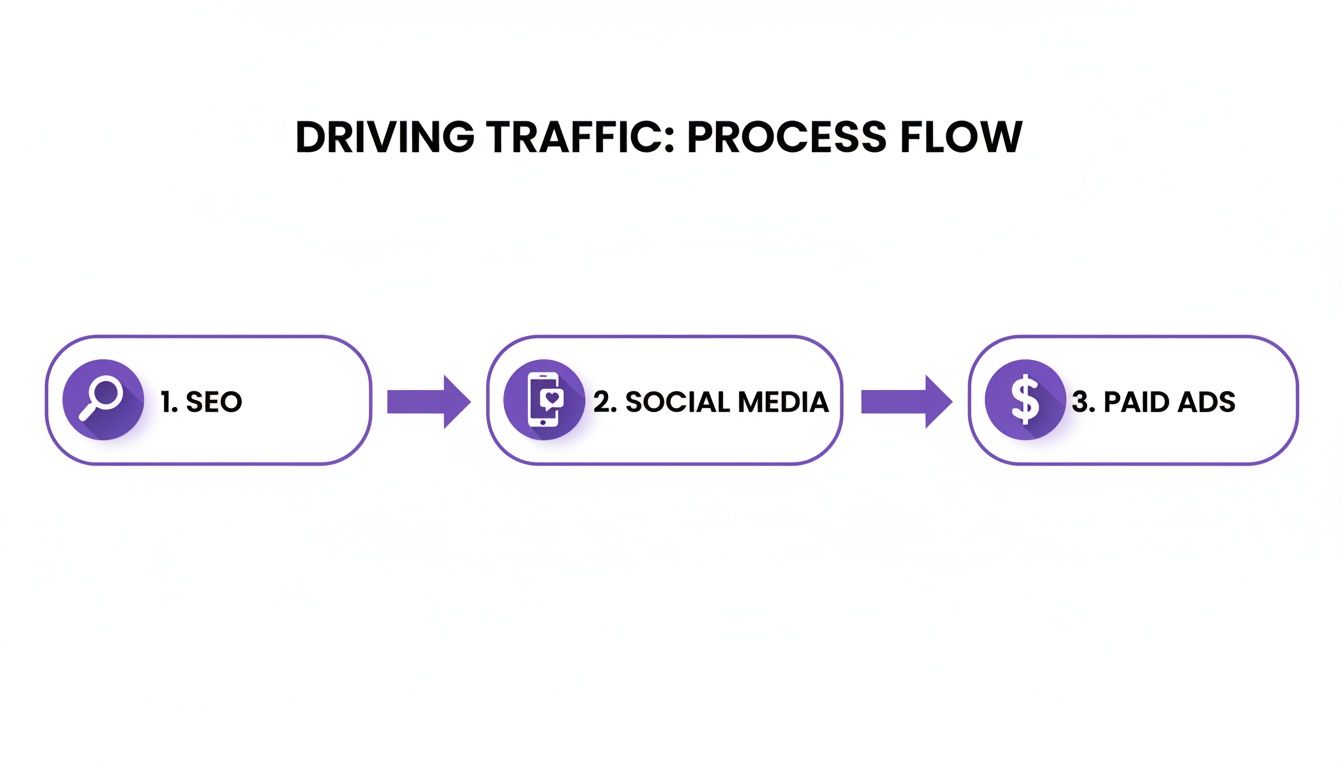
  • Your Guide to the Best Car Dealership Website Builder

    Your Guide to the Best Car Dealership Website Builder

    Think of a car dealership website builder as a purpose-built tool for a very specific job. You wouldn't use a regular hammer to do a mechanic's work, right? You'd use a set of specialized wrenches and ratchets. It’s the same idea here.

    Generic builders like Wix or Squarespace are like a basic home toolkit. They're great for a simple blog or a portfolio, but they just aren't designed to handle the heavy lifting that comes with selling cars online.

    What Is a Car Dealership Website Builder?

    At its core, a car dealership website builder is a platform designed from the ground up with one goal: to help you sell more cars. It's not just about creating a pretty website; it's about building an online showroom that actually works for you.

    This kind of platform comes packed with features that are non-negotiable for a modern dealership—things like automated inventory feeds and VIN decoding that a standard website builder simply doesn't have.

    It's More Than a Digital Brochure

    Years ago, a website was just an online version of your business card. It had your address, your phone number, and maybe a few pictures. That doesn't cut it anymore. Your website needs to be your #1 salesperson, working around the clock to turn casual browsers into serious buyers.

    This is where a purpose-built solution makes all the difference. It handles the unique, complex demands of the auto industry without you needing to duct-tape a bunch of expensive, clunky plugins together.

    A specialized builder transforms your website from a static digital flyer into an active, automated sales engine. It handles the technical heavy lifting so you can focus on what you do best—selling cars.

    The Tools of the Trade

    Instead of trying to force a generic platform to do something it wasn't built for, a dealership-focused builder gives you everything you need in one integrated package.

    • Automated Inventory Management: Your website needs to be a perfect mirror of your lot. A car sells? It comes off the site. You get a new trade-in? It's online in minutes, complete with photos, specs, and price, all automatically.
    • Effortless Data Entry: Forget spending hours typing in specs for every vehicle. With a VIN decoder, you just enter the VIN, and the system pulls in the make, model, trim, engine details, and factory options. It’s a massive time-saver that also eliminates costly errors.
    • Real Lead Generation: The goal is to get customers on the phone or onto the lot. Integrated tools like finance pre-qualification forms, trade-in estimators, and payment calculators give shoppers a reason to engage and hand over their contact info.

    Ultimately, using a platform built specifically for your industry is how an independent dealer can punch above their weight. It lets you create a professional, trustworthy online presence that not only looks great but actively drives your bottom line.

    8 Essential Features Your Dealership Website Needs

    Think of your website as more than just a digital business card. It’s your 24/7 salesperson, your lead-generation engine, and your virtual showroom all rolled into one. But to get the job done right, it needs the right tools under the hood. A generic website builder from a company like Wix or Squarespace is like trying to run a dealership with a family sedan—it might get you down the road, but it’s not built for heavy lifting.

    You need a platform specifically designed for the unique demands of selling cars. These aren't just fancy add-ons; they're the core components that separate a high-performing dealership site from one that just sits there. Without them, you’re leaving money on the table and letting your competition get ahead.

    The difference really comes down to specialization. A purpose-built platform has the critical automotive tools baked right in, while a generic builder forces you to bolt things on (if you even can).

    Builder hierarchy diagram showing generic and specialized builders, with sub-categories VIN Decode and Lead Gen.

    Let's break down the must-have features that will actually move the needle for your independent dealership.

    H3: 1. Automated Inventory Management

    Your inventory is the lifeblood of your business. If your website doesn't reflect exactly what's on your lot, you're creating a terrible customer experience. Manually updating your site every time you buy or sell a car is a recipe for disaster—it's slow, tedious, and full of opportunities for human error.

    A top-tier car dealership website builder plugs directly into your inventory management system. When you mark a car as "sold" in your DMS, it instantly vanishes from the website. Add a new vehicle to your stock, and it pops up online within minutes, ready to be discovered. It’s all about accuracy and saving you precious time.

    A website with sold cars still listed is a dead end for buyers. It kills trust instantly and sends them clicking over to the competitor who has their act together.

    H3: 2. Mobile-First and Responsive Design

    Let's be real: almost every car shopper starts their search on a phone. If your website is a clunky, hard-to-read mess on a mobile screen, you’ve already lost the sale. That's why a mobile-first design isn't just a nice perk; it's absolutely critical.

    This approach means the site is built for the small screen from the ground up, then adapted for tablets and desktops. It’s not about just shrinking everything down. A truly mobile-first site ensures a smooth, intuitive experience for every user, no matter the device.

    • Tap-Friendly Buttons: Big enough for thumbs, no frustrating missed clicks.
    • Legible Text: No need to pinch and zoom just to read a vehicle description.
    • Lightning-Fast Load Times: Mobile users are impatient. Your site has to keep up.
    • Simple Navigation: Buyers can find exactly what they’re looking for in just a couple of taps.

    H3: 3. Automatic VIN Decoding

    Nobody has time to manually type out every single feature, spec, and option for every car on the lot. It’s a mind-numbing task, and one typo can create a world of problems, from misleading a customer to damaging your credibility.

    This is where Automatic VIN decoding becomes a lifesaver. You just plug in the 17-digit VIN, and the system instantly pulls in all the correct information—engine, transmission, trim level, factory options, you name it. This feature alone saves dozens of hours and ensures every single one of your vehicle detail pages (VDPs) is 100% accurate.

    H3: 4. Built-In SEO and Google Vehicle Listings

    Having the best-looking website in town doesn't mean a thing if local buyers can't find you on Google. Search Engine Optimization (SEO) is the work that gets you on the first page of search results, and a great website builder should do most of the heavy lifting for you.

    This means it automatically handles the technical stuff—like creating search-friendly URLs and page titles for every car—so you don't have to. The real game-changer, though, is an integration with Google Vehicle Listings. This powerful tool pushes your live inventory directly into Google's search results, putting your vehicles right in front of motivated shoppers at the exact moment they're looking.

    H3: 5. Smart Lead Capture Forms

    The ultimate job of your website is to turn anonymous visitors into real, actionable leads. A simple "Contact Us" form just won't cut it. You need intelligent forms that match what a car buyer is actually trying to do.

    A specialized builder comes equipped with a toolkit of lead-capture forms designed to convert:

    • Finance Pre-Approval Forms: Identify high-intent buyers who are ready to talk numbers.
    • Trade-In Value Forms: Offer instant value and capture a lead in the process.
    • Test Drive Schedulers: Make it frictionless for a customer to book a time to come in.
    • "Keep Me Posted" Alerts: Let shoppers subscribe to updates for specific models, turning a "not yet" into a future sale.

    These tools transform your website from a passive brochure into an active lead-generation machine that works around the clock.

    Essential vs. Nice-to-Have Website Builder Features

    When you're shopping for a platform, it’s easy to get overwhelmed by a long list of features. To help you focus on what truly matters, we've broken down the essentials versus the "nice-to-haves." The features in the "Essential" column are non-negotiable for any serious dealership.

    Feature Why It's Essential Impact on Your Dealership
    Inventory Automation Eliminates manual data entry and ensures your online showroom is always accurate. Saves hours of administrative work, builds customer trust, and prevents lost sales due to outdated listings.
    Mobile-First Design The majority of your traffic will come from smartphones; a poor experience loses them. Captures more mobile shoppers, improves user engagement, and boosts your local SEO rankings.
    SEO & Google Vehicle Ads Makes your inventory discoverable to local buyers actively searching on Google. Drives highly qualified, free organic traffic directly to your vehicle pages, generating more leads.
    VIN Decoding Guarantees vehicle listings are accurate and detailed without tedious manual input. Increases operational efficiency, enhances credibility, and provides shoppers with reliable information.
    Smart Lead Capture Converts anonymous traffic into actionable sales leads by offering relevant tools. Turns your website into a 24/7 lead-generation engine, filling your pipeline with potential customers.
    CRM Integration (Nice-to-Have) Pushes leads directly into your Customer Relationship Management system. Streamlines your sales process but can be managed manually by smaller dealerships.
    Blog/Content Tools (Nice-to-Have) Allows you to publish articles and content to build authority. Good for long-term SEO and branding, but not as critical as core inventory and lead-gen features.

    Focus on nailing the essentials first. These are the features that will have the biggest and most immediate impact on your bottom line. Once those are locked in, you can explore the nice-to-haves to further enhance your digital presence.

    Why Website Speed Is Your Secret Sales Weapon

    In the online world, speed isn't just a nice-to-have feature; it's the bedrock of the entire customer experience. A slow website is the digital equivalent of a locked showroom door or a phone that rings and rings with no answer. It’s frustrating, shatters trust, and sends potential buyers straight to your competitors with a single click.

    Think about it this way: when a customer steps onto your lot, you greet them right away. You don't make them wait five or ten seconds before saying hello. Your website needs to offer that same immediate welcome, especially when shoppers can compare dozens of dealerships from their couch. A delay of even a single second can be the difference between a new lead and a lost opportunity.

    A person holds a smartphone displaying a fast load speed test next to shopping bags.

    The High Cost of a Slow Website

    Slow performance isn't just a minor hiccup—it hits your bottom line, hard. Every extra moment a visitor spends waiting for a page to load is another moment they might give up. The data here is crystal clear.

    If your site takes just a few seconds too long to load, you could be losing a huge chunk of your traffic before they even get a chance to see your inventory.

    This problem is even worse on mobile, where users are on the go and have zero patience for delays. Since most car buyers begin their search on a phone, a sluggish mobile experience is a critical failure.

    Google Cares About Speed, So You Should Too

    Website speed is so critical that Google has made it a major ranking factor in its search results. Google's goal is to give its users the best experience, which means sending them to sites that are fast, stable, and easy to use.

    Google measures this with a set of metrics called Core Web Vitals. You don't need to be a web developer to get the gist of what they measure. Put simply, they look at:

    1. Loading Performance: How fast does the main content on the page pop up?
    2. Interactivity: How quickly can a user click a button or fill out a form?
    3. Visual Stability: Does the page jump around and shift as it loads?

    A fast website isn't just about keeping visitors happy—it's about staying on Google's good side. Better Core Web Vitals scores can lead to higher search rankings, which means more free, organic traffic from local car shoppers.

    This is where a modern car dealership website builder comes in. It's engineered from the ground up to nail these performance metrics. It handles all the complex stuff behind the scenes—like compressing images, optimizing code, and managing server response times—so you don't have to. This gives your site an immediate SEO advantage right from the start.

    How Speed Builds Trust and Drives Leads

    A fast website does more than just stop people from leaving. It actively builds confidence and pushes them closer to becoming a lead. A snappy, responsive site feels professional and reliable. It sends a subconscious message that your dealership is modern, efficient, and on top of its game.

    On the flip side, a slow site creates doubt. If they can't even get their website right, what else are they cutting corners on? That's a terrible first impression that's nearly impossible to shake.

    A huge culprit for slow load times is unoptimized images. High-resolution photos are a must for showing off your inventory, but they can absolutely cripple your site's performance if they aren't handled correctly. You can learn some great techniques in our guide on how to optimize images for the web.

    Ultimately, a fast platform is a direct investment in your sales pipeline. It ensures every visitor has a smooth, hassle-free experience, keeping them engaged long enough to browse your cars, fill out a lead form, and book that all-important test drive. Speed isn't a luxury; it's a fundamental requirement for turning online traffic into real-world sales.

    Choosing the Right Website Builder for Your Dealership

    Picking a car dealership website builder isn't about finding the flashiest design. Think of it as choosing a business partner. The platform you select is the very foundation of your online showroom, and a smart decision now will save you a world of frustration and cash down the road.

    This choice directly impacts your budget, your daily workflow, and your ability to grow.

    So, how do you make a confident decision? You need a clear framework. Let’s cut through the marketing jargon by focusing on four critical areas: cost, scalability, support, and integrations. This isn’t just a tech decision; it's a strategic one that will shape your dealership's future.

    Uncovering the True Cost

    The price on the sales page rarely tells the full story. Website builder pricing can be notoriously tricky, riddled with hidden fees and add-on costs that balloon your actual monthly bill. You have to look past the attractive subscription price and dig into the total investment.

    For instance, some platforms will nickel-and-dime you for essentials like a VIN decoder, an SSL security certificate, or even a decent-looking theme. Others might cap your vehicle listings or take a cut of any online financing leads. Before you commit, always ask for a complete, itemized breakdown of every potential cost.

    Your goal is predictable, transparent pricing. A great partner won't surprise you with unexpected bills. Ask directly: "What costs are not included in this monthly price?" This simple question can reveal a lot about a company's business practices.

    For most independent dealers, a straightforward, all-inclusive subscription is the best bet. It makes budgeting simple and predictable. For more insights, see how this stacks up in our guide to the best website builders for small business.

    Planning for Future Growth and Scalability

    The dealership you run today might not be the same one you're running in two years. Can your website builder keep up? Scalability simply means the platform can handle more inventory, more website traffic, and more leads without slowing down or crashing.

    A platform that can't scale will eventually become a roadblock. Just imagine the nightmare of having to migrate your entire website because you grew your lot from 30 cars to 100. That’s a massive, expensive headache you want to avoid at all costs.

    Ask these key questions to see if a platform is built for growth:

    • Inventory Limits: Are there hard caps on how many vehicles you can list on each plan?
    • Performance Under Load: What happens if you get a huge spike in traffic from an ad campaign? Will the site grind to a halt?
    • Feature Upgrades: As your needs change, can you easily add more advanced tools without a complete overhaul?

    Choosing a scalable builder means your digital foundation is solid, freeing you up to focus on selling cars, not fighting with your technology.

    Evaluating Support and Essential Integrations

    When your website goes down on a busy Saturday, you need to know help is just a phone call away. The quality of a company’s customer support can make or break your entire experience. Before you sign anything, test them out. Do they answer the phone? Are their responses actually helpful?

    Just as important are integrations. Your website isn’t an island; it needs to talk to the other tools that run your business. This means your Dealer Management System (DMS), your CRM, and any third-party marketing tools. It's crucial to find platforms that understand the unique needs of auto repair shops and dealerships and are built to connect with the software you already use.

    Smooth integrations save you from the soul-crushing task of entering the same data in multiple places. The right connections ensure your whole operation—from inventory updates to lead follow-up—runs like a well-oiled machine.

    Turning Your Website Into a Lead Generation Machine

    Think of your dealership's website as your best salesperson. It works 24/7, never takes a day off, and is always ready to talk to a new customer. It shouldn't just be a digital business card with your address and a few photos; it needs to be the engine that drives your entire online sales strategy. A modern car dealership website builder is what turns that digital space from a simple online listing into a predictable, automated lead-generating machine.

    The whole point is to show up the moment a local buyer starts their search. To do that, your site has to be built to be found. That means nailing the powerful one-two punch of automotive search engine optimization (SEO) and getting your inventory seen directly by shoppers.

    A desktop computer screen displaying 'LEAD GENERATION' and a calendar on a modern wooden desk.

    Demystifying Automotive SEO

    Search Engine Optimization sounds more complicated than it is. At its core, it’s just the process of making your website more visible when people use Google to search for the cars you sell. When a potential customer down the street types "used Ford F-150 near me," you want your truck to be the first one they see. A website builder designed for dealers automates a ton of this work for you.

    Instead of you needing to become an SEO guru overnight, the platform handles the technical stuff behind the scenes.

    • Automated VDP Creation: Every time you add a car to your inventory, the builder instantly creates a unique, SEO-friendly Vehicle Detail Page (VDP). It automatically crafts optimized titles, URLs, and descriptions using the vehicle’s make, model, and year.
    • Structured Data Implementation: The platform embeds special code (often called "schema" or structured data) onto each VDP. This code speaks Google's language, feeding it key details like price, mileage, and availability, which helps your listings pop in search results.
    • Local SEO Signals: It makes sure your dealership’s name, address, and phone number are displayed consistently across your site, reinforcing to Google that you're a real, local business they can trust.

    Unlocking the Power of Google Vehicle Listings

    Google Vehicle Listings might just be one of the biggest opportunities for independent dealers right now. This feature puts your used car inventory directly inside Google's search results—complete with pictures, pricing, and a link right back to your website's VDP. It’s essentially a free, high-visibility billboard placed exactly where your customers are looking.

    The right website builder makes getting your inventory on Google an automated, set-it-and-forget-it process.

    By plugging directly into Google, a purpose-built platform syncs your live inventory automatically. This puts your vehicles right in front of highly motivated, active shoppers at the very moment they're ready to make a move, driving incredibly targeted traffic to your site for free.

    This isn’t about just getting more traffic; it’s about getting the right traffic. These are people who have already started their hunt and are looking for the exact vehicle you have on your lot. The next crucial step is turning those visitors into real, actionable leads.

    From Anonymous Clicks to High-Quality Leads

    Getting a visitor to land on your website is only half the battle. The real mission is to turn that anonymous click into a phone call, a finance application, or a scheduled test drive. This is where smart lead capture comes in. Before ever stepping onto a lot, today's buyers spend significant time researching online. Standing out means having pages that grab their attention and make them want to connect.

    A basic "Contact Us" form just doesn't cut it anymore. You need interactive tools that offer shoppers real value in exchange for their contact information.

    • Trade-In Estimators: Give people an instant valuation on their current car to capture details from potential sellers.
    • Payment Calculators: Let visitors estimate their monthly payments, turning casual browsers into serious planners.
    • Financing Applications: Securely gather information from buyers who are serious and ready to move forward.

    If you really want to see what works, checking out some high-converting lead generation form examples can spark some great ideas for your own site. When you connect the dots between great SEO, direct inventory visibility on Google, and smart lead capture, your website becomes a predictable and powerful source of new customers. To dive deeper, explore our guide for more strategies on generating leads for car dealerships. This complete, integrated approach is how you compete and win in today's market.

    Frequently Asked Questions

    Picking a new online home for your dealership is a big move. To help clear things up, we've put together some straight-talk answers to the questions we hear most often from independent dealers weighing their options.

    How Much Does a Car Dealership Website Typically Cost?

    The price tag can be all over the map, so it’s important to know what you’re looking at. If you hire a digital agency to build a fully custom website from scratch, you could easily be looking at an upfront cost of $5,000 to $25,000 or more. And that's before you even factor in the ongoing fees for hosting, security, and maintenance. That route gives you total control, but it's a huge initial investment and takes a lot more time.

    A modern car dealership website builder, on the other hand, works on a simple subscription model. Think of it like Netflix for your website—no massive upfront bill. Instead, you pay a predictable monthly fee, which is much more manageable for an independent lot. Many platforms offer different tiers to get you started, with affordable options that grow with you. You get a professional, high-powered site without draining your bank account.

    Can I Use My Own Domain Name?

    Yes, 100%. This is an absolute must-have for any real business. Most builders will give you a temporary subdomain to get you online right away (something like yourdealership.autofiresite.com), but connecting your own professional domain (www.yourdealership.com) is a standard feature on any paid plan.

    And honestly, using your own domain isn't negotiable. Here’s why:

    • Brand Credibility: It shows customers you’re a serious, established dealership.
    • Customer Trust: A custom domain is easier to remember and feels more secure to a potential buyer.
    • SEO Value: It’s the foundation for building your reputation with Google and ranking in local search results over the long haul.

    Getting it hooked up is usually a piece of cake. Most providers have simple guides or will have their support team walk you through it, making the switch to your official web address painless.

    How Long Does It Take to Go Live?

    This is where a specialized builder really shines. A traditional website project with an agency can drag on for weeks, sometimes even months. All that back-and-forth on design and development means you're sitting on the sidelines, not generating leads.

    With a platform built for dealers, you can have a professional website up and running in a matter of hours.

    The entire framework—the design, the inventory tools, the lead forms—is already built and ready to go. All you have to do is add your logo, pop in your business info, and, of course, load up your cars. You can go from having nothing to a fully functional website that brings in customers almost overnight.

    That speed means you start seeing a return on your investment immediately, not months down the road.

    Do I Need Technical Skills to Manage the Website?

    Not at all. In fact, that's the whole point. These platforms are built for car people, not coders. The idea is to get the tech out of your way so you can focus on what you actually do: buying and selling vehicles.

    The dashboard where you manage everything is designed to be completely intuitive. You can add new inventory, update your business hours, upload photos, and check your leads without ever having to look at a single line of code.

    All the complicated stuff humming along in the background is handled for you. This includes:

    • Security: Keeping your site and your customers' information safe from online threats.
    • Server Maintenance: Making sure your website is always online and running smoothly.
    • Performance Tuning: Optimizing page speed so your site loads lightning-fast for visitors.
    • Software Updates: Keeping all the features current without you having to lift a finger.

    It gives you all the power of a modern website without any of the headaches that come with maintaining it.


    Ready to launch a professional, high-performance website that turns browsers into buyers? With AutoFire™, you can get a stunning, SEO-optimized dealership site live in minutes—no contracts, no setup fees, and no coding required. Start your free trial today and see how easy it is to drive more leads.

  • Leads for car dealerships: Turn Your Website into a Conversion Engine

    Leads for car dealerships: Turn Your Website into a Conversion Engine

    Generating a steady stream of high-quality leads for car dealerships all comes down to one thing: a powerful, mobile-friendly website that serves as your digital showroom. This is the foundation of all your marketing efforts. It’s where you capture a browser's interest and turn them into a qualified buyer, often before they even think about stepping onto your lot.

    Your Digital Showroom Is Your Lead Generation Engine

    Two laptops on a wooden desk displaying digital car showrooms and mobile car listings.

    Let's be honest, the days of relying on foot traffic are long gone. The modern car buying journey starts with a Google search, not a trip down the street. This shift means independent dealers have to think differently. Your website isn't just an online brochure anymore; it's your #1 salesperson, working 24/7.

    In this market, one trend tells the whole story: the vast majority of car buyers do heavy research online before ever visiting a dealership. This massive change has turned the internet into the main arena for winning new customers.

    Your digital showroom is the engine that drives everything, and optimizing your lead capture forms is critical to turning that traffic into real opportunities. If you don’t have a strong online presence, you're practically invisible to most of today's buyers.

    The Foundation of a Lead-Generating Website

    So, what makes a website a lead-generating machine? It’s not magic. It comes down to a few core elements that directly shape the user's experience and, in turn, your bottom line.

    Think of it this way: a slow, confusing, or clunky website is the digital version of a locked front door. Potential customers will just leave and head straight to your competitor.

    Here’s what you need to get right:

    • Lightning-Fast Load Times: Every single second matters. A site that drags, especially on a phone, is frustrating and tells Google you don't value the user's time. Speed is non-negotiable for keeping people engaged.
    • Mobile-First Design: The vast majority of your customers are researching cars on their smartphones, often while standing on another lot. Your site has to look and work perfectly on any screen size. A bad mobile experience is a lead killer.
    • Clean, Intuitive Navigation: Can a visitor find your inventory, contact page, and financing application in two clicks? Simple menus and a clear layout help people find what they need without getting annoyed.
    • Automated Inventory Showcases: Your cars are the main event. Your website needs to automatically sync with your inventory, showcasing every vehicle with great photos, detailed specs, and clear pricing.

    Key Takeaway: Your website is more than a marketing tool—it's the central hub for your entire lead strategy. Every ad, social post, and search result should point back here, creating a smooth path from discovery to contact.

    To get you started, here’s a quick rundown of the essential features every dealership website needs to capture leads effectively.

    Essential Website Features for Lead Generation

    Website Feature Why It's Critical for Leads
    Mobile-First Design Captures the large majority of car shoppers who start their research on a smartphone.
    Fast Page Speed Reduces bounce rates; even a one-second delay can negatively impact conversions.
    High-Quality Photos/Videos Builds trust and allows shoppers to inspect vehicles from home, encouraging inquiries.
    Detailed VDPs Answers questions upfront, pre-qualifying buyers before they even reach out.
    Prominent CTAs Guides visitors to take the next step, whether it's "Schedule Test Drive" or "Get Pre-Approved."
    Simple Lead Forms Makes it easy for interested buyers to submit their information without friction.

    These aren't just "nice-to-haves"—they are the building blocks of a website that actively works for you, turning clicks into customers.

    The good news is that independent dealers can launch a professional, high-speed website without needing a huge in-house tech team. By focusing on these fundamentals, you build a digital showroom that doesn’t just attract visitors—it converts them. If you want to go deeper, check out our guide on high-performance https://goautofire.com/blog/website-design-for-car-dealers.

    Win Your Local Market with Automotive SEO

    Let’s be honest. Even with a fantastic website, most local car shoppers aren't going to find you by typing your dealership's name into their browser. Their journey starts with a search like "used Honda CR-V near me" or "independent car dealer Dallas."

    This is where local automotive SEO becomes your secret weapon for generating high-quality leads for car dealerships. It's all about making sure you show up the second a motivated buyer starts looking for a vehicle you have sitting on your lot.

    You don't need to get bogged down with overly complex, enterprise-level SEO tactics. For an independent dealer, winning the local game means mastering a few key areas that have a direct impact on who sees your inventory. The goal isn't just random traffic; it's about attracting ready-to-buy shoppers from your community.

    Master Your Google Business Profile

    Your Google Business Profile (GBP) is easily your most valuable local SEO asset. It’s that info box that pops up on Google Maps and in local search results, and it's often the very first impression a potential customer has of your dealership. A neglected or incomplete profile is a huge red flag for both Google and your buyers.

    Think of your GBP as your digital storefront. It has to be accurate, inviting, and professional.

    • Consistent NAP Information: Make sure your Name, Address, and Phone number are perfectly identical everywhere—on your website, your GBP, and any other online directory. A tiny difference like "St." versus "Street" can confuse search engines and knock you down in the rankings.
    • High-Quality Photos: Don't use stock photos. Upload recent, crisp pictures of your lot, your storefront, your team, and, most importantly, your actual cars. Seeing real inventory builds instant trust and gives people a reason to click.
    • Authentic Customer Reviews: Positive reviews are pure gold. Make it a habit to encourage happy customers to leave you feedback on Google. It’s also critical to respond professionally to all reviews, good and bad. It shows you’re engaged and stand by your business.

    Dominate Search Results with Google Vehicle Listings

    Beyond your GBP, there’s a game-changing (and free!) tool that every single dealer should be using: Google Vehicle Listings (GVL). You know that inventory carousel that shows up right on the search results page when you look for a specific make and model? That's GVL.

    Getting your cars into this prime real estate is one of the fastest ways to generate free, qualified leads.

    The best part? It's not a pay-to-play system. GVL is an organic feature that levels the playing field, giving independent dealers a real shot against the big franchises. The key is simply feeding Google clean, structured, and accurate inventory data so its system can easily display your vehicles.

    Expert Tip: Don't even think about managing your inventory feed manually. Automating it is the only way to succeed with Google Vehicle Listings. A modern dealership website platform can automatically format and send your vehicle data to Google the moment you add a car, ensuring your listings are always fresh without any extra work from you.

    This automation solves a huge customer-experience problem: clicking on a car that's already been sold. When your feed is updated in real-time, you guarantee every click is for a vehicle that's actually available, which helps protect your reputation. You can learn more in our complete guide to local SEO for car dealerships.

    Optimize Each Vehicle Listing for Clicks

    Just getting your cars to show up in Google Vehicle Listings is only half the battle. Now you have to convince a shopper to click on your car instead of the one listed by the dealer down the street. Every single detail matters.

    Here’s a quick checklist to make sure every vehicle you list is set up to win the click:

    • Accurate VIN Data: Always use a VIN decoder. It automatically populates all the correct specs, which builds trust by showing you’re transparent and detail-oriented. Plus, it gives Google a ton of rich data to work with.
    • Lots of Photos: A few pictures won't cut it. Post a full gallery for every car. Get all the angles—exterior, interior, the dashboard, the engine bay, and even close-ups of special features or any minor imperfections.
    • Compelling Descriptions: Go beyond just the standard specs. Write a short, engaging description that tells a story. Instead of just listing "2018 Ford Explorer," try something like, "The perfect family-hauler! This 2018 Ford Explorer has third-row seating and a spotless service history."

    By focusing on these core local SEO strategies, you'll stop passively waiting for customers and start actively pulling in local buyers who are searching for the exact cars you have for sale.

    Turn Vehicle Detail Pages into Conversion Tools

    A person holds a tablet displaying 'Vehicle Details' with multiple car images, including a silver SUV.

    Alright, you’ve pulled shoppers to your site with some smart local SEO. Now for the moment of truth: the Vehicle Detail Page (VDP). This isn’t just another page on your website; it's your digital showroom and your hardest-working salesperson, all rolled into one. It’s arguably the most critical piece of real estate you have for generating real leads for car dealerships.

    Think about it. A buyer who lands here isn't just window shopping anymore. They've clicked on a specific car, which means they have genuine interest. Your mission is to give them everything they need to take the next step, presenting it all in a way that’s clean, compelling, and builds immediate trust.

    This is where the little things become big things. A VDP that’s confusing, incomplete, or looks untrustworthy will send a motivated buyer clicking over to your competitor in a heartbeat. A great one makes it dead simple for them to get in touch.

    Build Trust with Comprehensive Vehicle Information

    The bedrock of a VDP that actually converts is complete and accurate information. Today’s car buyers are researchers. They’ve done their homework, and they will absolutely notice if you haven't. Transparency isn't just a buzzword; it's how you earn the trust needed to get their contact info.

    One of the best tools in your arsenal for this is a VIN Decoder. Manually typing in dozens of specs for every car is a recipe for typos and wasted time. A VIN Decoder automates the whole thing.

    Just pop in the Vehicle Identification Number, and it instantly fills your VDP with factory-correct data. We're talking about details like:

    • Engine and transmission specs
    • Standard features vs. optional add-ons
    • Official fuel economy ratings
    • Safety information
    • Exact exterior and interior colors

    This isn't just a time-saver. It guarantees accuracy and shows customers you're a professional, detail-oriented operation with nothing to hide. That's a huge step toward earning their business.

    The Anatomy of a High-Converting VDP

    Beyond the raw data, the VDP needs to be structured to guide the shopper toward a specific action. It’s a careful mix of great visuals, clear information, and obvious next steps. Every single element should work to answer a buyer's questions and remove any hesitation they might feel about reaching out.

    Key Insight: A successful VDP anticipates and answers a buyer’s questions before they even have to ask. The goal is to eliminate any reason for them to leave your page to find information elsewhere.

    Here are the non-negotiable components that will turn a basic inventory listing into a lead-generating machine:

    1. A Gallery of High-Resolution Images: A few blurry phone pics just won't cut it. Your photo gallery is the closest a buyer gets to seeing the car in person before they visit. You should aim for numerous high-quality photos from every conceivable angle—exterior, detailed interior shots of the dash and seats, cargo space, under the hood, and even close-ups of the tires.
    2. Transparent and Upfront Pricing: Don't play games with pricing. Display it clearly and prominently. If you make someone fill out a form just to see the price, they're gone. If you have special offers or financing options, put them right there next to the price to give a full financial picture.
    3. A Clear and Compelling Call-to-Action (CTA): What do you want them to do? Most likely, it's to schedule a test drive. Your CTA button needs to be impossible to miss. Use action-focused words like "Schedule Your Test Drive" or "Check Availability"—make it a command, not a suggestion.
    4. Simple, Accessible Lead Forms: Once they click that CTA, the form they see has to be short and sweet. Ask for the bare minimum: name, email, and phone number. A long, complicated form is a notorious conversion killer, especially for someone browsing on their phone.

    Putting these elements together creates a smooth, confidence-building experience that naturally encourages a shopper to get in touch. As you work on your VDPs, it's worth brushing up on the fundamentals of turning website visitors into leads. You can learn more about how to improve website conversion rates and apply those proven tactics here. Ultimately, your VDPs are where a browser becomes a real sales opportunity, making them the most powerful conversion tools you have.

    Drive Targeted Traffic to Your Dealership Website

    So, you've got a killer website with perfectly detailed vehicle pages. That’s like building a state-of-the-art racetrack—it's impressive, but it’s completely pointless until the cars actually show up. The next move is all about opening the floodgates and getting a steady stream of real, qualified buyers to your digital showroom.

    For an independent dealer, this isn't about outspending the big franchise stores. It’s about being smarter. We're going to focus on practical, budget-friendly tactics that pull in local, in-market shoppers—the people who actually buy cars from you.

    The mission is simple: get a constant flow of the right people to your site. This is how you turn your website from a static online brochure into a machine that actively generates leads.

    Attract Buyers with Helpful Organic Content

    One of the best long-term plays you can make is creating simple, genuinely helpful content that answers the real-world questions your customers are already Googling. Think beyond just "selling." Your goal is to become the go-to local authority on all things cars. A blog is the perfect place to do this.

    Forget writing about your dealership. Write for your customers. Craft posts around the exact topics they’re searching for. This strategy lets you connect with buyers at every stage, from the "just browsing" phase to the "I'm ready to buy today" moment.

    Here are a few ideas you can run with this week:

    • Head-to-Head Comparisons: Create a no-nonsense comparison like, "Honda CR-V vs. Toyota RAV4: Which SUV is Actually Better for Families?"
    • Price-Point Roundups: Target budget-conscious shoppers with titles like, "Our Top 5 Used Cars You Can Drive Off the Lot for Under $15,000."
    • Financing Guides: Break down a confusing topic with something like, "The Independent Dealer's Guide to Financing a Used Car in [Your City]."

    Every single post you publish is like opening a new digital door to your dealership, pulling in free search traffic month after month. The secret is to be legitimately helpful, which builds trust long before a customer ever steps on your lot.

    Drive Engagement on Social Media

    Social media, especially Facebook and Instagram, is an incredible channel for showing off your inventory and connecting with your local community. But here's the trick: you have to stop posting like a faceless corporation. Your social media needs to have a personality.

    Make sure your inventory posts pop. Use high-quality photos—your phone is fine, just wipe the lens!—and maybe even quick walk-around videos to literally stop people from scrolling past. Spark a conversation by asking questions in your captions, like, "Okay community, which one of these trucks are you taking on a weekend getaway?"

    Pro Tip: When you post a vehicle on Facebook or Instagram, don't just throw the price in the caption and call it a day. Always include a strong call-to-action and a direct link straight to that car’s VDP on your website. Social media’s job is to drive traffic back to your turf, where you can actually capture the lead.

    This kind of consistent, engaging activity keeps your dealership at the top of people's minds and builds a following that will eventually turn into customers.

    Run Budget-Friendly Paid Ad Campaigns

    Organic is great for the long game, but sometimes you just need leads now. That's where a little bit of smart, targeted paid advertising comes in on platforms like Google and Facebook. The key is to be surgical with every dollar you spend.

    Local Facebook Ads are fantastic for zeroing in on specific groups of people in your town. You can target users based on interests (like people who follow certain car brands), recent behaviors, and of course, location. For example, you could run an ad for a new Ford F-150 on your lot and show it only to men within a certain age range and radius who have shown an interest in trucks. That's powerful stuff.

    Google Ads let you get in front of people with sky-high buying intent. By bidding on search terms like "used Toyota Camry for sale near me," you can put your dealership right at the top of the page at the exact moment a motivated shopper is looking. It doesn't get much more direct than that.

    With both platforms, start small. You don't need a huge budget. The goal isn't to blanket the internet; it's to run hyper-focused campaigns that bring in more than they cost. This one-two punch of organic and paid strategies ensures your website is always busy, attracting the right people and turning them into real, actionable leads.

    Capture and Convert Leads with Smart Follow-Up

    Getting traffic to your dealership’s website is a huge win, but it’s just the starting line. The real race is won when a visitor becomes a lead, and that lead turns into a test drive. This is where your lead capture and follow-up strategy goes from being a nice-to-have to the most critical part of your sales process.

    Let's be honest: getting someone's contact info and responding quickly is what separates a missed opportunity from a done deal. A clunky form or a slow response time is all it takes to send a motivated buyer straight to your competitor down the street.

    The initial goal is to get those potential buyers to your digital doorstep, typically through SEO, social media, and paid ads.

    Process flow diagram showing three steps to drive traffic: 1. SEO, 2. Social Media, 3. Paid Ads.

    Each of these channels funnels interested shoppers right to your inventory. Now, the real work begins: capturing their information and starting the conversation.

    The Anatomy of a High-Converting Lead Form

    Think of your lead capture form as the handshake between a casual browser and a serious prospect. The goal is to make it as quick and painless as possible. I've seen countless dealerships kill their conversion rates with long, complicated forms, which is a disaster when you consider how many shoppers are browsing on their phones.

    Keep it simple. For an initial test drive request or a general inquiry, you only need the essentials:

    • Name: So you can greet them personally.
    • Email: For sending confirmations and helpful follow-ups.
    • Phone Number: This is gold. It’s your direct line for a quick call or text.

    Placement is just as important as the fields you ask for. Your lead forms should be impossible to miss. Stick them prominently on every Vehicle Detail Page, your contact page, and maybe even a pop-up that triggers when someone looks like they're about to leave your site.

    My Two Cents: Simplicity always wins. A form with just three or four essential fields will generate far more leads for car dealerships than a lengthy one that asks for their life story. You can always gather more details once you're actually talking to them.

    What Happens After They Hit ‘Submit’?

    The second a potential customer clicks that "submit" button, a timer starts. The speed of your response is one of the biggest predictors of whether you’ll close the deal. I’ve seen leads go completely cold in just a few hours.

    This is where a little automation goes a long way. Your very first move should be an instant auto-responder. It's a simple, automated email or text message that confirms you got their inquiry and tells them exactly when they can expect to hear from a real person.

    A solid auto-responder could say something like: "Thanks for your interest in the 2019 Honda Accord! We've received your request, and one of our team members will give you a call within the next 30 minutes to confirm your test drive." It's professional and it manages expectations perfectly.

    A Simple, Effective Follow-Up Workflow

    A consistent follow-up process ensures no lead ever falls through the cracks. While some dealers get lost in complex CRM workflows, I’ve found that a simple, repeatable sequence is often the most effective. A smart mix of emails, texts, and calls keeps you top-of-mind without being annoying.

    Here’s a practical checklist you can put into action right away to manage new leads.

    Lead Follow-Up Workflow Checklist

    Timeframe Action Item Goal
    Within 5 Minutes Instant Auto-Responder (Email/Text) Acknowledge receipt and set expectations.
    Within 30 Minutes Personal Phone Call Make a human connection and schedule the test drive.
    Day 1 (No Contact) Follow-Up Text Message Send a friendly, low-pressure reminder.
    Day 2 Follow-Up Email Provide additional vehicle info or similar options.
    Day 4 Final Follow-Up Call Make one last attempt to connect and offer assistance.

    Following a structured approach like this shows customers that you’re organized, professional, and genuinely interested in earning their business. When you master both capturing information efficiently and following up promptly, you create a powerful system that turns website clicks into real, tangible sales.

    Measure What Matters to Get More Leads

    You can't improve what you don't measure. All the hard work you pour into your website, local SEO, and paid ads is just spinning wheels if you don't know what’s actually bringing people through the door. This is where you stop guessing and start making smart, data-driven decisions that generate more leads for car dealerships.

    You don't need a Ph.D. in data science to get this done. A free tool like Google Analytics is all it takes to get a clear picture of how your digital showroom is performing. It'll show you exactly where your website visitors are coming from, which cars get the most attention, and how many people actually fill out your contact forms.

    Focus on a Few Key Metrics

    It's incredibly easy to get lost in a sea of data. Instead of drowning in dozens of "vanity metrics" that sound good but mean nothing, just focus on the handful that directly impact your sales.

    These numbers tell the real story of your dealership's health.

    • Website Conversion Rate: This is your big one. It's the percentage of website visitors who actually do something you want them to, like submitting a "Schedule Test Drive" form. If this number is low, it’s a red flag that something on your VDPs or forms is turning people away.
    • Cost Per Lead (CPL): If you're spending money on ads, this is non-negotiable. Simply divide your total ad spend by the number of leads you got. Knowing your CPL for a Facebook campaign versus a Google Ads campaign tells you where your money is best spent.
    • Lead-to-Test-Drive Ratio: Of all the form submissions and phone calls you get, how many people actually show up for a test drive? This metric cuts through the noise and shows you the quality of your leads and how well your team is following up.

    Key Takeaway: Your goal is to create a continuous improvement loop. You try something new (like a new ad campaign), measure its impact on these core metrics, learn from the results, and then adjust your strategy. This cycle is how you consistently get better.

    Turning Data into Actionable Insights

    Once you have the numbers, you have to do something with them. Data is useless without action.

    Let's say Google Analytics shows that a blog post you wrote, "Best Used SUVs Under $20,000," is bringing in a ton of traffic but almost no one is contacting you from that page. That's a clear signal. You could add a direct call-to-action with a link to your current SUV inventory right in the middle of the article.

    Or maybe you see that one specific Ford F-150 on your lot is getting way more VDP views than any other truck. That's a gold mine of information. Feature that truck on your homepage or run a targeted social media ad showing it off.

    To really get ahead, you can't just look at your own numbers in a vacuum. It's just as important to see what your competition is up to. Using AI competitor analysis tools can give you a major leg up by revealing market trends and what strategies are working for other dealers nearby.

    By consistently measuring what truly matters, you can stop wasting time and money on tactics that don’t move the needle and double down on the ones that do. This ongoing process—implement, measure, refine—is the secret to building a lead generation engine for your dealership that's both predictable and scalable.

    Your Top Questions About Dealership Leads, Answered

    If you're trying to build a solid sales pipeline, you've probably got questions. I hear the same ones from dealers all the time. Let's tackle some of the most common ones head-on.

    How Long Until My SEO Efforts Actually Start Working?

    This is the big one, isn't it? While you can get some quick traction with things like Google Vehicle Listings, the real, sustainable traffic from organic SEO takes time to build.

    Realistically, you should expect to see significant results in about 3-6 months. That might sound like a while, but it's an investment that pays off big time. Consistency is everything here—regularly optimizing your site, building up your local business listings, and posting genuinely useful content will get you there. A technically sound website from the get-go can definitely speed things up.

    What's the Single Most Important Thing for Capturing Leads on My Site?

    Hands down, it's your Vehicle Detail Pages (VDPs). Nothing else comes close. Think about it: when a shopper lands on a VDP, they're not just browsing anymore; they're seriously considering that specific car.

    Your VDP needs to be your best salesperson. That means:

    • High-quality photos from every angle.
    • Detailed specs pulled automatically with a VIN decoder.
    • Clear, upfront pricing.
    • A big, obvious call-to-action button like "Schedule a Test Drive" that works perfectly on a phone.

    A car buyer on a VDP is a hot lead. Your job is to make it incredibly easy for them to take the next step by giving them all the information they need, right then and there. Don't make them work for it.

    Do I Really Need a Huge Budget for Paid Ads?

    Not at all. In fact, starting small is often smarter. You don't need to spend a fortune to see results, especially with local advertising.

    Highly targeted campaigns on Facebook Ads or Google Ads can be incredibly effective, even with a modest budget. The trick is to focus on "in-market" audiences—people actively searching for the types of cars you have on your lot. The goal isn't just clicks; it's driving the right people to your VDPs to turn that ad spend into actual leads.


    Ready to turn your website into a lead generation engine? With AutoFire™, you can launch a modern, mobile-first dealership site designed to capture leads from day one. Get started for free.

  • A Modern Playbook for Generating Auto Dealership Leads

    A Modern Playbook for Generating Auto Dealership Leads

    Your website isn't just an online business card anymore. It's your digital showroom, your top salesperson, and by far your most powerful tool for generating real, high-quality auto dealership leads. A sharp, mobile-friendly design isn't just a nice-to-have; it's the absolute foundation for turning casual online browsers into paying customers on your lot.

    The whole game is about creating a smooth digital experience that builds immediate trust and makes it incredibly easy for a shopper to take the next step.

    Building a Digital Showroom That Converts

    Think about it: your website is often the very first handshake with a potential buyer. Long before they smell the new car scent or kick a single tire, they've already sized you up based on their experience online. This is where the modern battle for leads is won or lost.

    The journey from a casual Google search to a submitted lead form on your site has to be seamless. This visual breaks down that critical path.

    Flowchart illustrating the website lead process: Research, Visit, Convert, with awareness, engagement, and acquisition stages.

    As you can see, the path is straightforward. Your job is to remove any and all friction between those steps.

    To help visualize how specific website components directly contribute to lead generation, here’s a breakdown of the essentials.

    Essential Website Elements for Lead Conversion

    Website Element Impact on Leads Real-World Example
    Mobile-First Design Captures the majority of traffic from smartphones; prevents high bounce rates. A site where a user can easily browse inventory and fill out a form with one thumb on their phone.
    High-Quality VDPs Builds trust and answers questions upfront, pre-qualifying the lead. Including multiple high-res photos, a walkaround video, and an embedded CarFax report for every vehicle.
    Clear CTAs Guides visitors toward conversion actions instead of letting them wander. Using buttons like "Schedule a Test Drive" or "Get Today's Price" prominently above the fold on every VDP.
    Simple Lead Forms Reduces friction and increases form submissions by only asking for essential info. A contact form that only asks for name, email, and phone number, rather than a 10-field questionnaire.
    Live Chat/Texting Engages hesitant buyers in real-time, capturing leads that might otherwise leave. A chat widget that proactively asks, "Have questions about this Silverado? We can text you the details."

    Ultimately, every single element on your site should be strategically designed with one goal in mind: making it simple and compelling for a visitor to raise their hand and say, "I'm interested."

    The Mobile-First Imperative

    Let's be blunt: "mobile-first" is no longer a buzzword; it's the price of entry. The vast majority of your customers are looking at your cars on their phones, probably while on their lunch break or sitting on the couch. This means your site has to be designed for a small screen from the ground up—not as an afterthought.

    A truly mobile-first experience delivers on a few key promises:

    • It’s fast. Every second a customer waits for a page to load is a chance for them to hit the back button.
    • It’s easy to use. Big, thumb-friendly buttons and simple menus are crucial. No one wants to play tap-the-tiny-link.
    • It’s clean. A cluttered mobile site is a confusing mobile site. Key information like inventory, pricing, and your phone number should be impossible to miss.

    If a potential buyer has to pinch-and-zoom just to read a vehicle description, you've already lost them. It's that simple.

    Crafting High-Conversion Vehicle Detail Pages

    The Vehicle Detail Page (VDP) is where the magic happens. This is the moment a casual looker decides to become a serious lead. Your VDP is the digital equivalent of your best salesperson making a pitch for a specific car on your lot.

    Your VDP should answer every question a buyer might have before they even think to ask it. Transparency is the currency of trust online, and a detailed, honest VDP is your best tool for earning it.

    To make your VDPs work for you, not against you, every single one needs these core components:

    • High-Resolution Photos: Don't skimp here. We're talking a gallery of multiple crystal-clear photos. Show every angle—inside, outside, close-ups on the wheels, the dashboard, and even any minor imperfections.
    • Video Walkarounds: A quick 1-2 minute video tour brings the car to life in a way photos can't. It feels personal and shows you have nothing to hide.
    • Transparent Pricing: Display the price clearly. Even better, include a payment calculator or a link for financing pre-approval. Nothing kills trust faster than hidden fees or "call for price."
    • Detailed Vehicle History: Integrating a CarFax or AutoCheck report directly on the VDP is a massive trust-builder. It removes doubt instantly.
    • Obvious Calls-to-Action (CTAs): Guide the shopper with prominent buttons. "Check Availability," "Schedule Test Drive," and "Get E-Price" are your money-makers.

    Your goal is to build so much confidence and provide so much information that submitting their contact info feels like the natural next step. For a deeper dive into this, explore our comprehensive guide on effective website design for car dealers.

    Driving High-Intent Traffic to Your Inventory

    A world-class website is useless if the right buyers can't find it. Once your digital showroom is built to convert, the real mission begins: opening the floodgates to a steady stream of serious shoppers. We're not talking about random clicks; we're talking about attracting qualified visitors who are ready to become auto dealership leads.

    Person uses laptop and smartphone to view vehicle details, likely for car sales or management.

    The foundation for attracting these buyers is being visible right where they start their search: Google. This calls for a smart, multi-channel approach that blends organic search tactics with sharply targeted paid advertising.

    Dominate Local Search with Automotive SEO

    When someone in your town types "used Ford F-150 near me" into their phone, you have to show up. That’s the entire game of local automotive SEO—optimizing your digital footprint to rank high for the exact location-based and inventory-specific searches your customers are making every day.

    Think of it as digital curb appeal. Just as you want your physical lot to look immaculate to anyone driving by, your website needs to be front and center for digital searchers.

    Here’s where you need to focus your efforts for a strong local SEO strategy:

    • Google Business Profile (GBP) Optimization: Your GBP is your digital storefront on Google. It needs to be perfect. Fill it out completely with accurate hours, your address, phone number, and load it up with high-quality photos of your dealership and your best-looking inventory.
    • Location-Specific Website Content: Don't just be a generic dealership online. Create pages on your website dedicated to the towns and cities you serve. A simple page titled "Quality Used Cars in Springfield" can make all the difference in ranking for searches from that area.
    • Consistent Business Information: Make sure your dealership’s name, address, and phone number (what we call NAP) are identical everywhere online. From Yelp to your own website, any inconsistency can confuse search engines and drag down your rankings.

    A strong local SEO presence ensures you're not just another dealership on the internet, but the local dealership for a customer's specific needs. It’s the most cost-effective way to generate a consistent flow of highly qualified traffic over the long term.

    For a deeper dive, our guide on automotive SEO strategies covers more advanced tactics to help you climb those search rankings.

    Capture Ready-to-Buy Shoppers with Google Ads

    While SEO is your long game, Google Ads lets you jump the line and capture buyers with immediate intent. It's a pay-to-play strategy, but when done right, the ROI is fantastic. You’re essentially bidding on specific keywords to get your dealership right at the top of the search results page.

    The trick is to zero in on high-intent keywords. These are the search terms people use when they're done researching and are ready to pull the trigger.

    Keyword Type Example Buyer Intent
    Low Intent "best family SUVs" Just browsing, not ready to buy.
    High Intent "Honda CR-V for sale near me" Actively looking for a specific vehicle to purchase now.
    High Intent "used truck dealership Springfield" Searching for a specific type of dealership in their area.

    By targeting these bottom-of-the-funnel keywords, you ensure your ad budget goes toward clicks that are far more likely to turn into real leads. Your campaigns should always send users directly to a relevant VDP or a pre-filtered inventory search page, making it dead simple for them to go from search to lead.

    Tap into Social Marketplaces

    Don't sleep on the platforms where your local community already hangs out. Facebook Marketplace, in particular, has exploded into a massive hub for used vehicle searches. Listing your inventory there puts your cars directly in front of a local, engaged audience that trusts the platform.

    This channel lets you connect with buyers in a more direct, conversational way. To really make this work for you, check out this guide on Generating Auto Dealership Leads with Facebook Ads. By combining your organic visibility, targeted ads, and social selling, you build a powerful system for driving a continuous flow of great traffic right to your inventory pages.

    Turning Website Visitors into Qualified Prospects

    Getting people to your dealership’s website is a great start, but it's just half the battle. The real goal is turning those anonymous clicks into actual auto dealership leads. If someone browses your inventory and leaves without giving you their information, it’s a lost opportunity—no matter how great your cars are.

    You have to make it incredibly simple and genuinely compelling for a potential buyer to raise their hand. It's all about understanding what a car shopper is thinking and doing on your site. They're looking for answers, and your job is to guide them toward actions that help you both. This means ditching the generic buttons and getting strategic.

    Crafting Calls-to-Action That Actually Work

    Let's be honest: the "Contact Us" button is probably the most passive and least effective call-to-action (CTA) out there. It puts all the work on the customer and offers them nothing of value in return. A CTA that truly works meets the shopper exactly where they are in their buying journey with a specific, compelling offer.

    Instead of vague requests, your Vehicle Detail Pages (VDPs) need prominent, action-oriented buttons that align with what a buyer actually wants to do.

    • "Check Availability": This creates a little urgency and is a super low-commitment way for a shopper to start a conversation.
    • "Get E-Price": Perfect for the price-conscious buyer who wants instant, valuable information without having to ask.
    • "Schedule a Test Drive": This one targets visitors who are much further down the funnel and are ready for the in-person experience.
    • "Hold This Vehicle": A seriously powerful option for in-demand models that creates a feeling of exclusivity.

    By tailoring your CTAs like this, you provide clear, helpful next steps that don't feel demanding. This simple shift can make a massive difference in the number of leads you capture from the exact same amount of website traffic.

    Engaging Visitors Instantly with Chat and AI

    Not every visitor is ready to fill out a long form or pick up the phone. Many people browse inventory after hours or on a quick lunch break when they can't talk. This is where live chat and AI-powered chatbots become absolute game-changers for lead capture.

    A chat widget lets you engage with visitors in real-time, answering questions and building rapport the moment they're most interested. More importantly, it gives them a low-pressure way to share their contact info. A simple prompt like, "Have a question about this F-150? I can text you the answer," can instantly turn a silent browser into a warm lead.

    Today's AI chatbots can handle initial questions 24/7, qualify leads by asking a few basic questions, and even book appointments for your team. This means you never miss an opportunity, even if it comes in at 2 a.m.

    To take it a step further, many successful dealers are using text messaging to generate leads, engaging potential buyers directly on the device they use most.

    Prioritizing Your Hottest Leads with Lead Scoring

    Let's face it: not all leads are created equal. A visitor who downloaded a brochure is in a very different place than someone who viewed the same VDP three times and played with your payment calculator. Without a system to tell them apart, your sales team wastes precious time chasing cold leads while the hot ones go stale. This is where a simple lead scoring system comes in.

    Lead scoring is just a way of assigning points to leads based on their actions and attributes, allowing you to automatically see who is most likely to buy right now.

    Here’s a basic scoring model you can adapt for your dealership:

    Action Taken by Visitor Points Awarded Lead Temperature
    Visited 1 VDP +5 Lukewarm
    Viewed 3+ VDPs +15 Warming Up
    Used Payment Calculator +20 Hot
    Submitted a "Get E-Price" Form +25 On Fire
    Opened a Follow-Up Email +5 Lukewarm

    By adding up the points, your CRM can automatically flag the highest-value prospects for your team. A lead with a high score needs an immediate phone call. A lead with a score of just 5? They can be placed into an automated email nurture campaign. This data-driven approach ensures your team focuses its energy where it will have the biggest impact, turning more prospects into sales.

    Mastering the Follow-Up to Close More Car Deals

    Getting a lead is just the starting line. The real race is won in the follow-up. Those first few moments after a potential buyer sends you their information are the most critical part of the entire sales process. If you're slow to respond, you're practically handing that sale over to a competitor who was just a little bit faster.

    A person holds a tablet displaying a 'GET E-PRICE' button and an input field, tapping the screen.

    In this business, speed is everything. When someone requests an e-price or asks about a specific vehicle, their interest is at an absolute peak. Your ability to connect with them in that crucial window is what separates the top performers from everyone else.

    The goal here isn't just to be fast; it's to build a follow-up system that is rapid, persistent, and feels personal. You need a process that ensures no opportunity ever slips through the cracks.

    The Undeniable Power of Speed

    The difference between getting back to a lead in five minutes versus five hours is staggering. Think about it: in the car business, a rapid response to an online inquiry significantly increases your chances of having a meaningful conversation with that lead.

    A quick response does more than just answer a question. It sends a powerful message that you’re professional, you're on top of your game, and you value their time. That's how you start building the trust needed to make a big-ticket sale.

    Building Automated, Yet Personal, Follow-Up Sequences

    Let’s be realistic—you can't manually follow up with every single lead the second it comes in, especially after hours. This is where automated SMS and email sequences become your secret weapon. They let you deliver immediate and consistent communication without chaining your sales team to their desks.

    The trick is to make your automation feel human. Your sequences shouldn't sound like they came from a robot. They need to be helpful, timely, and offer real value with every message.

    Your follow-up automation should feel less like a machine and more like a helpful concierge guiding the customer through their next steps. The goal is to stay top-of-mind by providing value, not by being intrusive.

    A well-designed sequence can handle that initial, time-sensitive outreach, warming up the lead so your salespeople can focus their energy on conversations with people who are ready to talk.

    A High-Impact Lead Follow-Up Cadence

    To give you a clearer picture, here’s a sample multi-touch follow-up schedule designed to maximize engagement in those critical first few days. This is a great starting point you can adapt for your own dealership.

    A High-Impact Lead Follow-Up Cadence
    Timeline Action to Take Communication Channel
    First 5 Minutes Send an automated text confirming you got their request. Ask a simple qualifying question, like, "Thanks for your interest in the F-150! Are you looking to trade in a vehicle?" SMS Text
    First 15 Minutes A personalized email from a salesperson follows, with more vehicle details and a clear call-to-action to schedule a call or test drive. Email
    2 Hours Later The assigned salesperson makes their first call. No answer? Leave a short, friendly voicemail. Phone Call
    Day 2 Send another email, this time offering more value. Link to similar vehicles in your inventory or a helpful guide like "Top 5 Features of the Honda CR-V." Email
    Day 3 Fire off a quick, casual text: "Hi Alex, just wanted to see if you had any other questions about the CR-V. Let me know!" SMS Text
    Day 5 Make a final follow-up call to offer assistance one last time before moving the lead into a long-term nurture campaign. Phone Call

    This persistent, multi-channel approach meets customers where they are, dramatically increasing your chances of getting a response.

    Creating a Seamless Workflow with CRM Integration

    Your follow-up strategy is only as good as the system running it. A lead that gets forgotten or goes stale is pure lost profit—and it's completely avoidable with the right tech. That’s why integrating your website's lead forms directly with your Customer Relationship Management (CRM) system is non-negotiable.

    When a customer fills out a form on your site, this integration should instantly and automatically:

    • Create a new lead profile in your CRM.
    • Assign that lead to the right salesperson.
    • Kick off the appropriate automated follow-up sequence.

    This seamless connection gets rid of manual data entry, stops leads from getting lost in a cluttered inbox, and gives you a clear, time-stamped record of every interaction. It creates total accountability for your team and guarantees every lead gets the immediate attention it deserves. If you're exploring options, our guide on the best CRM for car dealers can help you find the right fit.

    Using Data to Fine-Tune Your Lead Generation Engine

    Throwing money at marketing and just hoping for the best is a fast way to go broke. Real, sustainable growth comes from making smart decisions based on hard data. To build a reliable engine for generating high-quality auto dealership leads, you have to measure what’s working, understand what the numbers are telling you, and constantly tweak your strategy.

    This data-first approach is what separates the dealerships that thrive from those that just survive. It ensures every single marketing dollar you spend is pulling its weight to bring real buyers to your lot.

    A person working at a desk with a laptop displaying charts, holding a smartphone, with "Quick Follow Up" banner.

    Identifying the KPIs That Actually Matter

    Don't get bogged down in a sea of vanity metrics. Key Performance Indicators (KPIs) are the vital signs of your marketing health, and you only need to focus on a handful that tie directly to your sales goals. These are the numbers you should be looking at every single week.

    • Cost Per Lead (CPL): This is your bottom line. Simply divide your total ad spend for a channel (like Google Ads) by the number of leads it generated. A low CPL means you're getting leads efficiently.
    • Lead Source ROI: Forget about which channels bring you the most leads—which ones bring you the most sales? You need to track leads from SEO, Facebook Marketplace, and third-party sites all the way to a closed deal. This tells you where your best customers are really coming from.
    • VDP Conversion Rate: What percentage of people looking at a specific car on your website actually fill out a form or start a chat? This KPI is crucial because it tells you how well your vehicle pages turn casual browsers into active leads.

    This is how you move from just spending money to making strategic investments. When you know your Cost Per Lead from Google Ads is lower than your CPL from another channel, you know exactly where to put your next marketing dollar for the best return.

    Using Analytics to See What Your Customers Do

    Tools like Google Analytics are a goldmine, and they're free. Think of it as putting a security camera in your digital showroom. It lets you watch exactly how shoppers move through your site, what they click on, and—most importantly—where they get frustrated and leave.

    By looking at user behavior flows, you can spot the leaks in your sales funnel. For example, maybe you see that a high percentage of visitors who start your credit application abandon it on the second page. That’s a massive red flag. It’s a clear sign that the form is too long, confusing, or asking for too much sensitive information too soon. Armed with that knowledge, you can simplify the form and likely see an immediate jump in your lead volume.

    Boosting Conversions with Simple A/B Tests

    You don't need a team of data scientists to start improving your site. A/B testing is a straightforward way to find out what really works. All you do is show two different versions of an element—like a button or a headline—to different visitors and see which one gets more clicks or conversions.

    The key is to change only one thing at a time. It’s these small, data-backed adjustments that compound over time to create huge gains in your lead count.

    Here are a few dead-simple A/B tests you can run on your site right away:

    Element to Test Version A (Control) Version B (Variation) Goal of the Test
    CTA Button Text "Submit" "Get My E-Price" Find out if a benefit-driven CTA increases form fills.
    Form Layout Two-column layout Single-column layout See if a simpler, mobile-friendly design reduces drop-offs.
    Hero Image Photo of your dealership Photo of a happy family with their new car Test whether a relatable, human image builds more trust.

    When you start testing and measuring, you replace guesswork with certainty. You stop wondering what works and you start knowing what works. This creates a powerful feedback loop of continuous improvement that will keep your lead generation engine tuned up and running at peak performance.

    Your Top Auto Lead Generation Questions, Answered

    As you start dialing in your strategy to get more high-quality auto dealership leads, you're going to have questions. It's totally normal. Buyer habits are always shifting, new tech pops up constantly, and it's tough to keep up.

    This section cuts right to the chase, giving you straight answers to the questions we hear all the time from dealership managers. Think of it as a quick guide to help you tackle those daily challenges and make smarter decisions.

    How Much Should I Be Paying for a Lead?

    This is the big one, right? The honest answer is, "it depends." The right Cost Per Lead (CPL) for your dealership is a moving target, influenced by your local market, the cars you sell, and where the lead came from. You can obviously afford to pay more for a lead on a high-margin luxury SUV than you can for someone kicking the tires on an older, budget-friendly sedan.

    But you're not flying blind. You can set a solid baseline by working backward from your numbers. Let's say your average gross profit on a vehicle is $2,500. If your sales team closes about 10% of the qualified leads they get, you know it takes ten leads to make one sale.

    Doing the math, that means you could spend up to $250 per lead just to break even on that one deal. Your real goal, of course, is to push that CPL way lower to make every sale as profitable as possible.

    The key is to track your CPL from every single source—Google Ads, Facebook Marketplace, third-party listing sites, you name it. That data is gold. It will show you exactly which channels are your most efficient performers and where your marketing dollars should be going.

    Should My Dealership Really Be Using AI for Leads?

    Yes, without a doubt. Artificial intelligence isn't some sci-fi concept anymore; it's a real-world tool that gives you a serious leg up on the competition. AI can make a huge difference in how you handle and qualify auto dealership leads, freeing up your team to do what they do best: sell cars. In fact, a recent CDK Global study found that 68% of dealerships already using AI are seeing a positive impact.

    Here’s how you can put it to work right away:

    • Round-the-Clock Lead Response: AI-powered chatbots can chat with your website visitors 24/7. They can answer common questions, grab contact info, and even book test drives long after your team has gone home for the night.
    • Instant Lead Qualification: Smart AI algorithms can analyze what a visitor does on your site—which VDPs they looked at, if they used the payment calculator—and score their buying intent on the spot. This instantly flags the hottest prospects for your team to jump on.
    • Smarter Follow-Up: AI can help automate personalized emails and texts based on the specific vehicles a customer showed interest in. It makes your outreach feel less robotic and a lot more relevant.

    Using these tools means you're faster and smarter with your response, which is everything in this market.

    What's More Important: Lead Quality or Quantity?

    It’s easy to get caught up in the numbers game, but the hands-down winner here is quality. A list of 100 random names and phone numbers is just going to frustrate your sales team and lead to a lot of dead ends. On the other hand, ten genuinely qualified leads who are actively showing they're ready to buy? That's where the money is.

    Focusing on quality forces you to be more precise with your marketing. Instead of casting a wide, generic net, you’re zeroing in on high-intent keywords for your ads or creating website content that speaks directly to someone deep in the buying cycle.

    A high-quality lead isn't just a name and number. It's someone who has signaled real interest through their actions online. When you prioritize these people, you ensure your sales team is spending their time on conversations that actually turn into sales.

    At the end of the day, your goal isn't just to cram your CRM with contacts—it's to sell cars. A strategy built around attracting better, more qualified auto dealership leads will always win. It creates a more efficient sales process, keeps your team motivated, and drives a healthier bottom line for your dealership.


    Ready to turn your website into a lead generation powerhouse? AutoFire™ provides independent dealerships with modern, mobile-first websites designed to convert browsers into buyers. Get online in minutes and start capturing more high-quality leads today. Explore AutoFire plans and start for free.

  • Proven Strategies to Generate More Car Dealer Leads

    Proven Strategies to Generate More Car Dealer Leads

    Generating quality car dealer leads all starts with one fundamental asset: your website. It’s easy to think of it as just a digital business card, but that's selling it short. Your website is your primary showroom—the one that’s open 24/7, pulling in and engaging potential buyers long before they ever step onto your physical lot.

    Your Digital Showroom Is Your Best Salesperson

    A laptop displaying a website with various cars, alongside a 'Digital Showroom' sign in a modern office.

    Let's face it, the car buying journey has changed. It almost always begins online now. According to Cox Automotive's 2023 Car Buyer Journey Study, a significant majority of buyers use digital sources to gather information. For most of them, that search starts on a computer or smartphone, not at a dealership. This shift makes your website the single most critical tool in your entire sales process.

    A slow, clunky, or outdated site doesn't just look bad; it actively pushes customers away. If a potential buyer lands on your site and it takes more than a few seconds to load, they're gone. They’ll just click back and head straight to a competitor with a faster, more modern online presence.

    Building Trust Through Professional Design

    Your website's design is the very first impression a customer has of your dealership. A clean, modern layout instantly communicates that you're a professional and trustworthy operation. It signals to a visitor that you're a serious business that cares about the customer experience, which is absolutely crucial for turning a casual browser into a real, qualified lead.

    To nail this first impression, your site needs a few key things:

    • A Mobile-First Approach: The vast majority of web traffic comes from mobile devices. Your site has to look great and work perfectly on a smartphone. No exceptions.
    • Strong Visual Appeal: High-quality photos and an intuitive design make your inventory pop and encourage people to stick around and explore.
    • Simple Navigation: Customers need to find what they're looking for—your inventory, contact info, or financing options—without having to think. A few clicks should get them anywhere they need to go.

    Building a great digital showroom isn't just about listing cars; it’s about creating a frictionless path from online discovery to an in-person test drive. Every element, from photo quality to page speed, either helps or hurts that journey.

    The Need for Speed and Simplicity

    Looks aren't everything. Your site's technical performance is a huge factor in generating car dealer leads. A fast-loading site keeps impatient buyers engaged and sends a powerful signal to search engines like Google that you offer a quality user experience. This can directly boost your search rankings, making it that much easier for local customers to find you.

    You can dive deeper into creating an effective online presence in our detailed guide on website design for car dealers.

    For an independent dealer without a dedicated tech team, all this can sound a bit daunting. The good news is that modern platforms like AutoFire™ are built to handle the heavy lifting. They offer pre-optimized, mobile-first templates that ensure your digital showroom is fast, secure, and professional right out of the box. This lets you focus on what you do best—sourcing great cars and closing deals—while your website works around the clock to bring you the leads you need to grow.

    Win Your Local Market with SEO and Google Vehicle Listings

    For an independent dealer, the real battle for car dealer leads is won right in your own backyard. Your website might be a fantastic digital showroom, but local search is what actually guides motivated buyers to your lot. This is where a sharp local SEO strategy becomes one of the most effective tools in your arsenal.

    Most dealers get the basics right—they have a Google Business Profile. But that's just scratching the surface. The real magic happens with a feature built specifically for dealerships: Google Vehicle Listings (GVL).

    This is a total game-changer. GVL puts your actual, live inventory directly into Google search results. We're talking photos, pricing, mileage, the whole nine yards—all without paying a dime per click.

    Just imagine it from the customer's point of view. Someone in your town searches for a "used Ford F-150," and your specific truck pops up instantly on the results page. You've just put your vehicle in front of a high-intent shopper at the exact moment they’re ready to make a move.

    Tapping Into Google Vehicle Listings

    Getting your inventory listed on GVL used to be a technical headache, but modern dealership platforms can handle it for you automatically. When you add a vehicle to your inventory management system, a tool like AutoFire creates the data feed Google needs and sends it over.

    This means your cars are consistently visible in local search without you having to do any extra work. It’s a massive source of free, high-quality traffic. You’re earning organic placements that build trust and drive shoppers directly to your Vehicle Detail Pages, skipping the costly pay-per-click route.

    The goal is to make your dealership the most helpful and visible answer to a local car shopper's search. Integrating your live inventory with Google Vehicle Listings is the fastest way to achieve that.

    In our business, generating leads is a numbers game, and every single click matters. Conversion rates for auto dealer leads can swing wildly, from as low as 2% to over 10% for high-quality sources. Leads from organic search almost always land on the higher end of that spectrum because they come from people who are actively hunting for a vehicle.

    This is where site performance becomes crucial. A faster website can lead to significantly better conversion rates, especially with mobile shoppers. Tools like AutoFire, with built-in GVL integration and lead capture forms, are designed for high performance, which is a huge deal for converting traffic into leads.

    Beyond GVL: Local SEO Essentials

    While GVL is incredibly powerful, it works best when it's part of a complete local SEO strategy. First, learning how to optimize Google Business Profile to dominate transactional searches is non-negotiable for boosting your dealership's visibility. But don't stop there.

    Here are a few other practical things you can do right now:

    • Think Local with Keywords: Weave the names of your city, county, and nearby towns naturally into your website copy. Think phrases like "Used SUVs in Springfield" or "Affordable Sedans near Glendale."
    • Answer Local Questions: Create content that solves real problems for your community. A blog post comparing the best family cars for local road trips is far more likely to attract relevant traffic than a generic article.
    • Go All-In on Reviews: A consistent stream of new, positive Google reviews is one of the strongest signals you can send to both customers and search engines that you’re a business they can trust.

    By combining an optimized Google Business Profile with automated GVL syndication and content that speaks to your local community, you can turn search engines into a reliable, lead-generating machine. For a deeper dive, check out our guide on developing an effective automotive SEO service.

    Turn Vehicle Detail Pages Into Lead Magnets

    Hands holding a tablet displaying a car dealership website with a grey SUV and a 'Schedule Test Drive' button.

    Your Vehicle Detail Pages (VDPs) are the most valuable real estate on your entire website. No question about it. This is the moment a casual browser leans in and starts getting serious. I like to think of a VDP as the digital test drive—it’s where a customer really connects with a specific car and decides if they want to take that next step.

    A great VDP isn't just a spec sheet with a price. It’s a sales pitch, a photo gallery, and a lead-capture machine all in one. If your pages are light on details or filled with grainy photos, you're absolutely losing leads before you even know you had them.

    Crafting the Perfect VDP

    It all starts with the visuals. You absolutely have to get this right. Today's buyers expect to see everything, and blurry, dark photos taken from your phone just won’t fly anymore. Your goal is to make them feel like they're walking around the car on your lot, right from their couch.

    To build a VDP that actually converts, make sure you nail these visual elements:

    • High-Quality, Multi-Angle Photos: Don’t stop at five or ten pictures. Aim for at least 20-30 clear, well-lit photos. Get every angle: exterior shots, detailed interior views, the engine bay, the trunk, and even close-ups of the infotainment screen or any minor imperfections. Transparency builds trust.
    • A Simple Walkaround Video: A quick, one-to-two-minute video tour is a game-changer. It brings the car to life in a way static photos can't. You don't need a Hollywood production crew—just a steady hand and good lighting can build a massive amount of confidence with a potential buyer.
    • Fast-Loading Images: Huge photo files will crush your page speed, especially on mobile, sending impatient shoppers straight to your competitor. For a rundown on how to keep quality high without slowing things down, check out our guide on how to optimize images for your website.

    Every VDP is a closing opportunity. Its job is to answer every question a buyer might have and make it incredibly easy for them to say, "I'm interested."

    Once your visuals are dialed in, it's time to tell the car's story. Don't just rely on the standard feature list from a VIN decoder. Does it have a rare trim package? Was it a one-owner, garage-kept gem? Highlighting these unique selling points makes your inventory stand out and helps justify the price you're asking.

    To help you visualize the shift from a basic page to a lead-generating machine, here's a quick checklist.

    Optimizing Your Vehicle Detail Pages for More Leads

    VDP Element Standard Approach Optimized for Leads
    Photos 5-10 low-res images 20+ high-res, multi-angle photos and a walkaround video.
    Description Basic VIN-decoded feature list A unique story, key selling points, and a full feature list.
    Calls-to-Action One "Contact Us" button Multiple, targeted CTAs like "Check Availability" & "Schedule Test Drive."
    Pricing Just the list price List price plus financing estimates and a "Get Pre-Approved" CTA.
    Trust Signals None CARFAX report, customer reviews, and transparent condition details.

    This table shows how a few strategic tweaks can completely transform your VDP from a simple listing into a powerful conversion tool.

    Driving Action with Clear CTAs

    Even the most beautiful, detailed VDP will fall flat if you don't ask for the lead. You need clear, compelling calls-to-action (CTAs) that make it dead simple for a shopper to raise their hand. A single "Contact Us" button buried at the bottom of the page is a recipe for missed opportunities.

    Instead, think about the different questions a buyer has and place CTAs where they make sense.

    • Near the Top: Use "Check Availability" or "Confirm Price" to grab those high-intent shoppers right away.
    • After the Photos: A "Schedule Test Drive" button is perfect here, when they're visually sold on the car.
    • Next to the Price: This is the ideal spot for "Get Pre-Approved" or "Calculate Payments" to capture leads thinking about their budget.

    By turning your VDPs from static listings into engaging, comprehensive sales pages, you create powerful magnets that consistently pull in high-quality car dealer leads. Every piece, from the first photo to the final button, works together to build buyer confidence and get them to start a conversation.

    Get Smart with Onsite Lead Capture and Follow-Up

    Getting people to your website is one thing, but turning that traffic into real, actionable car dealer leads is where the money is made. This is where your onsite strategy really has to shine. It's all about making it dead simple for a shopper to start a conversation, turning your digital showroom into a lead-generating machine that works for you 24/7.

    You can't just slap a "Contact Us" page on your site and call it a day. That's old-school thinking. Instead, you need to be strategic, placing lead capture forms right where a buyer's interest is at its peak.
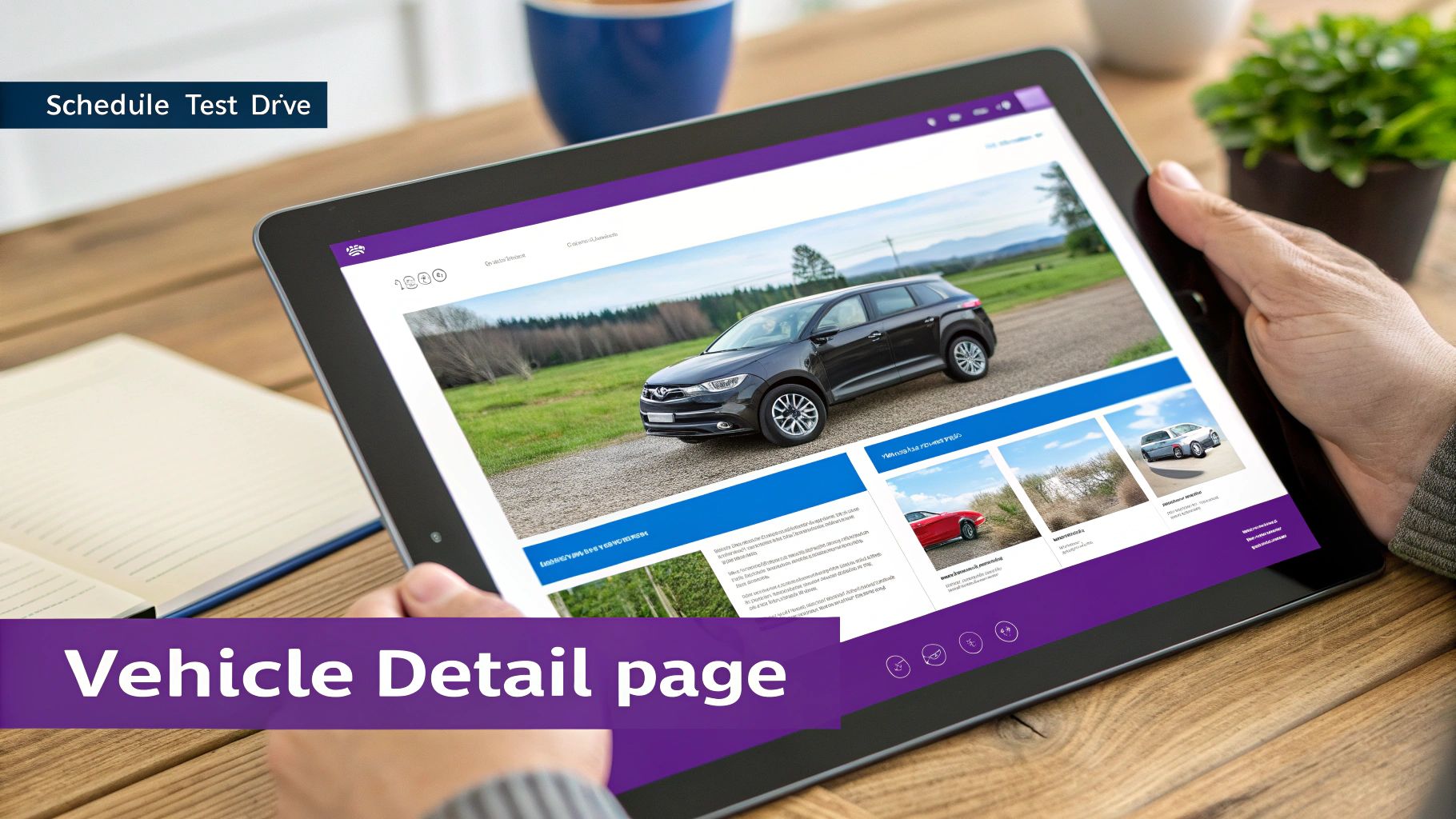
    High-Intent Forms That Actually Convert

    Look, not all lead forms are created equal. If you want to grab the attention of the most motivated buyers, you have to offer them something that makes sense for the next step in their journey.

    Here are the forms you absolutely must have:

    • Value Your Trade: Nine times out of ten, a buyer has a car they need to offload before they can buy yours. A simple, clear trade-in valuation form is a magnet for serious leads.
    • Get Pre-Approved: For shoppers who are thinking about financing, a pre-approval form is the most direct path to a sale. You're capturing highly qualified leads who are already past the "just browsing" stage.
    • Schedule a Test Drive: This is the big one. It's the ultimate goal for anyone looking at a specific vehicle. Having a prominent test drive CTA on every single vehicle detail page isn't just a good idea—it's essential.

    A great website doesn't just show off cars. It anticipates what a buyer is thinking and gives them an immediate way to get an answer. Forms for trade-ins and financing aren't just data-entry fields; they're the start of a real sales conversation.

    We all know the market has its ups and downs. When sales are hot, inquiries tend to rise. But when things cool off, you feel the pressure to convert every single lead that comes in. This is where having the right tools built into your website makes all the difference. Integrated forms and comparison tools can significantly boost your lead quality, helping push your conversion rate from the typical 2% toward 10%. For a small team, a website that can adapt like this isn't a luxury—it's a survival tool.

    Why Following Up Immediately is Non-Negotiable

    Capturing the lead is only half the job. The real work starts now. Many studies have shown that a significant percentage of sales go to the very first dealership that responds to a lead. Speed is everything. If you wait a few hours—or worse, until the next day—that hot lead has already called two other dealers.

    This is where a little bit of automation can be your secret weapon.

    Setting up an instant, automated email or text message is a game-changer. It immediately confirms you got their inquiry and keeps your dealership top-of-mind while they're still in shopping mode. It doesn't have to be fancy, either. A simple message like, "Thanks for your interest in the Ford F-150! A member of our team will be in touch shortly to confirm availability" is all it takes to keep the momentum going.

    That instant acknowledgment makes the customer feel heard and sets a professional tone right from the get-go. Really understanding what CRM lead management involves is the key to turning these website visitors into paying customers. When you combine smart lead capture with lightning-fast follow-up, you build a powerful system that keeps your sales pipeline full.

    Measure What Matters to Refine Your Strategy

    Getting a steady flow of car dealer leads is one thing, but if you don't know what’s actually working, you're just guessing. Tracking your performance is the final, crucial piece of the puzzle for building a predictable sales pipeline. This isn't about getting lost in spreadsheets; it's about zeroing in on a few key numbers that tell you the real story of your dealership's online health.

    Think of the entire process as a journey from that first click to a closed deal.

    A car dealer lead process flow diagram illustrating capture, respond, and convert stages.

    This simple flow shows that your success hinges on how well you capture interest, respond to it, and ultimately convert that person into a buyer. If any link in this chain is weak, you’re leaving money on the table. It's as simple as that.

    Identifying Your Core Metrics

    So, where do you start? You need to figure out which numbers actually matter. A handful of data points can give you a surprisingly clear picture of how your digital showroom is performing. Tools like Google Analytics are free and incredibly powerful for this.

    Here are the essential metrics every dealer should be watching:

    • Website Traffic Sources: Where are people coming from? Knowing if they found you through a Google search, a Facebook ad, or a link from another site tells you which channels are actually pulling their weight.
    • VDP Views: This is a direct measure of shopper interest. Tracking which cars get the most eyeballs helps you stock the inventory your local market is hungry for.
    • Conversion Rate by Form: Are more people filling out your "Value Your Trade" form or clicking the "Schedule a Test Drive" button? This tells you exactly which offers are resonating most with your site visitors.
    • Cost Per Lead (CPL): If you're running paid ads on Google or Facebook, you absolutely must know how much you're spending to get each lead. This is the only way to figure out your return on investment and decide where your ad budget is best spent.

    Measuring performance isn't just about looking back at what happened. It’s about gathering the intelligence you need to make smarter, more profitable decisions tomorrow.

    Using Data to Make Smarter Decisions

    Once you start tracking these numbers, you can begin to connect the dots and see the bigger picture.

    For instance, you might discover your Google Vehicle Listings are driving a ton of traffic to your site, but most of those visitors are bouncing right off your financing page. That's a huge red flag. It’s a clear signal that something on that page needs fixing—maybe the form is too long, the page loads slowly, or the information is just plain confusing.

    On the flip side, what if you see that a blog post you wrote six months ago about "the best family SUVs under $15k" is still bringing in consistent local traffic? That's your cue to create more content just like it.

    This data-driven approach takes the guesswork out of your marketing. You can confidently double down on what’s working and systematically fix what isn’t, creating a cycle of continuous improvement that brings in more—and better—car dealer leads over time.

    Answering Your Top Questions About Car Dealer Leads

    Trying to get a handle on online lead generation can feel like a lot, especially when you’re busy with the day-to-day of running your dealership. We get a ton of questions from independent dealers trying to make sense of it all, so let’s tackle some of the most common ones right now.

    These answers should help clear things up and give you a solid starting point.

    How Many Leads Should a Small Dealership Realistically Expect Each Month?

    This is the question on every dealer's mind, and the honest answer is: it depends. Your market, the size of your inventory, and how much you're marketing all play a huge role. That said, a small dealership with a good website and solid local SEO should aim for 25-50 qualified leads per month. That's a strong, achievable goal.

    The real key here is to focus on the quality of the leads, not just the raw number. Think about it—one lead from a local buyer who searched for the exact F-150 you have on your lot is worth more than a dozen random clicks from a generic ad. Once you build a strong digital foundation, you'll find that quality lead volume starts to grow naturally.

    Your goal isn't just to get clicks; it's to start real conversations. A smaller number of high-intent leads will always outperform a large volume of unqualified traffic, leading to better conversion rates and a healthier sales pipeline.

    What's the Most Cost-Effective Way to Get Car Dealer Leads?

    For the long haul, nothing beats the combination of organic search traffic from a well-built website and Google Vehicle Listings (GVL). Sure, paid ads on platforms like Facebook or Google can get you leads fast, but they come with a catch: the moment you stop paying, the leads dry up.

    On the other hand, when you invest in your website’s SEO and make sure your inventory is automatically sent to GVL, you're building a sustainable asset. This approach brings in a steady stream of free, high-intent traffic from shoppers who are actively looking for the cars you sell. It’s a strategy that generates car dealer leads without a constant per-click cost, delivering a much better return over time.

    Do I Need a Custom Website, or Is a Template Platform a Better Idea?

    For almost every independent dealer out there, a specialized dealership platform is the smarter, more practical choice. A fully custom website sounds nice, but they are incredibly expensive, often take months to build, and require constant technical maintenance that you just don't have the time or budget for.

    Platforms built specifically for dealers, like AutoFire, come with all the critical features you need, ready to go from day one.

    • Inventory Management: You can add and update your vehicle listings in minutes.
    • VIN Decoding: It automatically pulls in all the vehicle's features and specs for you.
    • GVL Integration: This ensures your cars show up right in Google's search results where people are looking.

    With these tools already built-in, you can focus your energy on selling cars instead of wrestling with web developers and technical glitches. It's simply a faster, more affordable, and more effective way to get online and start generating leads.


    Ready to turn your website into a lead-generating machine without the technical headaches? AutoFire delivers fast, mobile-first websites with built-in tools designed to capture high-quality car dealer leads from day one. Get started for free and see how it works.