Your website is your dealership's most powerful salesperson. It's the one that works 24/7, never calls in sick, and makes the first impression on almost every single one of your customers. The goal is to design a site that effortlessly turns those online lookers into real-life test drivers.
It all comes down to a smart mix of intuitive design, blazing-fast mobile speed, and a vehicle showcase that builds trust before anyone even thinks about stepping onto your lot.
Your Website Is Your Most Important Showroom
Think about what happens when a customer walks onto your physical lot. You want the entrance to be immaculate, the cars gleaming, and the whole place easy to get around. A salesperson is right there, ready to help, not hiding in some back office.
That's exactly what your website should be. For the vast majority of car buyers today, the journey begins with a Google search, and your site is that crucial first handshake.
This digital showroom never closes. It’s making an impression at 10 PM on a Tuesday just as much as it is on a Saturday afternoon. A slow, cluttered, or confusing website is the digital version of a dirty lot with cars parked haphazardly—it screams unprofessionalism and sends potential buyers straight to your competition.
Building Trust Before the Test Drive
A well-designed dealership website does more than just display your inventory; it builds genuine credibility. The aim is to create an online experience that mirrors the confidence and trust you want customers to feel when they're talking to you in person.
You get there with a few key, non-negotiable elements:
- Effortless Navigation: Shoppers need to find what they're looking for, fast. If they can't filter for "used SUVs under $25,000" in a couple of clicks, they're gone.
- Transparent Information: Pricing, vehicle history, and contact info should be crystal clear. Hiding details or making them hard to find just breeds suspicion.
- Professional Visuals: High-quality photos and videos are essential. Grainy, poorly-lit images make it seem like you have something to hide.
Your website isn't just a gallery of cars. It's an environment carefully engineered to answer questions, eliminate doubts, and guide a visitor confidently toward taking that next step—be it a test drive, a finance application, or a phone call.
Every single piece of your site, from how fast it loads on a phone to how simple your contact forms are, plays a critical role. A high-performance website isn't just a nice-to-have; it's the engine that drives qualified buyers to your door, setting the stage for every sale that follows.
7. The Blueprint for a High-Converting Website
Think of your website as your best salesperson—the one who works 24/7. A great site doesn't just display cars; it guides every visitor from the moment they land on your homepage toward the perfect vehicle for them. This all starts with a clean user interface (UI) and dead-simple navigation.
Your navigation menu is like the signage in your physical showroom. It needs to be crystal clear, pointing people to "Used Cars," "Financing," and "Contact Us" without a second thought. When people can find what they want effortlessly, they stick around, look at more of your inventory, and are way more likely to become a lead. A cluttered, confusing site just creates friction, sending potential buyers clicking away in frustration.
This diagram breaks down how the key pieces of your digital showroom—navigation, inventory, and lead capture—all fit together to create a smooth path for your customers.
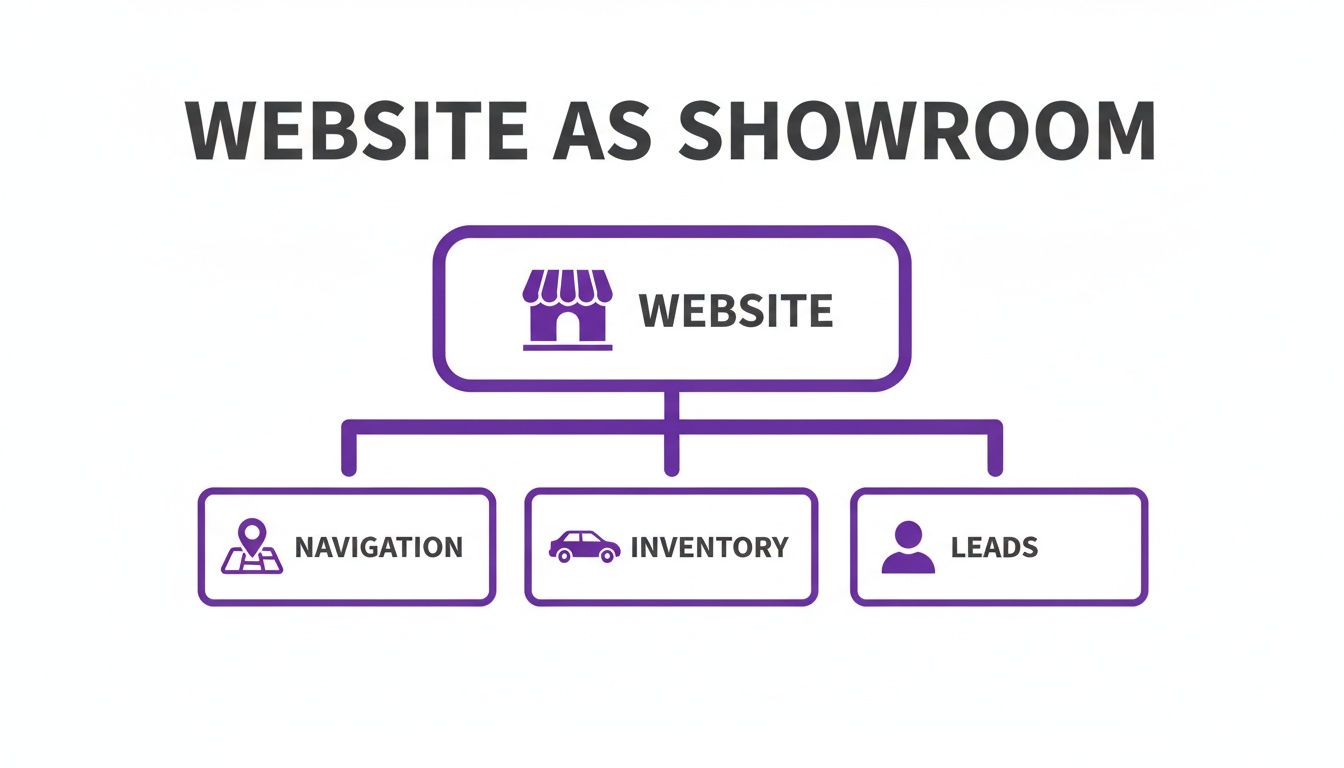
As you can see, a solid, user-friendly navigation system is the foundation that holds up everything else, from powerful inventory tools to effective lead funnels.
To really nail this, let's look at the essential features every modern dealership site needs. Think of this as your pre-flight checklist before you build or redesign your website.
Essential Features of a Modern Dealership Website
| Feature Category | Must-Have Element | Why It Matters |
|---|---|---|
| User Experience (UX) | Clean, intuitive navigation and mobile-first design | Makes it easy for visitors to find what they need on any device, reducing bounce rates. |
| Inventory Management | Powerful search with multiple filters (make, model, price, etc.) | Connects buyers with the right car quickly, turning browsing into a serious shopping experience. |
| Vehicle Pages (VDPs) | High-res photos/videos, 360° views, and detailed specs | Builds trust and confidence in the vehicle, mimicking an in-person inspection. |
| Lead Generation | Clear Calls-to-Action (CTAs) and simple contact forms | Guides the visitor to take the next step, like scheduling a test drive or asking a question. |
| Trust Building | Customer testimonials, vehicle history reports, and transparent pricing | Overcomes buyer skepticism and establishes your dealership as a credible, honest business. |
Getting these core elements right isn't just about having a pretty website; it's about building a machine that consistently turns website traffic into real-world customers.
The Heart of the Website: Powerful Inventory Search
Let's be honest: the main reason people come to your site is to look at cars. Your vehicle search tool is the absolute centerpiece. Shoppers show up with a mission, and your job is to help them find their target as fast as possible. A powerful search function isn't a perk; it's the engine that drives your entire online operation.
At a minimum, your search filters must include:
- Make and Model: The absolute basics. Non-negotiable.
- Price Range: Lets shoppers instantly filter for cars they can actually afford.
- Body Style: Crucial for helping someone find that SUV, sedan, or truck they have in mind.
- Mileage: A top consideration for any used car buyer trying to gauge a vehicle's remaining life.
- Features: Allows shoppers to zero in on their "must-haves," like leather seats, a sunroof, or a specific tech package.
The easier you make it for someone to find a "blue used SUV under $20,000 with less than 50,000 miles," the closer you are to making a sale. This is where a great user experience directly impacts your bottom line.
Anatomy of the Perfect Vehicle Detail Page (VDP)
When a shopper clicks on a car, they land on the Vehicle Detail Page (VDP). This is your make-or-break moment. It’s your digital sales pitch for that one specific vehicle, and it has to be perfect. A VDP that converts is designed to build trust and push the visitor to take action.
Every single element on your VDP should do one of two things: build the customer's confidence in the car, or make it ridiculously easy for them to take the next step. This is the most important conversion point on your entire website.
To get it right, your VDP needs a few key ingredients:
High-Resolution Photo Gallery: I'm talking at least 20-30 crystal-clear photos. Show every angle—inside, outside, even the dings and scratches. Lousy, blurry photos are the quickest way to kill a buyer's trust.
360-Degree Views: An interactive view of the interior and exterior lets people "sit" in the car from their couch. It's an immersive experience that gets them excited and builds serious confidence.
Transparent Pricing: Put the price front and center. No hiding it. Include a simple breakdown of any fees and add a payment calculator so shoppers can see what their monthly payment might look like.
Detailed Vehicle Information: List all the important specs, features, and the VIN. Embedding a vehicle history report right on the page is a massive trust signal.
Clear Calls-to-Action (CTAs): Your VDP needs big, obvious buttons like "Schedule Test Drive," "Check Availability," or "Get Pre-Approved." These CTAs are what turn a casual browser into a hot lead.
On top of a great layout, adding chat widgets for websites can be a game-changer. It lets you have a real-time conversation with a shopper while they’re looking at a car, answering their questions on the spot before they get distracted and leave. By mastering these core pieces, you transform your website from a simple online brochure into a powerful machine that generates high-quality leads around the clock.
Winning with Mobile-First Design and Page Speed
Picture this: a customer walks onto your lot, eager to see a specific car. Would you show it to them in a dark, cramped garage where they can't even open the doors? Of course not. You'd bring them into a brightly lit showroom where the car shines.
Your website's mobile experience is that digital showroom. For the vast majority of your customers, it's the first impression they'll ever have of your dealership.
Today's car shoppers live on their phones. A clunky website that’s slow to load is the digital equivalent of that dark, messy garage—it’s an instant turn-off that sends potential buyers running to your competitor's site. That's why a mobile-first design isn't just a nice-to-have; it's a core business strategy. It means you build the website experience for the smallest screen first, then scale it up for desktops.
This isn't just about making things look good. Google now primarily uses the mobile version of your site to determine its search rankings. A bad mobile site doesn't just frustrate users; it makes you invisible to local buyers searching for their next vehicle.
Why Speed Is Your Ultimate Conversion Tool
Beyond just looking good, your site needs to be fast. Lightning fast. Every single second a customer waits for a page to load is another reason for them to give up and leave. Modern buyers expect things to be instant, and their patience is incredibly thin.
This has a very real impact on your sales. According to industry data, over half of all traffic to dealership websites comes from a mobile device. Bounce rates can skyrocket on slow mobile sites because shoppers simply refuse to wait for vehicle photos and payment calculators to load. For an independent dealer, that's a massive chunk of potential business vanishing before they've even seen a single car.
Page speed isn't some technical jargon for your IT guy. It’s a direct measure of how much you respect your customer's time. A fast website builds trust instantly, while a slow one shatters it.
Think about it: a fast, snappy site keeps people browsing your inventory. They look at more cars, they engage with your content, and they are far more likely to fill out a credit application or give you a call. Speed is one of the most powerful conversion tools you have.
Practical Steps for a Faster Mobile Site
You don't need a team of Silicon Valley engineers to make your site faster. It really comes down to a few key things that make the biggest difference. A great car dealership website design is all about being efficient without cutting corners on quality.
Here are a few actionable tips to get you started:
- Optimize Your Images: Great photos sell cars, but massive, uncompressed image files are the #1 killer of website speed. You need to shrink those file sizes down without sacrificing quality. We have a whole guide on how to optimize images for the web that walks you through the process.
- Minimize Complex Scripts: All those third-party widgets for chat, analytics, or ads can really bog down your site. Take a hard look at what you’re running and cut anything that isn't absolutely essential. Every script is another thing a customer’s phone has to download.
- Keep the Design Clean and Focused: A cluttered design with flashy animations and constant pop-ups might look cool, but it often slows performance to a crawl. The best designs are clean, simple, and guide the user straight to what they’re looking for: your cars.
By adopting a mobile-first mindset and obsessing over page speed, you ensure your digital showroom is always open, welcoming, and ready to turn browsers into buyers.
Driving Traffic with Automotive SEO
So you've built a brilliant website. That's a huge step, but how do you make sure local car shoppers find it before they find your competition? The answer lies in a smart, targeted approach to automotive search engine optimization (SEO).
Think of SEO as the digital equivalent of a sign-spinner on the busiest intersection of the internet. Its job is to grab the attention of high-intent shoppers and point them directly to your online showroom. A great dealership website has SEO baked in from the very beginning—it’s not just an add-on, it’s the engine that powers your online visibility.
Without a solid SEO strategy, even the most stunning website will sit empty, like a dealership built on a dead-end road with no signs. For car dealers, this goes way beyond generic advice. It's about fine-tuning every single part of your site to answer the exact questions local buyers are typing into Google, whether it's "used Honda CR-V near me" or "best family SUVs under $30,000."
Optimizing Your Vehicle Detail Pages
Your Vehicle Detail Pages (VDPs) are absolute goldmines for SEO. Each VDP is a unique chance to rank for those super-specific, long-tail keywords that signal a customer is ready to buy. Simply using the generic, manufacturer-supplied descriptions just won't cut it anymore.
To really stand out, every VDP needs a unique, hand-written description. Don't just list features—tell a story. Mentioning the "spacious cargo area perfect for weekend camping trips" or the "advanced safety features ideal for a growing family" does two things: it connects with buyers on an emotional level and helps you rank for more natural, conversational search terms.
Another critical piece of the puzzle is structured data, also known as schema markup. This is basically a snippet of code that acts as a translator, telling Google exactly what your page is about. It clarifies that this is a specific vehicle for sale, along with its price, mileage, and location. This is the secret sauce for getting your inventory featured in Google's special vehicle listings, putting your cars front and center for motivated shoppers.
Mastering Local SEO for Your Dealership
For any dealership, winning the local search battle is everything. Your most valuable customers are the ones right in your own backyard. Local SEO is what ensures that when someone in your town searches for a car, your dealership is the first one they see.
Here's how to start dominating your local market:
- Google Business Profile (GBP): Think of your GBP as your digital storefront on Google Search and Maps. It needs to be perfect. Keep it meticulously updated with your correct address, hours, phone number, and a link to your website.
- Generate Positive Reviews: Reviews are incredibly powerful social proof. Make it a habit to actively encourage happy customers to leave reviews on Google. It's also vital to respond to all feedback—both positive and negative—to show you're an engaged and trustworthy business.
- Build Local Citations: Make sure your dealership's name, address, and phone number (what we call "NAP") are perfectly consistent across all online directories, like Yelp, and other local business listings.
Your local SEO strategy is what connects your digital presence to your physical lot. It builds a foundation of trust and authority within your community, making your dealership the obvious choice for nearby buyers.
Attracting Buyers with Helpful Content
Beyond just optimizing your inventory pages, you can draw in buyers much earlier in their journey by creating genuinely helpful content. Think about the common questions you get from customers every single day, and turn the answers into blog posts or guides.
Creating content like "Comparing the Top SUVs for Families" or "What to Look for When Buying a Used Truck" establishes your dealership as a trusted local expert. This strategy pulls in shoppers who are still in the research phase, letting you build a relationship long before they're ready for a test drive. When you provide real value upfront, your dealership will be the first one they think of when it's time to buy.
For a deeper dive into these strategies, check out our comprehensive guide on SEO for automobile dealerships.
Finally, don't overlook site speed—it's a critical, non-negotiable part of modern SEO. Site speed is the silent killer, or savior, of car dealership websites, especially as Google leans even more heavily on Core Web Vitals for its rankings. Industry leaders have shown that every second of delay can slash conversions by a staggering 7%. A slow site causes bounce rates to spike and trust to evaporate before a shopper even gets a chance to see your inventory. For independent dealers, where every single lead is precious, this metric is pure revenue gold.
As search evolves, staying ahead of the curve is key. Understanding the principles of A Guide to AI Search Engine Optimization (AEO) is quickly becoming essential for driving traffic effectively.
Designing Your Website to Generate Leads
Getting traffic to your site is just the first step. The real goal? Turning those anonymous clicks into qualified leads that actually grow your dealership. A great website doesn't just look good; it's a finely-tuned machine designed to guide visitors from casual browsing to taking that next step with you.
Think of your website not as a digital brochure, but as your best salesperson, working 24/7. It's all about building rock-solid trust and making it incredibly easy for a shopper to move forward—whether that’s scheduling a test drive, getting a trade-in value, or starting a finance application. Every button, image, and line of text has to work together to gently nudge them in the right direction.
This all comes down to placing clear, compelling calls-to-action (CTAs) where people expect to see them and making your lead forms so simple they’re a breeze to fill out.
Optimizing Your Lead Capture Forms
Your lead forms are the handshake that seals the deal online. A clunky, confusing form is like shoving a mountain of paperwork at a customer the second they walk onto the lot—it’s an instant turn-off. The secret is to keep each form short, intuitive, and focused on one specific job.
- Contact Forms: Keep it simple. All you really need is a name, email or phone, and a message box. Anything more is just a reason for them to click away.
- Test Drive Forms: Add fields for the specific vehicle and a preferred date and time. This gives your team actionable information to follow up on immediately.
- Trade-in Estimators: These are absolute gold for lead generation. Ask for the vehicle basics (VIN, make, model, mileage) and their contact info so you can send them the estimate.
- Credit Applications: This one is naturally longer, so break it into smaller, manageable chunks. Guiding them through step-by-step makes the process feel far less intimidating and dramatically reduces the chance they’ll give up halfway through.
No matter the form, make sure it works flawlessly on a phone, loads in a snap, and gives a clear "Thank You" message after submission. Every bit of friction you remove is a direct boost to your conversion rate.
Building Unbreakable Trust with Shoppers
Before anyone hands over their personal information, they have to trust you. Trust is the currency of the car business, online and off. Your website needs to scream "credible, professional, and customer-first" from every corner.
People buy from people they trust. Your website's job is to build that trust with every pixel, photo, and paragraph, making shoppers feel confident and secure long before they step onto your lot.
A few key elements are non-negotiable for building this trust:
- Showcase Customer Testimonials: Real reviews from happy customers are powerful social proof. Put them right on your homepage and even sprinkle them into your vehicle detail pages.
- Feature Your Team: An "About Us" page with friendly photos and short bios of your staff puts a human face to your dealership. It reminds people they’re dealing with real folks, not a faceless company.
- Provide Clear Contact Information: Your phone number, address, and business hours should be impossible to miss on every single page. If a customer has to hunt for it, they’ll assume you’re hiding something.
Beyond the basics, AI-powered personalization is really changing the game, with dealers seeing significant conversion lifts when they get it right. Imagine a shopper looks at your SUVs on Tuesday. When they come back on Thursday, your homepage greets them with specific offers on those exact models, complete with payment calculators already running. This isn't futuristic stuff anymore. AI tools analyze behavior to serve up dynamic, relevant content that makes the customer feel understood, shortening the sales cycle. For a deeper dive into this technology, it's worth exploring the emerging website cost trends for 2026.
Choosing the Right Path for Your Website
So, you’ve got a solid blueprint for what makes a great dealership website. Now comes the big question: how do you actually build it? Figuring out the best way to get your site online can feel like a huge task, but it really boils down to three things: your budget, your time, and your long-term vision.
For most independent dealers, there are three main roads you can take. Each one has its own set of pros and cons. Nailing this decision upfront saves you from a world of expensive headaches down the line and makes sure your online showroom is built to last. Let's walk through these options so you can see which one makes the most sense for your dealership.
Comparing Your Website Options
The route you pick will shape everything from your launch day costs to how much time you spend tinkering with the site each week. A do-it-yourself builder gives you a ton of creative freedom, but it also demands a ton of your time. At the other end, a custom agency can build your dream site, but it comes with a serious price tag. Specialized platforms are designed to hit that sweet spot in the middle.
Getting a handle on these trade-offs is the key to making a smart call that helps you grow without turning you into a full-time IT guy.
The best website solution is one that lets you focus on selling cars, not on becoming a part-time web developer. Your goal is to find a tool that handles the technical complexities so you can manage your inventory and leads with ease.
To make this crystal clear, here’s a simple table breaking down the three paths you can take.
Dealership Website Options Compared
This comparison lays out the most common ways for an independent dealer to get a website, helping you choose the best path for your business.
| Option | Best For | Initial Cost | Maintenance Effort | Key Advantage |
|---|---|---|---|---|
| DIY Website Builders | Tech-savvy dealers on a tight budget who have ample time. | Low | High | Total creative control and minimal upfront expense. |
| Custom Agency | Large, established dealerships with a significant budget. | Very High | Low | A completely bespoke design tailored to exact specifications. |
| Automotive Platforms | Independent dealers who need a professional site quickly. | Low/Moderate | Very Low | Built-in automotive features like VIN decoding and inventory feeds. |
After looking at the options, it's clear that each path serves a different type of dealership. The right choice depends entirely on your specific resources and priorities.
Finding the Smartest Path Forward
For the vast majority of independent dealers, a specialized automotive platform just makes the most sense. It’s the Goldilocks solution—not too expensive, not too time-consuming, but just right. These platforms are built from the ground up with one purpose: to help you sell cars online.
Unlike a generic DIY builder where you have to bolt on features with clunky plugins, these services come with all the essentials baked right in. Think VIN decoding, inventory feeds, and lead capture forms designed specifically for car buyers. For a deeper dive into how these tools are structured, check out our guide on the benefits of a dedicated car dealership website builder.
This all-in-one approach is a game-changer, especially for small teams. The platform provider handles all the technical heavy lifting—security updates, hosting, mobile-friendliness—freeing you up to do what you actually do best.
At the end of the day, your decision has to match your reality. A custom-built site from an agency is a luxury that few can afford, both in time and money. A DIY site might look cheap on paper, but the hours you’ll pour into fixing, updating, and troubleshooting are a hidden cost that adds up fast. A platform built for dealers gives you a high-performance, professional website without the crippling price tag or the constant technical headaches.
Frequently Asked Questions
Building a new website for your dealership can feel like a big project, and it's natural to have questions. Let's tackle some of the most common ones we hear from independent dealers.
How Much Does a Good Car Dealership Website Cost?
The price tag can swing wildly depending on how you approach it. If you hire a marketing agency for a fully custom build, you can expect to pay anywhere from $10,000 to over $25,000. For most independent lots, that’s a hefty upfront investment.
Thankfully, there's a much more budget-friendly route. Modern automotive SaaS platforms give you a professional, high-performance website for a simple monthly subscription, often under $100. This model gets rid of the intimidating upfront cost and makes top-tier web design accessible to any dealer.
What Is the Most Important Feature on a Dealer Website?
Hands down, the single most critical feature is your inventory search. It has to be fast, and it has to work flawlessly on a phone. The vast majority of people landing on your site are there for one reason: to see your cars.
If a potential buyer can't quickly filter your vehicles, see great photos, and pull up specs on their smartphone in seconds, they're gone. They’ll just bounce over to your competitor's site. How you present your inventory can make or break your online success.
Think of your inventory pages as the final handshake before a test drive. If the experience is slow, confusing, or untrustworthy, you lose the deal before it even begins. A seamless inventory experience is non-negotiable.
Ultimately, everything comes back to the cars. Effective website design is all about closing the gap between a curious browser and an interested buyer.
How Long Does It Take to Launch a New Website?
The timeline really depends on the path you take. A custom agency project is a long haul—you're typically looking at three to six months from the first meeting to the day you go live.
For a dealer who needs to get up and running now, that kind of wait just isn't practical. This is where specialized platforms shine. You can sign up, add your cars, and connect your domain to get a professional, fully functional website live in just a few hours. That speed means you can start bringing in leads almost immediately.
Do I Need Technical Skills to Manage My Website?
Not at all. The best platforms today are built for business owners, not developers. You shouldn't have to know a single line of code to run your online showroom.
You should be able to manage everything from a simple dashboard—adding new cars, updating prices, or changing your business hours. All the complicated stuff like security, software updates, and server maintenance is handled for you, leaving you free to do what you do best: sell cars.
Ready to launch a professional, high-performance website that captures leads without the technical headaches? With AutoFire™, you can get a stunning, mobile-first dealership site live in minutes. Our platform is built specifically for independent dealers, handling all the complex SEO, inventory management, and design work so you can focus on selling cars.