Tag: local SEO for dealers

  • Dealership Digital Marketing A Modern Playbook For Independent Dealers

    Dealership Digital Marketing A Modern Playbook For Independent Dealers

    Dealership digital marketing simply means using your online presence—your website, social media, and search engines—to find and sell to car buyers. Let's be honest, it's not an optional add-on anymore; it’s the core of your business. The vast majority of a car buyer’s journey now takes place online, long before they even think about visiting your lot.

    Why Your Dealerships Digital Front Door Matters More Than Ever
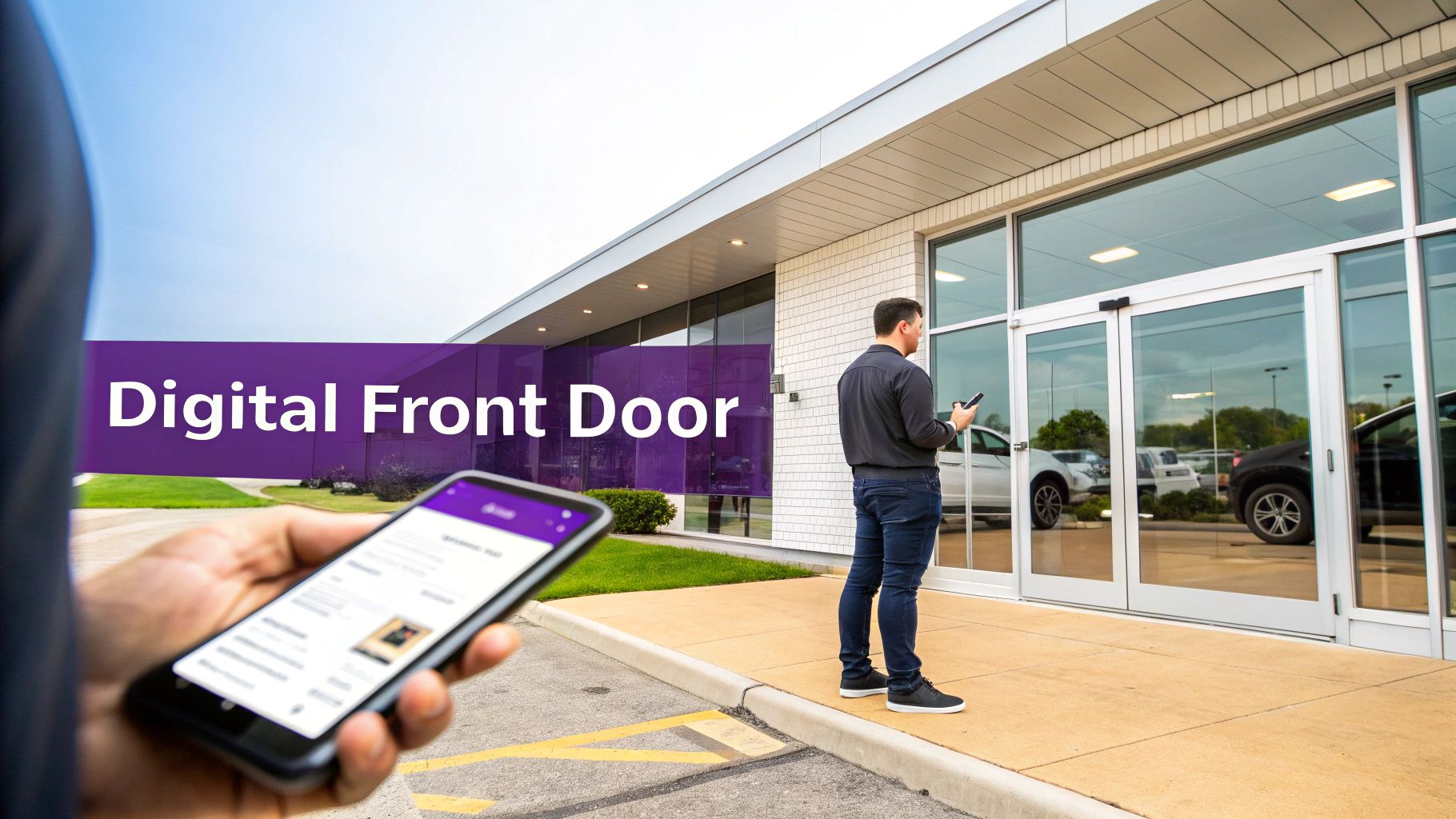
    Two people using smartphones in front of a modern dealership entrance with 'Digital Front Door' text.

    The way people buy cars has been completely flipped on its head. The days of families spending their weekends hopping from one dealership to the next are over. Today, your website is your primary showroom, and it’s open 24/7. This playbook is built to help you turn that "digital front door" into a machine that consistently brings in revenue.

    This new reality puts a ton of pressure on independent dealers to keep up online. Think of your website, your local search rankings, and how you follow up with leads not as separate jobs, but as gears in a single engine. When they all turn together smoothly, you create a clear, easy path for a customer to go from a Google search right to your showroom.

    The Modern Car Buyer Journey Starts Online

    Get this: a staggering number of car buyers now do their research online. They're spending hours digging into different options before they ever come to see a car in person. For independent dealers, this is a game-changer, since many of these shoppers are using search engines, review sites, and their phones to compare everything from prices to models.

    What does that mean for you? It means your first impression isn't a firm handshake—it's how fast your website loads and whether a customer can easily browse your inventory on their phone. Your marketing has to show up where your buyers are spending their time: on Google, Facebook, and local review sites.

    Your online presence is the most critical factor for survival and growth. It’s where trust is built, inventory is discovered, and sales are won or lost long before a test drive.

    Connecting the Dots for Success

    A winning digital marketing plan isn't about jumping on every new, flashy trend. It’s about getting the fundamentals right—the things that actually drive car sales. As your digital front door becomes more important, it's also worth looking into powerful tools like video marketing in the automotive industry to really stand out.

    This guide will give you a clear, step-by-step playbook to put those fundamentals in place. We'll cover:

    • Building a high-performance website that actually turns visitors into solid leads.
    • Using smart local SEO so you show up first for all those "car dealer near me" searches.
    • Creating a bulletproof lead follow-up process to make sure every click has a chance to become a customer.

    By connecting these pieces, you’re not just attracting buyers; you’re building a system that makes sure no opportunity ever slips through the cracks.

    Your Website: The Digital Showroom That Turns Clicks Into Customers
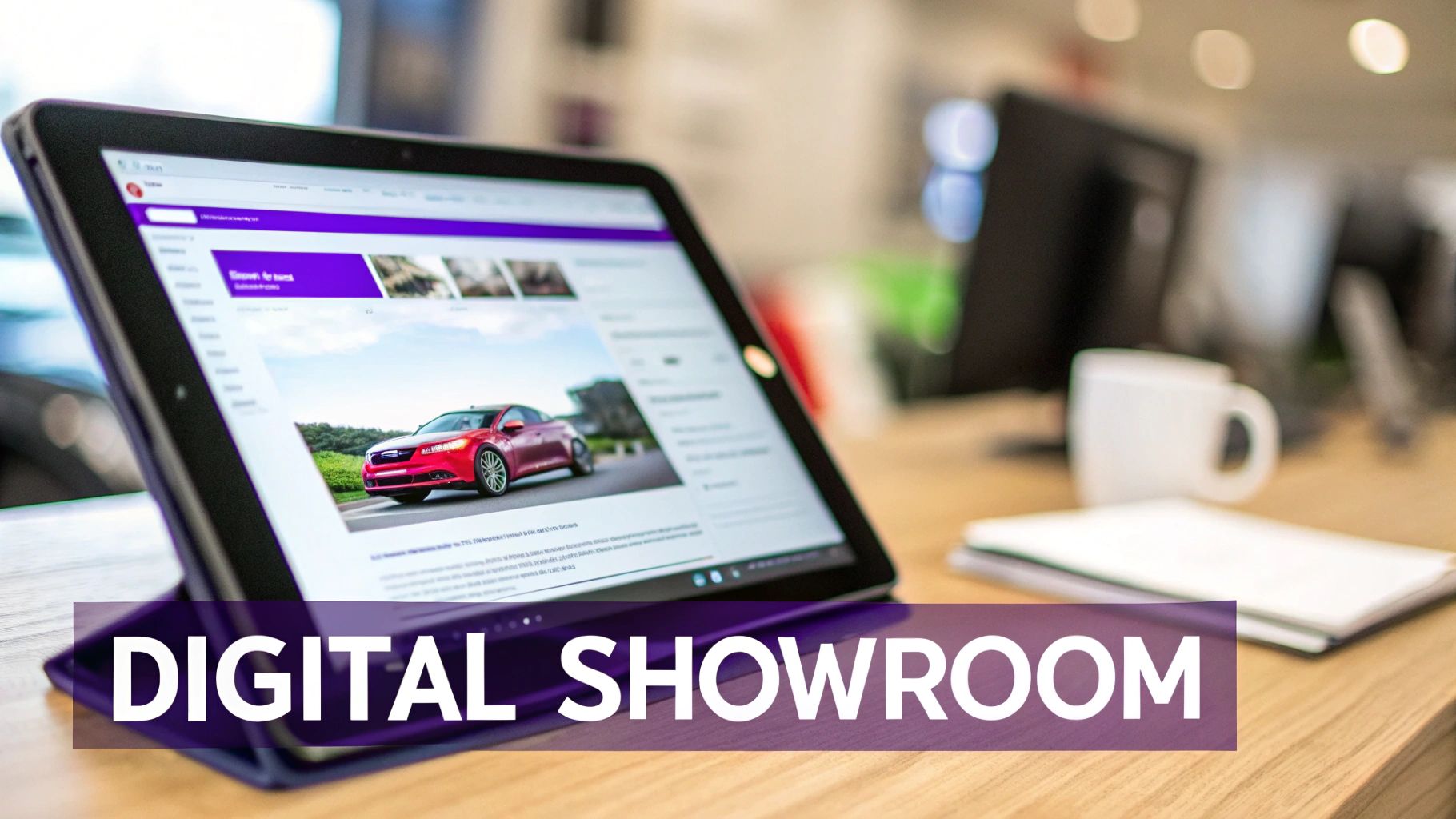
    A tablet displays a red car on a digital showroom website, with 'DIGITAL SHOWROOM' text overlay.

    Think of your website as your best salesperson. It’s working 24/7, never calls in sick, and for most potential buyers, it’s the very first handshake they get from your dealership. A clunky, slow-loading site is like having a salesperson who ignores customers at the door—it actively drives business away.

    Your website can't just be an online brochure. It needs to be a lean, mean, lead-generating machine, built from the ground up to turn casual lookers into qualified buyers. This is where your entire digital marketing effort begins: a fast, intuitive website that’s designed to convert.

    It All Starts With Speed and a Flawless Mobile Experience

    In an age of endless scrolling and zero patience, website speed isn't a feature; it's everything. A slow site is a deal-killer. We've all been there—if a page takes more than a couple of seconds to load, we're gone. For a car shopper flipping between tabs to compare inventory, even a one-second lag can send them straight to your competitor down the street.

    Just as critical is the experience on a smartphone. Most car research happens on a mobile device, whether a customer is on their lunch break or killing time in a waiting room. This means your site needs a mobile-first design—not just a shrunken-down version of your desktop site. It needs to be built for thumbs, with big buttons, clean layouts, and text that’s easy to read without pinching and zooming.

    The table below breaks down the key features your site absolutely needs and explains why they matter for an independent dealer trying to capture every possible lead.

    Essential Website Features for Lead Conversion

    Feature Why It Matters for an Independent Dealer How It Drives Sales
    Mobile-First Design A majority of car research starts on a smartphone. A bad mobile experience means losing most of your audience. An easy-to-use mobile site keeps buyers engaged, making them more likely to fill out a form or call you.
    Fast Page Load Speed Even a one-second delay can hurt conversions. Slow sites frustrate users and can impact your Google rankings. A quick, snappy site provides a professional impression and keeps potential buyers on your VDPs longer.
    High-Quality VDPs The Vehicle Detail Page (VDP) is your virtual sales pitch. It's where the customer decides if a car is worth pursuing. Great photos, videos, and clear CTAs on the VDP directly lead to test drive requests and financing applications.
    Multiple Lead Forms Not everyone is ready for a test drive. Offer forms for trade-in valuation, financing pre-approval, and general inquiries. More options to connect means you capture leads at different stages of their buying journey, not just the "ready-to-buy" ones.
    Click-to-Call Buttons Mobile users often prefer to call directly. Making it easy removes a step and connects you with a motivated buyer instantly. A simple tap connects a customer to your sales team, turning online interest into a real conversation immediately.

    Ultimately, every button, form, and page on your site should be designed with one goal in mind: making it incredibly simple for a customer to take the next step.

    Your Vehicle Detail Pages (VDPs) Are Your Pitch

    The VDP is where the magic happens. This is your digital handshake, your walkaround, and your sales pitch all rolled into one. It’s where a shopper decides whether your car is worth their time. A great VDP is the heart of any dealership digital marketing plan.

    Here’s what every single one of your VDPs needs:

    • Tons of High-Quality Photos & Video: Don't skimp here. Show every angle—inside, outside, the engine bay, tires, and even close-ups of any unique features or flaws. A quick 60-second video walkaround is even better; it builds trust and gives buyers a genuine feel for the vehicle.
    • Honest, Compelling Descriptions: Ditch the factory spec sheet copy. Tell the car's story. Is it a one-owner vehicle? Great for road trips? Mention its condition honestly and frame it as a solid value.
    • Upfront, Transparent Pricing: No one likes surprises. Display your price clearly. If you offer financing or have special deals, spell it out simply. Confusing pricing is the fastest way to lose a buyer's trust.
    • Crystal-Clear Calls-to-Action (CTAs): Tell visitors exactly what to do next. Big, bold buttons like "Schedule Test Drive," "Get Pre-Approved," or "Make an Offer" guide them down the path to becoming a lead.

    When you nail your VDPs, you create a smooth, frictionless journey for the customer. For a deeper dive, check out our guide on how to improve website conversion rates for your dealership.

    Get Front-and-Center with Google Vehicle Listings

    One of the single most powerful free tools for dealers today is Google Vehicle Listings. When a local shopper searches for a "used Ford F-150," Google can show your actual inventory right on the search results page—complete with your photos, your price, and a direct link to your VDP.

    Getting your cars to show up here is a game-changer. It’s like having a free billboard on the busiest digital highway in town.

    To make this work, your website needs to handle two technical tasks:

    1. Structured Data: This is a bit of code on your VDPs that acts like a name tag, telling Google all the critical details about each car: make, model, VIN, mileage, price, and so on.
    2. Inventory Feed Management: Your site needs to automatically package up your inventory data and send it to Google in a format it can read, ensuring it's always up-to-date.

    Getting your inventory into Google Vehicle Listings is no longer a "nice-to-have"—it's a must. You're putting your exact cars in front of highly motivated buyers the moment they start looking.

    This is where the right technology partner makes all the difference. Platforms like AutoFire™ are built to do this heavy lifting for you. The system automatically formats your VDPs with the right code and manages the inventory feed to Google, so your vehicles are always eligible to appear in these high-value search results. It removes the technical headache so you can focus on what you do best: selling cars.

    Winning the Local Search Battle In Your Own Backyard

    A great website is your digital showroom, sure. But let’s be honest—most of your customers live just a few miles down the road. This is where local search engine optimization (SEO) comes into play, and it's your absolute best friend. It’s the art and science of making sure that when someone in your town searches for "used trucks near me," your dealership is the first one they see.

    For an independent dealer, winning this local battle is everything. You're not trying to out-muscle national chains across the country. You're focused on being the obvious, go-to choice for buyers right in your community. Mastering local SEO is how you plant your flag and own your turf.

    Your Google Business Profile Is Your Digital Handshake

    Long before a potential buyer even thinks about clicking to your website, they'll bump into your Google Business Profile (GBP). This is that handy info box that pops up on Google Maps and in local search results, showing off your dealership’s name, address, hours, photos, and reviews. Think of it as your digital storefront on Google itself.

    An incomplete or outdated GBP is a huge red flag, not just for customers but for Google, too. It tells them you might not be on top of your game, and you can get completely buried in the search results. You need to treat this profile with the same care you give your physical lot.

    To really make your GBP work for you, dial in on these areas:

    • Fill Out Everything: Don't skip a single field. Fill out your service categories ("Used Car Dealer," "Auto Repair Shop"), attributes ("Financing available," "Veteran-led"), and write a solid business description packed with the kinds of keywords your customers are searching for.
    • Show, Don't Just Tell: Ditch the default Google Street View image. Get in the habit of regularly uploading high-quality, current photos of your inventory, your team, your lot, and even happy customers picking up their new ride. A quick video walkthrough can make a massive difference.
    • Own the Q&A Section: People will ask questions directly on your profile. Jump on those and answer them quickly and clearly. You can even get ahead of the game by asking and answering your own FAQs, like "Do you take trade-ins?" or "What are your Saturday hours?"

    Your Google Business Profile is often the real first impression a local buyer has of your dealership. Keeping it meticulously updated, accurate, and active isn't just a good idea—it's non-negotiable.

    Building Trust Through Reviews and Consistency

    Positive reviews are the fuel for your local SEO engine. They give potential buyers powerful social proof and send a clear signal to Google that you're a legitimate, trustworthy business. A steady flow of four- and five-star reviews will absolutely help you climb the rankings in the coveted "local pack" map results.

    Make it dead simple for happy customers to leave you a review. A quick follow-up text or email with a direct link to your GBP review page right after a sale works wonders. And just as important: respond to all reviews. Thanking someone for a great review shows you’re paying attention, and addressing a negative review professionally can turn a bad situation around while showing other shoppers you genuinely care.

    Beyond reviews, Google craves consistency. Your dealership’s Name, Address, and Phone number (NAP) needs to be identical everywhere it’s listed online. That means your website, your GBP, social media profiles, and other directories like Yelp or the Better Business Bureau. Even a small inconsistency like "St." vs "Street" can confuse search engines and ding your rankings.

    Your Website’s Role in Local Rankings

    Your website and your local SEO efforts are tied at the hip. Google wants to send people to websites that work well and provide good answers. As we've already covered, a fast, mobile-friendly site is a massive piece of this puzzle.

    Think about it: a local shopper finds you on Google Maps, taps on your profile, and then clicks through to your website on their phone. If that site is slow to load or a pain to navigate, they'll hit the back button in seconds. That "bounce" is a negative signal to Google, telling it that your site wasn't a good result for that search.

    Over time, that can seriously hurt your local rankings. This is why a high-performance website directly supports your goal of showing up for all those "near me" searches. The technical health of your site, from speed to mobile usability, is a cornerstone of your entire local SEO strategy. For more actionable advice, check out our complete guide on local SEO for car dealerships to dive even deeper.

    Driving Qualified Traffic With Smart Ads and Social Proof

    SEO and local search are your long game, the foundation for steady growth. But let's be real—sometimes you need to get eyes on a car right now. Maybe you just took in a great trade, or you're running a big weekend sale. This is where a smart, targeted paid advertising strategy earns its keep, putting your best vehicles directly in front of qualified buyers today.

    The secret to winning with paid ads isn't about outspending the big franchise stores. It’s about being surgical. Every dollar you spend should be aimed at campaigns that attract genuinely interested local shoppers. This means getting beyond just "boosting" a post and digging into the platforms where your customers are already looking for their next car.

    Get in Front of Active Buyers with Google Ads

    Think about the last time you searched for something specific you wanted to buy. When a local car shopper types "used Honda Civic for sale near me" into Google, they have their wallet out, figuratively speaking. They are ready to buy. A Google Ads campaign is your ticket to the top of the page for these high-value searches.

    For an independent dealer, the best approach is to get super specific. Don't waste your budget on a broad campaign for "used cars"—that's a good way to get a lot of expensive, irrelevant clicks. Instead, focus your efforts:

    • Model-Specific Campaigns: Got a clean Ford F-150 on the lot? Create an ad campaign just for that truck. Same for that low-mileage Toyota Camry. This targets buyers who already know exactly what they're looking for.
    • Hyper-Local Targeting: Make sure your ads are only showing to people within, say, a 25-mile radius of your dealership. There's no sense paying for clicks from someone three states away.
    • Ad Copy That Sells: Your ad needs to give them a reason to click. Mention low mileage, a fresh price drop, or a special financing offer. Make it impossible for them to scroll past.

    This laser-focused strategy means your ad budget goes toward reaching shoppers who are deep into the buying cycle, driving qualified traffic right to your Vehicle Detail Pages (VDPs).

    Unleash the Power of Social Media and Video

    While Google Ads are perfect for capturing active buyers, social media is where you build a following and show off your cars in a more human, engaging way. It's less about the hard sell and more about showing the personality of your dealership through visual storytelling.

    And right now, video is king. It’s not even close. Video posts on platforms like Facebook and TikTok get more eyeballs and engagement than anything else. A simple 60-second walkaround of a new car on your lot, shot on your smartphone, can build more trust than a dozen polished studio photos. It's a real trend—Longo Toyota of Prosper, for instance, pulls in an extra 12-15 sales every single month just from using AI-generated videos. This is why many auto advertisers have bumped up their social media budgets, pouring cash into YouTube, Instagram Reels, and especially Facebook Marketplace. You can read more about these shifts in recent automotive digital marketing trends.

    Don't overthink your social media videos. Authenticity is what sells. A quick, honest walkaround showing the car's features, condition—even its minor flaws—feels more real and trustworthy to someone scrolling their feed.

    Platforms like Facebook Marketplace are a goldmine for independent dealers. It’s a dedicated space where local buyers are already searching for vehicles, giving you a direct line to list your inventory and chat with interested shoppers.

    Stay Top-of-Mind with Smart Retargeting

    Have you ever looked at a pair of shoes online, only to see ads for those exact shoes following you around the web for the next week? That’s retargeting, and it’s a powerful tool for any dealership. Most people don’t buy a car on their first visit to your website. They browse, they compare, they sleep on it.

    Retargeting keeps your dealership and your cars in front of them during that critical thinking phase. Here's how it works in a nutshell:

    1. A potential buyer lands on your website and checks out a specific 2019 Toyota RAV4.
    2. A small, anonymous tracking pixel (a tiny bit of code) on your site logs their visit.
    3. Later, as they're scrolling through Facebook or reading the news, your ad pops up, reminding them of that beautiful RAV4 they were just looking at.

    This is an incredibly efficient way to spend your ad dollars because you're only marketing to people who've already raised their hands and shown interest. It’s that gentle, persistent nudge that brings a hesitant buyer back to your VDP to finally book that test drive.

    Turning Clicks Into Customers With A Bulletproof Follow-Up System

    All the traffic in the world—from Google Ads, social media, and local SEO—doesn't mean a thing if your leads go cold. This is exactly where most dealerships drop the ball. That gap between a customer hitting "Submit" on a lead form and your team actually making contact is where your marketing investment vanishes.

    Every single minute of delay absolutely craters your chances of making a sale. A slow, disorganized follow-up process is the most common reason a dealership's digital marketing fails. You can spend thousands getting people to your site, but if you don't have a rock-solid system to convert that interest into appointments, you're just lighting money on fire. The fix is a simple but powerful workflow that blends instant automation with a personal, human touch.

    Speed Is The Ultimate Competitive Advantage

    When a potential car buyer fills out a form on your website, their interest is at its absolute peak. They are actively shopping, probably looking at multiple dealer sites, and the very first dealership to respond gets a massive head start. Waiting even five or ten minutes can feel like an eternity to an excited buyer and gives them all the time in the world to find another car at another lot.

    This isn’t just a hunch; the numbers prove it. Car dealerships in the U.S. pour billions into advertising, but a huge chunk of that can go to waste because of slow lead follow-up.

    Just look at GMC Mount Vernon as a perfect example. Before they implemented a rapid-response system, their appointment set rate was a dismal 17%, with response times dragging on for an average of 8 minutes. After making a change, those numbers exploded: appointment sets shot up to 42%, and they were responding in under 45 seconds. You can learn more about how dealers are boosting conversions by reading the full breakdown of these strategies.

    The speed of your first response is more important than the response itself. An immediate, automated text confirming you got their info is far better than a perfectly crafted, personalized email sent an hour later.

    Building Your Hybrid Follow-Up Workflow

    The best systems aren't just automated or just manual; they're a smart combination of both. You need to let technology handle the instant, repetitive stuff. This frees up your sales team to do what they do best—build relationships and sell cars. The whole point is to make every new lead feel seen and valued from the very first second.

    Here’s a practical framework to build that bulletproof system:

    • The Instant Automated Acknowledgement: The second a lead comes in, an automated text message and email should fire off. This isn't a sales pitch. It’s a simple, reassuring message like, "Hey John, this is Mike from Main Street Motors. We got your inquiry on the Ford F-150 and are looking at it now. I'll reach out personally in just a few minutes."

    • The First Personal Touch: Within five minutes of that first automated message, a salesperson needs to follow up with a personal text. Keep it simple: "Hey John, Mike here again. Is now a good time for a quick call about that F-150, or would you prefer I text you the details?" This puts the customer in control.

    • The Meaningful Phone Call: If the customer is up for a call, this is where your team shines. The goal isn't to sell the car over the phone. It's to answer their immediate questions, build some real rapport, and lock in a firm appointment for a test drive.

    This simple process ensures no lead ever feels like they're shouting into the void. The automation buys your team precious time while creating a professional first impression. Of course, to manage all this, choosing the best CRM for your car dealership is a critical piece of the puzzle to keep every lead organized and moving forward.

    This flow shows how all your traffic-driving efforts funnel into your lead management system, where a rapid follow-up process is absolutely essential.
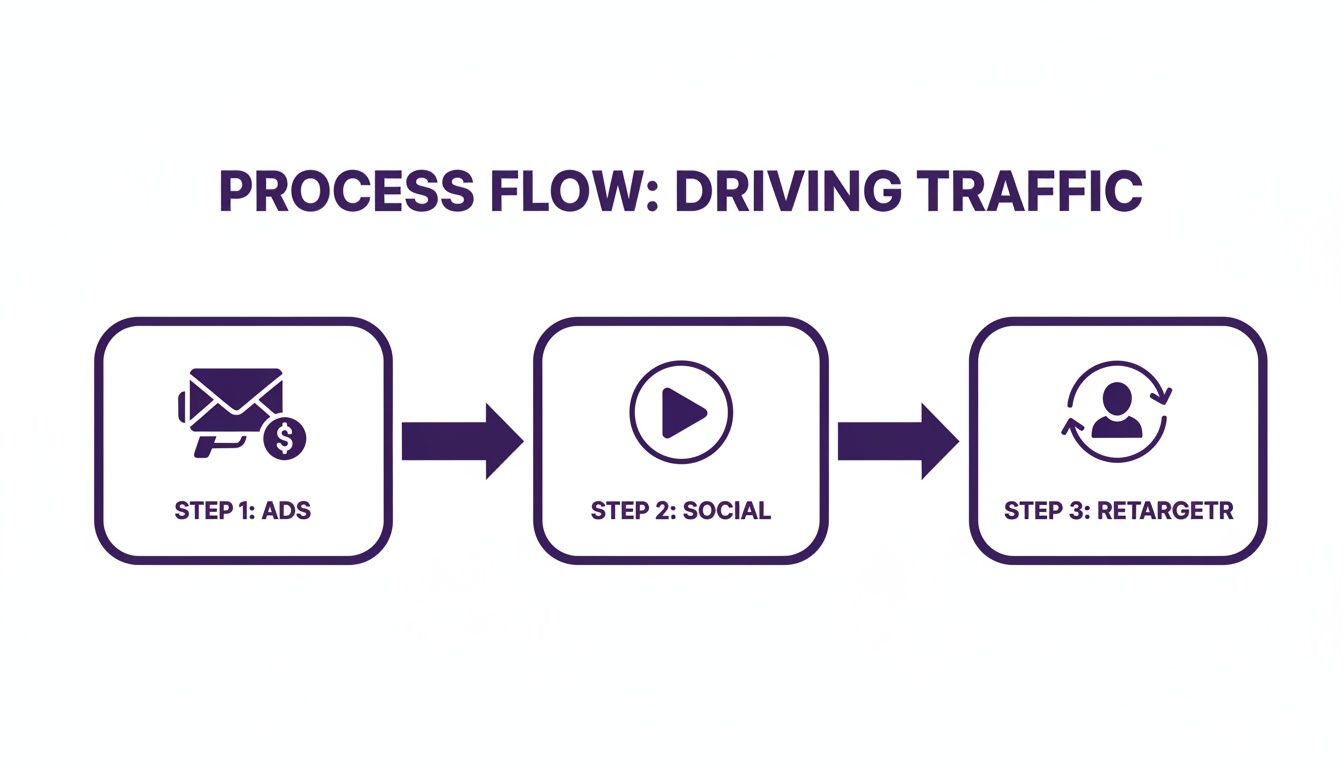
    Process flow diagram illustrating three steps for driving traffic: ads, social media, and retargeting.

    Each source—paid ads, social media conversations, and retargeting—creates interest that has to be captured and acted on immediately if you want to get the best return on your marketing spend.

    Measuring What Matters and Planning for Growth

    Let's be real: a digital marketing plan isn't something you can just set up and walk away from. It’s a living, breathing part of your dealership that needs constant attention to actually deliver results. To really grow, you have to know what’s working, what's a waste of money, and where to put your next dollar.

    It's all about cutting through the noise. Forget chasing vanity metrics like likes or followers. The true health of your marketing comes down to a handful of numbers that directly impact your sales.

    Key Metrics That Actually Matter

    Instead of getting lost in a sea of analytics, I always tell dealers to zero in on these essential data points. They paint a clear, actionable picture of what’s really going on.

    • Website Traffic Sources: Where are your online visitors actually coming from? Knowing if your best traffic is from organic search, Google Ads, or Facebook tells you exactly where to double down on your efforts.
    • VDP Views: This is your bread and butter. It's a direct measure of how much interest your inventory is generating. If your VDP views are high, your SEO and ads are hitting the mark and attracting the right kind of buyers.
    • Lead Form Submissions: This is the big one—the most critical conversion for any dealership website. It’s a potential customer literally raising their hand and asking to talk business.
    • Cost Per Lead (CPL): This is simple but powerful math. Divide your total marketing spend by the number of leads you generated. That number tells you precisely how much it costs to get a potential buyer's contact information.

    Your whole goal here is to create a cycle of continuous improvement. You track your results, shift more budget to the channels giving you the lowest cost per lead, and make smart adjustments to your strategy every single month.

    Budgeting for Smart Growth

    Once you're tracking the right numbers, you can finally build a marketing budget that makes sense. A classic mistake I see is dealers treating SEO and paid ads like two separate, unrelated expenses.

    Think of them as a team working together. Your SEO builds that crucial long-term, organic foundation, while your paid ads can drive immediate traffic and eyeballs to your highest-priority vehicles right now.

    To get a true grip on the impact of your marketing spend, you absolutely must set up robust Google Ads conversion tracking. This is non-negotiable. It allows you to connect your ad spend directly to those valuable lead form submissions, giving you that crystal-clear CPL. With that data in hand, you can budget with confidence, knowing every dollar is working to bring customers to your lot.

    Answering Your Top Dealership Digital Marketing Questions

    When you're running an independent dealership, you're wearing a lot of hats. It's only natural to have questions about where to put your time and money when it comes to digital marketing. Let's tackle some of the most common ones we hear from dealers just like you.

    How Much Should I Actually Spend on Digital Marketing?

    Forget the generic advice. The best way to set a budget is to work backward from your real-world sales goals. While some industry benchmarks exist, it's better to make the number mean something for your lot.

    Say you want to sell five more cars this month. If you know from experience that your team closes a certain percentage of the online leads you get, you can calculate how many solid leads you need to hit that goal.

    From there, look at what it costs you to get a lead from different places. Is Google Ads cheaper per lead than Facebook? Once you know your cost per lead, you can build a smart, targeted budget to get the number of leads you need instead of just throwing money at the wall and hoping something sticks.

    Should I Focus on SEO or Paid Ads?

    This is a classic question, but it's the wrong one to ask. It's not about "either/or"—it's about "both, but differently."

    Think of SEO as your long-term foundation. It’s the work you do to show up naturally on Google when someone searches for "used trucks near me." It takes time, often six months or more to really see traction, but it builds lasting value and brings in traffic without paying for every click.

    Paid ads are your immediate-results engine. They get your best inventory in front of motivated buyers right now. Need to move a specific car before the end of the month? A targeted ad campaign is the perfect tool for the job.

    SEO is like buying the property your dealership sits on—it's a long-term asset. Paid ads are like renting a billboard on the busiest highway in town for a weekend sale. A smart strategy uses both.

    Can I Handle This Myself, or Do I Need to Hire an Agency?

    You can absolutely get started on your own, and you should. Simple, powerful tasks like optimizing your Google Business Profile, consistently listing vehicles on Facebook Marketplace, and asking every happy customer for a review cost you nothing but time. These are the fundamentals.

    The real question comes down to what your time is worth. Managing a website, running complex ad campaigns, and keeping up with SEO is a full-time job in itself. For most independent dealers, the sweet spot is finding a platform that handles the technical headaches for you, freeing you up to focus on what you do best: buying and selling cars.


    Ready to build a digital showroom that works as hard as you do? AutoFire delivers a fast, mobile-first website designed to capture leads and showcase your inventory on Google, with no technical headaches. Get your dealership online in minutes. Launch your free site today.
  • Choosing an Automotive SEO Service That Drives Sales

    Choosing an Automotive SEO Service That Drives Sales

    An automotive SEO service is a specialized marketing strategy focused on one simple thing: getting your dealership—and every car on your lot—to show up when local buyers search online.

    It’s about moving past the old "spray and pray" advertising model. Instead, it connects your actual inventory with people who are right now typing things like "used SUVs near me" or "Ford F-150 in [Your City]" into Google. The goal is to put your dealership at the top of those results, driving ready-to-buy customers to your website and your showroom without you having to pay for every single click.

    What an Automotive SEO Service Does

    Laptop and car key on a table in front of a car dealership, with 'FIND LOCAL BUYERS' banner.

    Think of your website as your digital showroom. Just like your physical lot, if it’s hidden away on a back street, no one will find it. An automotive SEO service is how you secure that prime real estate on the digital highway—the first page of Google. It works to ensure that when a potential buyer in your area searches for a vehicle you have in stock, your dealership is one of the first things they see.

    This is a fundamental shift from traditional advertising. You aren't interrupting people with ads they might not care about. Instead, you're pulling in customers who have already raised their hand to say, "I'm looking for a car." They have a problem, and your job is to be the best and most visible solution they find.

    For dealers just dipping their toes into the digital marketing world, resources demystifying SEO for business owners can really help clear things up. They break down how these online activities actually translate into more test drives and sales.

    Moving Beyond Generic Marketing

    A lot of general marketing agencies say they "do SEO," but the car business is a different beast. A proper automotive SEO service isn't just about getting your homepage to rank. It’s about making every single car in your inventory a potential entry point for a new customer.

    This requires a multi-layered approach that includes:

    • Inventory Visibility: Making sure every vehicle is listed and optimized correctly so it can appear in specialized search features like Google Vehicle Listings.
    • Local Dominance: Dialing in your Google Business Profile to capture all those "near me" searches and land your dealership in the coveted Google Maps "3-pack."
    • Website Performance: Ensuring your website is fast, looks great on a phone, and is easy for both shoppers and search engines to navigate.

    The true measure of success isn't just website traffic. It’s about real-world results that grow your dealership: more phone calls, more people walking through your doors, and, ultimately, more cars sold.

    The core job of a specialized automotive SEO service is to build a steady, predictable pipeline of local car buyers who are ready to make a move. It turns your website from a static online brochure into a lead-generating machine that works for you 24/7.

    Leveling the Playing Field

    As an independent dealer, going up against the giant franchise stores with their million-dollar ad budgets can feel impossible. This is where a smart automotive SEO service becomes your great equalizer.

    By owning the local search results for the specific makes, models, and vehicle types you carry, you can intercept highly motivated buyers right in your own backyard. A solid SEO strategy builds its own momentum. Unlike paid ads that vanish the second you stop paying, the authority and visibility you earn through SEO keep delivering value for the long haul.

    To get a better handle on the basics, you can learn more about what SEO is and how it works in our detailed guide. It’s all about building a durable asset that constantly attracts new customers and cements your dealership's reputation as the go-to expert online.

    The Core Pillars of a Winning SEO Strategy

    Wooden building blocks, a notebook, and a pen on a desk with 'SEO Foundations' text, symbolizing strategic groundwork.

    A powerful automotive SEO service isn't a single trick or a one-time fix. It’s a coordinated effort built on several core pillars that all have to work together. Think of it like building a high-performance engine—each component must be perfectly tuned and synced with the others to produce real horsepower for your dealership.

    Let's break down these pillars to show you exactly what a complete, effective strategy should look like.

    On-Site SEO: Your Digital Curb Appeal

    On-site SEO covers everything you do on your actual website to make it more attractive to both search engines and, more importantly, your customers. For a car dealership, this goes way beyond just your homepage. It’s about optimizing every single Vehicle Detail Page (VDP) to turn it into a magnet for very specific searches.

    Imagine a buyer searching for a "2019 Honda CR-V EX-L." A well-optimized VDP will have a crystal-clear title, a unique description (not the generic text everyone else uses), high-quality photos, and all the key specs laid out perfectly. This sends a strong signal to Google: "This page is the best possible answer for someone looking for this exact car."

    Technical SEO: The Engine Under the Hood

    If on-site SEO is your dealership's shiny exterior, then technical SEO is the finely tuned engine that makes everything run smoothly. It’s all the behind-the-scenes work that search engines care deeply about, and it’s non-negotiable for today’s impatient car shoppers.

    Here are a few technical must-haves for any dealership website:

    • Mobile-Friendliness: Most car research now happens on a smartphone. Your site has to look great and work flawlessly on any device, period.
    • Site Speed: A slow-loading website is a deal-killer. A delay of just a few seconds can send a potential buyer bouncing right over to a competitor’s site.
    • Clean URL Structure: Simple, logical URLs (like yourdealership.com/inventory/used-ford-f150-2021) help both users and search engines understand your site’s layout instantly.

    Getting these technical foundations right ensures Google can crawl, understand, and rank your website without hitting any frustrating roadblocks.

    Local SEO: Winning Your Neighborhood

    Local SEO is the art and science of getting your dealership to show up for those all-important "near me" searches. For an independent dealer, this is often the most critical piece of the puzzle. The absolute centerpiece of this effort is your Google Business Profile (GBP).

    Think of a fully optimized GBP as a free digital billboard in your local market. It puts your dealership's name, address, phone number, hours, and customer reviews right on Google Search and Maps. The goal here is to dominate the "Map Pack"—that top-three list of local results that gets the overwhelming majority of clicks.

    For automotive dealers, a cornerstone of a winning SEO strategy is a comprehensive local SEO checklist, crucial for attracting nearby customers who are ready to visit a showroom.

    Inventory Indexing and Google Vehicle Listings

    Finally, there’s a specialized process called inventory indexing. This is how we get every single car on your lot listed correctly in Google's massive database. It’s like handing Google a perfectly organized, highly detailed spec sheet for your entire inventory, updated in real time.

    This is the key to getting your vehicles to appear in Google Vehicle Listings, that special search feature showing cars for sale directly in the results. A top-tier automotive SEO service automates this process, making sure that the moment a car hits your inventory system, it’s formatted correctly and fed straight to Google.

    You can dive deeper into how all these pieces fit together in our complete guide to SEO for automotive businesses.

    To put it all together, here’s a quick breakdown of what each of these core services does for your dealership.

    Key Automotive SEO Service Components

    SEO Component Primary Goal Example for a Dealership
    On-Site SEO Make each page highly relevant for specific searches. Writing a unique, detailed description for a 2020 Toyota Camry VDP.
    Technical SEO Ensure the website is fast, secure, and easy for Google to crawl. Optimizing image sizes to make inventory pages load in under 2 seconds.
    Local SEO Dominate search results for local buyers ("car dealer near me"). Keeping your Google Business Profile updated with current hours and new reviews.
    Inventory Indexing Get every car listed and visible in Google Vehicle Listings. Automating a data feed so new inventory appears on Google within hours.
    Citation Management Build consistent business info across the web to increase trust. Correcting an old address on Yelp or Yellow Pages to match your GBP.
    Schema & VIN Handling Give Google structured data about each vehicle for rich results. Adding VIN-specific schema markup to a VDP to show vehicle history.

    As you can see, each component plays a distinct but interconnected role. A winning strategy doesn't pick and choose—it masters them all.

    What's In It For an Independent Dealer, Really?

    Let’s cut through the technical jargon. What does a solid automotive SEO service actually do for your dealership’s bottom line? It’s not about getting more clicks or being number one for vanity’s sake. It’s about building a stronger, more profitable business that doesn't just rely on the next ad campaign.

    Think about the customers you really want. The ones who aren't just kicking tires but are actively searching for a "reliable used Honda Civic near me." That's the magic of good SEO. It puts your dealership directly in front of people who are deep into the buying process, creating a consistent flow of high-quality leads who are ready to talk business.

    This isn’t about casting a wide, expensive net. It’s about connecting with the right people at the exact moment they’re looking for what you sell. Every lead from an organic search is a testament to your dealership's authority in your local market—they found you because Google trusts you.

    Become the Go-To Dealer in Town

    A strong presence on Google does more than just bring in leads; it builds trust. When your dealership pops up time and again at the top of local search results, it sends a powerful message: you're a credible, authoritative choice. You become the default answer when someone in your community needs a trustworthy used car dealer.

    This digital handshake builds confidence before they even step onto your lot. A customer who finds you easily, sees great reviews on your Google Business Profile, and lands on a professional, fast website is already sold on your legitimacy. Over time, this consistent visibility cements your reputation as the local expert—something paid ads just can't replicate.

    SEO is a long-term investment in your dealership’s reputation. Unlike a paid ad that disappears when the budget runs out, a top search ranking is an asset that works for you 24/7, continuously building trust and attracting new customers.

    Get More Bang for Your Marketing Buck

    For most independent dealers, marketing budgets aren't infinite. Every dollar has to pull its weight. This is where a smart SEO strategy really proves its worth. Paid ads get you seen fast, but the second you turn off the spending, the leads dry up. It's like renting an audience.

    SEO, on the other hand, is about building an asset. The work you do today lays a foundation that keeps paying you back for months, even years. In the auto industry, the benchmark for organic conversion rates is 1.57%. And when you look at ROI, SEO consistently leaves other marketing channels in the dust. The average cost-per-click for vehicle sales keywords is $2.34, but the traffic you earn through SEO? It’s effectively free. You can read more about these automotive industry benchmarks to get the full picture.

    Punch Above Your Weight and Compete with the Big Guys

    Let's be honest—the big franchise stores can outspend you on advertising without breaking a sweat. So how do you compete? With a smarter game plan. A sharp automotive SEO strategy is the great equalizer. It lets you compete on relevance and authority, not just the size of your wallet.

    You can outmaneuver the giants by zeroing in on specific, long-tail keywords that they often ignore, like "used 2018 Toyota RAV4 under $20k." By dominating local "near me" searches, you can grab ready-to-buy customers right out from under their noses. You win by being the best, most helpful answer for a specific local car buyer, not by shouting the loudest. It’s how you carve out your space and thrive.

    How to Choose the Right SEO Partner

    Picking an SEO partner for your dealership is a huge decision. It's not just another line item in your marketing budget; it’s a choice that can either supercharge your lead flow or drain your resources with little to show for it. Get it right, and you’ll have a powerful engine driving qualified buyers to your lot. Get it wrong, and you’ll be left spinning your wheels.

    You need a partner who gets the car business. They should talk your language—VDPs, inventory feeds, local search, and what it takes to get a customer from a Google search to your showroom. A generic digital marketing agency might build you a slick-looking website, but a true automotive SEO specialist knows how to make that website sell cars.

    Look for Proven Automotive Experience

    Your first and most important filter should be direct, hands-on experience in the auto industry. The strategies that work for a local pizza shop or a law firm just don't translate to the highly competitive and technically unique world of selling cars online. Our space has its own rules, from mastering Google Vehicle Listings to implementing VIN-specific schema.

    A partner with a solid track record in automotive SEO already has a playbook. They're not experimenting with your money; they're deploying proven tactics that have already put other dealers ahead of the competition.

    Always ask for case studies or, even better, let them show you real-world examples of dealerships they've helped. Don't get distracted by fuzzy metrics like "increased traffic." You want to see hard evidence of what matters: more phone calls, more finance applications, and ultimately, more cars sold.

    Ask the Right Questions

    This is where you separate the real pros from the pretenders. Go into the conversation armed with specific, tough questions that test their actual knowledge of your business. If you get vague, jargon-filled answers, that’s a massive red flag.

    Here are a few questions I always recommend dealers ask:

    • Inventory Synchronization: “How, specifically, do you get our inventory indexed for Google Vehicle Listings? How often is that data refreshed to keep it accurate?”
    • Local Performance: “Show me a report. I want to see how you track local search performance, especially for high-intent searches like ‘used trucks near me’.”
    • Technical SEO: “Walk me through your process for handling VIN-specific schema. How do you make sure our VDPs are perfectly optimized to stand out in search results?”
    • Content Strategy: “Duplicate content is a killer for dealer sites that all use the same stock descriptions. What’s your strategy for creating unique content for our vehicles?”

    You're looking for clear, confident answers that show they have a well-defined process. If they can't explain their strategy in a way that makes sense to you, they're not the right fit.

    The Automotive SEO Provider Evaluation Checklist

    To make this process easier, we've put together a checklist. Use this table to compare potential partners and ensure they have the specialized skills needed to grow your dealership's online presence. It's a simple way to vet providers feature by feature.

    Feature / Capability Why It's Critical Questions to Ask Provider
    Inventory Indexing & GVL Your cars are your products. If Google can't see them properly, you're invisible to buyers. "What's your process for creating and managing our inventory feed for Google Vehicle Listings?"
    VIN & Schema Markup This technical detail tells search engines exactly what's on your VDPs, boosting visibility. "Can you show me an example of how you implement VIN-specific schema on a vehicle detail page?"
    Local SEO & GMB Focus Many car buyers search online first. Dominating local results is non-negotiable. "What specific strategies do you use to optimize a dealer's Google Business Profile for local searches?"
    On-Site SEO for VDPs/VRPs Optimizing your actual vehicle pages is key to ranking for model-specific searches. "How do you optimize our vehicle listing and detail pages to capture long-tail search traffic?"
    Automotive-Specific Reporting You need to see metrics that matter—leads, calls, and store visits—not just traffic and clicks. "Can you share a sample report? I want to see how you measure success for a dealership like mine."
    Proven Dealer Case Studies Past performance is the best predictor of future results. They need to show their work. "May I see two or three case studies from independent used car dealers you've worked with?"

    This checklist isn't about finding a provider who just says "yes" to everything. It's about finding a true partner who understands why these elements are so critical and has a proven system for executing them.

    Spot the Red Flags Early

    Knowing what to look for is only half the battle; you also have to know what to run from. Some companies make promises that are simply too good to be true, and in the SEO world, they usually are.

    Be extremely wary of any automotive SEO service that makes these claims.

    The most classic red flag is a guarantee of a #1 ranking on Google. No one can honestly promise this. Search algorithms are constantly in flux, and anyone who says they can lock in the top spot is either misleading you or using risky tactics that could get your site penalized.

    Another major warning sign is a total lack of transparency. If a provider is cagey about their methods or hides behind a wall of technical jargon, it’s time to walk away. You should also be cautious of anyone obsessed with a single tactic, like link building, without a holistic strategy that covers technical SEO, on-page content, and local visibility. Great SEO is a coordinated effort, not a one-trick pony.

    Finding a Simpler Way to SEO Success

    Let's be honest: trying to manage SEO, juggle different vendors, and keep up with every Google update feels like a second job you never signed up for. But what if you could get a powerful, dealership-focused SEO strategy working for you without all the headaches? The answer lies in modern dealership website platforms, which build all the essential SEO functions right into the foundation of your site from day one.

    This all-in-one approach means you can stop trying to bolt on different services from multiple agencies. Critical tools for inventory indexing, VIN decoding, and mobile-first design are already integrated and working together automatically. It’s a much more direct and effective path to getting more eyes on your inventory and more customers on your lot.

    Built for Speed and Simplicity

    A modern platform designed specifically for an automotive SEO service is engineered to get you results, fast. Forget about long, drawn-out setup processes. These systems are made for busy dealers who need to get online, get found, and start selling cars without a steep learning curve.

    The real magic is in the automation. All those time-consuming tasks that used to require special skills are now handled behind the scenes.

    • Automated Inventory Feeds: Your lot inventory syncs directly with Google Vehicle Listings automatically. The moment a car is ready for sale, it’s live and searchable on Google. This gets rid of tedious manual uploads and costly data-entry mistakes.
    • Mobile-First by Design: Most of your customers are shopping on their phones. A mobile-first design isn’t a bonus feature anymore; it’s a necessity. These platforms are built from the ground up to be lightning-fast and look great on any device, helping you pass Google’s PageSpeed tests and keep shoppers from bouncing.

    With an integrated system handling the technical details, you can get back to what you do best—selling cars—knowing your website is working 24/7 to bring in new leads. For a closer look at what separates a great site from a mediocre one, check out our guide on choosing the right automotive website builder.

    The timeline below breaks down just how straightforward it can be to find the right SEO partner.

    It really comes down to a simple process: asking smart questions, seeing what they can do, and then building a partnership you can count on.

    Content-Rich Vehicle Pages that Search Engines Love

    One of the toughest SEO hurdles for any dealership is creating unique, compelling content for every single car on the lot. Slapping up the generic, manufacturer-provided descriptions is a recipe for duplicate content penalties that can tank your search rankings. This is where a modern platform really shines.

    A built-in VIN decoder is the perfect example. It automatically pulls in all the detailed specs, features, and even vehicle history, instantly creating a rich, detailed vehicle detail page (VDP). All that unique information tells Google that your page is valuable, helping each car rank for very specific, high-intent searches from serious buyers.

    A modern platform turns a simple VIN into a fully optimized, content-rich vehicle page without you lifting a finger. Every car in your inventory becomes its own SEO powerhouse, attracting the right buyers looking for that exact make, model, and trim.

    This shift toward smarter, automated tools is driving massive growth in the SEO software industry. Projections show the market expanding from $84.94 billion in 2025 to a staggering $265.91 billion by 2034, fueled by AI and machine learning. As this tech gets baked into platforms, dealers get access to incredibly powerful tools without needing to become SEO experts themselves.

    Setting Realistic Goals for Long-Term Success

    While a modern platform can definitely speed things up, it's crucial to remember that SEO is a marathon, not a sprint. The initial setup gives you a huge head start, but the real, lasting advantage comes from building and maintaining that momentum over time.

    Think of it like building your dealership's reputation in the local community. It doesn't happen in a week. It takes consistent effort, good service, and a strong presence to become the go-to spot. Your website's authority with Google works the same way—it grows over weeks and months, eventually creating a reliable stream of organic traffic that you don't have to pay for. An integrated platform is simply the most efficient way to build that valuable digital asset for the long haul.

    Common Questions About Automotive SEO

    Diving into digital marketing can feel a little overwhelming, especially when you're deciding where to put your money. When it comes to something like an automotive SEO service, most dealers have the same questions about cost, how long it takes, and if it’s really the right play for their lot.

    Let's clear the air and tackle those common questions with some straight answers.

    How Long Until I Actually See Results From SEO?

    This is always the first question, and the honest answer is that it's a long game, not a quick fix. SEO is all about building a solid reputation with search engines like Google, and that kind of trust doesn't happen overnight. It’s a lot like building your dealership's reputation in your own community—it takes time and consistent effort.

    Generally, you'll start to see some early positive signs within three to six months. This might look like showing up for more specific car searches or getting more traffic from local shoppers.

    But the results that really move the needle—that steady flow of organic leads that turns into real sales—usually take about six to twelve months to build up. Think of it as a long-term investment. You're building an asset that will keep paying you back for years to come.

    What's the Real Difference Between SEO and Google Ads?

    The easiest way to understand the difference is to think about renting versus owning.

    • Google Ads (PPC) is like renting a billboard on the busiest road in town. You pay for the spot, and you get traffic as long as the check clears. The second you stop paying, your ad disappears, and the traffic stops. It's great for a quick boost or a weekend sales event, but it's a constant expense.
    • Automotive SEO is like buying the land on that busy road and building your own permanent showroom. It takes more work and time upfront, but once you're established, you own that digital real estate. The traffic you get is earned, and it keeps coming long after the initial work is done.

    A smart strategy often uses both, but SEO is what creates sustainable, long-term growth for your dealership.

    Can't I Just Do My Own SEO?

    You could, but it’s a bit like trying to be your own master mechanic without the training. While you can handle basic tasks, a true automotive SEO service requires a very specific set of skills that most general marketers don't have. You have to deal with complex inventory feeds, VIN-specific schema, Google Vehicle Listings, and super-targeted local marketing—all things unique to selling cars.

    For an independent dealer, the hours you’d spend trying to master the technical side of automotive SEO are almost always better spent on your lot, moving metal. The learning curve is steep. One wrong move with your website's code could make your entire inventory invisible to Google, costing you far more in lost sales than a professional service ever would.

    Working with a specialist means you can have peace of mind that it’s done right, leaving you free to focus on what you do best: selling cars.


    Ready to stop wrestling with complicated SEO and start getting more leads? AutoFire™ provides an all-in-one platform with built-in SEO tools designed specifically for independent dealers. Get a fast, mobile-friendly website that showcases your inventory perfectly on Google. Start your free site today at goautofire.com and see how simple it can be.

  • Proven Strategies to Generate More Car Sales Leads

    Proven Strategies to Generate More Car Sales Leads

    Let's be honest, car sales leads are just people—potential customers who've raised their hand, showing they’re interested in a car on your lot. The real game isn't just about getting a flood of names and numbers. It's about building a smart, automated system that attracts genuinely qualified buyers and makes it ridiculously easy for them to connect with you. Think of your website as your dealership's 24/7 sales engine.

    Turn Your Website Into a High-Converting Digital Showroom

    Your website is your single most important salesperson. It works tirelessly, day and night, to grab a buyer's attention and turn that initial click into a solid lead. In an era where almost every car buying journey starts on Google, your site can't just be a static digital brochure. It has to be a well-oiled machine, engineered from the ground up to attract, engage, and convert.

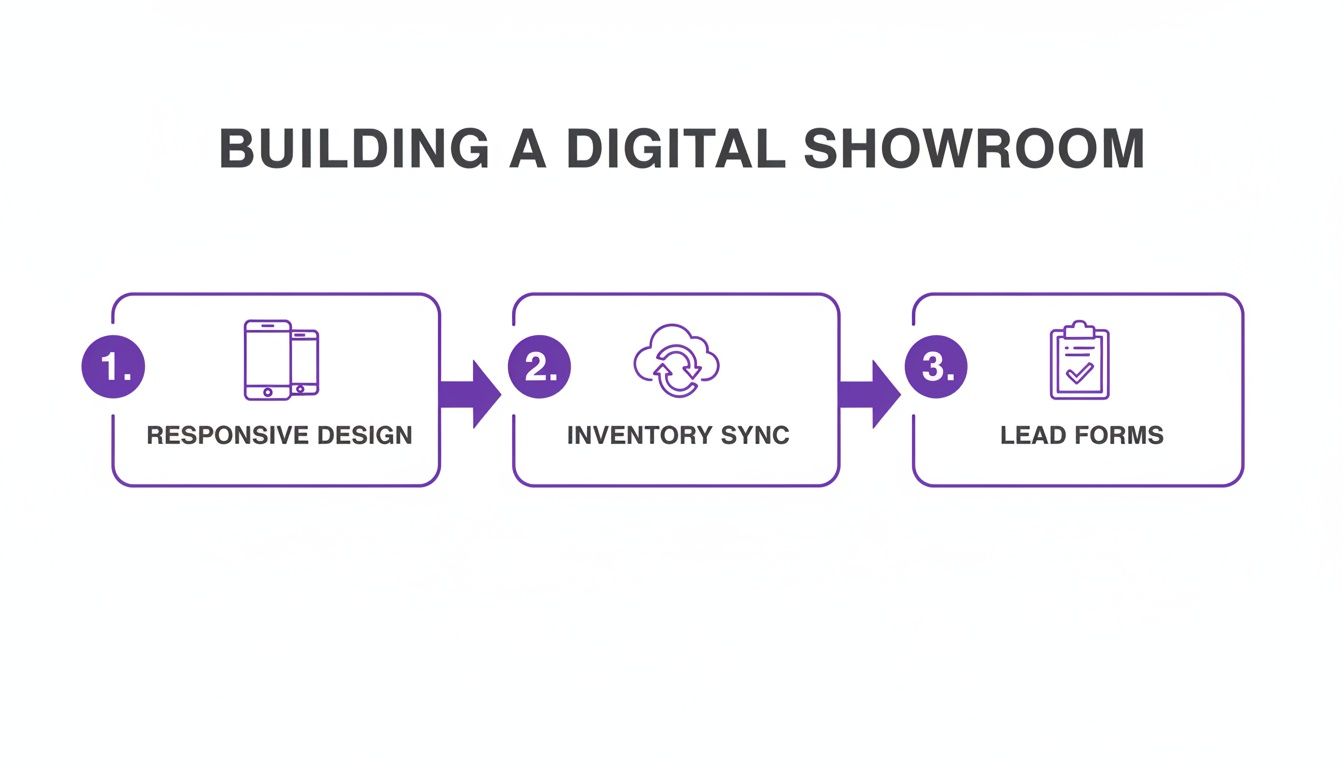
    This is what that machine looks like in its simplest form.

    Flowchart illustrating three steps to build a digital showroom: responsive design, inventory sync, and lead forms.

    It all boils down to three things: a flawless mobile experience, live inventory updates, and smart lead forms that capture interest at the right moment.

    It All Starts with a Mobile-First Foundation

    Most of your customers are scrolling through your inventory on their phones, often while standing in line for coffee or sitting on their couch. A clunky, slow-loading mobile site is the fastest way to lose them forever. Chasing high PageSpeed scores isn't just for the tech nerds; it's a business decision that directly impacts your bottom line. An impatient buyer won't wait for your site to load—they'll just leave.

    If you want to dive deeper into what makes a great site, we've covered it all in our guide on modern dealership website design.

    The market is heating up. S&P Global is forecasting 91.7 million light-vehicle sales for 2025, which will blow past pre-pandemic numbers. With the majority of auto buyers starting their hunt online, you have to be ready. A site that’s built for performance can significantly boost your inquiries, helping you grab your piece of that growing pie.

    The biggest wins come from making it incredibly simple for a buyer to express interest the moment they find a car they love. Your website should remove friction, not create it.

    Automate Your Inventory and Never Miss an Opportunity

    Stop wasting time manually updating your online inventory. It's a recipe for mistakes and missed sales. Setting up automatic inventory syncing is a game-changer. It ensures that the moment you add a car to your management system, it’s live on your website—accurate and ready to sell. This saves you countless hours and prevents that dreaded "Sorry, that one just sold" conversation.

    Finally, place simple, clear lead capture forms on every single vehicle detail page (VDP). Don't force a potential buyer to go searching for a "Contact Us" page. Put buttons like "Check Availability" or "Schedule Test Drive" right there, next to the photos of the car they're looking at. For those looking to get even more proactive, exploring some chatbot lead generation tactics can be a great way to engage visitors and turn casual browsers into qualified prospects.

    To pull this all together, here's a quick checklist of the must-have features your website needs to become a lead-generating powerhouse.

    Key Website Features for Generating Leads

    Feature Why It Drives Leads AutoFire Solution
    Responsive, Mobile-First Design Ensures a perfect browsing experience on any device, especially smartphones where most car shoppers start their search. All AutoFire websites are built with a mobile-first philosophy, ensuring fast load times and a seamless user experience.
    Automatic Inventory Sync Keeps your online listings 100% accurate without manual work, building trust and preventing customer frustration. Our platform syncs directly with your DMS, pushing real-time inventory updates to your site, Google, and Facebook.
    High-Quality VDPs Detailed Vehicle Detail Pages with large photos, videos, and key specs keep buyers engaged and on your site longer. We create compelling VDPs with unlimited photos, video integration, and clear feature lists to showcase every vehicle.
    Strategic Lead Forms & CTAs Simple forms placed on every VDP make it easy for shoppers to take the next step the moment they're interested. Customizable lead forms ("Check Availability," "Get ePrice") are placed strategically to maximize conversion opportunities.
    Online Credit Application Lets serious buyers start the financing process immediately, qualifying them and moving them down the funnel. Our secure, built-in credit applications help you capture high-intent leads and streamline the F&I process.
    Trade-In Valuation Tool Engages potential sellers and provides a valuable lead by capturing details about their current vehicle. Integrated trade-in forms powered by trusted valuation sources give you a steady stream of local inventory leads.

    Making sure these components are in place and working together is the first, most crucial step in building a predictable pipeline of car sales leads from your own website.

    Own Your Backyard: How to Dominate Local Search and Attract Buyers

    If you want a steady flow of high-quality car sales leads, you absolutely have to be visible the moment a local shopper starts looking for a car you have on your lot. This isn't about blanketing the internet with ads; it’s about being in the right place at the right time. That place is local search.

    A hand holds a smartphone displaying a car sales app and a map, with a 'LOCAL VISIBILITY' sign nearby.

    When someone down the street pulls out their phone and searches "used Ford F-150 near me," you need your dealership to pop up first. This kind of traffic is pure gold. These aren't just tire-kickers; they have intent and are often ready to make a move. The entire game hinges on mastering your presence on Google.

    Your Google Business Profile: The New Front Door

    Forget your physical storefront for a second. Your Google Business Profile (GBP) is the real front door to your dealership today. It’s the first impression you make on nearly every local customer, so it needs to be sharp. Just claiming it is the bare minimum. You need to treat it like an active, information-rich hub for your business.

    First things first, get the basics right. Your address, phone number, and hours must be 100% accurate. Nothing kills a lead faster than sending them to the wrong address. Next, load it up with high-quality photos. Go beyond a simple picture of the building—show off your best inventory, your friendly sales team, and even your clean service area. These visuals give people a feel for your dealership and start building trust before they even visit.

    Think of it this way: A complete and active Google Business Profile is the single most powerful free marketing tool you have for generating local leads. It’s what gets you on the map—literally—and connects you with shoppers who are ready to buy now.

    Finally, you need a game plan for customer reviews. They are a massive factor in how Google ranks you and are the ultimate social proof. Make it easy for happy customers to leave you a review, and be sure to respond to all of them, good and bad. It shows Google (and future buyers) that you’re engaged and stand behind your business. For a deep dive, our complete guide to local SEO for car dealerships has more advanced tactics you can put to work.

    Put Your Actual Cars Directly on Google

    A well-oiled GBP is crucial, but the real magic happens with Google Vehicle Listings. This is where you can push your live inventory feed directly into Google's search results.

    Imagine a potential buyer searching for a specific car. Instead of just seeing your dealership's name, Google shows them the exact 2019 Toyota Camry on your lot—complete with photos, your listed price, and the mileage. This is a game-changer.

    • Unbeatable Visibility: It puts your specific cars in front of motivated buyers, leapfrogging competitors who are still relying on just their website.
    • Highly Qualified Clicks: The people clicking these listings aren't just browsing; they are interested in that specific car. The lead quality is off the charts.
    • Instant Credibility: Having your inventory listed officially on Google lends a huge amount of trust to your dealership.

    The key is making sure your inventory management system or website provider can generate and send a compatible feed to Google. When you get this set up, you start turning casual searchers into motivated shoppers looking at your VDPs, which is how you generate some of the best car sales leads possible.

    Expand Your Reach with Smart Acquisition Channels

    While a solid SEO foundation is your long game, you can’t just wait for customers to find you. You need a mix of marketing channels working together to bring in a steady flow of car sales leads right now. Putting all your eggs in one basket is a recipe for disaster. A smart, multi-channel system means you're always connecting with potential buyers, no matter where they're looking.

    The trick is to go where the buyers already are. For used cars, that’s social media and the big online marketplaces. These are goldmines for independent dealers because you can run highly targeted, budget-friendly campaigns that put your best metal in front of local shoppers who are ready to buy.

    Dominate Social Media Advertising

    For dealers, Facebook and Instagram are still absolute powerhouses. The real magic isn't just posting pictures of your cars; it's the incredibly detailed targeting. Imagine showcasing that F-150 you just got in directly to people in your zip code who have been browsing truck forums or visiting competitor sites. That's the level of precision we're talking about.

    This goes way beyond just "boosting" a post. A real social ad strategy that moves cars involves:

    • Dynamic Inventory Ads: These are brilliant. They automatically show cars from your live inventory feed to people who have already visited your website. It’s like a personalized, digital follow-up.
    • Lead Generation Forms: Use Meta’s built-in lead forms. A potential buyer can show interest and send you their info without ever leaving Facebook or Instagram. This simple step can dramatically increase how many leads you get.
    • Video Walkarounds: Forget slick, overly-produced ads. A quick, authentic video walkaround of a hot car on your lot grabs attention and builds trust way faster than a static photo ever could.

    These platforms are visual. They’re perfect for showing off what you do best—selling great cars. If you feel like your marketing could use a shot in the arm, check out our guide on modern car dealership marketing strategies for more proven ideas.

    Tap Into High-Intent Marketplaces

    Let's not forget the old standbys. Platforms like Facebook Marketplace and Craigslist are still the first stop for a huge chunk of used car shoppers. Listing your inventory here puts you directly in the path of people who are actively hunting for their next vehicle.

    The name of the game on these sites is standing out and being lightning-fast. Your listings need high-quality photos (from every angle!) and detailed, honest descriptions. When an inquiry hits your inbox, you need to be on it immediately. Seriously. The first dealer to respond often gets the appointment. It’s a hands-on approach, but it builds momentum and shows customers you're serious. To make sure your team is chasing the right opportunities, it's worth brushing up on these 10 essential sales prospecting best practices.

    Looking at the bigger picture, the demand is definitely there. From January to November 2025, global new vehicle sales hit 14.8 million units—a 2.4% jump from the previous year. What's really interesting is the 5.1% surge in light trucks like SUVs and pickups. This trend is a massive opportunity for dealers who stock the right inventory and have a smart plan to reach these buyers. You can find more insights about the 2025 global car market trends at accio.com.

    Convert More Visitors with Engaging Onsite Tools

    Getting a shopper to your website is a huge win, but let’s be honest, it’s only half the battle. Now, you’ve got to convince them to actually talk to you. The trick is to turn your website from a passive digital brochure into an active tool that makes it incredibly easy for visitors to raise their hand and become a real car sales lead.

    Laptop displaying car sales website to boost conversions on a wooden desk with coffee.

    This all comes down to the user experience (UX). You need to remove friction and add genuine value. When a shopper feels like your website is actually helping them make a smart decision, they're far more likely to hand over their contact info.

    Make Lead Forms Effortless

    The single biggest mistake I see dealerships make is creating long, complicated lead forms. Think about it: modern car buyers spend a significant amount of time researching online. They don't have the patience for clunky forms that feel like an interrogation.

    Keep your forms short, simple, and place them where they feel natural. A simple "Check Availability" button on a vehicle detail page is a perfect, low-commitment entry point. It feels less like a hard sell and more like a helpful next step. You want to make it an easy, almost thoughtless, choice for a visitor to show they're interested.

    By removing friction and adding value, you make it an easy choice for a visitor to become a lead. Don't make them hunt for a way to contact you; put the opportunity right in front of them.

    Add Value with Smart Conversion Tools

    Beyond just a basic contact form, you can dramatically boost engagement by giving shoppers tools they actually want to use. These tools turn your site into a valuable resource, which keeps them from clicking away to a competitor’s site to finish their research.

    A few high-impact tools I've seen work wonders include:

    • A VIN Decoder: This is a fantastic way to offer instant value. If a customer is thinking about a trade-in, letting them enter their VIN to get detailed vehicle info builds trust and captures a lead from someone with high intent.
    • A Vehicle Comparison Tool: Shoppers are always comparing models. A tool like AutoFire's FireCompare lets them see specs for two or three cars side-by-side without ever leaving your website. This keeps them on your page and moves them closer to a decision.
    • High-Quality Photo Galleries: This isn't just a feature; it's a necessity. Today, the vast majority of vehicle buyers use digital sources for information. Your photos are your digital showroom. Invest in high-resolution, multi-angle shots that give people a true sense of the car's condition.

    At the end of the day, every single element on your site should work toward one goal: building enough trust and providing enough value that a visitor wants to connect. Transparent pricing, clear calls-to-action like "Schedule Test Drive," and helpful tools are what transform casual browsers into the high-quality car sales leads that actually grow your business.

    A Follow-Up System That Actually Closes Deals

    Getting a lead is just the starting gun. The real race is won in the follow-up. A name and a number in your CRM are pretty much worthless until you engage that person with a smart, persistent, and helpful communication plan. Honestly, this is where most dealerships completely drop the ball, and it's your single biggest opportunity to blow past the competition.

    Man using a smartphone and tablet simultaneously to manage sales leads and close deals.

    The key to all of this? Speed. The data is clear: leads contacted within the first five minutes are significantly more likely to convert. Every single minute you wait, the odds of that person buying from you plummet. A structured, multi-touch system is your insurance policy against lost opportunities.

    This isn't about being pushy. It’s about being present and genuinely helpful. When you combine immediate automated messages with timely personal calls, you start building real rapport and stay top-of-mind while they're making their decision.

    Design a Multi-Touch Follow-Up Sequence

    A solid follow-up plan has to hit prospects from multiple angles. Not everyone answers their phone on the first try, and plenty of people ignore emails. A blended approach is the only way to reliably generate and convert car sales leads.

    Here's a simple, effective sequence you can put into action today:

    • The Instant Response (Within 5 Minutes): The second a lead form hits your system, an automated text and email should fire off. This instantly confirms you got their message and sets the right expectation. Something simple like, "Hi [Name], thanks for your interest in the [Car Model]! This is [Salesperson Name] from [Dealership]. I'm confirming the vehicle is here and will call you in a few minutes to answer any questions. You can see it here: [Link to VDP]" is perfect.

    • The First Personal Call (Within 15-30 Minutes): This isn't a hard sell. The goal here is to build a connection, answer their initial questions, and set the next step. And that next step should always be scheduling a test drive.

    • Day 2 Follow-Up (Email & Text): If you couldn't connect, send another message. This time, add a little value. Try something like: "Hi [Name], just following up. Here’s a link to the CARFAX report for the [Car Model] you were looking at. Let me know if a quick test drive this afternoon works for you."

    This kind of structured workflow ensures you're persistent without being annoying. As the market heats up, this efficiency is everything. In the first half of 2025, global car registrations climbed 5% to 37.4 million units, and the full year is projected to hit 91.7 million. To grab your piece of that pie, a disciplined follow-up system is non-negotiable. You can learn more about these 2025 auto industry market trends.

    Prioritize Your Hottest Leads with Simple Scoring

    Let's be real—not all leads are created equal. The person who downloaded a brochure is in a very different place than the person who just submitted a full credit app. Lead scoring is a straightforward way to help your team focus their time on the prospects who are ready to buy now.

    Lead scoring isn't about some complex algorithm. It's just about paying attention to a lead's digital body language and using that info to point your sales team toward the easiest wins.

    You can start by simply assigning points to leads based on the actions they take on your website. This creates an instant priority list for your team.

    Action Taken Points Awarded Why It Matters
    Submitted Credit Application +25 The highest-intent action a buyer can take online. This is a five-alarm fire.
    Used Trade-In Tool +15 Shows they are serious about their budget and making a move soon.
    Scheduled a Test Drive +10 A clear signal they are ready to come in and kick the tires.
    Viewed VDP 3+ Times +5 Indicates strong interest in a specific vehicle on your lot.

    With a system like this, your team can immediately spot the leads most likely to close, making them more efficient and driving more sales. It's that simple.

    Your Top Questions About Car Sales Leads Answered

    When you're running an independent dealership, figuring out the best way to get—and handle—car sales leads can feel like a moving target. I get asked about this stuff all the time, so let's clear up a few of the most common questions.

    What's The Best Channel For Car Sales Leads?

    Everyone wants to know the "one best place" to get leads, but the honest answer is there isn't one. The real magic happens when you build a smart mix of different channels.

    Think of it like this: your own website, powered by good SEO and a dialed-in Google Business Profile, is your long-term powerhouse. It's fantastic for pulling in local buyers who are actively searching for what you sell. The catch? It takes time to get that momentum going.

    For results you can see this week, targeted social media ads are your best friend. Running a campaign on Facebook can put your best inventory right in front of people in your town who match your ideal buyer profile.

    A healthy lead pipeline combines both:

    • Long-term anchors: Your website and a strong local search presence.
    • Quick wins: Paid social ads and listings on busy online marketplaces.

    This way, you're not putting all your eggs in one basket. You get a steady stream of car sales leads from multiple places, which makes your business a lot more stable.

    How Can A Small Team Manage All These Leads?

    This is a huge one. It doesn't matter how many leads you get if you can't follow up with them properly. For a small team, the secret isn't hiring more people—it's working smarter with the right tools and a solid process.

    Automation and prioritization are your best friends here.

    First, you need a simple way to score your leads. A customer who submits a full credit application is obviously a hotter prospect than someone who just downloaded a PDF of a vehicle's specs. A basic scoring system helps your team instantly see who to call first.

    Next, set up automated first-touch responses. An immediate text or email that says "Thanks for your inquiry, we'll be in touch shortly!" works wonders. It acknowledges the customer right away, even if you're out on the lot with another buyer.

    A well-known study from the Harvard Business Review found that getting in touch with a new lead within the first hour makes you seven times more likely to have a meaningful conversation. Automation makes this speed possible without burning out your team.

    How Do I Measure The ROI Of My Lead Generation Efforts?

    You have to know if your marketing dollars are actually working. Don't get lost in a sea of complicated analytics. To start, just focus on two key numbers for every channel you're using: Cost Per Lead (CPL) and Cost Per Acquisition (CPA).

    • Cost Per Lead (CPL): Take the total you spent on a channel (like your monthly Facebook ad budget) and divide it by the number of leads you got from it. This tells you what you paid for each opportunity.

    • Cost Per Acquisition (CPA): Now, take that same ad spend and divide it by the number of cars you actually sold from those leads. This is the bottom line—what it cost you to sell a car.

    Tracking just these two numbers will tell you a story. You'll quickly see which channels are bringing you profitable customers and which ones are just wasting your money. It's the difference between guessing and having a real, data-driven strategy.


    Ready to turn your website into a lead-generating machine? AutoFire™ provides independent dealers with modern, mobile-first websites that automatically sync inventory and capture leads from day one. Get started in minutes at https://goautofire.com.