Tag: google business profile

  • Discover how to rank on google maps: Local SEO Mastery

    Discover how to rank on google maps: Local SEO Mastery

    When a potential customer pulls out their phone and types "used SUVs near me," that's your moment. That isn't just a casual search; it's a buyer on the hunt, and where you show up on Google Maps can make or break the sale. Getting your dealership to the top of those local search results is less about magic and more about mastering three key ingredients: Relevance, Distance, and Prominence.

    This is your roadmap to turning those "near me" searches into customers walking onto your lot.

    Why Google Maps Is a Dealership's Best Friend

    Let's be honest, old-school advertising doesn't bring in the foot traffic it used to. Your most valuable customer today is already looking for you online. They've decided they need a car and are actively searching for the right place to buy it. Winning that top spot on Google Maps puts you directly in their path at the exact moment they're ready to make a move.

    Think of your Google Maps listing as your digital front door. It’s not just a pin on a map. It’s the modern-day yellow pages, a collection of customer referrals, and a virtual showroom all in one. When a buyer sees your dealership pop up in the coveted "Local Pack" (those top three map results), it sends a powerful signal of trust and convenience. Instantly, they can see your location, hours, star rating, and even scroll through photos of your latest inventory.

    The Three Pillars of Google Maps Rankings

    So, how does Google decide who gets that prime real-estate? It all comes down to an algorithm built on three core pillars. While the exact formula is a closely guarded secret, the importance of each factor is well-understood by SEO experts. For a deeper dive into the mechanics, you can read a detailed guide on how these ranking factors work at gamitseo.com.

    With a huge number of Google searches having local intent, mastering these pillars is non-negotiable.

    Here’s a quick overview of what these ranking factors really mean for your dealership and how you can start influencing them.

    Ranking Pillar What It Means for Your Dealership Key Action Item
    Relevance How well your online profile matches a search query like "buy used Ford F-150." Optimize your Google Business Profile with precise categories and keywords.
    Distance How physically close your dealership is to the person searching. Ensure your Name, Address, and Phone number (NAP) are 100% accurate online.
    Prominence How well-known and respected your business is in the local community. Actively collect and respond to positive customer reviews.

    Now, let's break down each of those pillars a bit more.

    • Relevance: This is all about matching. When someone searches for a "used Honda Civic," Google's algorithm scans for dealership profiles that scream, "We sell used Hondas!" This means having the right business categories, mentioning specific makes and models, and having content that aligns with what buyers are looking for.

    • Distance: This one is pretty straightforward. It's the physical gap between your dealership and the person searching. While you can't move your lot, you can make darn sure your address is listed correctly and consistently everywhere online. Any confusion here can hurt your chances.

    • Prominence: Think of this as your dealership's reputation. Google measures this by looking at what others are saying about you. A flood of recent, positive reviews is a massive signal of prominence. So are mentions in local blogs or links back to your website from other trusted local businesses. A dealership with many glowing reviews will almost always outrank a competitor with only a few.

    At the end of the day, Google just wants to give its users the best, most trustworthy answer to their question. Your entire goal is to prove, through every online signal you can control, that your dealership is that answer. Every step that follows is designed to build on these three pillars.

    Laying the Groundwork: Your Google Business Profile

    Think of your Google Business Profile (GBP) as the digital front door to your dealership. It’s what shows up on Google Maps, and for most local car buyers, it's their very first interaction with your business. Long before they shake a salesperson's hand or kick a single tire, they're looking at your GBP for directions, hours, and what other customers have to say.

    Getting this foundation right is easily the most critical part of ranking on Google Maps. It's not just about filling out a form; it's about building trust with both Google and your future customers from the get-go.

    First Things First: Claim and Verify Your Digital Real Estate

    Before you can do anything else, you absolutely must claim and verify ownership of your profile. A lot of dealerships find Google has already created a basic listing for them. To take control, just search your business name on Google Maps, find your profile, and look for a link that says something like "Own this business?"

    If you're brand new, you'll need to create a profile from scratch. Heads up: Google’s verification process has gotten tougher. They often ask for a short video walkthrough of your dealership to prove you're a real business at that location. It might feel like an extra step, but an unverified profile is completely invisible and has zero chance of ranking. It's a non-negotiable first step.

    This flowchart breaks down how Google's algorithm decides who to show at the top of the map. It all comes down to relevance, distance, and prominence.
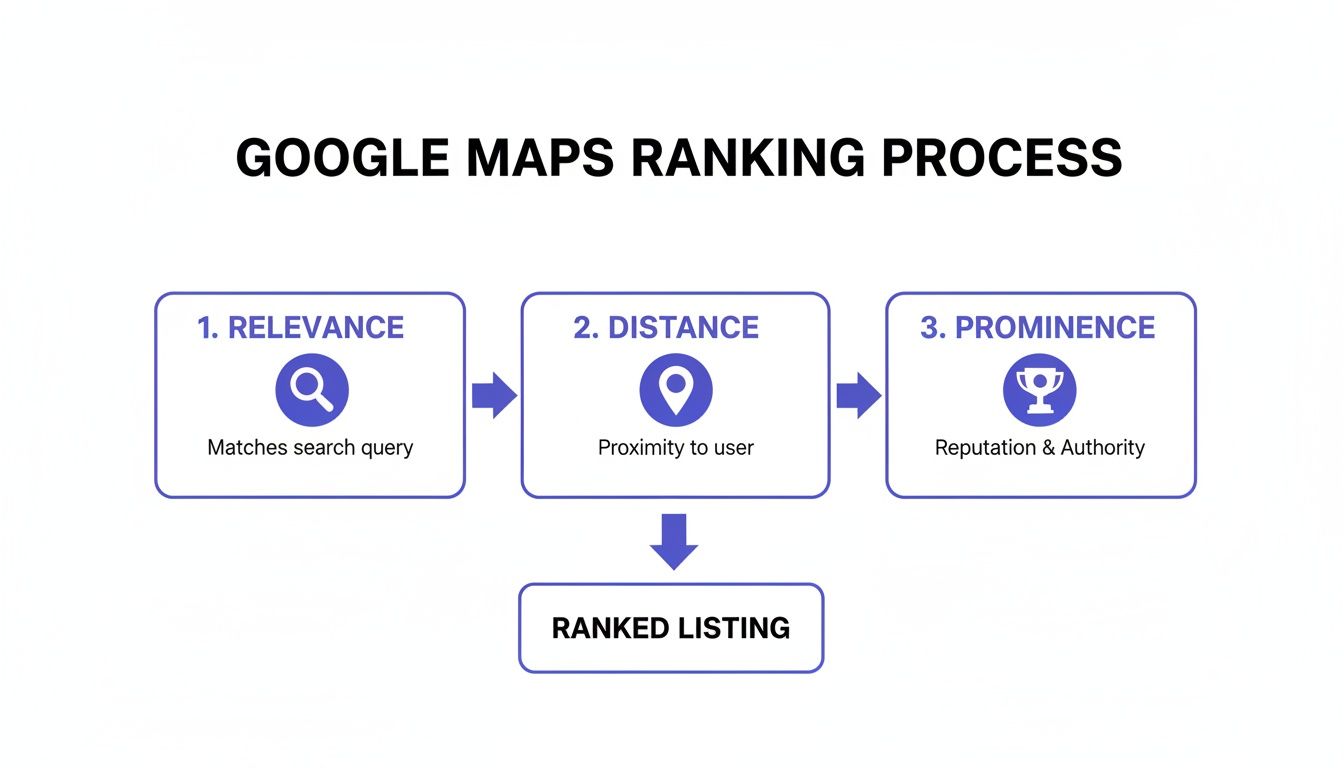
    Flowchart illustrating the Google Maps ranking process, detailing relevance, distance, and prominence as key factors.

    A fully fleshed-out, accurate profile directly boosts your "Relevance" and "Prominence," giving you a huge leg up on the competition.

    Dialing in Your Categories and Key Details

    Once you're verified, it's time to get into the details. The accuracy and depth of your profile information have a direct impact on where you show up in searches.

    • Primary Category: This is a big one. You need to choose "Used Car Dealer" as your primary category. Don't just pick the generic "Car Dealer." This tells Google exactly what you do, making you show up for high-intent searches like "used SUVs near me."

    • Secondary Categories: Don't stop there. If you also offer in-house financing or have a service bay, add secondary categories like "Auto Broker" or "Car Repair and Maintenance." Each one adds another layer of context for Google.

    • Website Link: Link this directly to your website. Even better, point it straight to your main vehicle inventory page. For AutoFire™ clients, this is a no-brainer. The seamless link from your GBP to your inventory creates a great user experience and tells Google that your site is a relevant result.

    Pro Tip: Use all 750 characters in your business description. This is your elevator pitch. Talk about what makes you different—maybe you're family-owned, specialize in work trucks, or offer guaranteed financing. Be sure to mention your main city and any surrounding areas you serve to reinforce your local authority.

    The Golden Rule: NAP Consistency

    One of the most common—and easily avoidable—mistakes I see dealerships make is having inconsistent business information online. Google's algorithm relies heavily on Name, Address, and Phone Number (NAP) consistency to confirm that your business is legitimate.

    Think of it this way: if one directory has you as "Smith Motors" and another has "Smith Motors, LLC," it plants a seed of doubt for Google. The same goes for using "St." on one site and "Street" on another, or having an old phone number floating around. These small discrepancies can quietly kill your ranking potential.

    To really nail this, you'll want to optimize your Google Business Profile to ensure every detail is identical everywhere. This consistency needs to be perfect across your GBP, your own website, your social media accounts, and every single local directory. If you're looking to tackle this as part of a bigger strategy, our guide on local SEO for car dealerships covers how this piece fits into the larger puzzle. This is the bedrock of local SEO—get it right, and you’re building on solid ground.

    Earning Trust and Authority Through Customer Reviews

    Think about the last time you bought something important. Did you check the reviews? Of course you did. Your customers are exactly the same. When it comes to Google Maps, customer reviews are the new word-of-mouth, and they're a huge signal that helps build your dealership's Prominence.

    A steady flow of positive, recent feedback tells Google you're a legitimate, active business that people in the community trust. It's not just about chasing a perfect five-star rating. It's the volume, the frequency, and what people are actually saying in those reviews that really moves the needle on your local ranking.

    Developing a Sustainable Review Strategy

    The real key is building a consistent and authentic review profile, not just getting a handful of perfect scores. You can't just cross your fingers and hope happy customers leave a review; you have to make it a seamless part of your sales process.

    Pinpoint that "golden moment" for the customer—it's usually right after they've signed the papers and are buzzing with excitement about their new car. That's the perfect time to ask. The request should be simple and feel like a natural next step, not a chore.

    A few low-pressure tactics that work wonders include:

    • A Simple Text Message: A quick text with a direct link to your Google review page is incredibly effective. Something like: "Hey [Customer Name], it was a pleasure helping you find your [Car Model] today! If you have a minute, we'd love to hear about your experience: [Link]"
    • A Follow-Up Email: Sending an email the next day can be just as good. It gives the customer a little time to settle in with their new car while the great experience is still fresh in their mind.
    • A Small QR Code Card: Have some small, professionally printed cards made with a QR code that goes straight to your review page. Tuck one in the glove box. It’s a subtle reminder they can act on whenever they have a spare moment.

    The goal is to make it as easy as possible for happy customers to share their feedback. Removing even a single extra step can dramatically increase the number of reviews you receive.

    The Power of Responding to Every Single Review

    Getting reviews is only half the battle. Responding to them—both the good and the bad—is where you truly set your dealership apart. When you reply, you're not just talking to that one person. You're showing every potential buyer who reads your reviews that you're engaged, professional, and genuinely care about your customers.

    For the good ones, a simple, personalized "thank you" is perfect. Mentioning the salesperson by name or the specific vehicle they bought makes the entire interaction feel more authentic.

    Negative reviews are where the stakes are even higher. A calm, professional, and genuinely helpful response can completely turn a bad situation around. It shows accountability and a commitment to making things right, which builds enormous trust with future car buyers. This kind of active engagement is a critical part of a solid strategy for automotive reputation management.

    How Reviews Directly Impact Your Ranking

    Reviews are a primary signal that feeds the "Prominence" part of Google's local algorithm. It sees businesses that consistently get high ratings from lots of people as more authoritative. In competitive markets, a dealership with a high star rating and a large volume of recent reviews often has a significant advantage.

    But it goes beyond just the star rating. Google’s algorithm reads the content of the reviews. When a customer writes, "Great experience buying my Ford F-150 from these guys," that keyword "Ford F-150" reinforces your relevance for anyone searching for that truck. Over time, dozens of reviews mentioning specific models or services act like mini-testimonials that tell Google exactly what your dealership specializes in, helping you show up for a much wider variety of valuable searches.

    Bring Your Dealership to Life with Photos and Posts

    Think of your Google Business Profile as your digital showroom. If you just set it up and walk away, it's like leaving last year's models gathering dust on the floor. An outdated profile sends a clear signal to Google that your business might be inactive, pushing you down in the search results.

    To really start climbing the ranks on Google Maps, you need to treat your profile as a living, breathing part of your dealership. This means consistently uploading fresh, high-quality photos and using Google Posts to keep both customers and Google’s algorithm engaged. Every new picture and post is a pulse of activity, signaling relevance and helping you stand out.
    A man takes a photo of a silver car in a parking lot, viewing the shot on a tablet.

    A Picture is Worth a Thousand Clicks

    Let's be honest: photos are probably the single most powerful tool on your profile. They give potential buyers a genuine feel for your dealership and your inventory before they even think about grabbing their keys. Sharp, professional images build trust on the spot and can be the final nudge that gets a customer to click for directions.

    The numbers don't lie. According to Google's own data, businesses with photos get 42% more requests for driving directions and 35% more clicks through to their websites. That's a massive, tangible advantage you simply can't afford to pass up.

    A strong photo gallery should cover all the bases:

    • Exterior Shots: Clear pictures of your dealership entrance, signage, and the overall lot. Let people see what to look for when they arrive.
    • Interior Photos: Show off your clean office, comfortable waiting area, and your team in action.
    • Inventory Photos: This is crucial. Post high-resolution shots of your best-looking vehicles—both inside and out.
    • Team Photos: A picture of your smiling staff adds a human touch and builds instant rapport.

    Pro Tip: When you upload new photos, take an extra minute to add a geotag. Geotagging embeds your dealership's GPS coordinates directly into the image file, which subtly reinforces your physical location to Google. It's a small detail that adds another powerful layer of local authority.

    Mastering Your Visuals

    Just dumping a folder of random photos onto your profile won't cut it. You need a bit of strategy to make sure your visuals have the biggest impact.

    Start by uploading at least 10 high-quality photos to get things rolling, but don't stop there. Make it a habit to add new images every single week. As you upload, Google will prompt you to sort them into categories like "Exterior," "Interior," or "At Work." Using these correctly helps Google understand the context of each image, which is great for SEO.

    Remember, quality is everything. Blurry, poorly lit phone pictures can do more harm than good, making your dealership look unprofessional. If you want to elevate your online presence, it's worth learning how to optimize images for the web so they load quickly and look fantastic on any device.

    Drive Real Engagement with Google Posts

    Google Posts are basically free, hyper-local ads that show up right on your profile in search results and on Maps. They are the perfect tool for announcing new arrivals, promoting a weekend special, or sharing dealership news. The real key here is consistency.

    This constant activity—from posts, new photos, and answering Q&As—is a direct signal to Google that your business is active, relevant, and deserves a better ranking. For AutoFire users, this is even easier with built-in integrations designed to help manage your online presence seamlessly.

    Here’s a simple content plan you can put into action right away:

    • New Arrival Mondays: Highlight a hot vehicle that just landed on your lot. Use a great photo and a call-to-action like "Book a Test Drive."
    • Financing Fridays: Promote any special financing deals or offers you have running for the weekend.
    • Customer Spotlights: Share a photo (with permission!) of a happy customer with their new ride. This is powerful social proof.
    • Dealership News: Announce holiday hours, welcome a new team member, or mention your sponsorship of a local little league team.

    Each post stays live for seven days, so the goal should be to publish at least one new post every week. This keeps a steady stream of fresh content flowing and is a simple, effective way to stay top-of-mind and climb higher in Google Maps.

    Strengthening Your Local Authority Across the Web

    Ranking high on Google Maps isn't just about what you do on your own Google Business Profile. Google is constantly scanning the entire web, looking for clues about your dealership's reputation and legitimacy. This idea, which Google calls "Prominence," is all about how often and where your business shows up online.

    Think of it like a community endorsement. Every time your dealership's name, address, and phone number appear correctly on another trusted website, it's a vote of confidence. These digital breadcrumbs prove you're a real, established business in your area, and they are crucial for building trust with Google.

    Building Your Digital Footprint with Citations

    Citations are the absolute bedrock of local SEO. They're simply mentions of your dealership's core information—Name, Address, and Phone number (often called NAP)—on other websites and online directories. The key here is absolute consistency. I can't stress this enough. Even a tiny difference, like using "St." on one site and "Street" on another, can confuse Google and weaken your authority.

    Your first move should be to get listed on the major data aggregators and the big-name directories. These platforms feed information to hundreds of smaller sites, so getting it right with them creates a ripple effect of consistent data across the web.

    For a car dealership, these are the must-haves:

    • The Big Guys: Make sure you're on Yelp, Apple Maps, Bing Places, and the Better Business Bureau (BBB).
    • Auto-Specific Hubs: Listings on Cars.com, Edmunds, and CarGurus are non-negotiable. Your customers are definitely looking there.
    • Hometown Directories: Don't forget your local Chamber of Commerce or city business directory.

    A strong, consistent citation profile is like pouring a solid foundation. It proves to Google that the address on your GBP is legitimate and shows you're an active part of the local business community.

    Earning Trust Through Quality Backlinks

    While citations confirm who and where you are, backlinks act as endorsements that signal your authority. A backlink is just a clickable link from another website to yours. In Google's eyes, a link from a respected, relevant site is a powerful recommendation, and it can seriously boost your Prominence score.

    Unlike citations, quality absolutely crushes quantity here. A single link from a well-regarded local news site or a popular community blog is worth more than a dozen links from spammy, irrelevant directories. The secret is to think locally and build real-world relationships that naturally translate into online credibility.

    Here are a few practical ways to earn valuable local backlinks:

    • Sponsor a Local Event: Getting behind a local little league team, a charity 5k, or a community festival almost always gets you a thank-you link on their website. It's good for the community and good for your SEO.
    • Partner with Neighboring Businesses: Team up with a nearby auto-detailer or a trusted repair shop. You can recommend each other to customers and feature one another in a "Local Partners" section on your websites, complete with a link.
    • Join the Chamber of Commerce: Most chambers have an online member directory that provides a high-authority backlink to your site. It’s an easy win.

    Each quality backlink you earn is another signal telling Google that your dealership is a trusted and important part of the local fabric. To really dig deep and dominate your service area, check out this comprehensive local SEO guide for contractors; it has fantastic strategies that apply to any local business. These off-page signals are how you prove to Google that you're not just present, but truly prominent.

    Tying Your Website into Your Google Maps Strategy

    Your Google Business Profile isn’t an island. It’s deeply connected to your dealership’s website, and they’re constantly sending signals back and forth that Google uses to decide where you rank. A seamless, high-quality connection between the two proves you’re a legitimate, relevant business, and that gives you a serious competitive advantage.

    Think about it from Google's perspective. When a potential buyer clicks from your Maps listing to your website, Google watches what happens. If they land on a fast, easy-to-navigate site, it tells the algorithm you’re providing a great experience. That’s a huge trust signal. But if your site is slow and clunky, visitors will bounce right off, torpedoing your credibility and hurting your visibility on Maps.

    Create Hyper-Local Landing Pages

    If you operate more than one lot, creating a separate, dedicated page on your website for each location isn't just a good idea—it's essential. Simply listing all your addresses on a single "Contact Us" page is a huge mistake. It completely dilutes your local authority and just confuses search engines.

    Instead, build out a unique page for each individual dealership. Each page needs to include:

    • The specific Name, Address, and Phone Number (NAP) for that one location.
    • An embedded Google Map showing that lot’s exact pin.
    • Photos of that specific showroom, your local team, and the building itself.
    • Unique content that mentions nearby landmarks, neighborhoods, or cross-streets.

    This approach sends crystal-clear geographic signals to Google. It proves you have a real, physical presence in each community you’re targeting, which makes your GBP for that location infinitely more powerful.

    Speak Google’s Language with Schema Markup

    Beyond what your customers see, you need to help search engines understand your website on a technical level. That's where Schema markup, also known as structured data, comes into play. It’s a piece of code you add to your site that acts like a translator, explicitly telling Google what your content is about.

    For any dealership, the most critical type is Vehicle Schema. This markup clearly labels all the key details about your inventory—make, model, year, VIN, mileage, price, you name it. When Google’s crawlers find this perfectly organized data, they can confidently understand your inventory and become much more likely to feature your vehicles in rich search results.

    Think of it this way: Without Schema, Google is just guessing what’s on your inventory pages. With Schema, you're handing it a perfectly detailed spec sheet for every car on your lot. This clarity doesn't just boost your traditional search performance; it forges a stronger link between your website's inventory and your GBP.

    The Overlooked Ranking Factor: Site Performance

    The raw performance of your website, especially on mobile, has a direct and significant impact on your Google Maps rank. Google relies heavily on user behavior signals—like how long someone stays on your site or whether they click through to other pages—to judge quality. A fast-loading, mobile-friendly site keeps users engaged, and Google rewards that engagement with better visibility.

    This is where your website platform can make or break your strategy. For example, AutoFire’s dealership websites are built for speed and can achieve 99+ PageSpeed scores. This directly improves those crucial user signals. In fact, these signals, including click-through rates, are an important part of your local ranking weight. Mobile shoppers have little patience for slow sites; they are far more likely to click and convert on a dealer site that's lightning-fast, reinforcing your prominence in the process. You can find more details on how user behavior impacts Maps rankings at gamitseo.com.

    By making sure your website is technically sound, locally focused, and incredibly fast, you complete the feedback loop. A strong website makes your GBP more authoritative, and a well-optimized GBP drives high-quality traffic back to your site. It’s a winning combination for dominating your local market.

    Common Questions About Google Maps for Dealerships

    Getting your dealership to show up on Google Maps always brings up a few key questions. It's totally normal. Getting the right answers is the first step toward building a local SEO plan that actually works. Let’s tackle some of the most common ones we hear from dealers.

    How Long Does It Take to See Google Maps Results?

    This is the big one, right? While some quick edits, like changing your business hours, will show up almost immediately, a real jump in your rankings won’t happen overnight. You should plan on seeing noticeable movement in a few weeks to several months.

    Honestly, the timeline depends heavily on how competitive your local market is and how consistently you work on your profile. Things like building a solid base of reviews and getting listed in reputable local directories take time. But that gradual, steady effort is what creates lasting results. Consistency is everything.

    Think of it this way: Local SEO is a marathon, not a sprint. Every photo you add, every review you answer, and every local mention you earn is another signal to Google that you're a legitimate, authoritative dealership. Those signals compound over time.

    Do I Need a Physical Dealership to Rank on Maps?

    For a car dealership, yes. This is a non-negotiable. To even be eligible for the Google Maps "Local Pack" (that coveted box with three listings), you absolutely must have a physical, customer-facing storefront.

    Google's entire system is built on verifying a real-world address where you actually do business with customers face-to-face. Your car lot is that location. It’s the anchor for your entire local search strategy and proves to Google that you’re a real part of the local community.

    Can I Rank in a City Where My Dealership Isn't Located?

    Trying to show up in a city where you don't have a physical address is an uphill battle, and frankly, it goes against how Google is designed to work. The algorithm’s primary job is to give searchers the most relevant results closest to them. Proximity is king.

    Sure, a dealership with an incredible online reputation might pop up in a search from a neighboring town now and then. But you will almost always get beat out by the dealerships that are physically in that city. Your best bet is to focus on completely dominating the area you actually serve.


    Ready to turn those local map views into real foot traffic and sales? The AutoFire platform gives you the fast, mobile-first website you need to connect with buyers who find you on Google. Get started for free and see how it all works together.
  • Local SEO for Car Dealerships Your Ultimate Guide

    Local SEO for Car Dealerships Your Ultimate Guide

    For car dealerships, local SEO is all about showing up online the exact moment a buyer in your town is looking for you. It's the strategy that puts your showroom front and center when someone searches for a "used truck near me" or a "Subaru service center in Springfield," making you the most obvious and convenient choice.

    Why Your Showroom Starts with a Local Search

    A person holds a smartphone displaying a location pin, standing outside a car dealership with a "Local Search" sign.

    Let’s be real: the days of customers cruising down the boulevard to discover car lots are pretty much over. The modern car-buying journey almost always kicks off on a search engine. This means your dealership's front door isn't just physical anymore—it's digital, and a solid local SEO strategy is the key that unlocks it.

    This isn’t about casting a wide net with generic SEO. A national campaign might get you ranked for "best used sedans," but what good is that if the person searching is three states away? Local SEO for car dealerships is about precision. It’s laser-focused on capturing high-intent buyers right in your backyard.

    Connecting with High-Intent Buyers

    When someone types "Ford F-150 in Dallas" or "Honda oil change near me" into Google, they aren't just kicking tires. They have an immediate need. These are your most valuable leads, and a targeted local strategy is your direct line to them.

    This hyperlocal focus is crucial because you're not just competing with other dealerships—you're competing on convenience. Today's consumer expects instant, relevant results. If you don't show up in the "local pack" (the map results at the top of the page), you're basically invisible to a massive chunk of your market.

    The link between a local search and a showroom visit is incredibly direct. Research from Google has found that "near me" searches for auto parts & services have doubled year over year, showing a clear rise in local intent. You can dive deeper into these local SEO findings for dealerships on fullpath.com.

    This immediacy is exactly why local SEO is non-negotiable. It’s not just another marketing tactic; it's a fundamental part of modern dealership operations that directly drives foot traffic and moves inventory.

    To get there, you need a coordinated approach that proves to both search engines and customers that you are the authoritative choice in your area. This table breaks down the essential pillars.

    Core Components of a Winning Local SEO Strategy for Dealerships

    Component Primary Goal Key Actions
    Google Business Profile (GBP) Maximize visibility in local search and Maps. Complete every field, upload photos/videos, use Google Posts, manage Q&A, and activate Vehicle Listings.
    On-Site SEO Signal local relevance and provide a great user experience. Create location-specific pages, optimize for mobile, improve site speed, and use vehicle schema markup.
    Reputation Management Build trust and social proof to attract customers. Proactively request reviews on Google, respond to all feedback, and showcase testimonials.
    Local Authority Building Establish credibility within your community. Build consistent business citations (NAP), earn links from local partners, and get involved in community events.

    By mastering these core areas, you create a powerful digital presence that aligns with how people actually shop for cars today. The rest of this guide is your playbook for putting each of these strategies into action and turning local searches into loyal customers.

    Turning Your Google Business Profile Into Your Digital Showroom

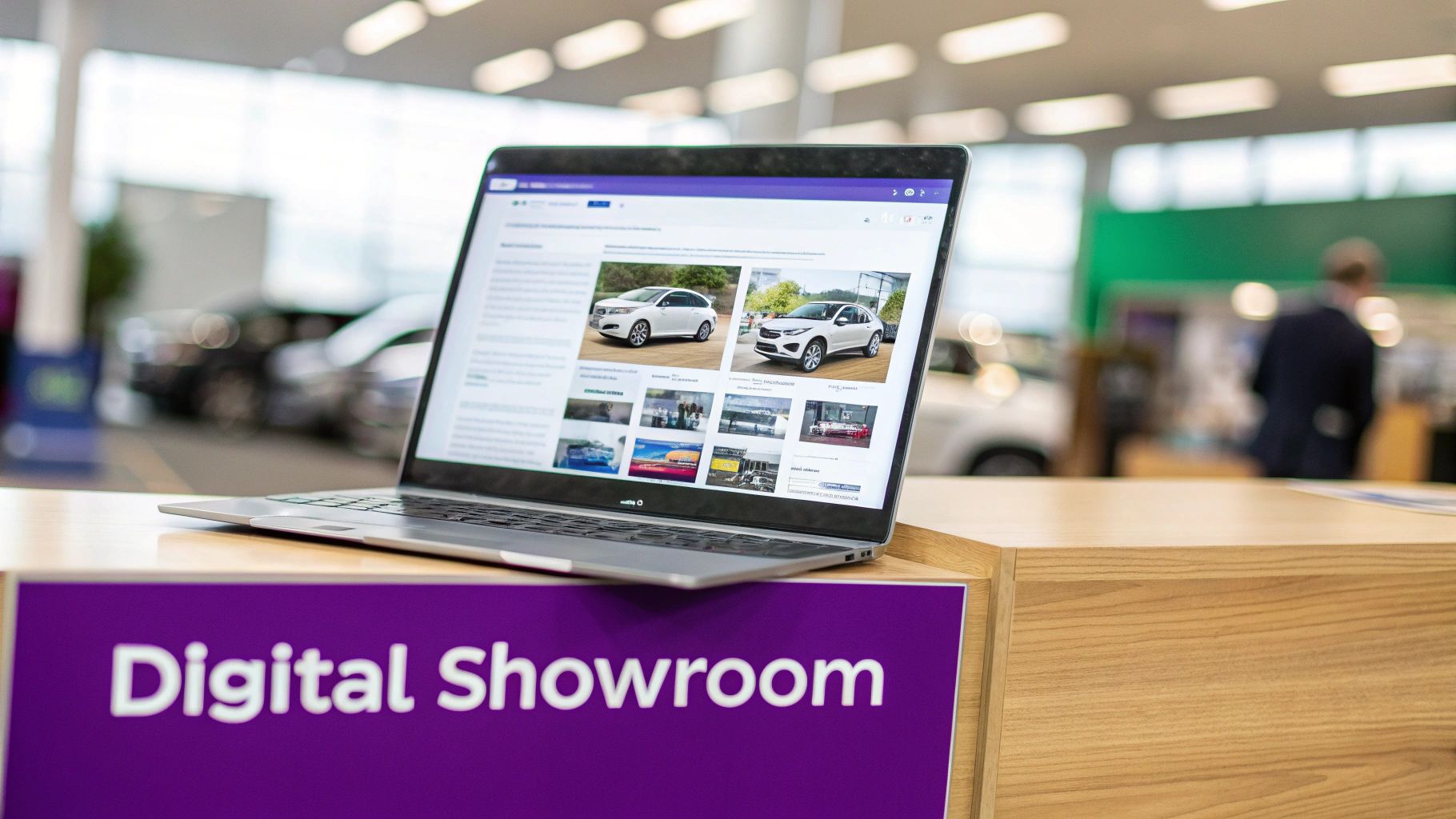
    A laptop on a wooden counter displays a digital car showroom website, with a 'Digital Showroom' sign below.

    Let's get one thing straight: your Google Business Profile (GBP) isn't just a map pin. It’s your digital front door.

    When a potential buyer searches for "used SUVs near me," your GBP is often the very first impression they get. A bare-bones profile is like showing up to a dusty, empty lot—it doesn’t inspire a lot of confidence, and it certainly doesn't invite anyone to take a closer look.

    Treating your GBP as an interactive digital showroom is one of the smartest things you can do for your dealership’s local SEO. It's where you start turning a casual searcher into a real lead, often before they even bother clicking to your website.

    Mastering Your Business Categories and Description

    So many dealerships trip up on the basics. Your primary category is the most important signal you can send to Google. For most independent dealers, this will be "Car Dealer," but the real magic happens in your secondary categories. This is where you can outmaneuver the competition.

    These extra categories help you show up for specific, high-intent searches. Go beyond the obvious and list every single service you offer.

    • Used Car Dealer: This is non-negotiable for capturing the pre-owned market.
    • Truck Dealer: A must if trucks are a big part of your inventory.
    • Auto Repair Shop: Essential for bringing in that lucrative service-related business.
    • Car Parts and Accessories Store: Catches searches directly targeting your parts department.

    Frankly, most of your competitors aren't doing this. A recent analysis found that a low percentage of auto dealerships actually use all ten available GBP categories, which is a huge missed opportunity for visibility. You can dig into the numbers yourself in this comprehensive report on auto dealership GBP usage.

    Next up is your business description. Write it for people first, but keep search engines in mind. Weave in local keywords like "[City Name] used cars" or "trusted auto service in [Your Neighborhood]," but make it sound natural. Talk about what makes you different—maybe it's your no-haggle pricing, your deep roots in the community, or your ace service team. Tell your story.

    Activating Advanced GBP Features for Real Engagement

    A static profile gets ignored. To really make your GBP work for you, you have to use the features Google built for engagement.

    Google Posts are your free billboard on the search results page. Use them constantly to announce things like:

    • New Inventory: "Just hit the lot: Low-mileage 2021 Honda CR-V. Come test drive it today!"
    • Service Specials: "This week only: Take 15% off your next oil change and tire rotation."
    • Community Events: "We're proud to sponsor the [Local High School] Tigers this season!"

    The Q&A section is another goldmine that most dealers ignore. Don't just wait for questions to roll in—seed it yourself. Post and answer common questions about financing, your trade-in process, or service hours. This lets you control the conversation and handle common objections before a potential buyer even has to ask.

    The Strategic Advantage of Department-Specific Profiles

    Here’s a pro-level move: if you have distinct service and parts departments, give them their own GBP listings.

    Think about it. A customer searching "Ford brake service in [City]" is on a completely different mission than someone looking for a new F-150. A separate, dedicated "Service Center" profile lets you intercept that targeted traffic directly.

    With this approach, you can tailor everything—categories, photos, Posts, hours—specifically to that department. The same industry study I mentioned earlier? It found that a significant number of dealerships don't have separate GBP listings for their Service & Parts departments. That’s a massive opening for you to fill.

    Setting these up ensures you appear for valuable, non-sales searches, building a relationship with customers that lasts long after they drive off the lot.

    Don't Forget Google Vehicle Listings

    The final piece of your digital showroom puzzle is Google Vehicle Listings. This feature is a game-changer. It syncs your live inventory directly to your GBP, letting shoppers browse your cars right there in the search results.

    It’s the ultimate way to show, not just tell, customers what you have in stock.

    A laptop on a wooden counter displays a digital car showroom website, with a 'Digital Showroom' sign below.

    This integration is a powerful signal to both Google and your customers that you have exactly what they’re looking for. It cuts down on friction and sends qualified buyers straight to your VDPs. Automating this sync is key to keeping it current. If wrestling with inventory feeds sounds like a headache, a platform built for dealerships can handle the heavy lifting. You can see a demonstration of how AutoFire™ handles inventory feeds here.

    By fully optimizing every part of your GBP—from the basic categories to advanced features and separate department listings—you create a rich, engaging experience that grabs local buyers right when they're ready to make a move.

    Your Website: The Digital Showroom for Local Buyers

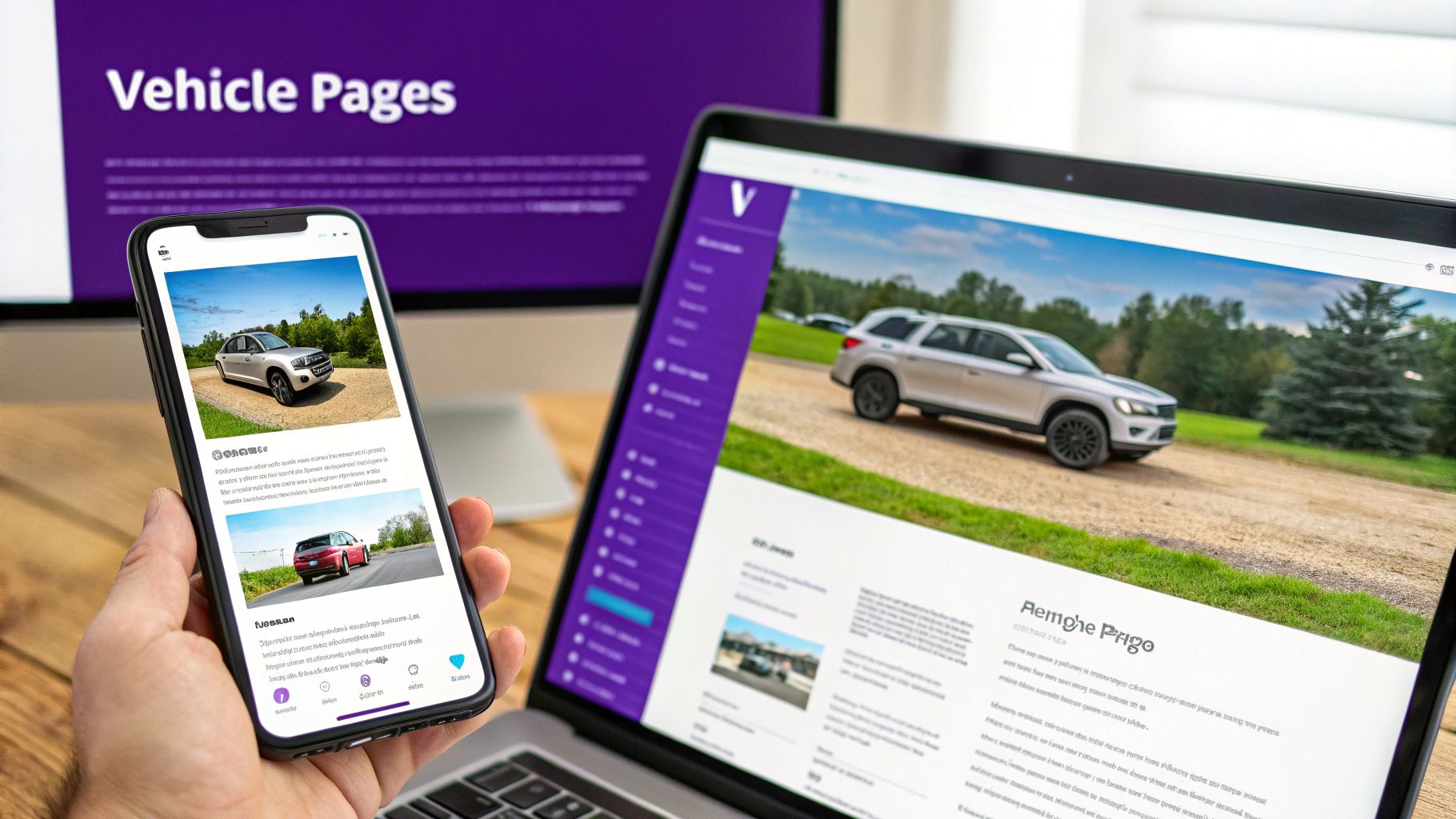
    A person views vehicle pages on a smartphone, laptop, and desktop monitor, showcasing digital automotive content.

    Think of your Google Business Profile as the sign on the highway that gets people to pull off at your exit. But once they turn onto your street, your website is the dealership itself. Does it look welcoming and easy to navigate, or is it a confusing lot that makes them drive away?

    Your website is the heart of your entire local SEO strategy. It has to be fast, dead-simple to use on a phone, and instantly give shoppers the answers they’re looking for. The stakes are high. According to Google, a staggering 53% of mobile users will leave a site if it takes more than three seconds to load.

    That’s over half your potential customers gone before they even lay eyes on your inventory. A slow, clunky site doesn't just frustrate people; it signals to Google that you offer a poor experience, which directly hurts your ability to rank locally.

    Your VDPs: Where Browsing Turns into Buying

    Let’s be clear: your Vehicle Detail Pages (VDPs) are the most important pages on your website. Full stop. When a local buyer lands here, they’re past the window-shopping phase. They are seriously considering this car. Your job is to give them everything they need to take the next step.

    A VDP needs to do more than just list specs. It needs to tell the car's story.

    • Photos and Video Are King: Get a full gallery of high-quality, well-lit photos of every angle—inside, outside, the engine, even close-ups of cool features. A simple walk-around video shot on your phone can make a world of difference.
    • Write a Real Description: Ditch the generic manufacturer copy. Write a few unique sentences for each vehicle. What makes this car special? Mention its condition, a unique feature, or who it’s perfect for (e.g., “The huge trunk space makes this SUV perfect for family trips to the lake.”).
    • Show the Price: Be upfront and clear with your pricing. Hidden fees and "call for price" are instant trust-killers for online shoppers. If you have financing specials, make that information obvious.
    • Make the Next Step Easy: Your calls to action (CTAs) should be big, bold, and impossible to miss. Use clear, action-oriented buttons like “Schedule a Test Drive” or “Check Availability.”

    When you structure your VDPs this way, you’re not just selling a car; you’re building confidence and guiding the buyer straight to your lot.

    Speaking Google's Language with Vehicle Schema

    Now for a powerful technical trick that many independent dealers miss: vehicle schema markup. This is a piece of code you add to your VDPs that translates your car’s information into a language search engines perfectly understand. It explicitly tells Google the make, model, year, mileage, price, and other key details.

    Why does this matter so much? Because schema helps your cars show up as rich results in Google search. Instead of a plain blue link, your listing can appear with a photo, price, and mileage right on the results page. This makes your inventory pop and practically begs for a click.

    Implementing vehicle schema is one of the most direct ways to boost your visibility in search. You're giving Google the exact, structured data it needs to feature your inventory, leading to more clicks from highly qualified local buyers.

    While you could add this code by hand, most modern dealership website platforms handle it automatically. For instance, a system built for car dealers can apply the correct schema as you upload inventory, giving you a huge SEO advantage without the technical headache. It's worth exploring the features included in modern dealership websites to see what's possible.

    Cast a Wider Net with Local Landing Pages

    Your VDPs are great for people searching for a specific car, but what about shoppers who are earlier in their journey? This is where location-specific landing pages come in. These pages are built to rank for those high-intent, but broader, local searches like “used trucks in Springfield” or “affordable SUVs near downtown.”

    But don't just throw a list of vehicles on a page and call it a day. To actually work, these pages need unique content that’s genuinely helpful for a local shopper.

    For example, on a "Used SUVs in Springfield" page, you could:

    • Talk about why an SUV is a great choice for the local weather or terrain.
    • Feature a few popular SUV models you typically carry.
    • Add a testimonial from a local customer who bought their SUV from you.
    • Embed a Google Map of your dealership to show how close you are.

    This strategy proves your local authority to both Google and your customers. You're building a wider net to capture valuable search traffic, guiding buyers from a general idea of what they want right to the specific cars sitting on your lot.

    Building Trust One Review at a Time

    Smiling woman points to 'Customer Reviews' banner with three stars, man holds car keys.

    In the car business, a handshake still means something. But these days, buyers look for proof of that promise online long before they ever set foot on your lot. Online reviews have become the new word-of-mouth referral, and for a dealership, they're one of the most powerful tools in your local SEO toolbox.

    Think about it from your customer's perspective. Buying a car is a massive financial decision, and nobody wants to deal with a shady operation. A high star rating and a string of positive testimonials on Google, DealerRater, or even Yelp offer immediate social proof. It eases their anxiety and makes your dealership the clear choice.

    Creating a Simple and Effective Review Generation System

    You can't just cross your fingers and hope for good reviews; you need a system to actively encourage them. The secret is making it incredibly simple for happy customers to share their experience while the excitement is still fresh. If it's complicated, they won't bother.

    The best approach is a simple follow-up, usually via SMS or email, right after a sale or service appointment. A friendly, non-pushy message works wonders.

    • Timing is everything. The sweet spot is within 24-48 hours. The positive experience is still top-of-mind, and they’re more likely to act.
    • Keep it simple. Ditch the corporate jargon. Something like, "Hi [Customer Name], thanks again for choosing us! Would you mind sharing your experience on Google? It really helps our local business," feels personal and genuine.
    • Provide a direct link. This is non-negotiable. Never make a customer hunt for your review page. Send a direct link to your Google Business Profile review section to remove all friction.

    This proactive approach doesn’t just pad your review count; it sends a strong signal to Google that your dealership is active, engaged, and valued by the local community.

    The Art of Responding to Every Single Review

    Getting reviews is only half the job. The real magic, and the real SEO value, comes from responding to them—all of them. Your replies are public, visible to every potential customer who reads your reviews. Think of it as free PR.

    A consistent response strategy shows you're engaged and that you actually care about customer feedback. It’s a crucial part of a healthy local SEO strategy for any car dealership.

    Responding to reviews is about more than just good manners; it's a powerful signal to Google's algorithm. Data shows that a consistent review response strategy, combined with frequently adding photos, can significantly boost a dealership's performance in the valuable local pack. You can explore more about these impactful dealership SEO statistics on a3brands.com.

    Turning Negatives into Positives

    Look, no dealership is perfect. Sooner or later, a negative review is going to happen. How you handle it tells potential customers everything they need to know about your commitment to service. Whatever you do, don't ignore it.

    First, acknowledge and apologize. Start by validating their frustration and offer a sincere apology, even if you feel they're off base. "We're very sorry to hear your experience didn't meet your expectations."

    Next, take it offline. The last thing you want is a public argument. Provide a direct contact, like a service manager's name and phone number, so you can resolve the issue privately. "Our manager, [Name], would like to connect with you directly to make this right. Please call them at [Phone Number]."

    Finally, stay professional. A calm, professional reply can de-escalate the situation and shows other potential buyers that you take customer satisfaction seriously. This approach often turns a public complaint into a powerful demonstration of your excellent service recovery.

    Earning Authority with Local Links and Citations

    https://www.youtube.com/embed/rN6VBqmUgUk

    Getting your own website in order is just one part of the puzzle. Google is constantly scanning the rest of the web, looking for signals that verify your dealership is a legitimate, active part of the local community. It finds these signals in two key places: citations and local links.

    Think of them as digital handshakes or endorsements. Every time a reputable local website mentions your dealership, it’s a vote of confidence. These votes build up over time, strengthening your online reputation and telling search engines you're a business people can trust. For any dealership aiming to win in local search, this off-page strategy is non-negotiable.

    The Foundation: Getting Your Citations Right

    Before you even think about earning high-powered links, you have to get your basic business information straight. A citation is simply any online mention of your dealership’s Name, Address, and Phone number (what we call NAP in the industry). You'll find them in online directories, on social media, and on auto-specific websites.

    The golden rule here is absolute consistency. Your NAP information must be a perfect match everywhere it shows up. Even a tiny difference—like using "St." on one site and "Street" on another—can create confusion for search engines and weaken your local authority.

    For car dealerships, some directories are more important than others. Nail these first:

    • Major Data Aggregators: These services are the source of truth for hundreds of smaller online directories.
    • The Big Players: This means your Google Business Profile, Apple Maps, Yelp, and Facebook page.
    • Auto-Specific Hubs: You have to be on platforms like DealerRater, Cars.com, and Edmunds. They scream relevance.
    • Hometown Directories: Don't overlook your local Chamber of Commerce or city business listings.

    Your NAP data is your dealership's digital fingerprint. Every consistent citation reinforces your location and identity, making it easier for Google to trust your business and show it to local searchers. Inconsistencies create doubt, which can directly harm your local rankings.

    Earning Links That Prove You're Part of the Community

    Citations are the table stakes. Local link building is how you win the game. A link (or backlink) is when another website directs traffic to your site. Google sees links from respected, relevant local sites as incredibly powerful endorsements.

    This isn't about spammy, old-school tricks. The goal is to earn these links naturally by actually being a valuable member of your community. It’s about forging real-world relationships that pay off with digital authority.

    Creative Link-Building Ideas for Your Dealership

    So, how do you get these valuable local links? It's less technical than you think and more about community engagement.

    Here are a few proven ideas that work wonders for dealerships:

    • Sponsor a Local Team or Event: Get involved with a high school football team, a summer festival, or a charity 5k race. Sponsorships nearly always come with a link from the organizer’s website—a fantastic local signal.
    • Partner with Neighboring Businesses: Team up with a go-to auto detailer, a trusted independent mechanic, or even a local insurance agent. You can offer mutual discounts and cross-promote each other online, which is a natural way to trade links.
    • Create a Genuinely Helpful Local Guide: Write a blog post that helps people in your area. Think "The Best Family-Friendly Road Trips from [Your City]" or a guide to local classic car shows. Share it with local bloggers and community Facebook groups; if it's truly useful, they'll link to it.
    • Offer a Scholarship: A small scholarship for a student at a local high school is a brilliant way to give back. It often earns you links from the school's website, the local newspaper, and other community outlets covering the award.

    These strategies do more than just build links. They build real goodwill, strengthen your brand, and prove to both customers and search engines that your dealership is a true pillar of the local community.

    Common Questions About Dealership Local SEO

    As you start digging into a local SEO strategy for your dealership, you’re bound to have some questions. It’s a space that changes fast, but thankfully, the fundamentals are pretty solid. Here are some of the most common questions we get from dealers, answered directly to help you plan your next move.

    How Long Does Local SEO Take to Show Results?

    This is the big one, and the honest answer is: it’s a long game. While you might see some quick traction from a fully dialed-in Google Business Profile in just a few weeks, true local SEO is about building momentum over time. Think of it like earning a great reputation in your town—it doesn’t happen overnight.

    For most dealerships, you can expect to see real, meaningful movement in local rankings and organic traffic within three to six months. The key is consistency. Unlike paid ads that vanish the second you stop paying, the work you put into SEO compounds, creating a valuable, long-lasting asset for your business.

    Local SEO vs. Traditional SEO: What's the Difference?

    The biggest difference boils down to geography and what the searcher is actually looking for. Traditional SEO is a broad net, trying to rank for national keywords like "best used SUVs." Local SEO, on the other hand, is all about your specific turf.

    It’s hyper-focused on catching customers right in your backyard who are searching with local intent. You know the ones:

    • "Toyota service center near me"
    • "Ford dealership in Springfield"
    • "Used trucks for sale in Dallas"

    This is where signals proving your local relevance become critical—things like your Google Business Profile, reviews from local customers, and listings in local online directories. It’s all about showing Google you’re the go-to dealer for your community.

    Can I Handle Local SEO In-House?

    Absolutely. Many of the foundational local SEO tasks can be managed by your team, especially if you have someone dedicated to marketing. Things like keeping your Google Business Profile updated, responding to every review, and posting about community events are totally achievable in-house.

    Where it gets tricky is with the more technical stuff. Properly implementing schema markup, diagnosing and fixing site speed issues, or running a targeted local link-building campaign often calls for a specialist. We see a lot of dealerships succeed with a hybrid model: they handle the daily activities and partner with an expert for the heavy-lifting, technical audits, and high-level strategy.

    What Is a Realistic Budget for Local SEO?

    Your budget can swing quite a bit depending on how competitive your market is and how much work needs to be done. A dealership in a crowded metro area is playing a different game than one in a smaller town with less competition.

    As a general benchmark, dealerships may invest between $3,000 and $8,000 per month for a comprehensive local SEO program that covers content, technical optimization, and proactive reputation management.

    Try to think of this as an investment, not just an expense. A powerful organic presence will dramatically lower what you have to spend on pay-per-click advertising down the road. If you're curious about what a strategy tailored to your dealership might look like, feel free to contact our team for expert guidance.


    Ready to stop wrestling with technical headaches and start showcasing your inventory on a website built to convert local buyers? AutoFire delivers a modern, mobile-first website that gets you online fast and is optimized for local search from day one. https://goautofire.com

    Article created using Outrank