Tag: dealer websites

  • Leads for car dealerships: Turn Your Website into a Conversion Engine

    Leads for car dealerships: Turn Your Website into a Conversion Engine

    Generating a steady stream of high-quality leads for car dealerships all comes down to one thing: a powerful, mobile-friendly website that serves as your digital showroom. This is the foundation of all your marketing efforts. It’s where you capture a browser's interest and turn them into a qualified buyer, often before they even think about stepping onto your lot.

    Your Digital Showroom Is Your Lead Generation Engine
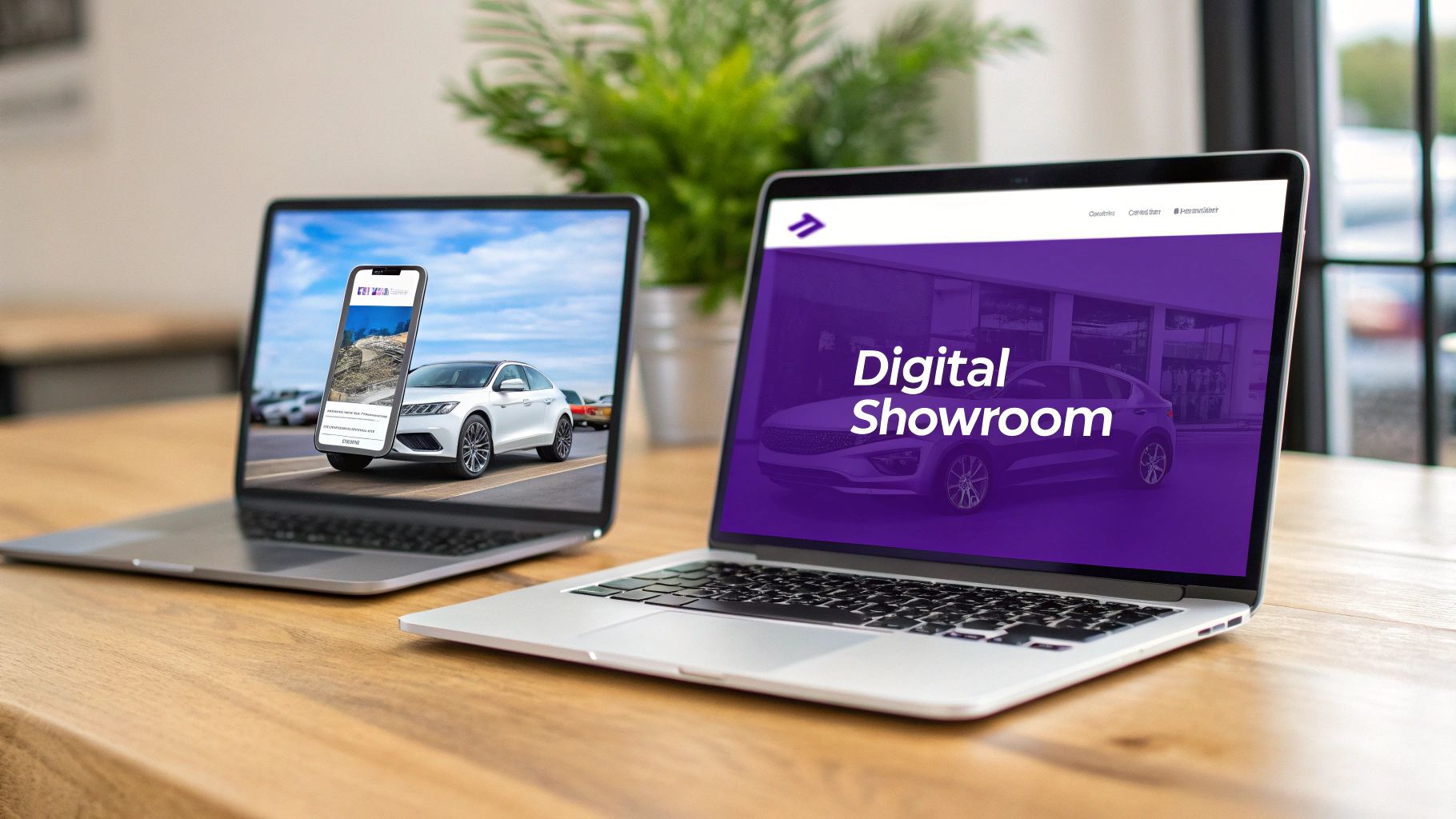
    Two laptops on a wooden desk displaying digital car showrooms and mobile car listings.

    Let's be honest, the days of relying on foot traffic are long gone. The modern car buying journey starts with a Google search, not a trip down the street. This shift means independent dealers have to think differently. Your website isn't just an online brochure anymore; it's your #1 salesperson, working 24/7.

    In this market, one trend tells the whole story: the vast majority of car buyers do heavy research online before ever visiting a dealership. This massive change has turned the internet into the main arena for winning new customers.

    Your digital showroom is the engine that drives everything, and optimizing your lead capture forms is critical to turning that traffic into real opportunities. If you don’t have a strong online presence, you're practically invisible to most of today's buyers.

    The Foundation of a Lead-Generating Website

    So, what makes a website a lead-generating machine? It’s not magic. It comes down to a few core elements that directly shape the user's experience and, in turn, your bottom line.

    Think of it this way: a slow, confusing, or clunky website is the digital version of a locked front door. Potential customers will just leave and head straight to your competitor.

    Here’s what you need to get right:

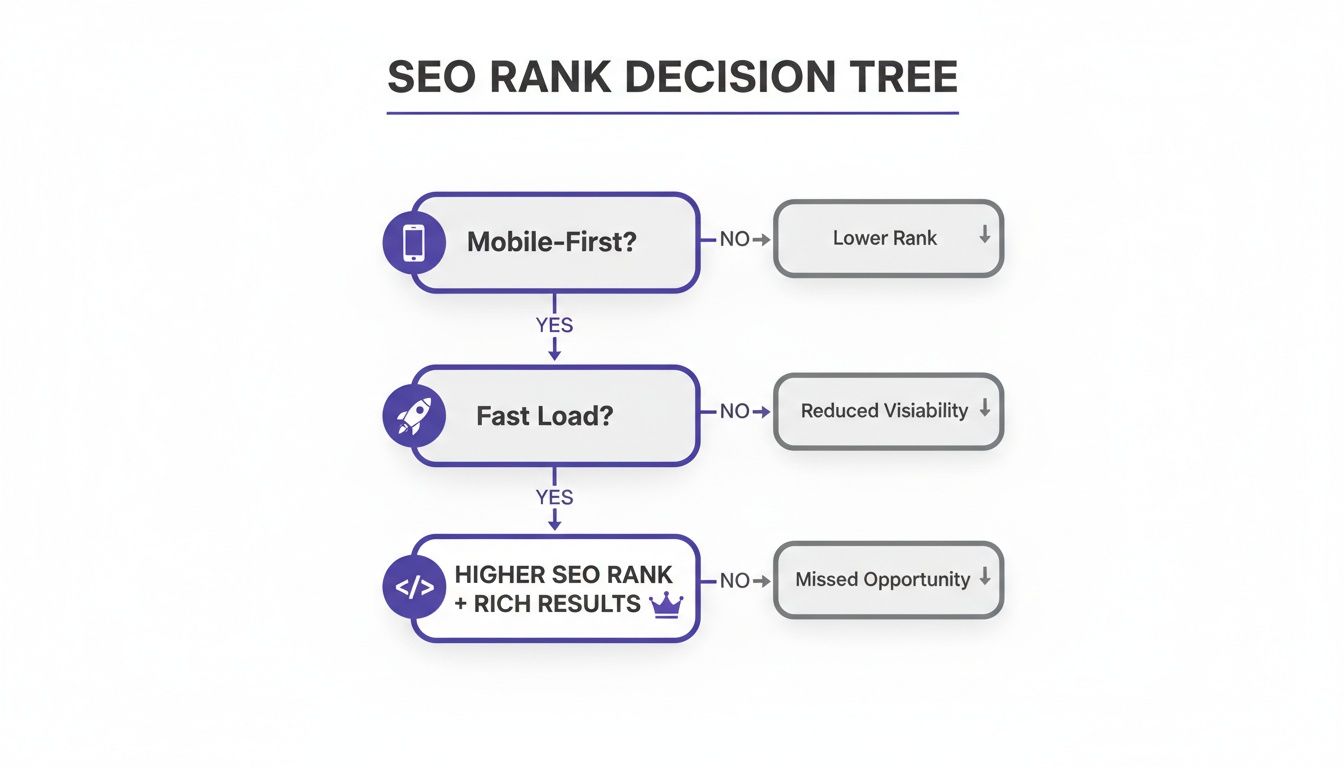
    • Lightning-Fast Load Times: Every single second matters. A site that drags, especially on a phone, is frustrating and tells Google you don't value the user's time. Speed is non-negotiable for keeping people engaged.
    • Mobile-First Design: The vast majority of your customers are researching cars on their smartphones, often while standing on another lot. Your site has to look and work perfectly on any screen size. A bad mobile experience is a lead killer.
    • Clean, Intuitive Navigation: Can a visitor find your inventory, contact page, and financing application in two clicks? Simple menus and a clear layout help people find what they need without getting annoyed.
    • Automated Inventory Showcases: Your cars are the main event. Your website needs to automatically sync with your inventory, showcasing every vehicle with great photos, detailed specs, and clear pricing.

    Key Takeaway: Your website is more than a marketing tool—it's the central hub for your entire lead strategy. Every ad, social post, and search result should point back here, creating a smooth path from discovery to contact.

    To get you started, here’s a quick rundown of the essential features every dealership website needs to capture leads effectively.

    Essential Website Features for Lead Generation

    Website Feature Why It's Critical for Leads
    Mobile-First Design Captures the large majority of car shoppers who start their research on a smartphone.
    Fast Page Speed Reduces bounce rates; even a one-second delay can negatively impact conversions.
    High-Quality Photos/Videos Builds trust and allows shoppers to inspect vehicles from home, encouraging inquiries.
    Detailed VDPs Answers questions upfront, pre-qualifying buyers before they even reach out.
    Prominent CTAs Guides visitors to take the next step, whether it's "Schedule Test Drive" or "Get Pre-Approved."
    Simple Lead Forms Makes it easy for interested buyers to submit their information without friction.

    These aren't just "nice-to-haves"—they are the building blocks of a website that actively works for you, turning clicks into customers.

    The good news is that independent dealers can launch a professional, high-speed website without needing a huge in-house tech team. By focusing on these fundamentals, you build a digital showroom that doesn’t just attract visitors—it converts them. If you want to go deeper, check out our guide on high-performance https://goautofire.com/blog/website-design-for-car-dealers.

    Win Your Local Market with Automotive SEO

    Let’s be honest. Even with a fantastic website, most local car shoppers aren't going to find you by typing your dealership's name into their browser. Their journey starts with a search like "used Honda CR-V near me" or "independent car dealer Dallas."

    This is where local automotive SEO becomes your secret weapon for generating high-quality leads for car dealerships. It's all about making sure you show up the second a motivated buyer starts looking for a vehicle you have sitting on your lot.

    You don't need to get bogged down with overly complex, enterprise-level SEO tactics. For an independent dealer, winning the local game means mastering a few key areas that have a direct impact on who sees your inventory. The goal isn't just random traffic; it's about attracting ready-to-buy shoppers from your community.

    Master Your Google Business Profile

    Your Google Business Profile (GBP) is easily your most valuable local SEO asset. It’s that info box that pops up on Google Maps and in local search results, and it's often the very first impression a potential customer has of your dealership. A neglected or incomplete profile is a huge red flag for both Google and your buyers.

    Think of your GBP as your digital storefront. It has to be accurate, inviting, and professional.

    • Consistent NAP Information: Make sure your Name, Address, and Phone number are perfectly identical everywhere—on your website, your GBP, and any other online directory. A tiny difference like "St." versus "Street" can confuse search engines and knock you down in the rankings.
    • High-Quality Photos: Don't use stock photos. Upload recent, crisp pictures of your lot, your storefront, your team, and, most importantly, your actual cars. Seeing real inventory builds instant trust and gives people a reason to click.
    • Authentic Customer Reviews: Positive reviews are pure gold. Make it a habit to encourage happy customers to leave you feedback on Google. It’s also critical to respond professionally to all reviews, good and bad. It shows you’re engaged and stand by your business.

    Dominate Search Results with Google Vehicle Listings

    Beyond your GBP, there’s a game-changing (and free!) tool that every single dealer should be using: Google Vehicle Listings (GVL). You know that inventory carousel that shows up right on the search results page when you look for a specific make and model? That's GVL.

    Getting your cars into this prime real estate is one of the fastest ways to generate free, qualified leads.

    The best part? It's not a pay-to-play system. GVL is an organic feature that levels the playing field, giving independent dealers a real shot against the big franchises. The key is simply feeding Google clean, structured, and accurate inventory data so its system can easily display your vehicles.

    Expert Tip: Don't even think about managing your inventory feed manually. Automating it is the only way to succeed with Google Vehicle Listings. A modern dealership website platform can automatically format and send your vehicle data to Google the moment you add a car, ensuring your listings are always fresh without any extra work from you.

    This automation solves a huge customer-experience problem: clicking on a car that's already been sold. When your feed is updated in real-time, you guarantee every click is for a vehicle that's actually available, which helps protect your reputation. You can learn more in our complete guide to local SEO for car dealerships.

    Optimize Each Vehicle Listing for Clicks

    Just getting your cars to show up in Google Vehicle Listings is only half the battle. Now you have to convince a shopper to click on your car instead of the one listed by the dealer down the street. Every single detail matters.

    Here’s a quick checklist to make sure every vehicle you list is set up to win the click:

    • Accurate VIN Data: Always use a VIN decoder. It automatically populates all the correct specs, which builds trust by showing you’re transparent and detail-oriented. Plus, it gives Google a ton of rich data to work with.
    • Lots of Photos: A few pictures won't cut it. Post a full gallery for every car. Get all the angles—exterior, interior, the dashboard, the engine bay, and even close-ups of special features or any minor imperfections.
    • Compelling Descriptions: Go beyond just the standard specs. Write a short, engaging description that tells a story. Instead of just listing "2018 Ford Explorer," try something like, "The perfect family-hauler! This 2018 Ford Explorer has third-row seating and a spotless service history."

    By focusing on these core local SEO strategies, you'll stop passively waiting for customers and start actively pulling in local buyers who are searching for the exact cars you have for sale.

    Turn Vehicle Detail Pages into Conversion Tools
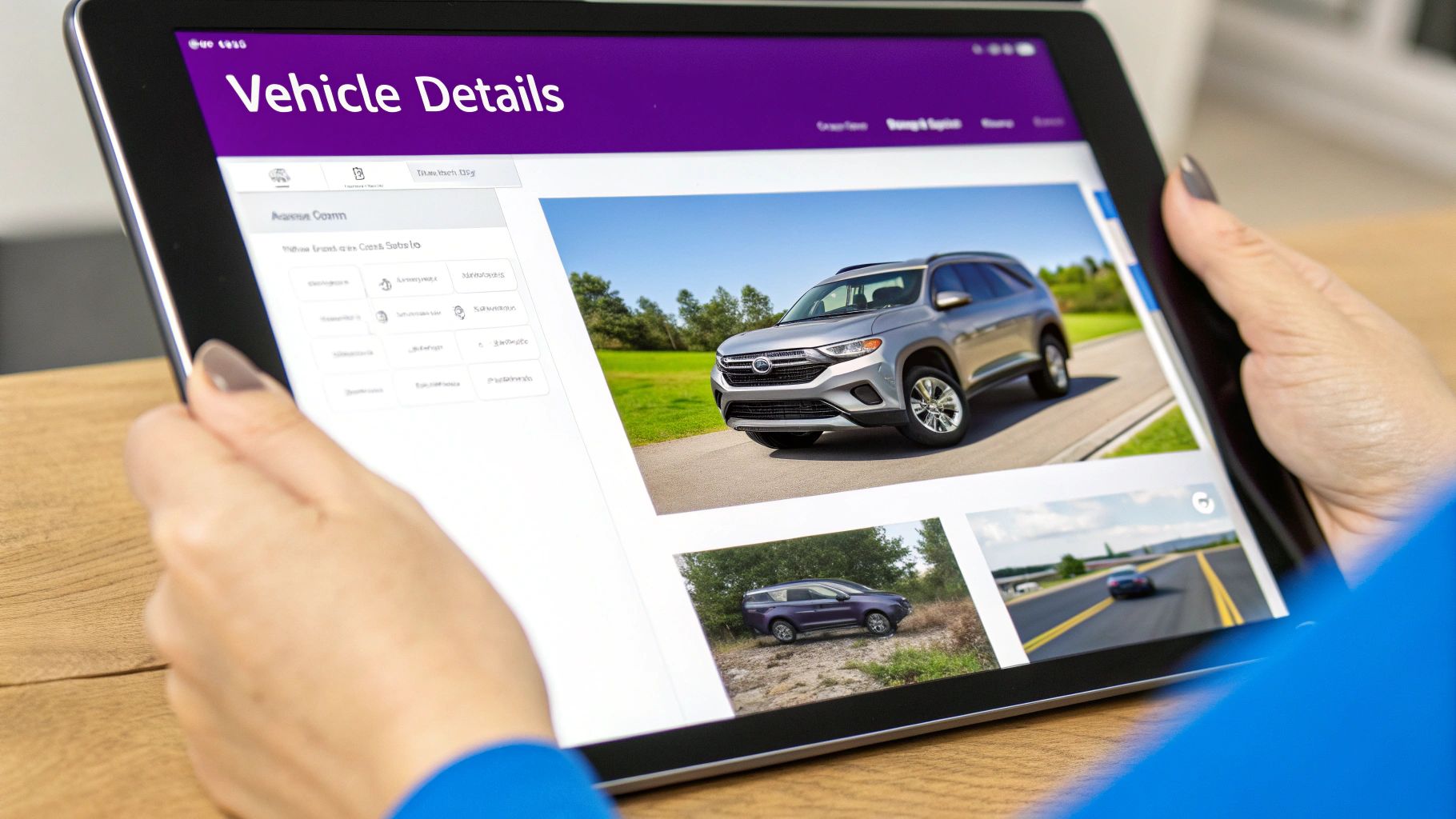
    A person holds a tablet displaying 'Vehicle Details' with multiple car images, including a silver SUV.

    Alright, you’ve pulled shoppers to your site with some smart local SEO. Now for the moment of truth: the Vehicle Detail Page (VDP). This isn’t just another page on your website; it's your digital showroom and your hardest-working salesperson, all rolled into one. It’s arguably the most critical piece of real estate you have for generating real leads for car dealerships.

    Think about it. A buyer who lands here isn't just window shopping anymore. They've clicked on a specific car, which means they have genuine interest. Your mission is to give them everything they need to take the next step, presenting it all in a way that’s clean, compelling, and builds immediate trust.

    This is where the little things become big things. A VDP that’s confusing, incomplete, or looks untrustworthy will send a motivated buyer clicking over to your competitor in a heartbeat. A great one makes it dead simple for them to get in touch.

    Build Trust with Comprehensive Vehicle Information

    The bedrock of a VDP that actually converts is complete and accurate information. Today’s car buyers are researchers. They’ve done their homework, and they will absolutely notice if you haven't. Transparency isn't just a buzzword; it's how you earn the trust needed to get their contact info.

    One of the best tools in your arsenal for this is a VIN Decoder. Manually typing in dozens of specs for every car is a recipe for typos and wasted time. A VIN Decoder automates the whole thing.

    Just pop in the Vehicle Identification Number, and it instantly fills your VDP with factory-correct data. We're talking about details like:

    • Engine and transmission specs
    • Standard features vs. optional add-ons
    • Official fuel economy ratings
    • Safety information
    • Exact exterior and interior colors

    This isn't just a time-saver. It guarantees accuracy and shows customers you're a professional, detail-oriented operation with nothing to hide. That's a huge step toward earning their business.

    The Anatomy of a High-Converting VDP

    Beyond the raw data, the VDP needs to be structured to guide the shopper toward a specific action. It’s a careful mix of great visuals, clear information, and obvious next steps. Every single element should work to answer a buyer's questions and remove any hesitation they might feel about reaching out.

    Key Insight: A successful VDP anticipates and answers a buyer’s questions before they even have to ask. The goal is to eliminate any reason for them to leave your page to find information elsewhere.

    Here are the non-negotiable components that will turn a basic inventory listing into a lead-generating machine:

    1. A Gallery of High-Resolution Images: A few blurry phone pics just won't cut it. Your photo gallery is the closest a buyer gets to seeing the car in person before they visit. You should aim for numerous high-quality photos from every conceivable angle—exterior, detailed interior shots of the dash and seats, cargo space, under the hood, and even close-ups of the tires.
    2. Transparent and Upfront Pricing: Don't play games with pricing. Display it clearly and prominently. If you make someone fill out a form just to see the price, they're gone. If you have special offers or financing options, put them right there next to the price to give a full financial picture.
    3. A Clear and Compelling Call-to-Action (CTA): What do you want them to do? Most likely, it's to schedule a test drive. Your CTA button needs to be impossible to miss. Use action-focused words like "Schedule Your Test Drive" or "Check Availability"—make it a command, not a suggestion.
    4. Simple, Accessible Lead Forms: Once they click that CTA, the form they see has to be short and sweet. Ask for the bare minimum: name, email, and phone number. A long, complicated form is a notorious conversion killer, especially for someone browsing on their phone.

    Putting these elements together creates a smooth, confidence-building experience that naturally encourages a shopper to get in touch. As you work on your VDPs, it's worth brushing up on the fundamentals of turning website visitors into leads. You can learn more about how to improve website conversion rates and apply those proven tactics here. Ultimately, your VDPs are where a browser becomes a real sales opportunity, making them the most powerful conversion tools you have.

    Drive Targeted Traffic to Your Dealership Website

    So, you've got a killer website with perfectly detailed vehicle pages. That’s like building a state-of-the-art racetrack—it's impressive, but it’s completely pointless until the cars actually show up. The next move is all about opening the floodgates and getting a steady stream of real, qualified buyers to your digital showroom.

    For an independent dealer, this isn't about outspending the big franchise stores. It’s about being smarter. We're going to focus on practical, budget-friendly tactics that pull in local, in-market shoppers—the people who actually buy cars from you.

    The mission is simple: get a constant flow of the right people to your site. This is how you turn your website from a static online brochure into a machine that actively generates leads.

    Attract Buyers with Helpful Organic Content

    One of the best long-term plays you can make is creating simple, genuinely helpful content that answers the real-world questions your customers are already Googling. Think beyond just "selling." Your goal is to become the go-to local authority on all things cars. A blog is the perfect place to do this.

    Forget writing about your dealership. Write for your customers. Craft posts around the exact topics they’re searching for. This strategy lets you connect with buyers at every stage, from the "just browsing" phase to the "I'm ready to buy today" moment.

    Here are a few ideas you can run with this week:

    • Head-to-Head Comparisons: Create a no-nonsense comparison like, "Honda CR-V vs. Toyota RAV4: Which SUV is Actually Better for Families?"
    • Price-Point Roundups: Target budget-conscious shoppers with titles like, "Our Top 5 Used Cars You Can Drive Off the Lot for Under $15,000."
    • Financing Guides: Break down a confusing topic with something like, "The Independent Dealer's Guide to Financing a Used Car in [Your City]."

    Every single post you publish is like opening a new digital door to your dealership, pulling in free search traffic month after month. The secret is to be legitimately helpful, which builds trust long before a customer ever steps on your lot.

    Drive Engagement on Social Media

    Social media, especially Facebook and Instagram, is an incredible channel for showing off your inventory and connecting with your local community. But here's the trick: you have to stop posting like a faceless corporation. Your social media needs to have a personality.

    Make sure your inventory posts pop. Use high-quality photos—your phone is fine, just wipe the lens!—and maybe even quick walk-around videos to literally stop people from scrolling past. Spark a conversation by asking questions in your captions, like, "Okay community, which one of these trucks are you taking on a weekend getaway?"

    Pro Tip: When you post a vehicle on Facebook or Instagram, don't just throw the price in the caption and call it a day. Always include a strong call-to-action and a direct link straight to that car’s VDP on your website. Social media’s job is to drive traffic back to your turf, where you can actually capture the lead.

    This kind of consistent, engaging activity keeps your dealership at the top of people's minds and builds a following that will eventually turn into customers.

    Run Budget-Friendly Paid Ad Campaigns

    Organic is great for the long game, but sometimes you just need leads now. That's where a little bit of smart, targeted paid advertising comes in on platforms like Google and Facebook. The key is to be surgical with every dollar you spend.

    Local Facebook Ads are fantastic for zeroing in on specific groups of people in your town. You can target users based on interests (like people who follow certain car brands), recent behaviors, and of course, location. For example, you could run an ad for a new Ford F-150 on your lot and show it only to men within a certain age range and radius who have shown an interest in trucks. That's powerful stuff.

    Google Ads let you get in front of people with sky-high buying intent. By bidding on search terms like "used Toyota Camry for sale near me," you can put your dealership right at the top of the page at the exact moment a motivated shopper is looking. It doesn't get much more direct than that.

    With both platforms, start small. You don't need a huge budget. The goal isn't to blanket the internet; it's to run hyper-focused campaigns that bring in more than they cost. This one-two punch of organic and paid strategies ensures your website is always busy, attracting the right people and turning them into real, actionable leads.

    Capture and Convert Leads with Smart Follow-Up

    Getting traffic to your dealership’s website is a huge win, but it’s just the starting line. The real race is won when a visitor becomes a lead, and that lead turns into a test drive. This is where your lead capture and follow-up strategy goes from being a nice-to-have to the most critical part of your sales process.

    Let's be honest: getting someone's contact info and responding quickly is what separates a missed opportunity from a done deal. A clunky form or a slow response time is all it takes to send a motivated buyer straight to your competitor down the street.

    The initial goal is to get those potential buyers to your digital doorstep, typically through SEO, social media, and paid ads.
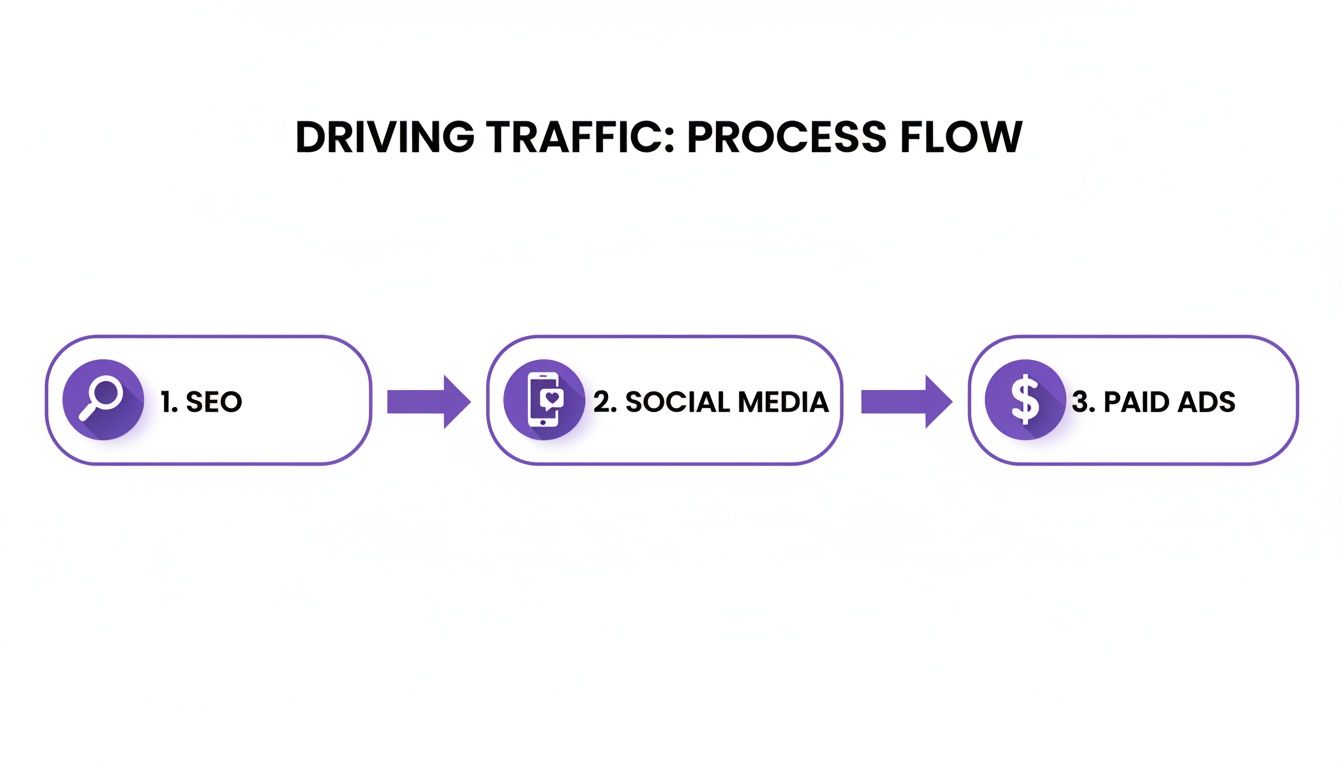
    Process flow diagram showing three steps to drive traffic: 1. SEO, 2. Social Media, 3. Paid Ads.

    Each of these channels funnels interested shoppers right to your inventory. Now, the real work begins: capturing their information and starting the conversation.

    The Anatomy of a High-Converting Lead Form

    Think of your lead capture form as the handshake between a casual browser and a serious prospect. The goal is to make it as quick and painless as possible. I've seen countless dealerships kill their conversion rates with long, complicated forms, which is a disaster when you consider how many shoppers are browsing on their phones.

    Keep it simple. For an initial test drive request or a general inquiry, you only need the essentials:

    • Name: So you can greet them personally.
    • Email: For sending confirmations and helpful follow-ups.
    • Phone Number: This is gold. It’s your direct line for a quick call or text.

    Placement is just as important as the fields you ask for. Your lead forms should be impossible to miss. Stick them prominently on every Vehicle Detail Page, your contact page, and maybe even a pop-up that triggers when someone looks like they're about to leave your site.

    My Two Cents: Simplicity always wins. A form with just three or four essential fields will generate far more leads for car dealerships than a lengthy one that asks for their life story. You can always gather more details once you're actually talking to them.

    What Happens After They Hit ‘Submit’?

    The second a potential customer clicks that "submit" button, a timer starts. The speed of your response is one of the biggest predictors of whether you’ll close the deal. I’ve seen leads go completely cold in just a few hours.

    This is where a little automation goes a long way. Your very first move should be an instant auto-responder. It's a simple, automated email or text message that confirms you got their inquiry and tells them exactly when they can expect to hear from a real person.

    A solid auto-responder could say something like: "Thanks for your interest in the 2019 Honda Accord! We've received your request, and one of our team members will give you a call within the next 30 minutes to confirm your test drive." It's professional and it manages expectations perfectly.

    A Simple, Effective Follow-Up Workflow

    A consistent follow-up process ensures no lead ever falls through the cracks. While some dealers get lost in complex CRM workflows, I’ve found that a simple, repeatable sequence is often the most effective. A smart mix of emails, texts, and calls keeps you top-of-mind without being annoying.

    Here’s a practical checklist you can put into action right away to manage new leads.

    Lead Follow-Up Workflow Checklist

    Timeframe Action Item Goal
    Within 5 Minutes Instant Auto-Responder (Email/Text) Acknowledge receipt and set expectations.
    Within 30 Minutes Personal Phone Call Make a human connection and schedule the test drive.
    Day 1 (No Contact) Follow-Up Text Message Send a friendly, low-pressure reminder.
    Day 2 Follow-Up Email Provide additional vehicle info or similar options.
    Day 4 Final Follow-Up Call Make one last attempt to connect and offer assistance.

    Following a structured approach like this shows customers that you’re organized, professional, and genuinely interested in earning their business. When you master both capturing information efficiently and following up promptly, you create a powerful system that turns website clicks into real, tangible sales.

    Measure What Matters to Get More Leads

    You can't improve what you don't measure. All the hard work you pour into your website, local SEO, and paid ads is just spinning wheels if you don't know what’s actually bringing people through the door. This is where you stop guessing and start making smart, data-driven decisions that generate more leads for car dealerships.

    You don't need a Ph.D. in data science to get this done. A free tool like Google Analytics is all it takes to get a clear picture of how your digital showroom is performing. It'll show you exactly where your website visitors are coming from, which cars get the most attention, and how many people actually fill out your contact forms.

    Focus on a Few Key Metrics

    It's incredibly easy to get lost in a sea of data. Instead of drowning in dozens of "vanity metrics" that sound good but mean nothing, just focus on the handful that directly impact your sales.

    These numbers tell the real story of your dealership's health.

    • Website Conversion Rate: This is your big one. It's the percentage of website visitors who actually do something you want them to, like submitting a "Schedule Test Drive" form. If this number is low, it’s a red flag that something on your VDPs or forms is turning people away.
    • Cost Per Lead (CPL): If you're spending money on ads, this is non-negotiable. Simply divide your total ad spend by the number of leads you got. Knowing your CPL for a Facebook campaign versus a Google Ads campaign tells you where your money is best spent.
    • Lead-to-Test-Drive Ratio: Of all the form submissions and phone calls you get, how many people actually show up for a test drive? This metric cuts through the noise and shows you the quality of your leads and how well your team is following up.

    Key Takeaway: Your goal is to create a continuous improvement loop. You try something new (like a new ad campaign), measure its impact on these core metrics, learn from the results, and then adjust your strategy. This cycle is how you consistently get better.

    Turning Data into Actionable Insights

    Once you have the numbers, you have to do something with them. Data is useless without action.

    Let's say Google Analytics shows that a blog post you wrote, "Best Used SUVs Under $20,000," is bringing in a ton of traffic but almost no one is contacting you from that page. That's a clear signal. You could add a direct call-to-action with a link to your current SUV inventory right in the middle of the article.

    Or maybe you see that one specific Ford F-150 on your lot is getting way more VDP views than any other truck. That's a gold mine of information. Feature that truck on your homepage or run a targeted social media ad showing it off.

    To really get ahead, you can't just look at your own numbers in a vacuum. It's just as important to see what your competition is up to. Using AI competitor analysis tools can give you a major leg up by revealing market trends and what strategies are working for other dealers nearby.

    By consistently measuring what truly matters, you can stop wasting time and money on tactics that don’t move the needle and double down on the ones that do. This ongoing process—implement, measure, refine—is the secret to building a lead generation engine for your dealership that's both predictable and scalable.

    Your Top Questions About Dealership Leads, Answered

    If you're trying to build a solid sales pipeline, you've probably got questions. I hear the same ones from dealers all the time. Let's tackle some of the most common ones head-on.

    How Long Until My SEO Efforts Actually Start Working?

    This is the big one, isn't it? While you can get some quick traction with things like Google Vehicle Listings, the real, sustainable traffic from organic SEO takes time to build.

    Realistically, you should expect to see significant results in about 3-6 months. That might sound like a while, but it's an investment that pays off big time. Consistency is everything here—regularly optimizing your site, building up your local business listings, and posting genuinely useful content will get you there. A technically sound website from the get-go can definitely speed things up.

    What's the Single Most Important Thing for Capturing Leads on My Site?

    Hands down, it's your Vehicle Detail Pages (VDPs). Nothing else comes close. Think about it: when a shopper lands on a VDP, they're not just browsing anymore; they're seriously considering that specific car.

    Your VDP needs to be your best salesperson. That means:

    • High-quality photos from every angle.
    • Detailed specs pulled automatically with a VIN decoder.
    • Clear, upfront pricing.
    • A big, obvious call-to-action button like "Schedule a Test Drive" that works perfectly on a phone.

    A car buyer on a VDP is a hot lead. Your job is to make it incredibly easy for them to take the next step by giving them all the information they need, right then and there. Don't make them work for it.

    Do I Really Need a Huge Budget for Paid Ads?

    Not at all. In fact, starting small is often smarter. You don't need to spend a fortune to see results, especially with local advertising.

    Highly targeted campaigns on Facebook Ads or Google Ads can be incredibly effective, even with a modest budget. The trick is to focus on "in-market" audiences—people actively searching for the types of cars you have on your lot. The goal isn't just clicks; it's driving the right people to your VDPs to turn that ad spend into actual leads.


    Ready to turn your website into a lead generation engine? With AutoFire™, you can launch a modern, mobile-first dealership site designed to capture leads from day one. Get started for free.

  • Choosing an Automotive Website Builder for Your Dealership

    Choosing an Automotive Website Builder for Your Dealership

    So, what exactly is an automotive website builder? Think of it as a specialized platform built from the ground up for car dealerships. It’s packed with tools designed for one purpose: selling cars. This includes features like automatic inventory updates, VIN decoding, and direct integrations with Google Vehicle Listings. These systems aren't just about looking good; they’re engineered to convert your website traffic into real leads and, ultimately, customers on your lot.

    Why Specialized Automotive Website Builders Outperform Generic Platforms

    A person holds a tablet displaying "Bulit for Dealers" in a car dealership lot.

    Picking a website platform is one of the most important decisions you'll make for your independent dealership. It’s tempting to look at popular, all-purpose builders like Wix or Squarespace, but they simply weren't designed for the unique grind of selling cars. A dealership’s website isn't a static online brochure; it's your digital showroom, and it needs to operate as a 24/7 sales machine.

    The general website builder market is booming, expected to jump from USD 3.94 billion in 2024 to an incredible USD 49.12 billion by 2034. This growth is fueled by small businesses hungry for easy, no-code solutions. But while this trend shows a clear demand for user-friendly platforms, it also shines a light on what generic builders miss: industry-specific functionality. You can dive deeper into the website builders market growth to see the full picture.

    The Dealership Dilemma: Generic vs. Specialized

    Sure, a generic platform can give you a decent-looking site. But it will inevitably buckle under the weight of a dealership’s core operational needs. It’s like trying to tow a trailer with a sports car—it might move a few feet, but it’s the wrong tool for the job and something’s bound to break. Specialized platforms, on the other hand, are the heavy-duty trucks of the industry, built specifically for a dealership's workflow.

    The fundamental difference is purpose. A generic builder helps you display information. An automotive website builder helps you sell cars by automating inventory, capturing qualified leads, and getting your vehicles in front of buyers on Google.

    This distinction is everything. Today’s car buyer starts their journey online, and they expect to see your up-to-the-minute inventory with great photos and accurate details. If your site is clunky, outdated, or slow on a phone, that potential buyer is gone. Forever.

    Here’s a quick breakdown of how these two options stack up in the real world:

    Feature Generic Website Builder (e.g., Wix, Squarespace) Specialized Automotive Website Builder
    Inventory Management Requires manual data entry for every single vehicle. No sync. Automated inventory feeds, instant VIN decoding, and VDP creation.
    SEO Focus General SEO tools that need a ton of manual work to be effective. Built-in SEO optimized for Google Vehicle Listings and local search.
    Lead Capture Basic contact forms that gather a name and an email address. Integrated credit applications and trade-in value forms.
    Industry Tools No built-in connections to the tools you use every day. Integrates with your DMS, pricing guides, and vehicle history reports.

    At the end of the day, opting for a generic builder means you'll be stuck duct-taping different solutions together and wasting hours on manual tasks. An automotive-specific platform automates all of that, freeing up your time and giving you a serious competitive edge over dealers still trying to make the wrong tools work.

    The Core Features That Actually Drive Car Sales

    When you're shopping for an automotive website builder, it's easy to get lost in endless feature lists. But let's be honest—most of those features are just noise. A generic builder might give you a pretty online brochure, but what an independent dealer really needs is a high-octane sales engine.

    The right platform isn't about having the most bells and whistles. It’s about having the right tools that directly automate your daily grind, pull in real buyers, and turn clicks into customers walking onto your lot. Let's cut through the fluff and look at the non-negotiables that will make or break your online success.

    Automated Inventory Management and VIN Decoding

    If you're still manually uploading cars to your website, you're losing time and money. Period. Taking photos, writing descriptions, and typing in specs for every single vehicle is a brutal time-suck, and it’s a breeding ground for typos that kill customer trust.

    This is where automated inventory management becomes your best friend. A solid automotive website builder should plug right into your DMS or let you upload inventory in a snap, instantly building out a professional vehicle detail page (VDP) for every car.

    The real game-changer here is a built-in VIN decoder. This one tool is non-negotiable.

    • Instant Accuracy: You pop in the VIN, and it automatically fills out the year, make, model, trim, engine specs, and all the factory options. No more guesswork.
    • Time Savings: This feature alone can save you dozens of hours of mind-numbing data entry every month. That’s more time you can spend sourcing cars and talking to buyers.
    • Building Trust: When a shopper sees a detailed, accurate listing, it builds immediate confidence that you’re a professional outfit.

    Without this level of automation, your website becomes a liability—an outdated, inaccurate mess that misrepresents what’s actually on your lot.

    Built-in SEO for Google Vehicle Listings

    Having a website is pointless if nobody can find it. For car dealers, Search Engine Optimization (SEO) has a very specific goal: getting your inventory to show up in Google Vehicle Listings. This is Google’s free feature that puts your cars right in front of local buyers the second they search.

    The catch? Your website needs special technical code (called schema markup) to even qualify. Your average website builder has no idea how to do this, leaving you invisible to Google.

    A purpose-built automotive platform handles all that technical wizardry for you. It automatically structures your VDPs with the right code so every vehicle is eligible for Google Vehicle Listings—no extra work required. This feature alone can become your single best source of free, high-intent traffic.

    It means your cars get discovered where it matters most, driving real, local buyers from Google straight to your website and your front door.

    High-Performance Mobile Speed

    Let's face it: almost every car shopper starts their search on a phone. If your site is slow and clunky on mobile, you’ve already lost them. A top-tier automotive website builder is built for mobile first.

    • Optimized Images: It should automatically shrink your vehicle photos for lightning-fast loading without making them look grainy.
    • Clean Code: The platform is engineered for speed, not weighed down by the bloated code you find in generic builders.
    • Responsive Design: Your site will look sharp and work perfectly whether it’s on a tiny smartphone or a huge desktop monitor.

    When you’re vetting platforms, don’t just trust their sales pitch. Ask for live examples of their dealer sites and test them yourself using Google's PageSpeed Insights tool. A high score tells you the platform is built for how people shop for cars today. You can dive deeper into a full list of essential automotive website features that boost both speed and sales.

    Integrated Lead Capture and Management Tools

    The whole point of your website is to generate leads, right? A simple "contact us" form just doesn't cut it anymore. Your site needs smart, integrated tools that make it dead simple for a shopper to take the next step.

    Look for these essential lead capture forms built right in:

    • Credit Applications: Let buyers securely submit their financing info directly on your site.
    • Trade-in Valuation Forms: Capture leads from people looking to trade in their old car.
    • "Schedule a Test Drive" Forms: Make it effortless for interested shoppers to book an appointment.

    These aren't just contact forms; they’re high-intent lead magnets. They capture shoppers who are serious about buying and give your sales team the critical information they need to have a productive conversation and close the deal.


    Before we move on, let's consolidate these ideas into a quick-reference checklist. This will help you keep the most important criteria top of mind as you evaluate different providers.

    Critical Feature Checklist for Automotive Website Builders

    Use this table to quickly assess and compare platforms based on the features that matter most for dealership growth.

    Feature Category What to Look For Impact on Your Dealership
    Inventory Automation Built-in VIN decoder, DMS integration, automatic VDP creation. Saves dozens of hours per month; eliminates costly data entry errors and builds shopper trust.
    SEO & Google Listings Automatic schema markup for Google Vehicle Listings. Taps into a massive source of free, high-intent local traffic directly from Google search.
    Mobile Performance Mobile-first design, automatic image optimization, fast load times. Improves user experience and provides a professional online presence.
    Lead Capture Integrated credit apps, trade-in forms, test drive schedulers. Captures serious, high-intent buyers and provides your team with actionable sales leads.
    Customization Full control over your domain (no subdomains), ability to add custom pages. Builds a strong, independent brand and avoids "renting" a website you don't truly own.

    This checklist isn't exhaustive, but it covers the core functions that separate a basic online brochure from a powerful sales tool. If a platform can't deliver on these five points, it’s probably not the right partner for your dealership's growth.

    A Practical Comparison of Website Builder Options

    Picking the right technology partner is a high-stakes decision for any independent dealership. You need to look past the slick marketing and see how different platforms actually perform in the real world. Let’s do a straight-up comparison of the three most common routes: a specialized automotive website builder, a generic builder like Wix, and a custom Content Management System (CMS) like WordPress.

    We'll frame this comparison around the things that actually move the needle for a dealership: inventory automation, SEO, mobile speed, and lead capture. By looking at each option through this lens, you'll see which one really lines up with how you operate and where you want to go.

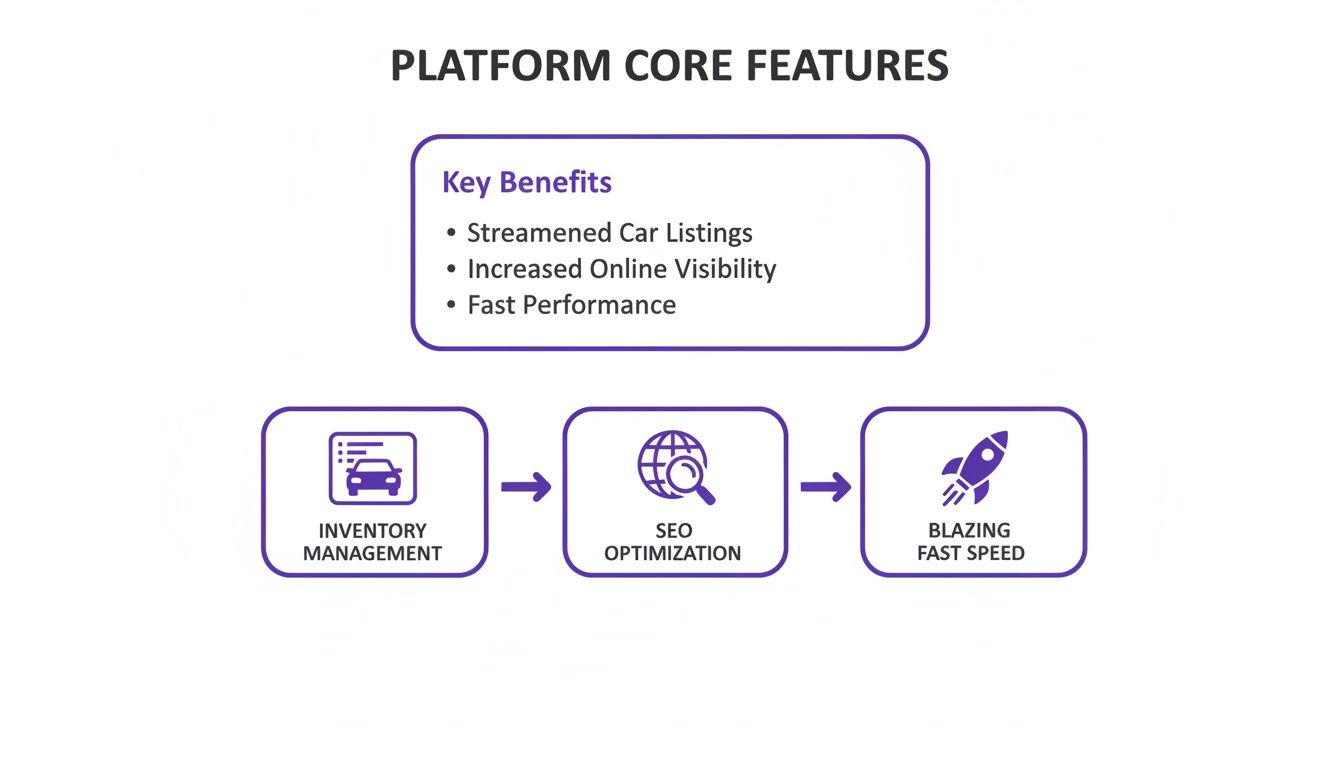
    This diagram nails the core strengths a purpose-built automotive platform should deliver.

    Diagram of platform core features: inventory management, SEO optimization, and blazing fast speed, offering streamlined listings and visibility.

    As you can see, it’s not just about having a website. It’s about having a sales engine where inventory, SEO, and speed all work together.

    Inventory Automation and VDP Creation

    Your inventory is the lifeblood of your website. How fast and accurately you can get your cars online has a direct line to your sales numbers.

    • Specialized Automotive Builder: This is their home turf. These platforms are built to talk directly to your Dealer Management System (DMS). They hook up to your inventory feed and have a built-in VIN decoder. You add a car to your DMS, and minutes later it's on your website with a perfect, detailed Vehicle Detail Page (VDP). It's a true "set it and forget it" solution.

    • Generic Builder (e.g., Wix): These platforms have no idea what a car is. You have to add every single vehicle by hand, one at a time, like a blog post. It's painfully slow, easy to make mistakes, and totally unworkable if you have more than a few cars on the lot. Forget VIN decoding—you’re typing in every spec yourself.

    • Custom CMS (e.g., WordPress): Sure, you can make a custom site automate inventory. But it means paying for expensive, third-party plugins and hiring a developer who knows how to connect them to your DMS. You get total control, but it comes with a big price tag and the constant headache of technical maintenance. When a plugin breaks, that's your problem.

    The Takeaway: For sheer operational sanity, a specialized builder wins hands down. It gets rid of manual data entry, making sure your online showroom is always in sync with your physical lot, without you having to lift a finger.

    SEO and Google Vehicle Listings Support

    If local buyers can't find you online, you don't exist. Automotive is a unique space where websites are digital showrooms that pull in huge traffic. A platform's ability to get you ranked—especially in Google's free Vehicle Listings—is a massive differentiator.

    • Specialized Automotive Builder: These platforms are engineered from the ground up for automotive SEO. They automatically create the specific "schema" code that Google needs to understand your inventory and show it in Vehicle Listings. This feature is baked right in, meaning your cars get in front of thousands of local shoppers for free, with zero extra work from you.

    • Generic Builder: Out of the box, a generic builder doesn't know vehicle schema from a hole in the ground. You could try to add the code manually, but it's a complicated, technical task you'd have to do for every single car. It’s just not a realistic option for a busy dealer.

    • Custom CMS: Just like with inventory, a custom site can be optimized for Vehicle Listings, but you'll need a developer or an SEO agency that specializes in automotive to build and maintain the schema. It’s powerful, but it requires a serious, ongoing investment in technical SEO. To learn more about this, check out our guide on the best website practices for used car sales.

    Mobile Speed and Performance

    Most of your customers start their car search on a smartphone. A slow mobile website isn't just an annoyance; it's a lead killer. Performance isn't a nice-to-have, it's a must-have.

    • Specialized Automotive Builder: Because these platforms do one thing, they do it well. They're highly optimized for speed, often including automatic image compression for your vehicle photos and using clean, lightweight code. The best providers build on a "mobile-first" philosophy, so your site loads fast where it counts the most.

    • Generic Builder: These platforms are jacks-of-all-trades, which often means their code is bloated to support a million features you'll never use. This can drag down performance, especially on mobile, unless you're extremely careful about the templates and plugins you choose.

    • Custom CMS: Performance is a total wild card here. It all comes down to the skill of your developer, your hosting plan, and the plugins you use. A well-built custom site can be lightning-fast, but a poorly built one can be a slow, expensive nightmare to fix. The burden of performance is entirely on you.

    Lead Capture and Management Tools

    A dealership website isn't an online brochure. Its job is to turn visitors into real, actionable leads.

    • Specialized Automotive Builder: These come with the lead capture tools you actually need, built right in. We're talking about integrated credit applications, trade-in value estimators, and "Schedule Test Drive" buttons placed right where they need to be on the VDPs. These tools are designed to catch serious buyers right when they're most interested.

    • Generic Builder: You're stuck with basic contact forms asking for a name, email, and message. Sure, you can bolt on third-party form tools, but they often feel clunky and disconnected from the car-buying journey. They rarely integrate smoothly into your sales process.

    • Custom CMS: You can integrate almost any tool you can dream of, from custom finance calculators to deep CRM connections. This gives you the most power and flexibility, but once again, it requires a bigger budget and the technical know-how to implement and manage everything.

    For the vast majority of independent dealerships, the specialized automotive website builder hits the sweet spot. It delivers the essential, industry-specific tools you need to compete online without the operational nightmare of manual work or the sky-high costs and technical burdens of a custom build. It’s made to do one job: sell cars.

    How to Pick the Right Website Platform for Your Dealership

    Choosing an automotive website builder isn't about finding the one with the longest feature list. The “best” platform is the one that actually fits your business goals, your team's bandwidth, and where you plan to be in a few years. It's about finding a tool that translates techy features into real dollars and sense for your specific lot.

    A platform that’s perfect for a new dealership just getting its footing could easily hold back an established operation trying to ramp up its online leads. To make the right call, you have to look past the sales pitch and match a provider’s real-world capabilities to your dealership's profile.

    Match the Platform to Your Dealership’s Reality

    First, be honest about where your business is today and where you want it to go. Different stages of business need different tools. Thinking this way helps you invest in a solution that works for you right now but won't need to be replaced the moment you start growing.

    Here are a couple of common dealership profiles and what they should be looking for:

    • The New Dealership: Your main goal is getting online fast, looking professional, and capturing leads without a massive upfront investment or a steep learning curve. You need a platform that’s simple to launch, automates your inventory with minimal fuss, and looks sharp on a smartphone. Ease of use and affordability are your top priorities.

    • The Established Lot: You’ve already got business coming in, but you want to scale up your online lead gen and own the local search results. You should be looking for advanced SEO tools, especially for Google Vehicle Listings, powerful lead capture forms like built-in credit apps, and the flexibility to customize the site to reflect your hard-earned brand.

    This kind of analysis gets you beyond a simple feature-to-feature comparison and helps you find a true partner.

    The right platform doesn't just display your cars; it supports your operational workflow. It should feel like an extension of your sales team, working 24/7 to attract and qualify buyers without adding to your workload.

    Knowing where you stand is the first step. The next is to ask the tough questions that will give you a clear framework for making your decision.

    Your Decision-Making Framework

    Before you sign on the dotted line, run every potential provider through these critical questions. Answering them honestly will reveal what you really need and help you weed out the platforms that just aren't a good fit.

    1. How much time can my team realistically spend managing a website?
      If you're a small, busy crew, you need a "set it and forget it" solution with as much automation as possible. But if you have someone who can dedicate a few hours a week, a platform with more hands-on customization might be the smarter choice.

    2. Is ranking on Google Vehicle Listings a top priority?
      If your answer is yes—and for most independent lots, it absolutely should be—then you must pick a platform with built-in, automated schema markup for your inventory. Generic website builders can't do this properly, and you'll miss out on a massive source of free, high-intent traffic. Our guide on SEO for automotive dealerships dives deeper into why this is so critical.

    3. What’s our real budget for setup and ongoing costs?
      Look past the attractive monthly fee. Are there hidden charges for setup, support, or essential tools like a VIN decoder? A platform that seems cheap at first can get expensive fast if core functions are all sold as "add-ons."

    4. How important is controlling our brand and owning our domain?
      Using a provider’s subdomain (like yourlot.provider.com) is okay to get started, but building a lasting brand means owning your own domain (yourlot.com). Make sure the platform lets you use your own domain and won't trap you in their system forever.

    By putting each option through this filter, you stop being sold to and start actively choosing a strategic partner. This structured approach ensures the automotive website builder you select isn't just another monthly bill, but a genuine asset that helps your dealership grow.

    Key Questions to Ask Before Choosing a Provider

    Two professionals in a meeting, one reading a resume and the other working on a laptop.

    Let's be honest, every sales pitch for an automotive website builder sounds great. They all promise more leads, lightning-fast speeds, and a design that’ll leave your competition in the dust. But to find a real technology partner, you have to dig deeper. You need to ask the tough questions that uncover a platform’s real-world performance, its hidden limits, and any surprise costs.

    When you walk into a demo armed with specific, targeted questions, you shift the conversation from a generic sales pitch to your dealership's actual needs. It’s the best way to vet providers properly, sidestep common traps, and make a decision based on substance, not just slick promises.

    Uncovering the Truth About Automation and SEO

    Your first line of questioning should hit the two most critical functions for any dealership website: how it handles your inventory and how it shows up in search engines. Vague answers here are a massive red flag.

    Get right to the point with these questions about their core tech:

    • "What is the exact process and frequency for automated inventory updates?" A good answer will get specific, detailing their DMS integration methods, update schedules (like "every 15 minutes"), and how you can make manual overrides. A bad answer is a brush-off like, "Oh, we handle all that for you."
    • "What are the specific requirements and steps for integrating with Google Vehicle Listings?" The provider should be able to confidently walk you through how their platform automatically generates and submits the required data feeds. If they get hesitant or start talking about manual work, their SEO game is probably weak.
    • "Can your VIN decoder accurately handle unique trims, aftermarket additions, or older vehicles?" This is a great way to test the sophistication of their system beyond just pulling standard vehicle data.

    This approach cuts right through the marketing fluff. It forces the provider to explain how their system actually works, not just give you a high-level overview.

    A provider’s willingness to openly discuss the technical specifics of their inventory and SEO automation is a direct reflection of their platform’s quality. Evasive answers often signal a system that relies on manual workarounds.

    The market for commercial website builder software is booming, with projections showing an increase from USD 2,674.9 million in 2026 to USD 4,406.6 million by 2033. This intense growth is pushing providers to innovate faster than ever. You can learn more about the trends in the website builder software market to see how this competition is shaping the tools available to you.

    Vetting Performance, Onboarding, and Long-Term Support

    Beyond the core features, you need to understand what it's actually like to use their platform—both for your customers and for your own team. A fast website and a supportive partner are just as crucial as a good VIN decoder.

    Here are the questions that reveal the reality of working with them day-to-day:

    1. "Can you provide three live client websites that score above 90 on Google PageSpeed Insights for mobile?" This is non-negotiable. Don't just take their word for it; this forces them to back up any speed claims with verifiable, real-world proof.
    2. "Describe your onboarding process for a user with limited technical skills." You're looking for a structured plan that includes guided setup, help with data migration, and one-on-one training—not just a link to a knowledge base.
    3. "What are the all-in costs? Are there extra fees for premium support, advanced features, or exceeding inventory limits?" This question is designed to uncover any hidden charges that aren't advertised in the monthly price.
    4. "What is your process for handling technical issues or site outages, and what is your guaranteed response time?" A clear Service Level Agreement (SLA) shows they take support seriously and hold themselves accountable for their platform’s uptime.

    Asking these questions turns you from a passive listener into an informed buyer. You’ll be able to compare providers on tangible performance metrics and support structures, ensuring the automotive website builder you choose is truly built to help you grow.

    Answering Your Questions About Dealership Website Builders

    When you're shopping for an automotive website builder, a lot of practical questions come up about cost, difficulty, and what you actually get for your money. Your website is the digital front door to your lot, so getting this decision right is a big deal. Let's tackle the most common questions we hear from independent dealers.

    My goal here is to give you straight-up, clear information so you can pick a platform that actually fits how you run your business. Once you have these answers, you can move forward feeling confident in your choice.

    How Much Should a Dealership Website Cost?

    The price tag for a dealership website is all over the map, but you can generally break it down into three tiers. Knowing the difference helps you set a realistic budget and not get caught off guard by hidden costs.

    • DIY Builders: You'll see platforms like Wix or Squarespace with plans that look cheap, maybe $16 to $50 a month. The problem is, that price doesn't include the expensive add-ons you'll need for inventory management, and it definitely doesn't account for all the hours you'll spend uploading cars by hand.
    • Specialized Automotive Platforms: These are the systems built specifically for car dealers. They usually run between $50 and $300 a month. That price typically includes the essentials like automatic inventory feeds, VIN decoding, and the right SEO setup for Google Vehicle Listings. You get a lot more real-world value here.
    • Custom-Built Websites: Hiring a web design agency to build a site from scratch can cost you anywhere from $5,000 to $25,000 just to get started, plus you'll have ongoing fees for maintenance. It gives you total control, but for most independent lots, it's complete overkill.

    Can I Just Build My Own Dealership Website?

    Technically, yes, you can. But the better question is, should you? If you go with a generic website builder, get ready to spend a huge amount of time manually adding every single vehicle, wrestling with photos, and trying to figure out automotive SEO on your own. You usually end up with an outdated, broken site that actually costs you leads.

    A specialized automotive website builder is just a smarter way to go. It does all the heavy lifting for you—inventory automation, technical SEO, the works—so you can get a professional site up and running in minutes, not weeks. That means you can get back to selling cars instead of messing around with web design.

    For a busy independent dealer, the best strategy isn't just to build a website. It's to launch a sales tool that works from day one with zero friction. A purpose-built platform does exactly that by automating the most painful, time-sucking tasks.

    How Long Does It Really Take to Get a New Site Live?

    The timeline to launch your site completely depends on the route you take. A full custom-built website can easily take several months to go from the first design mock-up to the final launch.

    On the other hand, a modern platform designed for dealers can get you online almost immediately. With a system built for speed, you can often set up your site, hook up your inventory feed, and have a professional-looking online showroom live in less than an hour. That speed is a massive advantage, especially if you're just starting out or need to replace a bad website fast.

    What’s the Single Most Important Feature to Look For?

    While a lot of features are nice to have, automated inventory management with VIN decoding is the one thing you absolutely cannot live without. If your website doesn't automatically reflect what's actually on your lot, you're just going to frustrate customers and lose sales. It's that simple.

    This one feature saves you countless hours of manual data entry, prevents costly mistakes in your vehicle listings, and makes sure your online showroom is always 100% current. Think of it as the engine that powers your entire website; without it, nothing else really works right.


    Ready to launch a dealership website that works as hard as you do? AutoFire™ provides a powerful, easy-to-use platform designed specifically for independent dealers. Get automated inventory, built-in SEO for Google Vehicle Listings, and a blazing-fast mobile site in minutes. Start your free trial with AutoFire today and see how simple it is to drive more leads.

  • Best Website for Used Car Sales: Compare Top Platforms for Your Dealership

    Best Website for Used Car Sales: Compare Top Platforms for Your Dealership

    The best website for used car sales is more than just an online brochure; it's a high-performance digital showroom. The platforms that truly move the needle for dealerships today are the ones that blend automated SEO, seamless inventory management, and a mobile-first design. The goal is simple: attract and convert online shoppers before they even think about visiting the lot.

    Why Your Dealership Website Is Your Digital Showroom

    Let's be honest, the days of a dealership website being just a glorified business card are long gone. Today, your website is your primary sales and marketing engine—a virtual showroom that never closes. Modern car buyers start their hunt online. They're researching models, comparing prices, and checking out local dealerships long before they ever pick up the phone.

    This fundamental shift in how people buy cars means a high-performance, SEO-optimized, and mobile-friendly site isn't a luxury; it's essential for survival. For independent dealers, this is a huge challenge. You aren't just up against the dealership down the street. You're competing with massive franchise operations that have dedicated marketing teams and budgets to match.

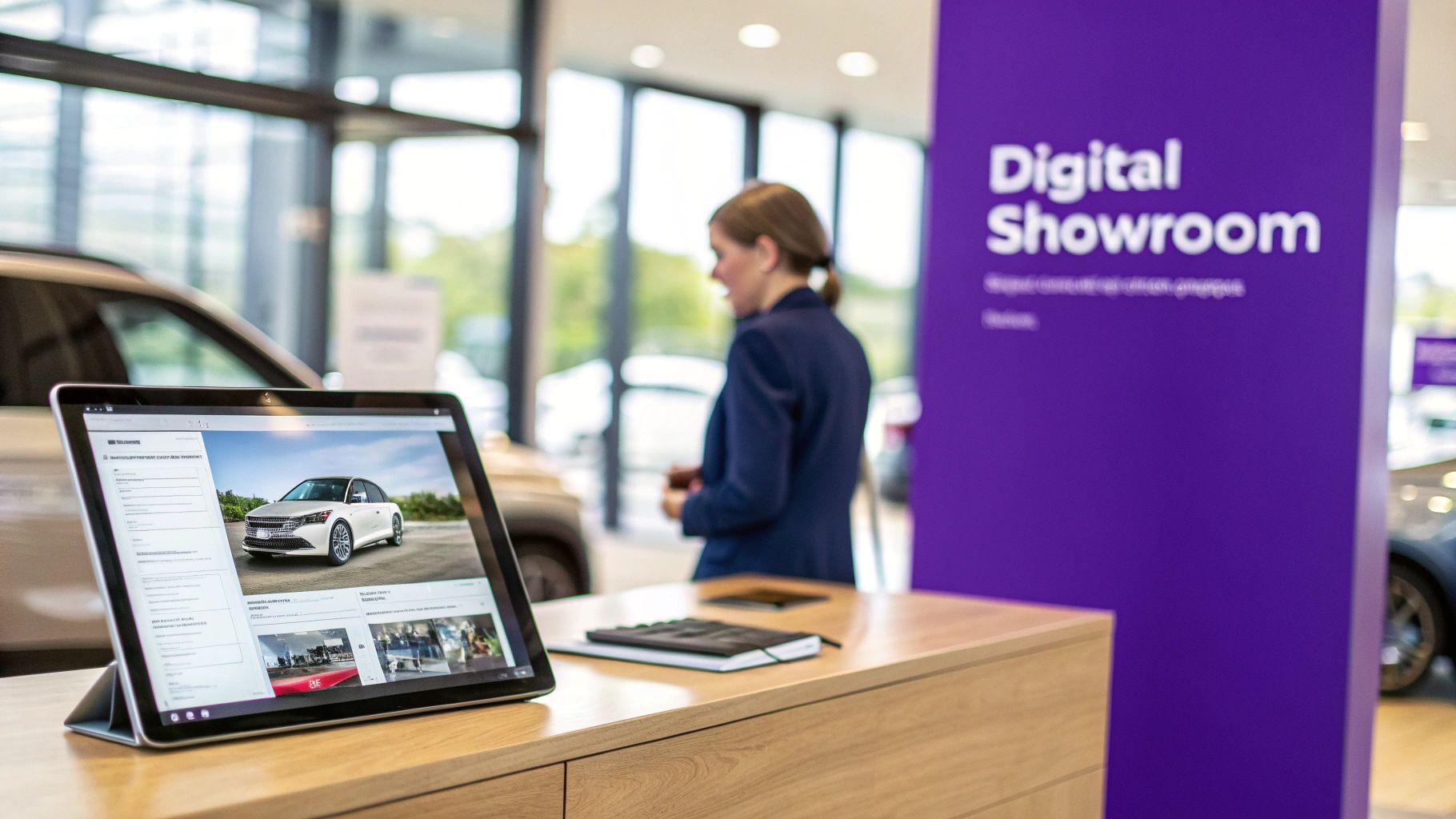
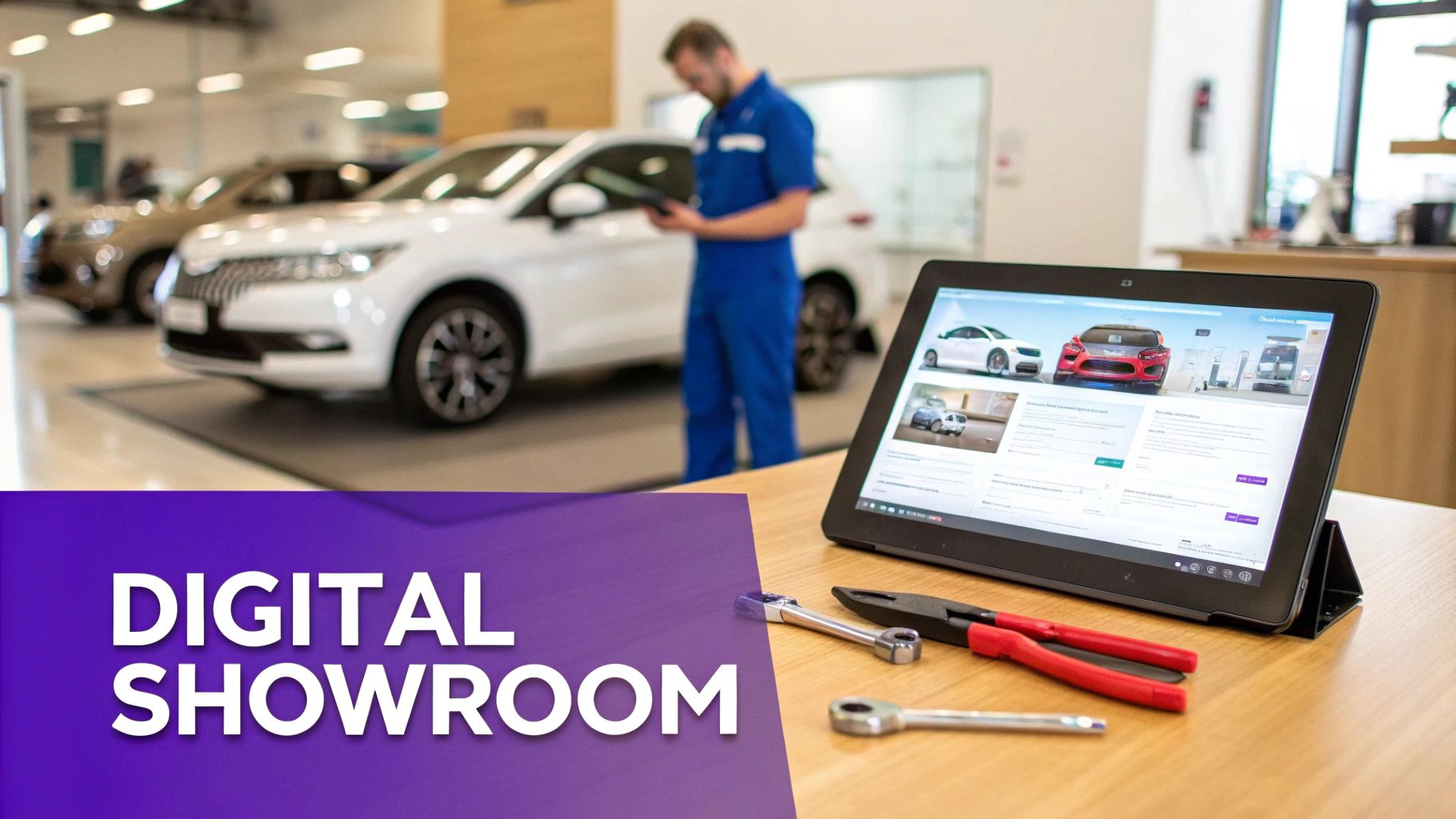
    Tablet in a modern car showroom displaying car models, with a saleswoman in the background.

    The Core Challenges for Independent Dealers

    To get ahead, you have to tackle a few key hurdles that can really limit your reach and profitability. Nailing these is the first step toward picking the right website platform.

    • Limited Online Visibility: If your site doesn't have strong SEO or an integration with Google Vehicle Listings, your inventory is practically invisible to local buyers who are actively searching for the exact cars you have in stock.
    • Technical Overload: Who has time to manage website hosting, security updates, and design tweaks? That can feel like a full-time job, pulling you away from what you actually do best—selling cars.
    • Ineffective Lead Capture: An old, clunky website doesn't just look bad; it fails to turn visitors into actual leads. Potential customers just end up clicking away to your competitors.

    The market trends only reinforce how critical this is. According to Grand View Research, the global used car market is projected to see significant growth, demonstrating the massive digital opportunity for dealers. With North America holding a substantial market share, a powerful digital strategy is what separates the leaders from the laggards. You can dig into more used car market insights on Grand View Research.

    Finding a Competitive Advantage

    The good news? Modern website platforms are built to level the playing field. The right solution automates the technical heavy lifting, boosts your online visibility, and makes your sales process much smoother. This guide will walk you through a detailed comparison to help you find the best website for used car sales, so you can overcome these challenges and truly compete.

    Here’s a quick look at how things have changed:

    Key Dealer Challenge Traditional Website Approach Modern Platform Solution
    Search Visibility Requires manual SEO work & expertise Automated SEO & Google Vehicle Listings sync
    Technical Maintenance Requires hiring developers for updates Handled by the platform (hosting, security)
    Lead Generation Basic contact forms, low conversion Integrated lead capture & management tools
    Mobile Experience Often outdated and slow on phones Mobile-first design for on-the-go shoppers

    What Every Modern Dealer Website Actually Needs

    When you're shopping for a website platform, it's easy to get lost in a sea of features. But what separates a high-performing site from a simple online brochure? It comes down to a few core elements that work together to attract real buyers and make your life easier.

    Think of your website as your best salesperson—one that works 24/7 without a break. It needs to be visible, persuasive, and incredibly efficient at turning a casual browser into a hot lead. Let's break down the non-negotiables.

    A hand holding a smartphone displaying a purple app with icons, next to a computer and keyboard, highlighting core features.

    Advanced SEO and Google Vehicle Listings

    If buyers can't find you online, you don't exist. It’s that simple. Solid Search Engine Optimization (SEO) is the engine that drives local car shoppers directly to your inventory. Your site needs to be built with clean code and load lightning-fast, with every vehicle getting its own dedicated, search-friendly page automatically.

    Even more important today is a direct pipeline to Google Vehicle Listings (GVL). This is the feature that gets your cars, complete with photos and pricing, to show up right in the Google search results when someone nearby looks for a "used Honda CR-V." It's one of the most powerful, high-intent marketing channels available, and it's completely free.

    A platform with automated GVL integration is a game-changer. It eliminates hours of manual work and ensures your vehicles are constantly visible to the most motivated shoppers at the exact moment they are searching.

    A Mobile-First User Experience

    Let's face it: your customers are shopping on their phones. They’re scrolling through inventory on their lunch break, comparing prices in line at the grocery store, and checking out your dealership from their couch. If your website is a clunky, slow, or broken mess on a smartphone, you are actively turning away business.

    A true "mobile-first" approach isn't about just making your desktop site fit on a smaller screen. It’s about designing the experience from the ground up for a thumb, with big buttons, readable text, and simple navigation. The goal is to make it ridiculously easy for a customer to find a car, see the details, and contact you in just a couple of taps.

    Automated Inventory Management

    Manually adding and removing cars from your website is a massive time-sink and a recipe for mistakes. Your website platform absolutely must automate this. The second you scan a VIN or add a vehicle to your management system, it should pop up on your site as a professional, fully-detailed listing.

    This kind of automation frees you up to do what you do best: buy and sell cars. The key tools here are:

    • VIN Decoding: Automatically pulls in all the specs, features, and options.
    • Photo Management: Simple drag-and-drop for uploading and arranging high-quality images.
    • Real-Time Syncing: Instantly removes sold cars so you don't frustrate potential buyers.

    Integrated Lead Capture and CRM Tools

    A pretty website that doesn't bring in leads is just an expensive digital billboard. To turn those website visitors into actual sales opportunities, you need smart, easy-to-use forms on every vehicle page. These should invite shoppers to ask a question, check availability, or schedule a test drive.

    Once that lead comes in, the platform should organize it for you in a simple Customer Relationship Management (CRM) tool. This lets you track every inquiry, respond quickly, and manage your sales pipeline without paying for extra software. You can explore a full list of dealership website features to see how these tools should work together to turn clicks into customers.

    Simplicity of Launch and Maintenance

    Finally, the best website platform is one you can actually use without needing an IT degree. As an independent dealer, you need a solution that’s dead simple to get running and requires zero technical upkeep.

    Find a platform that handles all the hosting, security, and software updates for you. This lifts a huge weight off your shoulders, letting you focus 100% on your dealership. A system you can set up in minutes, not months, gives you an immediate edge over the competition.

    Comparing Top Website Platforms for Independent Dealers

    Picking the right website for your used car lot means sorting through a ton of options, each with its own philosophy on how a dealership should operate online. For an independent dealer, this isn't just a technical decision. It’s about finding a partner that gets your business goals, matches your comfort level with technology, and can actually help you grow.

    Let's break down the three main types of platforms you'll encounter: a modern, all-in-one system like AutoFire™; flexible DIY builders like Wix or Squarespace; and the old-guard, traditional dealer platforms. The best fit for you hinges on what you truly need for SEO, inventory management, and getting more leads.

    The All-in-One Solution: AutoFire

    Modern platforms like AutoFire were built from the ground up to solve the real-world headaches independent dealers face every day. They bundle everything—hosting, security, design, and car-specific sales tools—into one simple subscription. The whole point is to get the tech out of your way so you can just focus on selling cars.

    AutoFire is a perfect example of this. Its biggest strength is automation, especially for your inventory and SEO. When you add a car, the platform instantly builds a search-optimized vehicle detail page (VDP) and automatically syncs it with Google Vehicle Listings. This one feature alone can put your inventory in front of thousands of local buyers without you ever having to learn what "SEO" means.

    Getting started is also incredibly fast. You can have a professional-looking, high-performing website live in minutes, not weeks. That's a huge win if you're just starting out or if your current site is bleeding customers. While you don't get the same pixel-perfect design control as a DIY builder, the trade-off is a guaranteed smooth experience that works perfectly on mobile. The focus here is on results—generating real leads and moving metal. You can see how these specialized designs translate into sales in our guide to used car dealer website templates.

    The DIY Builder: Wix or Squarespace

    DIY website builders give you total creative freedom. If you have a strong brand vision and enjoy getting your hands dirty with design, platforms like Wix or Squarespace can look really attractive. They give you a blank slate and drag-and-drop tools to build pretty much anything you can imagine.

    But all that freedom comes with a lot of responsibility. A standard Wix site isn't designed to sell cars. You’ll have to hunt down third-party apps and plugins to handle essentials like inventory feeds, VIN decoding, and lead forms. This patchwork approach can get complicated and expensive fast, with each plugin adding another monthly fee and another potential point of failure.

    Key Differentiator: The biggest hurdle with DIY builders is the complete lack of automated, auto-specific SEO. You can optimize pages by hand, but there’s no built-in system to get your cars listed on Google Vehicle Listings—a non-negotiable for any modern dealership. You are 100% responsible for all the technical SEO, security updates, and maintenance.

    This path really only makes sense for dealers who have the time, skill, and desire to be their own webmaster. You can build something unique, but the effort to replicate the core sales functions of a dedicated auto platform is massive.

    The Traditional Dealer Platform

    Traditional dealer platforms have been around for a long time. They typically serve the big, established franchise stores and come packed with a huge, if sometimes clunky, set of features. Their main claim to fame is deep integration with major Dealer Management Systems (DMS) and other legacy software common in the industry.

    For a large, multi-lot operation with complex internal processes, that direct DMS connection can be a game-changer. These platforms offer powerful backend tools for managing just about every digital aspect of the business.

    The catch? Cost and complexity. Traditional platforms often come with steep setup fees, lock you into long-term contracts, and have a significant learning curve. Their user interfaces can feel dated compared to modern solutions, and simple tasks like changing a banner image might require you to submit a support ticket. For a smaller independent dealer, the feature set is often overkill and the price tag is simply out of reach.

    Side-by-Side Platform Breakdown

    To make the differences crystal clear, here’s a look at how these three platform types stack up against the key needs of a modern used car dealership. This table provides a side-by-side look at how different website solutions stack up against the key needs of a modern used car dealership, from technical setup to sales-focused features.

    Platform Comparison for Independent Dealerships

    Feature AutoFire DIY Builders (e.g., Wix) Traditional Dealer Platform
    Google Vehicle Listings Automated & Fully Integrated Manual Setup Required Often available, but may require extra configuration or fees.
    Ease of Launch Extremely Fast (Minutes) Moderate to Slow (Days/Weeks) Slow (Weeks/Months)
    Technical Maintenance None (Fully managed) High (Dealer is responsible) Low (Managed by provider)
    Inventory Management Built-in & Automated Requires third-party plugins Deep DMS integrations available
    Upfront Cost Low to None Low (plus plugin costs) High (Setup fees are common)
    Mobile Experience Mobile-First by Design Dependent on template/user skill Can be inconsistent or dated

    As the comparison shows, the "best" platform is entirely situational. A new dealer flying solo will get the most value from AutoFire's speed and automation. On the other hand, an established dealership heavily reliant on a specific DMS might find a traditional platform's integration worth the higher cost.

    Make no mistake, having a strong digital presence is no longer optional. The digital used car market is experiencing explosive growth, which means a website that automates your marketing and simplifies lead capture isn't a luxury—it's a critical competitive advantage. You can check out the complete used car market forecast on Research and Markets. Ultimately, your choice should be a direct reflection of your resources, priorities, and where you want to take your dealership.

    Choosing The Right Platform for Your Dealership's Growth Stage

    Finding the best website for used car sales isn't about chasing a single "perfect" platform. It's really about matching the tech to where your dealership is right now—your size, your goals, and how comfortable you are with the technical side of things. A solution that's a godsend for a new solo operator can quickly become a bottleneck for an established dealership with multiple lots.

    Think of it this way: your business stage dictates the trade-offs you're willing to make between speed, features, and cost. Each type of dealer has a completely different set of needs. The right platform should feel like a natural part of your sales process, not another technical headache you have to manage. Getting this right means you're investing in a tool that helps you win today and can grow with you tomorrow.

    The New Solo Operator: Speed and Simplicity

    If you're just getting started, your two most precious assets are time and money. You need a website that's live yesterday without a punishing learning curve or a big price tag. The only thing that matters is getting a professional-looking site up so you can start showing off your first few cars.

    For a new dealer, any technical friction is a deal-breaker. You can't afford to be messing around with complex setups, managing plugins, or trying to figure out SEO from scratch. The name of the game is automation—a solution that handles the digital grunt work so you can stay focused on what you do best: buying and selling cars.

    • What You Need: Affordability, a fast launch, and automated inventory listings.
    • Best Fit: This is exactly why all-in-one SaaS platforms like AutoFire exist. They take all the technical heavy lifting off your plate and can get your inventory online in minutes, fully integrated with Google Vehicle Listings right out of the box.

    The Growing Independent Dealership: Advanced Tools

    Once your dealership starts to pick up steam, your needs change. You're not just trying to get online anymore; you're building a brand and fine-tuning your sales funnel. That means you need more sophisticated tools to cut through the noise and manage a bigger, faster-moving inventory.

    At this point, things like a custom domain (YourDealership.com), automatic VIN decoding, and some basic market analysis tools are no longer "nice-to-haves"—they're essential. You need a platform that helps you build a real brand identity while making it easy to create the kind of detailed, professional vehicle listings that pull in serious buyers.

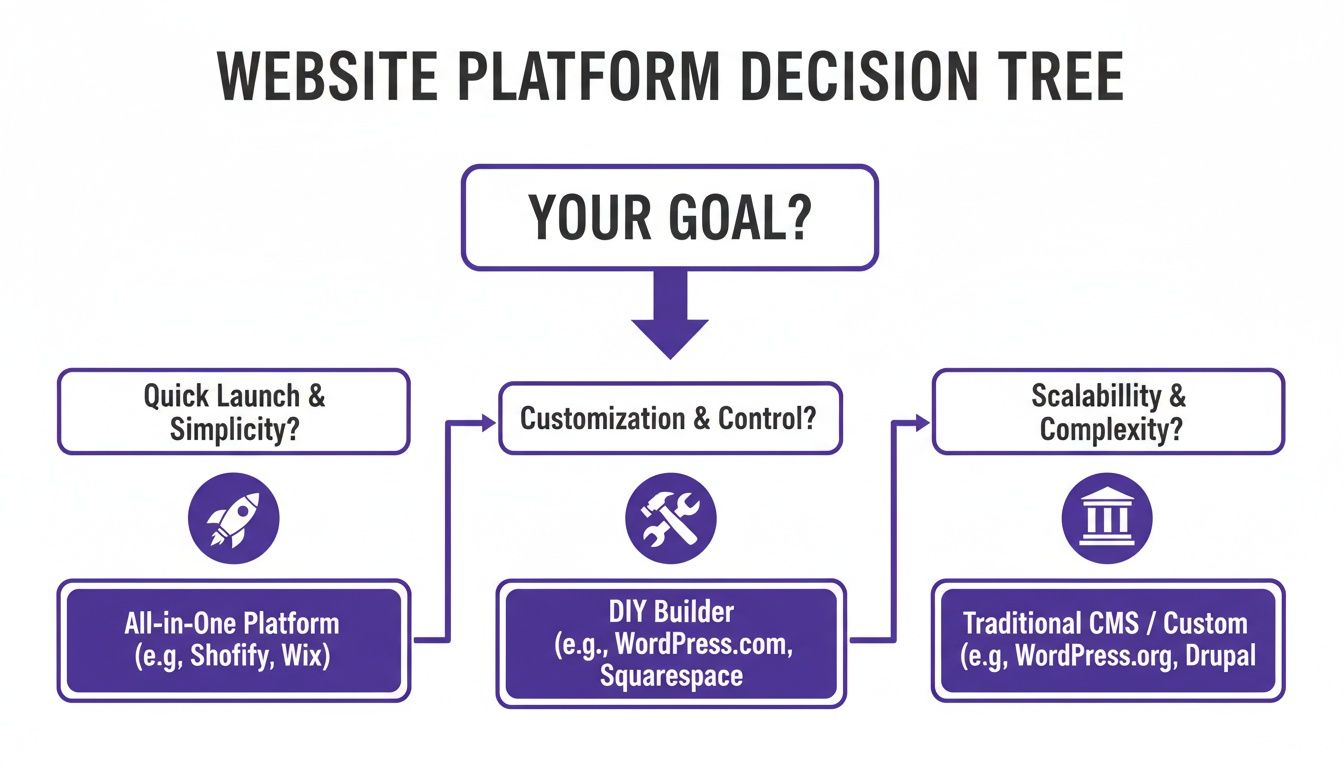
    This decision tree gives you a visual on how to think about your options based on your main goal.

    A decision tree diagram for choosing a website platform based on goals like quick launch, customization, or scalability.

    As you can see, all-in-one solutions are built for speed and sales, while the other paths require you to be much more hands-on with the technical side of things.

    A growing dealership has to strike a balance between powerful features and ease of use. The right platform gives you the tools you need to scale without turning you into a full-time IT manager.

    The Established Multi-Lot Operation: Agility vs. Legacy

    For a big, established dealership with multiple locations, the conversation often gets complicated by legacy systems. You might already have a clunky, traditional website that’s deeply woven into your long-standing Dealer Management System (DMS). The big question is: Is that deep integration worth the high costs and lack of flexibility?

    Modern SaaS platforms present a very compelling alternative. They’re more cost-effective, deliver a much better mobile experience for your customers, and let you adapt to market shifts in real-time. While they might not have the same custom-coded connection to every old-school DMS, their built-in marketing automation and SEO power often drive a far better ROI by generating more organic leads.

    For larger operations, it boils down to a strategic choice:

    1. Stick with Tradition: You can prioritize the deep DMS hookup, but you'll have to accept the higher price tag and slower pace that come with a legacy platform.
    2. Embrace Modern Agility: Or, you can opt for a modern, cost-effective platform that excels at lead generation and customer experience, even if it requires tweaking a few of your internal processes.

    Knowing which stage you're in is the first and most important step. It's how you pick a platform that doesn't just solve today's problems but sets you up for success down the road.

    How to Nail the Launch of Your New Dealership Website

    You've picked out the best website platform for your used car dealership—that's a huge win. But a top-tier platform is only as good as its launch. A sloppy, rushed setup can trip you up before you even get started, making all those powerful features useless. The good news? Most modern platforms are built to make this process surprisingly simple, breaking it down into a few key steps.

    The real goal here is to get from sign-up to a live, lead-generating digital showroom without pulling your hair out. A smooth launch builds the foundation for everything that follows: attracting the right buyers, capturing their information, and, of course, selling more cars. It's about making sure every piece, from your VDP photos to your "Contact Us" forms, is ready for showtime the moment you go live.

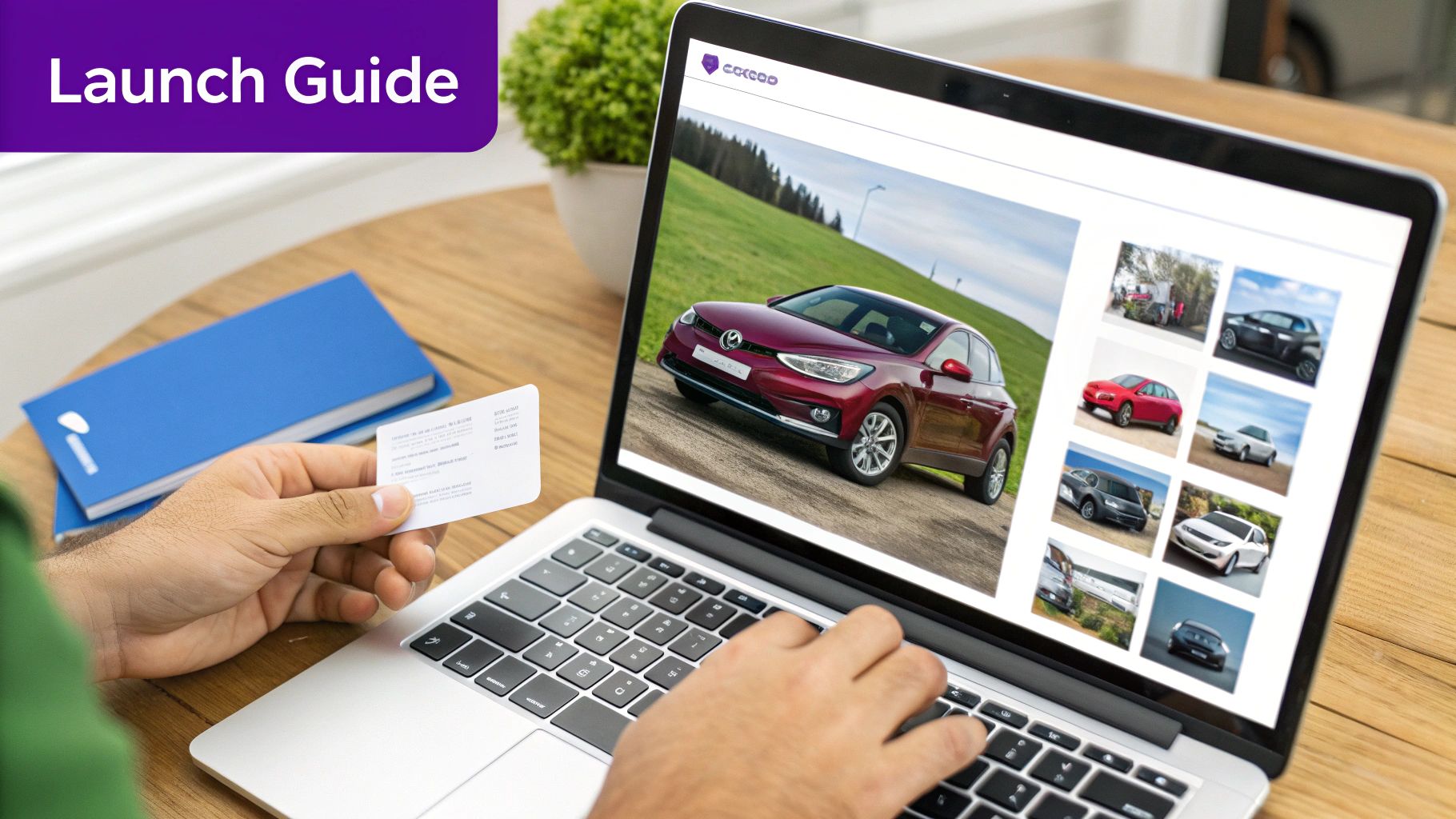
    Hands typing on a laptop showing a car sales website with multiple car images, including a red sedan.

    Your Pre-Launch Checklist

    Before flipping the switch, a little prep work goes a long way. These are the non-negotiables to ensure your website looks professional and works perfectly for customers from day one.

    1. Get Your Inventory Data Ready. Your cars are the main event. You need high-resolution photos from every angle—inside and out. Write honest, detailed descriptions that call out the best features and the vehicle's condition. This is your first impression.
    2. Lock Down Your Domain and Branding. Grab a professional domain name that’s easy for customers to remember (like YourDealership.com). Make sure you have your logo files handy to upload so your brand looks consistent from the get-go.
    3. Set Up Your Lead Forms. Think about what info you actually need from a potential buyer. Customize your contact forms to make it dead simple for someone to ask about a car, book a test drive, or get pre-qualified for financing.

    Must-Have Integrations to Get Found

    Once the basics are in place, it’s time to connect your site to the tools that matter. These integrations give you a direct line into how your site is performing and, more importantly, help local car shoppers find you.

    • Google Analytics: This is a free, indispensable tool. It tells you exactly how people find your site, which cars get the most clicks, and how visitors navigate your pages. It’s like having a map of customer behavior.
    • Google Business Profile: Linking your website to your Google Business Profile (GBP) is critical for local SEO. This ensures your dealership’s address, hours, and website show up correctly in Google Maps and local search results when someone is looking for a "used car dealer near me."

    With the used vehicle market remaining a significant part of the U.S. economy, every digital advantage counts. For independent dealers, a clean website launch is how you compete. The right platform handles inventory, automates SEO, and captures leads on mobile, turning a technical headache into a simple, money-making task. For more on this, check out the outlook for the future of used car sales on NIADA.com.

    Moving from an Old Website? Read This First.

    If you already have a website, migrating to a new one requires extra care. One wrong move and all the search engine authority you’ve built up can vanish overnight, making your inventory invisible to online shoppers.

    A seamless migration is all about telling search engines where your old pages have moved. Failing to do this is like moving your dealership to a new address without leaving a forwarding note—customers simply won't find you.

    Your migration plan needs to include:

    • URL Redirects: Map every old URL to its new counterpart and set up 301 redirects. This tells Google the page has moved for good and transfers most of its SEO value.
    • Content Transfer: Don't leave good content behind. Make sure your blog posts, customer reviews, and other valuable pages are moved over to the new site.
    • Final SEO Check: After you go live, open up Google Search Console and hunt for any broken links or crawl errors. Fix them immediately.

    Following these steps takes the mystery out of the launch process. It gives you the confidence to manage the transition yourself without hiring an expensive agency. For more pointers, take a look at our guide on creating an engaging dealership website with these essential tips.

    Common Questions We Hear From Dealers

    Picking the right website platform can feel overwhelming. You're balancing SEO, features, ease of use, and, of course, cost. To cut through the noise, we've answered some of the most common questions we get from independent dealers. These are straight answers, based on years of experience, to help you feel confident in your choice.

    Think of this as a quick-start guide to the essentials. We'll cover everything from must-have integrations to branding and long-term costs, so you can pick a platform that actually helps you sell more cars.

    How Important Is Google Vehicle Listings Integration?

    Honestly? It's a non-negotiable in today's market. Google Vehicle Listings (GVL) is what gets your inventory to show up directly in Google search results when someone nearby is looking for the exact car you have on your lot. It's essentially free advertising aimed at buyers who are ready to pull the trigger.

    Platforms that automatically sync your inventory with GVL are worth their weight in gold. They save you from the nightmare of manual data entry and make sure your cars are always in front of the right people. If your website provider doesn't offer this, you're leaving a massive amount of money on the table and letting your competitors get the first click.

    Can I Use My Own Domain Name?

    Yes, and you absolutely should. Any serious website platform for dealers will let you use your own custom domain (like YourDealership.com). This isn't just a nice-to-have feature; it's fundamental to building a brand that customers recognize and trust.

    A custom domain also anchors your long-term SEO efforts, helping you build authority with search engines over time. The setup is usually painless—you just have to update a few settings where you registered your domain to point it to your new website.

    Key Takeaway: Using your own domain name turns a generic webpage into a legitimate business destination. It tells both shoppers and Google that you're a serious, established dealership.

    What Is The Difference Between A SaaS Platform And A Custom Website?

    This is a big one, and it comes down to your budget, time, and technical comfort level.

    A SaaS (Software-as-a-Service) platform is what most dealers use. You pay a monthly or annual subscription, and you get an all-in-one package that includes the website, hosting, security, software updates, and car-dealer-specific tools like inventory management and lead forms. The biggest wins here are the low upfront cost and the fact that you don't have to worry about maintenance.

    A custom-built website is exactly what it sounds like—a site built from the ground up just for you by a developer. While you get total control over the design, the initial price tag is steep, often running into the tens of thousands of dollars. On top of that, you're on the hook for ongoing costs for hosting, security, and paying a developer every time you need an update. For most independent dealers, it's just not practical.

    How Do I Know If My Website Is Mobile-Friendly?

    Don't just take your web provider's word for it—test it yourself. The best way is to pull out your phone and act like a customer. Navigate your own site. Can you easily tap the buttons? Is the text readable without zooming in? How frustrating is it to fill out a form?

    For a more technical answer, use Google's free Mobile-Friendly Test tool. Just plug in your website's address, and it will give you a clear "yes" or "no" on whether it meets Google's standards. With so many car shoppers starting their search on a phone, a clunky mobile site is a surefire way to lose sales.


    Ready to launch a dealership website that attracts buyers and drives sales without the technical headaches? AutoFire provides an all-in-one platform with automated Google Vehicle Listings, mobile-first designs, and a launch process so simple you can be online in minutes. Build your digital showroom today.

  • Choosing a Website Builder for Auto Dealers

    Choosing a Website Builder for Auto Dealers

    A website builder for auto dealers isn't your average website tool. It's a specialized platform built from the ground up to handle the very specific digital needs of a car dealership—things generic builders simply can't do. Think of it as the engine powering your entire digital showroom, handling everything from inventory management to closing sales online. It’s the single most important tool for turning casual online browsers into paying customers.

    Your Digital Showroom Needs a Specialized Toolkit

    Man in a car showroom with a tablet displaying a digital showroom interface for car models and tools.

    The car buying journey almost always starts online now. That means your dealership's website is no longer a simple digital brochure. It has become your main storefront, your 24/7 sales floor, and the very first impression you make on nearly every potential customer. With so much riding on it, the platform you choose to build and manage this vital asset matters more than ever.

    You might be tempted to use a general-purpose website builder, the kind a local bakery or a blogger might use. While those platforms are great for simple sites, using one for a dealership is like trying to fix a modern performance engine with a basic wrench set. You might tighten a bolt or two, but you’ll be missing the specialized tools needed for the complex, high-stakes job of selling cars.

    The Right Tools for the Automotive Trade

    A generic builder simply wasn't designed for the unique demands of automotive retail. It doesn't speak the language of VINs, makes, models, or financing. This is exactly where a dedicated website builder for auto dealers proves its worth. It’s not just a tool; it’s a professional-grade toolkit built specifically for running a high-performance digital operation.

    Take a look at how a generic platform stacks up against a purpose-built solution for dealerships.

    General vs Specialized Auto Dealer Website Builders

    This quick comparison highlights the essential tools dealers need to succeed online, which are often missing from generic builders.

    Feature Generic Website Builder (e.g., Wix, Squarespace) Specialized Auto Dealer Website Builder
    Inventory Management Manual entry required; no automated feeds. Automated, real-time sync with Dealer Management Systems (DMS).
    VIN Decoding Not available. All vehicle details must be entered by hand. Instant and automatic. Populates listings with accurate specs.
    Financing Tools Relies on basic forms or third-party plugins. Fully integrated payment calculators and credit applications.
    Trade-In Estimators Requires third-party widgets that can be clunky. Built-in tools that capture leads directly from the website.
    Vehicle Detail Pages (VDP) Basic page templates; not optimized for vehicles. Highly optimized VDPs designed to convert shoppers.
    SEO for Automotive General SEO tools; lacks industry-specific features. Specialized SEO for vehicle models, locations, and local search.

    As you can see, specialized platforms come loaded with non-negotiable features built right into their core. You get everything you need, working together seamlessly, right out of the box.

    The modern dealership website must function as a complete sales and marketing hub. It’s not just about showcasing cars; it's about providing a seamless, interactive experience that guides a customer from initial research to a final purchase decision, all within a single, cohesive platform.

    Adapting to the Digital-First Car Buyer

    The need for these specialized tools is a direct response to a massive shift in how people buy cars. The growth of digital retail in the automotive sector has significantly changed consumer behavior, moving much of the sales process online.

    This trend makes one thing crystal clear: your website is now the primary battleground for winning new customers. Its design, speed, and integrated features have a direct impact on your bottom line. You can explore more about these evolving automotive trends and what they mean for your dealership. The right platform isn’t just an expense; it’s a strategic investment in capturing leads, streamlining sales, and staying ahead as the industry accelerates online.

    Must-Have Features for a Dealer Website That Actually Sells Cars

    A computer monitor on a wooden desk displays an automotive inventory website featuring a silver car.

    A top-tier dealership website is so much more than a digital business card. It’s a sales machine, and every single part needs to be engineered to turn a casual browser into a serious buyer. While a generic website can show a picture of a car, a platform built specifically for dealers creates an entire shopping experience around it.

    These features aren't just bells and whistles. They're the core machinery that grabs a customer's attention, builds trust, and captures qualified leads long before they ever set foot on your lot. Each tool is designed to meet a buyer exactly where they are in their journey, from early-stage research to the final financing questions.

    Inventory Management That Does the Heavy Lifting

    Let's be honest, your inventory is the heart and soul of your website. A proper website builder for auto dealers knows this and provides smart, automated systems to save you hours of work and prevent expensive mistakes. Forget manually typing in every last detail for every single vehicle.

    A perfect example is automatic VIN decoding. You just plug in the VIN, and the system instantly populates the listing with the right information—engine size, transmission type, standard features, you name it. This kills two birds with one stone: it eliminates tedious data entry and drastically reduces the chance of human error. It's the difference between a sparse, unprofessional listing and a detailed, trustworthy one that gives buyers confidence.

    Building Vehicle Detail Pages That Pop

    Your Vehicle Detail Pages (VDPs) are the most valuable real estate in your digital showroom. This is where a browser decides to become a buyer. A high-converting VDP needs to be visually stunning and loaded with all the information a shopper is looking for.

    • High-Resolution Photos and Videos: Buyers want to see everything. Your site has to support big, beautiful photo galleries and video walkarounds that show off the vehicle from every angle, inside and out. This is the visual proof that gets someone to book a test drive.
    • Smart, Clean Layouts: Key details like price, mileage, and a big, obvious call-to-action button should be visible right away—no scrolling required. A good design naturally guides the visitor's eye to the most important info, making the whole experience feel easy.

    A great VDP answers a customer's questions before they even think to ask. It lays everything out in one place, from specs to financing options, removing friction and pushing the buyer closer to making a decision.

    Interactive Tools That Reel In Serious Buyers

    The best dealer websites don't just throw information at people; they engage them with interactive tools that help them figure things out. These features are absolute lead magnets because they attract shoppers who are past the "just looking" phase and are genuinely thinking about buying.

    Industry research backs this up. Studies on automotive website performance have shown that integrated tools like payment calculators and vehicle history reports can dramatically increase how long users stay on a site. It turns out that a slick look, fast load times, and interactive features are key drivers of customer satisfaction.

    Here are a few tools you just can't do without:

    1. Integrated Financing Calculators: Letting a customer estimate their monthly payment right on the VDP keeps them on your site. It makes an abstract price tag feel real and manageable, and it helps them qualify themselves right then and there.
    2. Trade-In Value Estimators: Most car deals involve a trade-in. A built-in estimator tool is a genius way to capture a lead's contact info and current vehicle details in exchange for an instant, helpful quote.
    3. Vehicle Comparison Tools: Shoppers are almost always weighing their options. A tool that lets them see two or three vehicles' specs side-by-side keeps them on your website instead of sending them back to Google to get lost on a competitor's page.

    By building in these kinds of features, a dealership website goes from being a static brochure to a dynamic sales assistant that works 24/7. You can check out a full list of these powerful AutoFire™ features to see how they all work together to create a better customer experience and grow your dealership.

    Dominating Local Search with Automotive SEO

    Let's be blunt: a stunning website that nobody can find is just a pretty picture. It's the digital equivalent of a pristine showroom hidden down a back alley with no sign. If you want to connect with local car buyers, you have to show up where they're looking—and that means dominating local search results on Google.

    This isn't about some secret trick or a stroke of luck. It's about building your website on a rock-solid technical and search engine optimization (SEO) foundation. Think of SEO as the detailed map and bright, flashing road signs that guide Google's algorithms directly to your inventory. Without them, your dealership is lost in a sea of competitors. A proper website builder for auto dealers handles all the heavy lifting behind the scenes, making sure search engines can find your site and understand exactly what you have on the lot.

    The Technical Foundation for Visibility

    Before we even get to keywords and content, your site has to pass Google's basic technical inspection. These aren't just suggestions; they're non-negotiable requirements for earning a high rank, especially since most of your customers are searching on their phones.

    • Mobile-First Design: Your website absolutely must look and work perfectly on a smartphone. Search engines are all-in on mobile, and a clunky, hard-to-use mobile site will get buried in the search results.
    • Fast Page Load Speeds: Every single second matters. If your Vehicle Detail Pages (VDPs) lag, potential buyers will hit the back button before they even see the car. Meeting Google's Core Web Vitals isn't just a good idea; it's essential proof that your site offers a great user experience.
    • Clean URL Structures: A clean, readable URL like yourdealership.com/inventory/used-2022-ford-f150 does more work than you'd think. It helps both shoppers and search engines instantly understand what the page is about, unlike a messy URL filled with random characters.

    Get these elements right, and you've built the bedrock of your online presence. Without them, even the most aggressive marketing campaigns will struggle to gain traction.

    Automotive-Specific SEO That Drives Traffic

    With a solid technical base, you can start layering on SEO strategies designed specifically for the car business. This is where a specialized website builder leaves generic platforms in the dust. The game isn't just about ranking for "used cars nearby"; it's about making every single vehicle in your inventory pop up for the right buyer at the right time.

    The real goal of automotive SEO is to translate your physical inventory into a digital language that Google can read, understand, and rank highly. It’s all about structuring your vehicle data to perfectly match what a car shopper is typing into the search bar.

    The most powerful weapon in your arsenal for this is schema markup. In simple terms, this is a special code that acts like a label for all the key details on your VDPs—the make, model, year, price, mileage, and more. When Google sees these labels, it understands your inventory with perfect clarity.

    The payoff? Google can then feature your vehicles in highly-visible "rich results," like the interactive carousels you see at the very top of the search page. Snagging a spot in that prime digital real estate can send a flood of highly-qualified traffic straight to your VDPs.

    Optimizing Your Most Valuable Pages

    Your Search Results Pages (SRPs) and VDPs are where the magic happens—it's where shoppers turn into leads. They need to be perfectly optimized for search from the get-go. A good dealer website platform will give you templates that are already built for SEO success. That means they automatically generate keyword-rich titles, meta descriptions, and headers that align with common search terms.

    Finally, a truly effective platform gives you the tools to build your reputation as the local authority. An integrated blog is a perfect example, letting you publish articles that answer real customer questions like, "What are the best used SUVs for families?" or "What should I look for when buying a used truck?" This shows you're an expert, not just a seller. Couple that with tools for managing your Google Business Profile, and you'll be well on your way to dominating the local map pack and driving actual foot traffic to your showroom.

    How to Choose the Right Website Builder Partner

    Choosing a website builder isn't just a technical decision; it's a strategic partnership. You’re not just buying a piece of software. You’re picking a technology partner that will play a huge role in your dealership’s growth for years to come.

    A great partner will feel like an extension of your team, making your life easier and your sales process smoother. The wrong one? They'll become a massive roadblock, costing you valuable time and, more importantly, sales. The key is to look past the flashy sales pitch and really dig into the details that matter to your daily operations.

    Vetting Potential Partners Systematically

    First things first: schedule live demos. Don't settle for a pre-recorded video. You need to be on a call with a real person, walking you through the platform in real time. This is your chance to interrupt, ask very specific questions, and see how the system handles the exact scenarios your dealership faces every day.

    During these demos, zero in on integrations. A dealership website is useless if it’s an island. You have to confirm—not just assume—that the platform has solid, proven connections to your existing Dealer Management System (DMS) and Customer Relationship Management (CRM) software. Ask the nitty-gritty questions: How often does the data sync? Is it a one-way push or a two-way conversation? Flawless integration is non-negotiable.

    Think of your website builder as the central hub of your digital operations. If it can't talk seamlessly with your DMS and CRM, you’re just creating data logjams that will bring your entire sales process to a crawl.

    Asking the Hard Questions

    Once you’ve confirmed the tech can do the job, it’s time to talk about what happens when things go wrong—and how you’ll get started. If you're moving from an old site, how will they handle migrating all your existing data? A bumpy transition can disrupt business for weeks.

    And what about customer support? When your site is down or a feature isn't working, you need expert help, fast.

    • What are their support hours? Are they available when you actually need them?
    • Is support handled by experts or a generic call center? You need someone who understands the car business, not just a script.
    • What are the guaranteed response times? Don’t accept vague promises. Get a real commitment.

    This decision tree shows just how crucial foundational elements like mobile-first design and fast loading speeds are. They aren't just nice-to-haves; they are the absolute starting point for achieving better SEO and unlocking those valuable rich results on Google.

    SEO Rank Decision Tree showing mobile-first design and fast loading as key factors for higher SEO and rich results.

    This visual makes it clear: without these core technical pillars in place from the start, all your other SEO efforts will be fighting an uphill battle. You need a provider that builds its platform on this solid foundation.

    Scrutinizing the Fine Print

    Finally, demand a detailed breakdown of all costs. It’s a classic move: lure you in with a low monthly fee, then hit you with a dozen hidden charges for things you can’t operate without. Get a complete fee schedule in writing before you sign anything.

    Keep an eye out for extra costs tied to:

    1. Initial setup and data migration
    2. DMS/CRM integration modules
    3. Premium support tiers
    4. Specific feature add-ons

    A transparent partner will be completely upfront about every potential expense. By following this process and asking tough, detailed questions, you can truly compare providers on an apples-to-apples basis. Taking the time to schedule a personalized demo will give you a clear picture of what a modern, dealer-focused platform should deliver. This approach ensures you choose a partner that doesn't just meet today's needs but is ready to help your dealership grow for the long haul.

    AutoFire: A Platform Built for Dealer Growth

    A man in a suit views two laptops showing data dashboards and charts in an office environment, featuring 'AUTOFIRE PLATFORM'.

    It’s one thing to understand the need for specialized tools, great features, and a rock-solid SEO foundation. It's a completely different challenge to find a single platform that actually brings it all together. This is where AutoFire comes in. We go way beyond a simple checklist of features to deliver a complete growth engine for your dealership.

    AutoFire was built from the ground up to solve the real-world problems dealers face every single day. Think of it less like another piece of software and more like a partner designed to help you save time, capture more leads, and ultimately, sell more cars.

    From Good Ideas to Real Results

    We've talked about how critical unique, high-quality content is for your Vehicle Detail Pages (VDPs). But let's be honest—manually writing compelling descriptions for every single car on your lot is a massive job that often falls by the wayside. AutoFire tackles this head-on with AI-powered VDP descriptions that generate engaging, SEO-friendly content automatically. This ensures every vehicle listing is pulling its weight to attract buyers.

    The same idea applies to technical performance. You shouldn’t have to be a web developer to compete online. AutoFire’s lightning-fast architecture is engineered to satisfy Google's demanding Core Web Vitals right out of the box. That means your website is built for speed and mobile performance from day one, giving you an immediate leg up in local search.

    AutoFire bridges the gap between knowing what your dealership needs and actually having it. It translates best practices in automotive marketing and SEO into a practical, automated platform that works for you 24/7.

    More Than a Website—A Growth Partner

    A truly effective website builder for auto dealers is all about benefits, not just a long list of features. Every tool within the AutoFire platform is designed with one clear goal: to drive your dealership's success and give you a competitive edge.

    • Seamless Inventory Management: Forget about tedious manual updates. AutoFire syncs directly with your inventory, using tools like our VIN Decoder to ensure every listing is accurate and rich with detail. This saves your team countless hours, freeing them up to focus on selling.
    • Advanced Lead Generation Tools: We build the tools that capture serious buyers directly into the shopping experience. From trade-in estimators to financing calculators, every feature is strategically placed to turn passive browsers into hot leads for your sales team.
    • Effortless SEO Dominance: AutoFire handles the technical heavy lifting of automotive SEO. From creating clean URL structures to implementing the schema markup that helps your inventory stand out in Google, the platform does the work so you can reap the rewards.

    Tapping Into a Growing Digital Market

    The shift to online car shopping isn't just a trend; it's a permanent change in how people buy cars. The global automotive ecommerce market continues to expand, with forecasts predicting aggressive growth for years to come. For dealerships, this is a massive opportunity, but only for those with the right digital tools. You can read more about the automotive ecommerce surge on BigCommerce.

    This is precisely the environment AutoFire was built for. We give independent dealers the technology to compete and win in this expanding digital marketplace. By bringing everything you need into one cohesive platform, we get rid of the technical hurdles that hold so many dealerships back.

    Ultimately, choosing AutoFire is a commitment to your own growth. We handle the tech, the speed, the security, and the SEO so you can concentrate on what you do best: building relationships and moving metal. To see how this all comes together, you can explore the entire AutoFire platform and find a smarter way to run your digital showroom.

    Your Top Questions About Dealer Websites, Answered

    Choosing a new website platform is a big move for any dealership. It’s totally normal to have questions about how it all works, what it costs, and what it really means for your business. Let's tackle some of the most common questions we hear from dealers to give you the straight scoop.

    How Long Does It Take To Launch a New Dealer Website?

    Downtime is a deal-killer, and nobody wants a launch to drag on forever. The good news? With a team that knows the auto industry, getting a powerful new site live doesn't have to be a painful process. While every dealership is different, a typical timeline from kickoff to launch is usually somewhere between two and six weeks.

    A professional launch isn’t just a flip of a switch; it's broken down into clear, manageable stages. This makes sure nothing falls through the cracks and your team is ready for the changeover.

    • Discovery and Design: We start by getting to know your dealership—your brand, your goals, and your customers. This helps us create a design that feels like you.
    • Data Migration: This is where the magic happens. We pull your entire vehicle inventory from your Dealer Management System (DMS) and get it loaded onto the new site. A good partner makes this completely painless.
    • Content and SEO Setup: We build out your core pages and put all the foundational automotive SEO in place, so search engines can start finding you from day one.
    • Training and Go-Live: Your team gets a walkthrough of the new system, learning how to manage leads and update content. Once everyone feels confident, we launch the site.

    A dedicated project manager should be your guide through this entire process. Their job is to handle all the technical details, keep you in the loop, and make sure the transition is so smooth your business never misses a beat.

    Can a New Website Integrate With My Existing CRM and DMS?

    Yes, it absolutely has to. This is a non-negotiable. Any top-tier website builder for auto dealers is built from the ground up to connect with the major Dealer Management Systems (DMS) and Customer Relationship Management (CRM) tools you already use. This is the glue that holds your digital operations together.

    Why is this so critical? Seamless integration automates your most important work. When a customer fills out a form on your site, that lead should instantly appear in your sales team's CRM. No more manual data entry, no more delays, and no more good leads getting lost in the shuffle.

    It also keeps your online inventory perfectly in sync with your physical lot. A car sells? It’s automatically removed from the website. This prevents that frustrating call from a customer asking about a vehicle that’s already gone. Before you sign with any provider, get a firm "yes" that they have proven, certified integrations with the systems you rely on every day.

    What Is the Real ROI of a Specialized Auto Dealer Website?

    The return on your investment goes way beyond just a fresh design. A specialized dealer website impacts your bottom line in several real, measurable ways. It's not an expense; it's an investment in a more efficient, profitable business.

    First and foremost, you'll see a big jump in both the quantity and quality of your leads. Smart tools like payment calculators, trade-in estimators, and engaging Vehicle Detail Pages (VDPs) are designed to capture the interest of serious buyers. They help you connect with shoppers who are much further down the road to making a purchase.

    Second, think of the operational efficiency you'll gain. When you automate inventory management, VDP creation, and lead routing, you give your team their time back. They can spend less time on busywork and more time on what they do best: building relationships and selling cars.

    Think of the ROI in two ways: making more money and saving more money. Great SEO drives more organic traffic over time, which means you can gradually pull back on how much you spend on paid ads.

    Finally, a fast, professional, and easy-to-use website builds your dealership's reputation. In an industry built on trust, a high-quality digital showroom tells customers you're credible and gives them the confidence to do business with you. That better experience leads directly to higher closing rates and customers who come back again and again.

    How Much Does a Website Builder for Auto Dealers Cost?

    Getting a clear picture of the costs is essential. For a dedicated website builder for auto dealers, the price is usually split into two parts: a one-time setup fee and an ongoing monthly subscription.

    The one-time setup fee covers all the initial heavy lifting—things like the custom design work, the technical process of migrating your inventory data, and getting your foundational SEO configured.

    The recurring monthly subscription is for all the ongoing services that keep your site secure, fast, and up-to-date. This fee typically bundles:

    • High-speed web hosting
    • Security monitoring and software updates
    • Platform feature enhancements
    • Access to customer and technical support

    Monthly costs can range from a few hundred to over a thousand dollars, depending on the provider and the features you need. A word of caution: be wary of rock-bottom prices. They often hide extra fees for things that should be standard, like CRM integrations or key sales tools. Always ask for a detailed proposal that spells out every single cost before you sign anything.


    Ready to see how a modern website can drive real growth for your dealership? AutoFire provides an all-in-one platform engineered to get you online fast and start capturing leads immediately. Discover the AutoFire difference today!