Tag: car sales tips

  • A Modern Dealer’s Guide to the Steps to the Car Sale

    A Modern Dealer’s Guide to the Steps to the Car Sale

    The most effective steps to the car sale actually start way before a customer ever picks up the phone. It all begins with how you prep your vehicles and build your online reputation. Think of it as laying a foundation of trust from that very first click, making sure your cars—and your dealership—scream quality and reliability.

    Building Your Foundation for a Seamless Sale

    Before you even think about snapping a photo or writing a vehicle description, you've got to do the groundwork. This isn't just about making things look pretty; it’s about signaling to buyers that you're a professional who offers real value. Get this part right, and you'll find the whole sales cycle shortens up, and your bottom line will thank you for it.

    The journey kicks off with reconditioning. And I don’t just mean a quick wash and a vacuum. A proper "recon" process involves a deep dive: mechanical checks, topping off fluids, swapping out worn brake pads, and fixing those little cosmetic dings. Spending a little bit to repair a scuffed bumper or shampoo a stained seat can have a massive impact on a car’s perceived value and a buyer's confidence.

    Here’s the thing: a clean, well-maintained vehicle tells a story. When a buyer sees a car that’s been properly detailed and prepped, they instinctively feel it’s been cared for its whole life. That perception builds instant trust and makes the negotiation process a whole lot smoother down the road.

    Your Digital Showroom Matters

    Just as crucial is your dealership's website. We live in a world where customer experience is a deciding factor in buying decisions. Your website is their first taste of that experience. A slow, clunky, or confusing site is the digital version of a rundown lot with weeds growing through the pavement—it sends customers running.

    A modern, fast-loading website is your 24/7 digital showroom. It needs to be a breeze to use, especially on a phone, which is where most people start their car search. Your site must show off your inventory clearly, give all the key details, and make it incredibly simple for people to contact you. A good customer relationship management system can make managing all this much easier. If you're weighing your options, you can learn more about the best CRM for car dealers in our detailed guide.

    This simple flow shows how solid reconditioning, a great website, and the trust they create are the pillars of every successful sale.
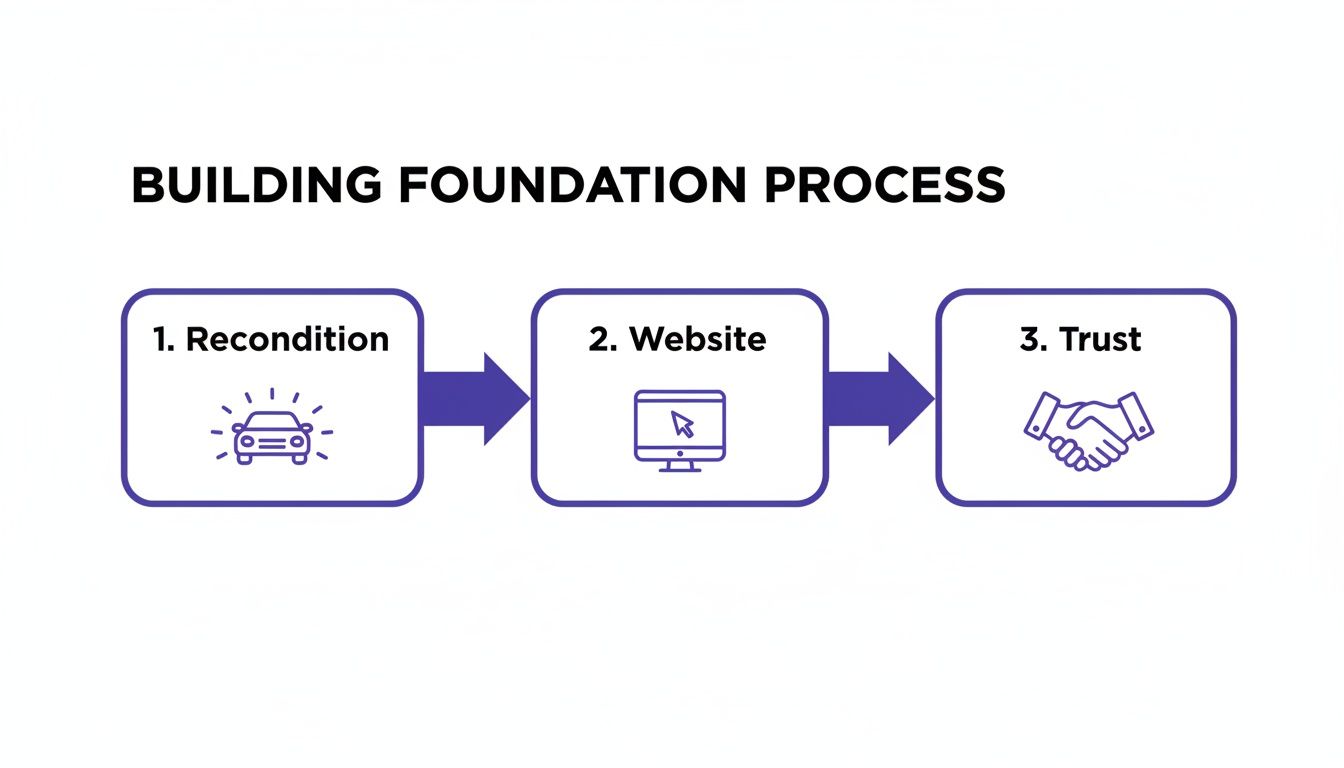
    A diagram illustrating the three-step building foundation process: recondition, website, and trust.

    It all comes down to a deliberate strategy focused on quality and presentation from the very start.

    By focusing on these foundational steps to the car sale, you’re not just prepping a vehicle for the lot. You're building a professional first impression that sets a positive tone for the entire customer journey. That upfront effort translates directly into faster sales and healthier profits.

    2. Create Digital Listings That Actually Sell Cars
    Laptop displaying a car listing with "LISTING THAT SELLS" on screen, a camera lens, and smartphone.

    Once a car is prepped and shining on the lot, your next job is to build its digital storefront. This isn't just about uploading a few photos; it's about creating an online listing that works for you 24/7. Think of it as your most diligent salesperson, one that turns casual online window shoppers into real, qualified leads.

    The sales floor has moved online. It's a fact of the business that a vast majority of car buyers now begin their search on the internet long before they ever set foot in a dealership. That's why a well-crafted listing is no longer a "nice-to-have"—it's the core of modern car sales. Get this part right, and you'll see a massive difference in your lead quality. For more on the latest trends, Best-Selling-Cars.com offers great insights into European and global sales figures.

    This is your chance to turn a simple inventory page into a powerful lead-generation engine.

    Go Beyond the Spec Sheet: Write Descriptions That Connect

    Anyone can copy-paste a feature list. What separates a listing that gets ignored from one that gets a phone call is a description that connects with a buyer's real-life needs and wants.

    Don't just say "all-wheel drive." Instead, talk about the peace of mind that comes with "tackling snowy roads or rainy highways with confidence." Instead of just listing "heated seats," paint a picture: "Imagine hopping into a warm, toasty seat on a freezing winter morning." This helps a customer visualize themselves owning and loving the car, creating a much stronger emotional pull.

    This storytelling approach is what sets savvy dealers apart. You can learn more about crafting compelling car listings in our dedicated guide.

    Perfect Your Visuals: Photos and Videos Make the Sale

    Let's be blunt: grainy, poorly lit photos will kill a sale before it even starts. It screams unprofessionalism and makes buyers wonder what you're trying to hide. You don't need a high-end photo studio, but you absolutely need a consistent process.

    Create a simple shot list and stick to it for every single vehicle. This ensures you capture all the important angles and gives your entire online inventory a clean, professional, and trustworthy look.

    Your shot list should always include:

    • Front Three-Quarter View: The classic "hero shot" showing the front and side.
    • Rear Three-Quarter View: Captures the back and the other side for a full exterior look.
    • Direct Side Profile: Shows the car's lines, length, and proportions.
    • Cockpit and Dashboard: Gives the buyer the driver's-seat perspective.
    • Close-ups of Key Features: Highlight the good stuff—a sunroof, premium sound system, slick alloy wheels, or advanced safety tech.

    A quick, one-minute walkaround video can be pure gold. Just use your smartphone to circle the car, open the doors, show the interior, and maybe even start the engine. This raw, unedited feel builds a massive amount of trust by proving you have nothing to hide.

    The Power of Details and Total Transparency

    Finally, it’s the small details that build credibility and get serious buyers to contact you. Always, always include the Vehicle Identification Number (VIN) in every listing. This is a huge sign of transparency, allowing interested shoppers to run their own vehicle history reports and feel confident in what you're selling.

    Being upfront about pricing is just as crucial. State your price clearly, and if you have dealer fees, list them. Nothing destroys trust faster than surprise costs during the final negotiation. Platforms like Google Vehicle Listings actually reward this kind of clarity, giving detailed, transparent listings better visibility—which means more qualified traffic comes directly to you.

    To help you nail every listing, here’s a quick checklist of the essential components.

    Essential Elements of a High-Converting Vehicle Listing

    This table breaks down the must-have pieces for every online listing you create. Think of it as your pre-flight checklist before you hit "publish."

    Element Why It Matters Pro Tip
    High-Res Photos The first thing a buyer sees. Poor photos suggest a poor-quality vehicle. Create a consistent shot list (15-20 photos minimum) and always shoot in good, natural light. A clean background makes a huge difference.
    Video Walkaround Builds immense trust by offering an unedited, real-time view of the car. A simple 60-second video from your smartphone is all you need. Point out key features and even any minor blemishes for total transparency.
    Compelling Title Grabs attention in search results. Include year, make, model, trim, and a key feature. Example: "2021 Ford F-150 Lariat 4×4 – Low Miles, FX4 Package!"
    Story-Driven Description Connects features to real-world benefits, creating an emotional connection. Instead of "Bluetooth," write "Stay connected and stream your favorite music safely on the go."
    VIN Number Shows you're transparent and confident in your inventory. A must for serious buyers. Always double-check the VIN for accuracy before publishing the listing.
    Transparent Pricing Builds trust and avoids frustrating surprises that kill deals at the last minute. Clearly list the sale price. If you have standard dealer fees, mention them upfront in the description.
    Clear Call-to-Action Tells the buyer exactly what to do next, turning passive browsing into an active lead. Use strong, clear language like "Call us today to schedule your test drive!" or "Click here to get pre-approved."

    By consistently including these elements, you're not just listing a car; you're creating a powerful marketing asset that attracts the right buyers and makes your sales process smoother from the very first click.

    Turning Inbound Inquiries Into Test Drives
    A woman in a car dealership holding a clipboard, with a blue car and 'SCHEDULE TEST DRIVE' text.

    The moment your listing goes live, the race is on. When that first text, email, or phone call dings, the clock starts ticking. I can't stress this enough: your initial response is everything. It sets the tone for the entire relationship and often decides whether a casual browser becomes a serious buyer or simply ghosts you.

    A quick, professional reply isn't just a good idea; it's the bare minimum. Today's buyers expect immediate answers and total transparency. A slow response feels like you don't value their time, and that’s a surefire way to lose a sale before it even starts. This is your chance to build real rapport and have a genuine conversation, not just a transactional exchange.

    Choosing the Right Communication Channel

    How you reply is just as critical as how fast you do it. My go-to rule is to meet the customer where they are. If they shoot you a text, text them back. An email inquiry? A prompt email reply is the way to go. It shows you’re paying attention to their preferences and keeps things comfortable for them.

    That said, don't hesitate to pick up the phone when the time is right. Following up an initial text or email with a quick call can be a game-changer for qualifying the lead and booking a test drive right then and there. It cuts through the digital noise and adds a human touch that messages just can't match.

    The key is to be helpful, not high-pressure. Frame your call as a simple offer to answer questions in real-time, not a hard pitch. This one shift in approach builds massive trust and makes it much easier for the customer to say "yes" to a visit.

    To make sure you never miss a beat, especially after hours, an AI Receptionist for Car Dealerships can be a lifesaver. It ensures every inquiry gets an instant, professional response, so you can focus on the qualified leads.

    Asking the Right Qualifying Questions

    Your time is your most valuable asset, so you need to quickly figure out who's a serious buyer and who's just kicking tires. The secret is asking smart, open-ended questions that get them talking. Ditch the simple "yes" or "no" queries.

    Instead, try asking things like:

    • "What are the top three things you're looking for in your next car?"
    • "Are you thinking about trading in your current vehicle?"
    • "What’s your timeline looking like for making a purchase?"
    • "Have you driven anything similar yet? What did you think?"

    These kinds of questions do two things: they give you the intel you need to help them properly, and they show you actually care about finding them the right fit. For a small independent dealer, that personal touch is your superpower.

    Want to dive deeper into getting more leads from your website? Check out our guide on how to improve website conversion rates. By focusing on having a quality conversation, you can naturally guide them from a simple question to a confirmed appointment in your showroom.

    Mastering the Test Drive and Negotiation
    Smiling car salesman and customer shaking hands with keys, ready for a test drive.

    This is where the rubber meets the road, literally. The test drive is the moment of truth where all your reconditioning work and slick online marketing pay off. It’s far more than a quick spin around the block; it's your chance to turn a browser's interest into a buyer's confidence.

    A great test drive builds a real connection. It’s where you solidify trust and get to answer those final, lingering questions that have been on their mind.

    Crafting a Winning Test Drive Experience

    The most effective test drives I've seen are never improvised. Don't just hand over the keys and tell them to "take it for a spin." Have a specific route planned out.

    A solid route should showcase the car's strengths. Think about including:

    • A smooth stretch of highway to feel out the acceleration and quiet ride.
    • A few good corners to demonstrate the handling and responsiveness.
    • A place to test the brakes safely.

    Your role here is co-pilot, not auctioneer. Point things out naturally as you drive. As you merge onto the highway, you might say, "Notice how quiet the cabin is at this speed." When making a tight turn, mention the impressive turning radius.

    Let the customer drive the conversation, though. Pay attention to what they comment on. Their focus tells you exactly what’s important to them, which is pure gold when you sit down to talk numbers.

    Shifting Gears to a Smooth Negotiation

    After a positive test drive, the mood is right, and the conversation will almost always turn to price. This doesn't have to be a battle. The trick is to keep that same helpful, transparent vibe you've had all along.

    Start by asking them what they liked most about the car. "How did it feel on the highway?" This reinforces all the positives in their mind right before the negotiation begins. You're selling the value, not just the price tag.

    The goal isn’t to “win.” It’s to find that sweet spot where everyone walks away feeling good. A great deal isn't just about today's profit; it's about earning a five-star review and a future referral.

    Navigating Objections and Laying Out Options

    Objections are a normal part of the process, usually about price. Don't get defensive. Hear them out and validate their concern. "I understand, let's talk about that."

    This is your cue to gently justify the price by reminding them of the car’s excellent condition, any recent work you’ve put into it, or its current market value. Have your facts ready.

    It's also the perfect moment to discuss financing. Showing a customer a clear, affordable payment plan can instantly close the gap between your asking price and their budget.

    Speaking of options, this is where your digital presence comes back into play. The steps to the car sale today are a blend of physical and digital. Many buyers will leave a dealer's site if they can't easily see the inventory with all the key specs. That’s why a clean, modern website isn't a luxury anymore; it's a necessity. For a broader look at market trends, you can always review the latest stats on top-selling vehicle models in the USA.

    Closing the Deal With Confidence and Clarity

    Getting that verbal "yes" from a customer feels like you've crossed the finish line, but hold on. The final paperwork is where you truly lock in a great customer experience. A clumsy, confusing closing can poison an otherwise perfect sale, leaving a bad taste that customers won't forget. For an independent dealer, a smooth and transparent closing process builds the kind of trust that earns you customers for life.

    A professional finish doesn't just wrap up the transaction; it validates the buyer's decision and becomes the reason they leave you a five-star review. This is your final chance to prove you’re a pro they can count on.

    Have Every Piece of Paper Ready to Go

    Before your buyer even walks in the door to sign, you need to have every single document prepped, organized, and laid out. Nothing kills the excitement of buying a car faster than watching a dealer fumble around for forms or realize something is missing mid-signature. It makes you look unprepared and, to a cautious buyer, it can feel downright sketchy.

    Your closing packet should be a well-oiled machine. At a minimum, it must include:

    • Bill of Sale: Think of this as the official receipt. It needs to spell out every detail: the vehicle's year, make, model, and VIN, the final sale price, the date, and the full names and addresses of both your dealership and the buyer.
    • Odometer Disclosure Statement: This isn't optional; it's a federal requirement. The form certifies the car's exact mileage at the moment of sale. There is zero room for error here.
    • Vehicle Title: This is the big one. Make absolutely sure the title is clean, legally in your dealership's name, and ready for a smooth transfer. If there were any previous liens, they must be fully satisfied and officially released before this point.

    State-specific rules can trip up even seasoned dealers, so you have to know the local playbook inside and out. For example, the exact process for transferring a car title in Texas has its own unique steps. Knowing these details cold protects you and gives your customer peace of mind.

    A disorganized closing table screams amateur. When you hand a customer a neat, organized folder and walk them through each document, you're not just being efficient—you're showing them you respect their time and reinforcing that they made a smart choice buying from you.

    Handling the Money: Secure and Straightforward

    Talking about money should never feel awkward. Be completely transparent about your accepted payment methods long before the final meeting to head off any last-minute hiccups.

    For most dealers, the safest bets are cashier's checks, certified bank drafts, or wire transfers. If you're considering personal checks, you absolutely need a rock-solid policy and verification process. Thinking about taking credit cards? Be upfront about any processing fees the customer will have to cover.

    The goal here is zero ambiguity. When a customer feels secure and respected during this final step, you've officially nailed the sale.

    Burning Questions: Your Car Sale Process FAQs Answered

    Even with the best plan, selling cars always has its twists and turns. Let's tackle some of the most common questions I hear from independent dealers trying to dial in their sales process. Think of this as practical advice you can start using right away.

    What’s the Single Most Important Digital Tool for a Small Lot?

    Hands down, it’s your website. For a small, independent dealer, a modern, fast, and mobile-friendly website is your digital showroom, lead machine, and brand headquarters all in one. Sure, a good CRM and social media presence are important, but where do they all lead? Right back to your site.

    A great dealership website isn’t just a digital business card; it's an active player in your sales process. It should automatically pull in your inventory, be built to rank high in Google searches, and make it dead simple for a customer to get in touch. If your site is slow or a nightmare to use on a phone, you're losing customers you never even knew you had.

    How Can I Move Aging Inventory Without Taking a Bath?

    Moving a car that’s been collecting dust on the lot is a balancing act. The secret is to be proactive, not reactive. Don't wait until that car is bleeding you dry to make a move.

    Here are a few strategies that have worked for me and countless other dealers:

    • Relaunch the Listing: Go take a whole new set of high-quality photos and completely rewrite the vehicle description from scratch. This time, highlight a different feature you didn't focus on before. A fresh look is often all it takes to catch a new buyer's eye.
    • Create a Spotlight: Make the car the star of the show. Feature it on your website's homepage as a "Dealer Special" or "Car of the Week." This creates a little urgency and frames it as a great value, not an unwanted car.
    • Be Smart with the Price: Make a real, noticeable price drop, but don’t make it look like a fire sale. A strategic reduction tells buyers you're ready to negotiate. I like to pair it with a small perk, like a full tank of gas or a free oil change, to make the deal even sweeter.

    Remember, the goal isn't just to unload the car; it's to protect your reputation. Massive, desperate-looking price slashes can make buyers suspicious. A strategic, well-marketed price adjustment always works better.

    What Are Some Easy Post-Sale Follow-Up Tricks to Get More Reviews?

    That small window of time right after a customer drives away is pure gold. A simple, personal follow-up can transform a happy buyer into an evangelist who leaves great online reviews and sends their friends your way. The key is not to overthink it.

    A few days after they take delivery, shoot them a quick, personal text message or email. Don't just copy and paste a template. Bring up something specific from your conversation to prove you're not a robot.

    Try something like this: "Hey [Customer Name], just wanted to check in and see how you're enjoying the [Car Model]. Hope that first trip to [mention a place they talked about] was a blast! If you get a second, leaving a review on our Google page would mean the world to us. Thanks again!"

    That personal touch shows you actually care about them, not just the sale. It makes them far more likely to spend a few minutes helping your business grow.


    Ready to build a website that handles these critical sales steps for you? AutoFire™ delivers clean, fast, SEO-optimized dealership sites that turn browsers into buyers. Get your professional site online in minutes and start capturing more leads today.
  • 10 High-Impact Car Dealership Marketing Strategies for 2026

    10 High-Impact Car Dealership Marketing Strategies for 2026

    In today's competitive automotive market, a great inventory isn't enough to guarantee success. Winning dealerships are built on a robust digital presence that captures buyer attention from their first online search to the final handshake on the lot. The difference between a thriving independent dealership and one that struggles often comes down to a well-executed, modern marketing plan. This guide is your roadmap to achieving that, breaking down 10 proven car dealership marketing strategies designed specifically for independent operators and small auto dealers.

    We're moving beyond generic advice to provide a comprehensive playbook. For each tactic, you’ll find actionable implementation steps, key performance indicators (KPIs) to track your success, and real-world examples to guide your efforts. This roundup is structured to help you identify both quick wins that can generate immediate leads and long-term strategies that build a sustainable, trusted brand. To lay a strong foundation for your dealership's success, consider exploring these additional 10 potent small business growth strategies which complement the specialized tactics discussed here.

    From mastering Google Vehicle Listings and local SEO to leveraging video for virtual showroom tours, each strategy is presented as a practical, measurable tool for your arsenal. You’ll learn how to optimize lead capture forms, build powerful email retargeting campaigns, and manage your online reputation effectively. Our goal is simple: to equip you with the knowledge and confidence to implement these high-impact tactics, track your return on investment, and drive significant growth for your dealership. Let's get started.

    1. Google Vehicle Listings & Local SEO Optimization

    This foundational car dealership marketing strategy focuses on capturing high-intent local buyers at the exact moment they are searching. It involves two powerful, interconnected tactics: optimizing your Google Business Profile (GBP) for local searches and ensuring your inventory is automatically fed into Google’s free Vehicle Listings program. This combination makes your dealership and its specific cars visible in both Google Maps and the dedicated vehicle search results, driving direct, organic traffic.

    When a potential buyer searches for "used Ford F-150 near me," you want your inventory to appear at the top of the results. This isn't just luck; it's the result of targeted local SEO and structured data that tells Google exactly what you have for sale.

    How to Implement This Strategy

    • Google Vehicle Listings: The fastest way to get your cars listed is by using a DMS or inventory management system with a direct feed. This automatically syncs your inventory, including photos, VIN, mileage, and price, to Google, eliminating manual data entry.
    • Optimize Vehicle Detail Pages (VDPs): Your website's VDPs are critical. Optimize title tags with location-specific keywords like "Used 2021 Toyota RAV4 for Sale in San Diego." Write unique, keyword-rich descriptions for each vehicle, highlighting features and condition.
    • Strengthen Your Local Signals: Ensure your dealership’s Name, Address, and Phone number (NAP) are consistent across your website, Google Business Profile, and major online directories. This consistency builds trust with search engines.

    Key Insight: Google Vehicle Listings are not ads; they are free organic listings. By providing a clean, structured inventory feed, you gain prominent placement without paying per click, offering one of the highest ROIs available.

    Why This Strategy Works

    This approach targets customers who are beyond the initial research phase and are actively looking to make a purchase. Appearing in the Google Maps "3-pack" or having your specific vehicle show up in a search is a powerful signal of relevance and proximity, two of the most significant factors for local car buyers.

    For example, an independent lot that optimizes its GBP and VDPs can outrank larger franchise stores for hyper-local searches, like "used SUV in [Your Neighborhood]." This levels the playing field, allowing you to compete on visibility and inventory rather than ad spend. For a deeper dive into optimizing your online presence, you can learn more about local SEO for car dealerships.

    • Priority: High (Quick Win & Long-Term)
    • Best For: All dealerships, especially those targeting local community buyers.
    • KPIs to Track: Organic VDP views, phone calls from Google Business Profile, direction requests, and website clicks from GBP.

    2. Lead Capture Forms & Conversion Rate Optimization

    This strategy centers on turning website visitors into actionable leads by systematically optimizing how you capture their contact information. It’s not just about having a "Contact Us" page; it's about embedding frictionless, high-converting forms throughout your website, especially on your Vehicle Detail Pages (VDPs). By reducing the effort required for a user to express interest, you dramatically increase the volume of qualified leads.

    A well-designed form acts as a digital salesperson, engaging customers at their peak interest level. The goal is to make the process of providing information feel like a natural, valuable exchange rather than a tedious chore, directly boosting one of the most crucial car dealership marketing strategies: lead generation.

    Hand holding a smartphone displaying an instant quote application in a car dealership, with text 'Get Instant Quote'.

    How to Implement This Strategy

    • Simplify Your Forms: Start by testing single-field forms. A button that asks only for a phone number or email to "Get Today's Price" can convert significantly higher than a form demanding a name, email, and phone number upfront.
    • Offer a Clear Value Exchange: Use compelling, benefit-driven calls-to-action (CTAs). Replace generic "Submit" buttons with powerful phrases like "Get My E-Price," "Check Availability," or "Get Pre-Approved in 2 Minutes."
    • Strategic Placement: Place lead capture forms directly on every VDP. This is where buyer intent is highest. A visitor shouldn't have to navigate away from the car they are interested in to contact you.

    Key Insight: The speed of your follow-up is as important as the lead capture itself. Studies have shown that responding to a web lead within five minutes can dramatically increase contact rates. Automate instant SMS or email responses to acknowledge submission and set expectations.

    Why This Strategy Works

    This approach meets modern consumer expectations for speed and convenience. Buyers are often on mobile devices and have limited patience for complex forms. By removing friction, you capture leads who might otherwise abandon the process. A simple SMS lead capture form, for instance, can significantly reduce abandonment compared to traditional email-only options.

    For example, offering an instant trade-in value via a simple form gives the customer immediate value and provides your sales team with a highly qualified lead who has a vehicle to trade. This turns a passive website visit into an active sales conversation. To explore more advanced techniques, you can find a deeper dive into lead generation for car dealerships on goautofire.com.

    • Priority: High (Quick Win & High Impact)
    • Best For: All dealerships, especially those with significant website traffic.
    • KPIs to Track: Website conversion rate (leads/visitors), form submission rates, cost per lead, and lead-to-appointment ratio.

    3. Content Marketing & Educational Resources

    This long-term car dealership marketing strategy builds authority and trust by creating valuable content that educates buyers. By addressing common questions about vehicle purchasing, maintenance, financing, and local trends, you position your dealership as a knowledgeable resource. This approach drives organic traffic and builds brand credibility that extends far beyond an immediate sales pitch, attracting customers before they are even ready to buy.

    Instead of only targeting "used Toyota Camry for sale," you can capture a much broader audience searching for "best used cars under $15,000" or "common problems with used Honda CR-Vs." By providing the answers, you become the trusted destination when they are ready to make a purchase.

    How to Implement This Strategy

    • Create Inventory-Adjacent Content: Write blog posts or create videos that align with the vehicles you typically stock. For example, if you sell a lot of Ford Escapes, create a "Ford Escape Maintenance Guide" or a "Used Ford Escape Buyer's Checklist."
    • Target Educational Keywords: Use SEO tools to find "buyer education" keywords that have lower competition than direct sales terms. These are often phrased as questions, like "how to check for flood damage on a used car."
    • Repurpose Content: Turn a single blog post into multiple assets. A detailed article can become a short YouTube video, a series of social media tips, and an email newsletter feature, maximizing your reach with minimal extra effort.
    • Link Content to Inventory: Within your educational articles, embed links to relevant VDPs. A post about the "most reliable used sedans" should link directly to the Accord, Camry, and Civic models you have in stock.

    Key Insight: Content marketing shifts the dynamic from a sales transaction to a trusted advisory relationship. A customer who finds your 'financing guide' helpful is far more likely to trust your finance department when it's time to sign the paperwork.

    Why This Strategy Works

    This strategy intercepts buyers at the top of the sales funnel, during the research and consideration phases. By providing value upfront, you build brand loyalty before your competitors have even had a chance to engage. It's a powerful way for independent dealers to compete against larger franchises that rely heavily on ad spend.

    For example, an independent lot that creates a definitive guide on "the best used family SUVs in Texas" can rank on Google for that term, attracting consistent, high-quality traffic from in-market buyers. This content works for you 24/7, establishing your dealership as a go-to expert in your community.

    • Priority: Medium (Long-Term Investment)
    • Best For: Dealerships focused on building a sustainable brand and generating organic leads.
    • KPIs to Track: Organic website traffic, time on page for blog posts, new vs. returning visitors, and lead form submissions from content pages.

    4. Social Media Marketing & Inventory Showcasing

    This strategy leverages social platforms like Facebook, Instagram, and TikTok to build a community, showcase inventory dynamically, and drive qualified traffic to your dealership’s website. Modern social marketing goes beyond just posting pictures of cars; it involves a mix of organic content, targeted advertising, community engagement, and platform-specific features like Facebook Marketplace vehicle listings and Instagram Reels to connect with buyers where they spend their time.

    Unlike traditional advertising, social media allows you to build a brand personality and foster direct relationships with potential customers. For independent dealerships, this is a powerful way to compete against larger chains by creating authentic, engaging content that highlights your unique inventory and customer-first approach.

    Two smartphones showcasing car inventory and vehicle images, representing modern car dealership marketing strategies.

    How to Implement This Strategy

    • Create Platform-Specific Content: Don't just cross-post the same content everywhere. Use short, engaging walkaround videos for TikTok and Instagram Reels. Post high-quality photo carousels and customer testimonials on Instagram and Facebook.
    • Leverage Facebook Marketplace: List your used inventory directly on Facebook Marketplace. This is a powerful, often free channel to reach local buyers who are actively searching for vehicles in your area.
    • Engage with Your Community: Respond to comments and messages promptly. Run polls, ask questions, and share user-generated content (like photos from happy customers with their new car) to build a loyal following.
    • Use Targeted Ads: Run Facebook and Instagram ad campaigns that target users based on location, interests (e.g., specific car brands), and online behaviors. Use carousel ads to showcase multiple vehicles at once.

    Key Insight: Video content is no longer optional. Short-form videos, like Reels and TikToks, generate significantly higher engagement and provide an authentic, unpolished view of your vehicles that builds trust with younger buyers.

    Why This Strategy Works

    Social media marketing allows you to reach potential buyers earlier in their journey and stay top-of-mind. It humanizes your dealership, turning it from a simple lot into a trusted local business. By consistently providing valuable and entertaining content, you build an audience that will think of you first when they are ready to buy.

    For instance, an independent dealer who posts weekly walkaround videos of new arrivals on Instagram can generate immediate interest and direct messages before the vehicle is even fully detailed. This creates a sense of exclusivity and urgency, one of the most effective car dealership marketing strategies for moving inventory quickly.

    • Priority: High (Ongoing Effort)
    • Best For: Dealerships looking to build a brand, engage with the community, and reach younger demographics.
    • KPIs to Track: Follower growth, post engagement rate (likes, comments, shares), website clicks from social media, leads from social platforms, and VDP views from social referrals.

    5. Email Marketing & Retargeting Campaigns

    This powerful car dealership marketing strategy nurtures leads and builds loyalty long after a potential buyer leaves your website or lot. It focuses on using automated, personalized email communication to re-engage prospects, remind them of vehicles they've viewed, and encourage repeat business from past customers. From abandoned browsing recovery to service reminders, email marketing maximizes customer lifetime value.

    Instead of letting a lead go cold after a website visit or a form submission, this strategy uses automation to deliver the right message at the right time. This turns one-time interactions into an ongoing conversation, keeping your dealership top-of-mind.

    How to Implement This Strategy

    • Segment Your Audience: Don't send the same email to everyone. Create distinct lists for new leads, past customers, service clients, and even by vehicle interest (e.g., "truck shoppers" vs. "sedan shoppers").
    • Automate Follow-Up Sequences: Set up automated emails that trigger based on user actions. A popular sequence is a 3-part series for users who view a specific VDP but don't inquire, reminding them of the vehicle and suggesting similar inventory.
    • Personalize with Dynamic Content: Use a system that can automatically insert vehicles a user has browsed directly into an email. Seeing the exact car they were interested in is far more effective than a generic newsletter.
    • Optimize for Mobile: Keep subject lines short and compelling (35-50 characters) and ensure emails are easy to read on a phone. The vast majority of your audience will open your message on a mobile device.

    Key Insight: The first hour after a lead submits a form or abandons a VDP is the golden window. Automated retargeting emails sent within this timeframe see significantly higher open and conversion rates than those sent 24 hours later.

    Why This Strategy Works

    Email marketing provides a direct line of communication to your most valuable audiences: interested prospects and existing customers. It’s a cost-effective way to build relationships and drive action without relying solely on paid ads. This is a crucial strategy for nurturing leads that aren't ready to buy today but will be in the coming weeks or months.

    For example, a used car dealership can use a monthly email newsletter to showcase new inventory and special offers to past buyers, helping to maintain strong customer relationships and encourage repeat business. Similarly, sending automated service reminders can drive a significant number of appointment bookings, creating a consistent revenue stream for your service department.

    • Priority: High (Long-Term Value)
    • Best For: Dealerships focused on lead nurturing and maximizing customer lifetime value.
    • KPIs to Track: Email open rate, click-through rate (CTR), VDP views from email, and lead form submissions from email campaigns.

    6. Google Ads & Paid Search Marketing

    While SEO builds long-term authority, this paid search strategy delivers immediate, high-intent traffic by placing your dealership directly in front of buyers actively searching for vehicles. Google Ads allows you to bid on specific keywords, from broad terms like "used car dealership" to highly specific long-tail searches like "2018 Honda Civic automatic under $15k," ensuring you capture customers at their moment of decision. This approach is essential for filling the pipeline while your organic efforts mature.

    Paid search marketing isn't just about text ads anymore. It encompasses a powerful suite of tools including Shopping ads that display your actual inventory visually, and remarketing campaigns that re-engage visitors who have already browsed your website. This multi-pronged attack ensures maximum visibility across the Google ecosystem.

    How to Implement This Strategy

    • Focus on Long-Tail Keywords: Avoid expensive, broad keywords dominated by large franchises. Instead, target specific, high-intent phrases that signal a user is ready to buy (e.g., make, model, year, trim, and feature combinations).
    • Segment Campaigns Logically: Create separate campaigns for different vehicle types (e.g., trucks, SUVs, budget cars under $10k) and top-selling models. This allows for precise budget allocation and highly relevant ad copy.
    • Leverage Location Targeting: Use geotargeting to focus your ad spend on your primary market area. This prevents wasting your budget on clicks from outside your service radius and allows you to compete effectively against local rivals.
    • Implement Conversion Tracking: Set up conversion tracking to measure what truly matters: VDP views, form submissions, and phone calls. This data is critical for calculating your cost-per-lead and optimizing your return on ad spend (ROAS).

    Key Insight: Start with Google Shopping ads that feature your vehicle inventory. These visually engaging ads often have a higher click-through rate (CTR) and lower cost-per-click (CPC) than standard text ads, providing a faster path to qualified leads.

    Why This Strategy Works

    Paid search is one of the most effective car dealership marketing strategies because it is based entirely on user intent. You are not interrupting a user's activity; you are providing a direct answer to their explicit search query. This results in highly qualified traffic from shoppers who are further down the buying funnel.

    For example, an independent dealer can use precise location and keyword targeting to capture leads for a specific vehicle that a larger competitor might overlook. By bidding on "used Toyota Tacoma TRD in [Your City]," you can attract a buyer looking for that exact truck, leading to a much higher conversion rate than a generic "used trucks for sale" campaign.

    • Priority: High (Quick Win)
    • Best For: All dealerships needing immediate lead generation and those in competitive markets.
    • KPIs to Track: Cost-per-click (CPC), Click-through rate (CTR), Conversion rate, Cost-per-lead (CPL), and Return on ad spend (ROAS).

    7. Video Marketing & Virtual Showroom Tours

    This car dealership marketing strategy leverages video to create an immersive and transparent shopping experience that static images cannot match. It involves producing content like 360-degree vehicle walkarounds, test drive point-of-view videos, customer testimonials, and virtual showroom tours. This approach builds trust and significantly boosts engagement by showing buyers every detail of a vehicle before they ever set foot on the lot.

    In an era where customers do most of their research online, professional and authentic video content can be the deciding factor that brings a buyer to your dealership over a competitor. It humanizes your brand and provides the clarity and detail that modern consumers demand.

    How to Implement This Strategy

    • Vehicle Walkarounds: Film short (60-90 second) walkaround videos for each vehicle in your inventory. Use a modern smartphone with a gimbal for stability, shooting in good natural light to highlight the exterior, interior, trunk, and key features.
    • Embed on VDPs: Host your videos on YouTube or Vimeo and embed them directly onto your website's Vehicle Detail Pages (VDPs). This simple action can dramatically increase time-on-page, a key signal for SEO.
    • Short-Form Social Content: Create 15-30 second clips for platforms like TikTok, Instagram Reels, and YouTube Shorts. These can be quick feature highlights, "before and after" detailing videos, or introductions to new inventory.
    • Customer Testimonials: Ask satisfied customers if they would be willing to record a short video testimonial. Authentic social proof is incredibly powerful for building credibility with new prospects.

    Key Insight: Authenticity trumps production value. A clean, well-lit video shot on a smartphone is often more relatable and trustworthy to viewers than a slick, overly-produced commercial. Focus on providing genuine value and transparency.

    Why This Strategy Works

    Video marketing directly addresses a primary friction point in car buying: uncertainty. A virtual tour or detailed walkaround gives a customer the confidence that the vehicle is exactly as advertised, making them far more likely to inquire or visit. Platforms like CarGurus have shown that listings with video receive higher engagement because they provide a richer, more informative experience.

    For example, a dealership that posts a quick walkaround of a newly arrived trade-in on TikTok can generate thousands of views in a single day, reaching a local audience that might not have seen a static classified ad. This approach is not just a marketing tactic; it's a powerful tool for building a transparent and trustworthy brand reputation.

    • Priority: High (Quick Win & Long-Term)
    • Best For: All dealerships, especially those active on social media or wanting to improve VDP engagement.
    • KPIs to Track: Video views, average view duration, website clicks from video platforms, and VDP time-on-page for listings with video.

    8. Customer Reviews & Reputation Management

    This strategy focuses on actively managing and leveraging customer feedback across platforms like Google, Facebook, and industry-specific sites to build credibility and influence purchase decisions. Your online reputation is your digital handshake; it’s often the first impression a buyer gets before they ever step onto your lot. A strong collection of recent, positive reviews acts as powerful social proof, directly impacting local search rankings and a potential customer's trust in your dealership.

    Modern reputation management is more than just hoping for good reviews. It involves a proactive system for generating feedback, a clear protocol for responding to all comments, and showcasing your best reviews to reinforce your brand's commitment to customer satisfaction.

    How to Implement This Strategy

    • Automate Review Requests: Use SMS or email to request a review within 24-48 hours of a sale or service appointment, when the positive experience is still fresh. The message should include a direct link to your Google Business Profile to make it as simple as possible.
    • Establish a Response Protocol: Designate a team member to monitor and respond to all reviews within 48 hours. Thank customers for positive feedback and address negative comments professionally and transparently, offering to resolve the issue offline.
    • Showcase Your Best Reviews: Integrate a review widget on your website's homepage or testimonials page. Share standout 5-star reviews on your social media channels to amplify positive customer experiences.

    Key Insight: Responding to every review, both positive and negative, shows that you are an engaged and customer-centric business. This public interaction can often turn a neutral observer into a potential customer and a negative review into a resolved issue.

    Why This Strategy Works

    Trust is a primary factor in a car buyer's decision-making process. A dealership with a 4.8-star rating from over 100 reviews is statistically more likely to attract and convert customers than a competitor with a 3.5-star rating. These reviews are a significant ranking factor for local SEO, helping your Google Business Profile appear more prominently in map-based searches.

    For example, when a buyer is choosing between two similarly priced vehicles at different independent lots, the dealership with a higher volume of recent, positive reviews will almost always win their business. Cultivating a strong online reputation involves more than just gathering feedback; it's also crucial to learn how to effectively respond to positive customer reviews to build stronger customer relationships. This makes it one of the most vital car dealership marketing strategies for building long-term community trust.

    • Priority: High (Quick Win & Long-Term)
    • Best For: All dealerships, especially those in competitive local markets.
    • KPIs to Track: Average star rating, number of new reviews per month, response rate, and website clicks from review sites.

    9. Referral & Loyalty Programs

    This car dealership marketing strategy transforms your happiest customers into a powerful, low-cost sales force. It focuses on incentivizing existing customers and community members to refer new buyers, turning word-of-mouth from a passive hope into a structured, measurable lead generation channel. Modern programs use a mix of cash bonuses, service credits, and easy-to-use digital tools to encourage advocacy and build long-term loyalty.

    Instead of paying high costs per lead from third-party sites, you reward the people who already know and trust your dealership. A referred customer arrives with a built-in level of trust, often leading to a shorter sales cycle and higher closing rate compared to cold leads.

    How to Implement This Strategy

    • Define a Simple, Tangible Incentive: The most effective rewards are easy to understand and desirable. A straightforward cash bonus (e.g., $100-$200) often motivates more action than a service credit of higher value.
    • Make Sharing Effortless: Provide customers with unique referral links, social sharing buttons, or pre-written email templates. The fewer steps required, the more likely they are to participate.
    • Promote the Program Everywhere: Integrate your referral program messaging on sales invoices, your website’s homepage, in email signatures, and through social media posts. Consistently remind customers that their referrals are valued and rewarded.
    • Track Everything: Use unique referral codes or a simple CRM to track where each lead comes from. This ensures proper attribution so you can thank and reward the referrer promptly, reinforcing the behavior.

    Key Insight: The power of a referral program lies in its authenticity. A recommendation from a friend or family member is far more credible than any advertisement, making it one of the most effective car dealership marketing strategies for building trust.

    Why This Strategy Works

    Referral and loyalty programs tap into the fundamental principle of social proof. Buyers are more likely to trust a dealership recommended by someone they know than one they find through a traditional ad. This approach is highly efficient, as you only pay for a successful outcome-a completed sale.

    For example, an independent dealer offering a $200 referral bonus can generate several high-quality leads each month from a single customer advocate. This not only drives new sales but also strengthens the relationship with the referring customer, increasing their likelihood of returning for service or their next vehicle purchase.

    • Priority: Medium (Sustained Effort)
    • Best For: Dealerships with a strong customer service reputation and an established customer base.
    • KPIs to Track: Number of referrals per month, referral-to-sale conversion rate, customer lifetime value (CLV) of referred vs. non-referred customers.

    10. Mobile-First Website Design & Conversion Optimization

    This strategy prioritizes the mobile user experience above all else, acknowledging that the majority of your customers will first interact with your dealership on a smartphone. A mobile-first approach means designing your website for the smallest screen first and then adapting the layout for larger devices. It’s a critical component of modern car dealership marketing strategies, directly impacting user experience, lead generation, and SEO performance.

    With studies showing that a majority of automotive website traffic comes from mobile devices, a clunky, slow-loading mobile site is no longer an option. Customers expect a fast, intuitive experience, and failing to provide one means they will simply tap the back button and visit a competitor.

    A tablet displays a silver car, next to a notepad labeled 'Mobile Ready', a smartphone, and coffee.

    How to Implement This Strategy

    • Audit Your Current Site: Use Google's PageSpeed Insights to test your site’s mobile performance. Pay close attention to metrics like Largest Contentful Paint (LCP) and Cumulative Layout Shift (CLS).
    • Prioritize Above-the-Fold Content: Ensure your most critical information, such as vehicle photos, price, and a clear call-to-action (CTA), is visible without scrolling on a mobile device.
    • Optimize for Touch: All buttons, links, and form fields should be large enough to be easily tapped. A minimum size of 48×48 pixels is a common best practice. Place click-to-call buttons in a fixed header for instant access.
    • Compress and Lazy-Load Images: Use modern image formats like WebP to reduce file sizes without sacrificing quality. Implement lazy loading so images below the fold only load as the user scrolls, drastically improving initial page speed.

    Key Insight: A mobile-first design isn't just about a responsive layout; it's about performance and simplicity. Stripping away non-essential elements for mobile users creates a faster, more focused path to conversion, whether that’s a form fill or a phone call.

    Why This Strategy Works

    Google's algorithm uses mobile-first indexing, meaning it primarily uses the mobile version of your site for ranking and indexing. A slow, poorly optimized mobile site will hurt your visibility in search results, even for desktop users. By focusing on a seamless mobile experience, you directly improve your SEO potential and cater to the browsing habits of today's car buyers.

    For example, a dealership that reduces its mobile page load time from 5 seconds to under 2 seconds can see a significant increase in lead form submissions. This isn't a minor tweak; it’s a fundamental shift that respects the user's time and delivers a better first impression. For more insights on this topic, you can explore our guide on dealership website design.

    • Priority: High (Foundation for all digital marketing)
    • Best For: All dealerships, as mobile traffic is dominant across the industry.
    • KPIs to Track: Mobile bounce rate, mobile conversion rate, average session duration on mobile, and Google PageSpeed Insights score.

    10-Point Car Dealership Marketing Comparison

    Strategy Implementation Complexity 🔄 Resource Requirements ⚡ Expected Outcomes 📊 Ideal Use Cases 💡 Key Advantages ⭐
    Google Vehicle Listings & Local SEO Optimization 🔄 Medium–High — needs schema, Google integration, local citations and ongoing technical SEO ⚡ Moderate — SEO expertise, CMS access, regular content updates 📊 High-intent organic traffic; improved Maps/Shopping visibility; typical impact in 3–6 months Dealers seeking sustainable local visibility and automatic inventory syndication ⭐ Lower CAC long-term; better local credibility; rich snippets in search
    Lead Capture Forms & Conversion Rate Optimization 🔄 Low–Medium — form design, A/B testing, and CRM wiring ⚡ Low — form tools, CRM integration, design/testing time 📊 Immediate lift in lead volume and conversion rate when optimized Sites with steady traffic that need to convert visitors into contacts quickly ⭐ Direct, measurable leads; builds first-party data; fast ROI
    Content Marketing & Educational Resources 🔄 Medium — editorial strategy, research, and SEO coordination ⚡ High — ongoing content creation, editing, and distribution budget 📊 Long-term organic growth, authority building, attracts research-phase buyers Dealers aiming to build brand authority and capture early-stage demand ⭐ Evergreen traffic, shareable assets, improved topical SEO
    Social Media Marketing & Inventory Showcasing 🔄 Low–Medium — regular content cadence and platform management ⚡ Moderate — content creation (photo/video), community management, paid budget for reach 📊 Increased awareness and engagement; variable lead quality; good for local reach Dealers showcasing visual inventory and building local community engagement ⭐ High visual reach; real-time engagement; supports retargeting funnels
    Email Marketing & Retargeting Campaigns 🔄 Medium — segmentation, automation flows, and measurement ⚡ Low–Moderate — ESP subscription, creative, and list-building effort 📊 Very high ROI; improved retention and repeat purchases; measurable conversion metrics Dealers with an existing lead/customer database looking to nurture and retain ⭐ Best ROI channel; automated nurture; strong lifetime value impact
    Google Ads & Paid Search Marketing 🔄 Medium–High — keyword strategy, campaign setup, continual optimization ⚡ High — ongoing ad spend and paid-search management expertise 📊 Immediate traffic and leads; precise CPA tracking; stops when budget stops Dealers needing fast, targeted visibility and scalable lead volume ⭐ Instant visibility; highly targeted intent; scalable spend control
    Video Marketing & Virtual Showroom Tours 🔄 Medium — planning, production, editing, and platform optimization ⚡ Moderate–High — equipment or outsourcing, editing time, hosting 📊 Higher engagement and dwell time; stronger trust and perceived vehicle value Dealers with unique inventory or aiming to reduce purchase uncertainty remotely ⭐ Boosts engagement and conversions; authentic presentation of inventory
    Customer Reviews & Reputation Management 🔄 Low–Medium — process for review requests, monitoring, and responses ⚡ Low — automation tools, staff time for responses 📊 Better local SEO, higher CTR, stronger trust signals that increase conversions All dealers, especially local businesses relying on reputation and foot traffic ⭐ Social proof that improves visibility and buyer confidence
    Referral & Loyalty Programs 🔄 Medium — program design, tracking, and incentive fulfillment ⚡ Moderate — incentive budget, tracking systems, promotional effort 📊 Lower CPA from referred customers; higher close rates and LTV Dealers with satisfied customers and service-oriented businesses ⭐ Cost-effective acquisition; higher-quality, warm leads
    Mobile-First Website Design & Conversion Optimization 🔄 Medium–High — responsive design, performance tuning, UX work ⚡ Moderate–High — development resources, testing, and ongoing optimization 📊 Improved conversions, lower bounce, better SEO (mobile-first indexing); speed boosts leads Any dealer (majority mobile traffic) or sites with slow/desktop-first designs ⭐ Foundation for all channels; faster pages → higher conversion and rankings

    Putting Your Dealership in the Fast Lane

    The road to success in the modern automotive market is paved with strategic, consistent, and customer-focused marketing. We've navigated through ten powerful car dealership marketing strategies, from the foundational necessity of Google Vehicle Listings and Local SEO to the brand-building power of video marketing and customer loyalty programs. Each strategy represents a different gear in your dealership’s growth engine, capable of propelling you past the competition when engaged correctly.

    The landscape for independent dealerships is more dynamic than ever. Customers are armed with unprecedented access to information, conducting extensive research online long before they ever consider stepping onto a lot. This shift means your digital showroom, your online reputation, and your ability to connect with buyers through multiple channels are no longer optional extras; they are the core components of a resilient business.

    From Overwhelmed to Overdrive: Your Action Plan

    Seeing this comprehensive list can feel overwhelming, but the key isn't to implement everything at once. The goal is to build sustainable momentum. True growth comes from strategic, incremental implementation. Start by identifying the most significant bottleneck in your current process. Are you getting website traffic but no leads? Focus on Lead Capture Forms and Conversion Rate Optimization. Is your lot invisible to local searchers? Prioritize Google Vehicle Listings and fortify your Google Business Profile.

    Here's a practical way to begin your journey:

    • Quick Wins (Next 30 Days): Focus on foundational tactics with immediate impact. Optimizing your Google Business Profile for local search and ensuring your website has a mobile-first design are two of the most critical first steps. These actions directly impact how easily local, high-intent buyers can find and engage with you.
    • Mid-Term Growth (Next Quarter): Begin layering in consistent content and engagement. Launch a targeted email marketing campaign to nurture past leads and previous customers. Start actively soliciting customer reviews to build social proof and improve your online reputation management.
    • Long-Term Dominance (Next 6-12 Months): Invest in assets that build your brand's authority and create a lasting competitive advantage. Develop a content marketing strategy with helpful blog posts or vehicle-buying guides, and experiment with video marketing to give potential buyers a virtual tour of your best inventory.

    The Unifying Thread: A Seamless Customer Experience

    Ultimately, the most effective car dealership marketing strategies are those that place the customer experience at the center of every action. Whether it's a seamless mobile website that loads instantly, a helpful blog post that answers a specific question, or a timely email follow-up, every touchpoint contributes to a potential customer's perception of your dealership.

    Your goal is to build trust and demonstrate value long before you ask for the sale. By providing educational content, showcasing your inventory transparently on social media, and managing your reputation diligently, you transition from being just another car lot to becoming a trusted automotive advisor in your community. This shift in positioning is what cultivates not just one-time buyers, but lifelong customers and vocal brand advocates. The strategies outlined in this guide are your roadmap to making that transformation a reality, ensuring your dealership doesn't just survive in a competitive market, but thrives for years to come.


    Ready to build the high-performance digital foundation your dealership deserves? AutoFire™ provides the essential tools you need, from SEO-optimized websites with instant VIN decoding to seamless Google Vehicle Listings integration, all designed to amplify your car dealership marketing strategies. Stop wrestling with technology and start connecting with customers by exploring what AutoFire can do for you today.