Category: Leads & Sales

Lead generation, online sales, digital retailing, CRM, and follow-up strategies for dealerships.

  • Lead Generation for Car Dealerships Winning Buyers

    Lead Generation for Car Dealerships Winning Buyers

    Your website isn't just a digital business card; it's your 24/7 sales engine. To get it generating real leads, you need to think of it less like a brochure and more like your best salesperson. It all starts with creating an online experience that pulls customers in, builds immediate trust, and makes it incredibly easy for them to take the next step.

    Build Your Digital Showroom to Convert

    Let's be honest, a slick-looking website is table stakes these days. What really matters is whether it turns casual browsers into hot leads for your sales team. The secret is designing it for how people actually shop for cars today: on their phones.

    A mobile-first design isn't a "nice-to-have" anymore; it's everything. If a potential buyer has to pinch and zoom just to read vehicle specs or find your phone number, they’re gone. They'll bounce right over to your competitor's site without a second thought. Every single part of your site, from inventory search to credit applications, has to be flawless on a small screen.

    Establish Instant Credibility

    You have about three seconds to convince a new visitor that you're a legitimate, trustworthy dealership. Car buyers are naturally wary, so you have to win them over fast. This is where trust signals come into play.

    Think of it like keeping your physical lot clean and professional. You want to showcase things that make customers feel comfortable and confident.

    • Splash your best customer reviews and testimonials right on the homepage.
    • Display any industry awards or local business certifications you've earned.
    • Make sure your site has a visible HTTPS lock icon, showing their data is secure.
    • A clear, easy-to-find privacy policy also goes a long way.

    These small details add up, telling a visitor that you’re a professional operation they can rely on.
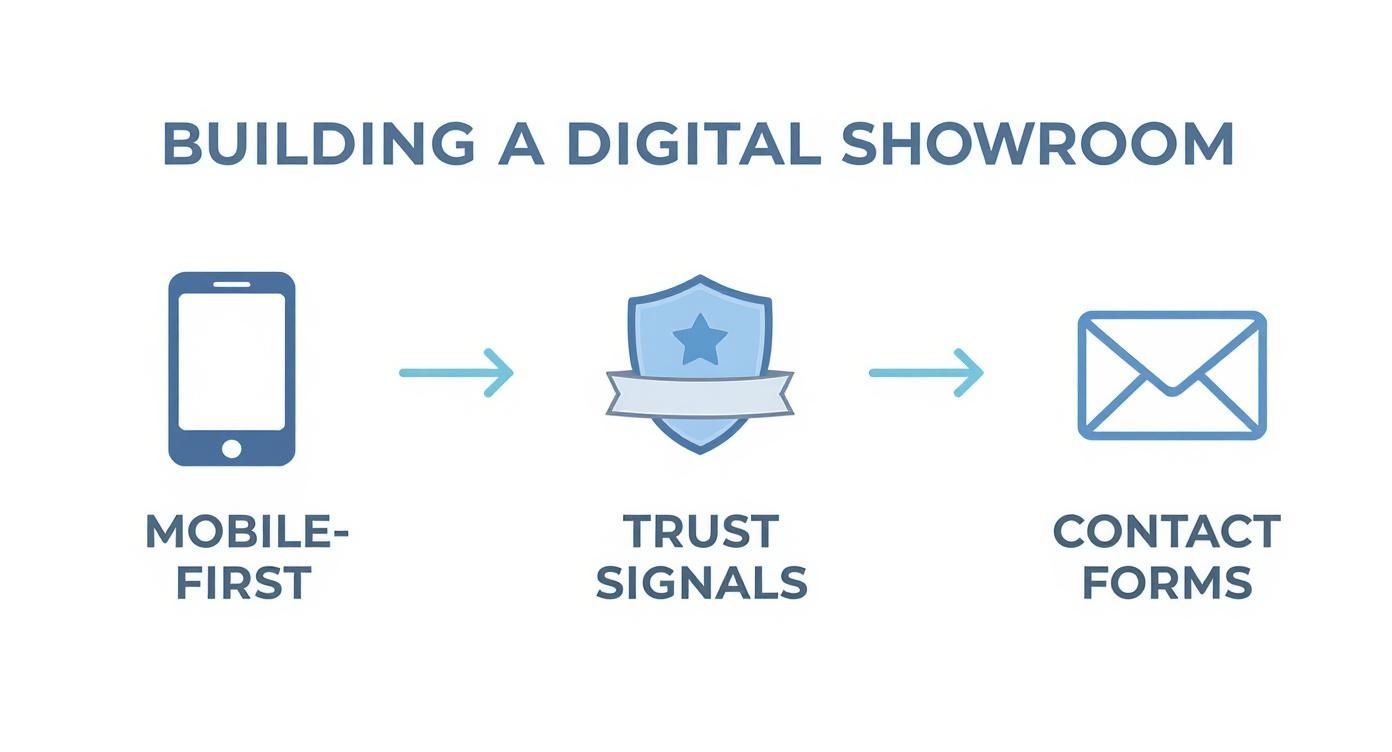
    Diagram illustrating steps to build a digital showroom: mobile-first, trust signals, and contact forms.

    As you can see, it's a simple formula: get the mobile experience right, layer on the trust, and then make it dead simple for them to reach out.

    Make Contact Effortless

    Okay, you've got them on your site, and they trust you. Now what? You have to make the next step completely obvious. Every single Vehicle Detail Page (VDP) needs clear, compelling calls-to-action (CTAs). And I don't just mean a generic "Contact Us" button buried in the footer.

    Your goal is to remove all friction between a visitor's interest and their action. If a potential buyer has to hunt for a way to contact you, you’ve already lost them. Every page should present an obvious next step.

    Give them multiple ways to raise their hand and show they're interested.

    • Simple Contact Forms: Perfect for quick questions or "check availability" requests.
    • "Schedule Test Drive" Buttons: This is a high-intent CTA for serious buyers. Make it big and bold.
    • Online Financing Applications: Capture leads who are already thinking about the numbers and are ready to buy.

    This is exactly what platforms like AutoFire™ are built for. They integrate clean, mobile-first designs with lead capture forms that are already optimized to convert. If you're tired of a website that doesn't pull its weight, you can explore a demo of the AutoFire platform to see how it all works.

    Get Found by Local Buyers: Mastering Inventory SEO
    Tablets displaying cars, a 'Digital showroom' sign, and a keyboard on a wooden desk.

    When a serious buyer in your area pulls out their phone and searches for a "used Honda CR-V with leather seats," you need to be the first dealership they see. Not just your dealership's homepage, but the exact car they want. This is what powerful inventory SEO is all about—transforming your website from a simple online catalog into a customer-magnet.

    The entire strategy hinges on your Vehicle Detail Pages (VDPs). Each VDP isn't just a page; it's a unique, digital storefront for a specific car. Relying on the generic, cookie-cutter descriptions from a manufacturer's feed is a recipe for getting lost in the crowd. To really stand out, every single VDP needs a unique, keyword-rich description written for an actual human being.

    Making Your Vehicle Detail Pages Work for You

    Stop and think about how your customers actually search. They aren't typing in "pre-owned compact sport utility vehicle." They’re much more specific, searching for things like "used blue Ford Explorer for sale in Phoenix." Your VDPs need to speak that language.

    Weaving in local terms is a game-changer. Simply mentioning your city or even a specific neighborhood in the description helps Google connect that vehicle to local searchers. It’s a simple move that signals you’re the relevant, local option they’ve been looking for.

    A top-performing VDP needs more than just good text:

    • A Killer Photo Gallery: Don’t skimp here. Aim for at least 20-30 crystal-clear photos of the vehicle from every conceivable angle. Get shots of the dashboard, the tires, the engine, and any special features that make it stand out.
    • All the Specs: Go deep. List out every package, feature, and aftermarket upgrade. The more detail you can provide, the more you build trust and answer questions before they're even asked.
    • Upfront Pricing: Be transparent. Show the price clearly, and if you can, embed a payment calculator to keep potential buyers engaged on the page longer.

    A great VDP is all about answering a buyer's questions before they even have to ask. When a page is comprehensive and well-optimized, it builds instant trust. It also pre-qualifies your leads, so when someone finally reaches out, you know they're serious.

    Supercharge Your Reach with Google Vehicle Listings

    Once your VDPs are dialed in, it’s time to put them directly in front of buyers on Google. This is where Google Vehicle Ads come in. Forget traditional paid search ads—this is a dynamic, feed-based system that displays your actual inventory, complete with photos and pricing, right on the search results page.

    The whole thing runs on your inventory feed. This is a data file containing everything about each car—make, model, VIN, price, photos, and the link to your VDP—which you send to Google. This can get technically complicated, which is why platforms like AutoFire are so valuable. They automate the entire process, making sure your feed is always fresh and correctly formatted.

    Keep an eye out for common feed errors that can kill your visibility:

    • Missing or outdated pricing
    • Broken image links or low-quality photos
    • Information in the feed that doesn't match what's on the VDP

    When you combine sharp, on-page VDP optimization with a technically sound Google Vehicle Ads feed, you’ve created a powerful one-two punch. Your inventory gets seen by the most motivated local buyers, driving clicks from qualified shoppers directly to the specific car they’re ready to buy.

    Turn Website Visitors Into Actionable Leads

    Getting eyes on your dealership's website is a solid first step, but let's be honest, traffic doesn't pay the bills. The real challenge—and where the money is made—is turning those anonymous clicks into actual, qualified leads your team can work with. This is where your on-site lead capture strategy needs to shine, creating a smooth, easy path for a curious browser to become a serious buyer.

    Simply put, you need to give people multiple, convenient ways to raise their hand and say, "I'm interested." A basic "Contact Us" form buried on a back page just doesn't cut it anymore. Today’s car shoppers expect helpful tools that give them answers and move them forward in their journey, directly from your website.

    Go Beyond Basic Contact Forms

    To catch buyers at every stage of their process, you need a full toolkit of lead capture options. Think of it like having different conversation starters for different types of customers.

    • Trade-In Valuation Tools: So many deals hinge on the trade-in. An instant trade-in estimator is a killer lead magnet because it gives the customer something they genuinely need to know before they can even think about buying.
    • Financing Pre-Approval Forms: This one is for your high-intent shoppers, the ones who are ready to talk numbers. A secure, simple pre-approval form not only captures a lead but qualifies them, giving your sales team a massive head start.
    • "Check Availability" Inquiries: On every single Vehicle Detail Page (VDP), you should have a low-pressure way for someone to express interest. This simple button is often the easiest first step for a hesitant buyer.

    These aren't just forms; they're intelligence-gathering tools. They pull in crucial data that tells your team what a customer needs before you even pick up the phone.

    Engage Buyers Instantly with Chat

    In this business, speed is everything. We've all seen it: the dealership that responds first usually gets the deal. The impact of rapid response is significant, with studies showing that contacting a lead within the first few minutes can dramatically boost conversion rates. It's no wonder so many dealers are using AI-powered virtual agents and chat tools to engage people the second they land on the site. You can dig into more research on the massive impact of lead response time, but the takeaway is clear: be fast.

    Live chat and AI chatbots act as your 24/7 digital BDC. They’re always there to answer common questions, schedule test drives, and grab contact info, even when your team is swamped or gone for the day.

    Here’s a look at a popular chat tool that shows how you can guide visitors and get their info without making them fill out another boring form.

    The key is to be present and helpful the exact moment a buyer shows intent. An AI chatbot can answer "Is this car still available?" at 11 PM on a Saturday, capturing a lead that would have otherwise been lost forever.

    When you combine value-driven forms with instant engagement tools, you create a powerful lead-gen machine. You’ll capture everyone from the shopper who's just starting to look, to the one who’s ready to fill out a full credit app. For dealerships wanting to add these features without the tech headaches, it’s worth seeing how an integrated platform can help you get in touch with more qualified buyers.

    Bring In Qualified Buyers With Smart Advertising
    Laptop on a wooden desk displaying website analytics and a 'Convert Visitors' speech bubble.

    Alright, your website is tuned up and ready to convert visitors into leads. Now, it's time to open the floodgates and get people there. A great site is useless without traffic, so we need to actively drive local car shoppers to your digital showroom.

    This is where a targeted advertising strategy comes into play. We'll focus on the local and social channels where your future customers are already looking for their next vehicle.

    The absolute cornerstone of your local marketing is your Google Business Profile (GBP). Seriously, don't sleep on this. It’s often the very first impression a buyer has of your dealership, and treating it as a "set it and forget it" task is a massive mistake. A well-managed, active profile is one of the most powerful free tools you have for generating local leads.

    To get the most out of it, you need to do more than just list your address and hours.

    • Post Regularly: Share your latest inventory, special offers, or even just some news from the dealership at least once a week. This tells Google you're an active business worth showing to searchers.
    • Keep Photos Fresh: Don't just upload inventory shots. Add pictures of your lot, your team, and especially happy customers with their new cars (always ask for permission first!).
    • Push for Reviews: Make it a habit to ask every happy customer to leave a review. A steady flow of fresh, positive reviews builds incredible trust with both Google and potential buyers.

    Find Ready-to-Buy Shoppers on Social Media

    While your GBP is perfect for capturing people actively searching on Google, social media ads let you get in front of buyers before they even search. Platforms like Facebook and Instagram have incredibly powerful targeting options that let you put your best vehicles directly in the newsfeeds of people in your area who are showing signs of being in the market for a car.

    This isn't about just blasting an ad to everyone in your zip code. You can create specific audiences based on demographics, interests (like pages they follow for specific car brands), and online behaviors that signal they're car shopping.

    Think about it this way: you can run a carousel ad showing off that new 2021 Ford F-150 that just hit your lot. The ad can feature a gallery of high-quality photos, the price right up front, and a clear call-to-action like "View All 30 Photos."

    The real magic of social ads is the precision. You can target people within a 25-mile radius of your dealership who have recently browsed sites like Autotrader or Cars.com. This ensures your ad budget is spent only on people who are genuinely potential customers.

    The key to making any of this work is obsessively tracking your Return on Investment (ROI). You have to connect your ad campaigns back to real business results. With the right setup, you can see exactly which ads are leading to phone calls, finance applications, and even test drives. This data lets you confidently pour more money into what’s working and kill the campaigns that are just wasting your cash.

    Mastering Follow-Up with Your CRM

    Getting a lead is just like having a customer step onto your lot—it's the very beginning of the conversation. The real work, where you actually win or lose the deal, all comes down to the follow-up. A name in a spreadsheet is just a name until you make a real connection. Your Customer Relationship Management (CRM) system is the engine that powers this entire process.

    Without a solid CRM in place, leads are guaranteed to slip through the cracks. Think about it: an email from your website, a message from Facebook, and a phone inquiry can all end up in different inboxes. Funneling every single lead source directly into your CRM creates one central hub, ensuring nothing ever gets missed.

    This isn’t just about plugging leaks in your process. It’s about giving your sales team the context they need to win. When a salesperson can see every interaction—every car a customer viewed online, every form they filled out—they can skip the small talk and have smarter, more relevant conversations from the get-go.

    Building Your Automated Follow-Up Cadence

    Great follow-up is a mix of persistence and perfect timing. Trying to track every lead manually is a recipe for disaster, which is exactly why automation is your best friend here. A well-thought-out follow-up plan uses a blend of communication channels to stay on a customer's radar without being a pest.

    The key is a multi-channel approach that layers different touchpoints.

    • The Instant Text Message: The second a lead hits your system, an automated text should fire off. Keep it simple: "Hi [Name], thanks for your interest in the [Vehicle]! A real person from our team will call you shortly to answer any questions." This buys you time.
    • The Value-Add Email: Within the first hour, follow up with an email that gives them something useful. This could be a link to similar cars on your lot or even a PDF of the vehicle's Carfax report.
    • The First Phone Call: The automated messages handle the immediate response, freeing your team up to make a genuine, personal phone call within a few hours.

    The goal of automation isn’t to replace your sales team; it’s to empower them. Automated texts and emails handle the immediate response, freeing up your team to focus on having high-quality, personal conversations that actually close deals.

    For smaller independent dealerships, combining a solid lead program with a built-in follow-up process can be a game-changer. A structured approach can lead to significant growth in a short amount of time, turning a higher percentage of leads into actual sales by ensuring consistent and timely communication. This kind of disciplined process is what drives a strong return on investment.

    A structured follow-up plan ensures no lead is forgotten. This table outlines a sample multi-channel cadence for new web leads.

    Sample 7-Day Lead Follow-Up Cadence

    Day Action Channel Notes
    1 Instant Auto-Response SMS & Email Acknowledge inquiry immediately. Let them know a person will reach out.
    1 Personal Phone Call Phone Call within the first hour. If no answer, leave a brief voicemail.
    2 Follow-Up Email with Alternative Vehicle Email "Thought you might also like this one…" Shows you're paying attention.
    3 Check-In Text SMS "Just checking in to see if you had any questions about the [Vehicle]."
    4 Second Phone Call Attempt Phone Try calling at a different time of day (e.g., evening).
    5 "Breaking the Pattern" Email Email Send a video walkaround of the car or a text about a new special.
    7 Final Follow-Up Call & Email Phone/Email Last attempt before moving the lead to a long-term nurture sequence.

    This kind of structured approach keeps you consistently in front of potential buyers without overwhelming them, dramatically increasing your chances of making the sale.

    Tracking Every Interaction to Refine Your Strategy

    Your CRM is more than just a digital rolodex; it's a goldmine of data that shows you what’s actually working. By tracking every call, email, and text, you can start spotting patterns. Which email subject lines get opened the most? Is Tuesday afternoon really the best time to make calls?

    This data-driven approach takes the guesswork out of your follow-up and turns it into a repeatable, scalable process. You can fine-tune your cadences, double down on the strategies that work, and turn your marketing spend into pure profit. A modern platform like AutoFire is built to integrate with your CRM, ensuring the powerful features you use to capture leads feed seamlessly into your follow-up workflow. This is how you build a true lead generation machine.

    Common Questions on Dealership Lead Generation
    A desk with a computer displaying a dashboard, a landline phone, and a plant, promoting 'AUTOMATED FOLLOW-UP'.

    Running a dealership comes with its own set of challenges, and I get these questions all the time. Let's cut through the noise and get you some straight answers on how to generate more, and better, leads in this market.

    How Much Should a Dealership Spend on Lead Generation?

    There’s no one-size-fits-all answer here, but I can give you some solid starting points I’ve seen work time and again. A good rule of thumb is to dedicate 10-15% of your gross profit goal to your overall marketing budget. That bucket covers everything you do for lead generation.

    Another way to look at it is budgeting a specific cost-per-sale. For most independent lots, that number usually falls somewhere between $200 and $400 per vehicle sold.

    My best advice? Start with a budget you can track meticulously. Put your first dollars into the channels with the highest potential return, like dialing in your Google Business Profile and local SEO. Once you see what’s actually bringing people to your lot, you can confidently ramp up your spending.

    What Is the Best Lead Source for Used Car Dealerships?

    Hands down, your two most valuable lead sources will almost always be your own website and your Google Business Profile. I can't stress this enough. These channels are absolute gold because they connect you with buyers who are already searching for the exact cars you have in stock.

    Sure, third-party listing sites and paid ads can goose your numbers and bring in volume. But a killer organic presence? That delivers a consistent flow of high-quality leads that don't cost you an arm and a leg per click. Best of all, you own them completely.

    The highest quality leads often come from the channels you own. An optimized website and a well-managed Google Business Profile attract serious buyers who are looking for a local, trustworthy dealership—not just the lowest price.

    How Can I Get Better Quality Car Sales Leads?

    Getting better leads isn't about casting a wider net; it's about using the right bait. It all starts with being incredibly specific in your marketing to attract the right kind of buyer from the get-go.

    • Go After Long-Tail Keywords: Stop targeting generic terms like "used cars." Get specific. Think like your customer and target phrases like "used Ford F-150 with tow package in Austin." This brings in shoppers who've already done their homework.
    • Show, Don't Just Tell: High-resolution photos from every angle and obsessively detailed vehicle descriptions are non-negotiable. This builds trust, answers questions upfront, and helps pre-qualify people before they even contact you.
    • Add Qualifying Tools to Your Site: A financing pre-approval form or a trade-in value estimator does more than just capture contact info. These tools give your sales team crucial context, helping them spot the most serious, ready-to-buy customers in the pipeline.

    Ready to turn your website into a lead-generating machine without the technical headaches? AutoFire provides independent dealerships with modern, mobile-first websites that are optimized for SEO and Google Vehicle Listings right out of the box. Start capturing more qualified leads today by visiting https://goautofire.com.

    Article created using Outrank
  • How to Sell Cars Online: A Modern Dealer’s Playbook

    How to Sell Cars Online: A Modern Dealer’s Playbook

    When you boil it all down, selling cars online comes down to three things: creating digital listings people can trust, genuinely connecting with them, and making the final paperwork as painless as possible. Think of it as building a digital showroom that mirrors your physical lot, putting every vehicle you have right at a buyer's fingertips, no matter where they are.

    This guide is your complete playbook for getting it right.

    Your Dealership's Shift to the Digital Showroom

    Let's face it—the days of customers spending their entire Saturday wandering from lot to lot are pretty much over. The modern car buying journey starts with a search on a phone, tablet, or laptop. For an independent dealer, this isn't a problem to be solved; it's your single biggest opportunity to punch above your weight and compete with anyone.

    Making this shift is about more than just throwing up a basic website. It’s about rethinking how you present your inventory, market your dealership, and ultimately, close the deal. The goal is to build a seamless bridge that takes a customer from their initial online search all the way to a signed deal, whether they finish the purchase from their couch or come down to your lot to get the keys.

    The New Reality of Automotive Retail

    The amount of money changing hands online for vehicles is staggering. The global online car buying market is on track to hit a massive $722.79 billion by 2030. This explosion is fueled by one thing: customers want convenience and straight answers.

    In fact, almost 39% of car dealers worldwide are already set up to let customers handle the entire purchase online, and that number is only going up. You can dig deeper into these automotive retail trends to see just how fast the market is moving.

    This guide is your practical roadmap. We're cutting through the noise to give you actionable steps you can put into practice today to get your piece of this growing digital pie.

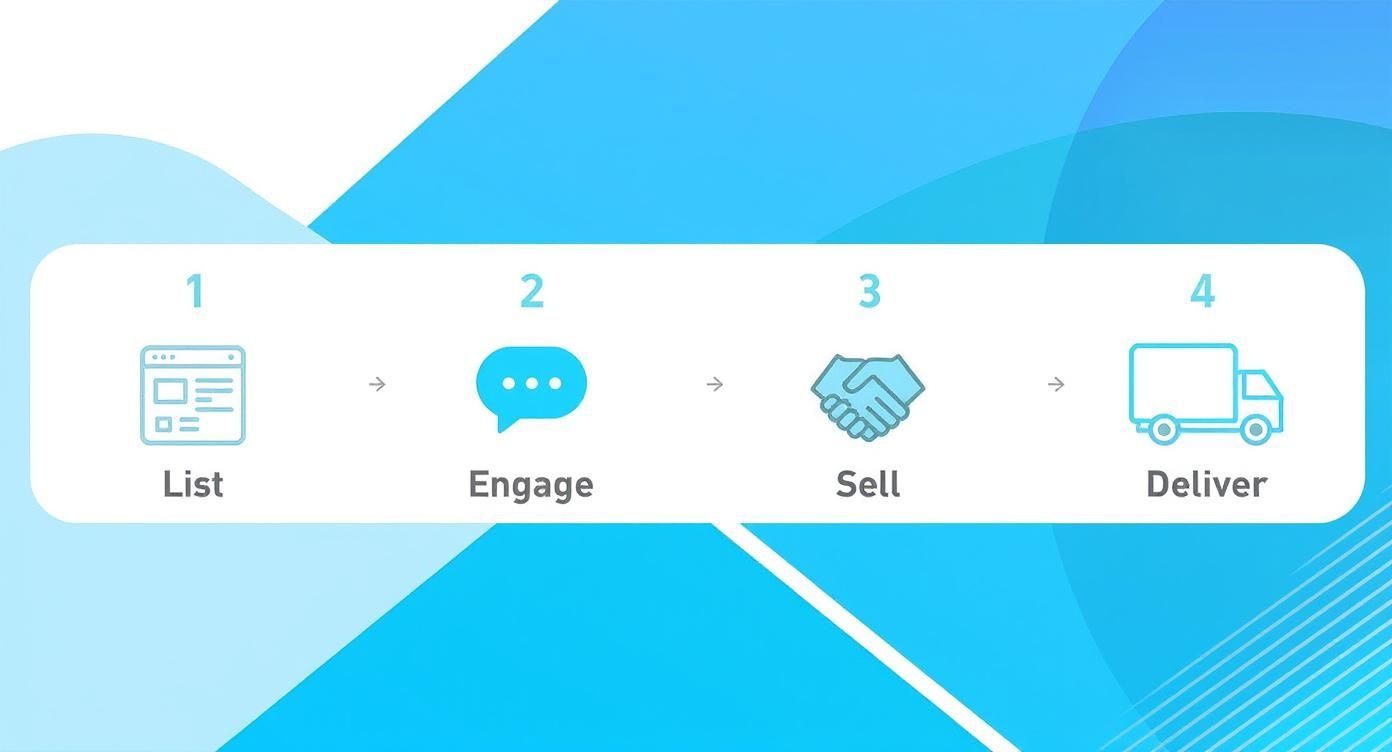
    To give you a bird's-eye view, here's a quick rundown of the main stages you'll need to master.

    Key Stages of Selling a Car Online

    Stage Key Objective
    List Create detailed, high-quality digital listings for every vehicle.
    Engage Capture leads and build trust with potential buyers through timely communication.
    Sell Guide the customer through pricing, financing, and final purchase decisions.
    Deliver Handle paperwork, secure payment, and arrange for vehicle pickup or delivery.

    Getting each of these stages right is what separates a frustrating online effort from a profitable one.

    A 4-step process flow showing List, Engage, Sell, and Deliver, with corresponding icons for each stage.

    Each phase—List, Engage, Sell, and Deliver—is a chance to build confidence and move a buyer forward. It’s also where a sale can fall apart if you're not prepared.

    Your Playbook for Selling Cars Online

    To really succeed, your dealership needs a solid game plan that covers the entire online sales journey. We've built this guide as a step-by-step playbook, keeping the realities of small teams and independent lots in mind.

    Here’s what we’ll cover:

    • Prepping Your Inventory: How to create photos and descriptions that actually sell cars.
    • Listing and Pricing: Mastering your own dealer website and the big third-party marketplaces.
    • Lead Nurturing: Practical tips for turning casual online interest into appointments and closed deals.
    • Finalizing the Deal: Handling digital paperwork, payments, and delivery without the headaches.

    By focusing on these key areas, you'll build an online sales engine that works for you, complementing your physical lot and driving real growth for your business.

    Building an Online Inventory That Sells Itself

    Think of your online listing as your new showroom floor. It’s the very first—and sometimes only—chance you get to make a solid impression. This is where you go beyond just posting a few pictures and start building Vehicle Detail Pages (VDPs) that actually do the selling for you.

    When a customer can't walk your lot in person, your digital inventory has to do all the heavy lifting. It needs to build trust, answer questions before they're even asked, and get a buyer excited enough to pick up the phone. A great listing makes your phone ring; a bad one gets scrolled past in seconds.

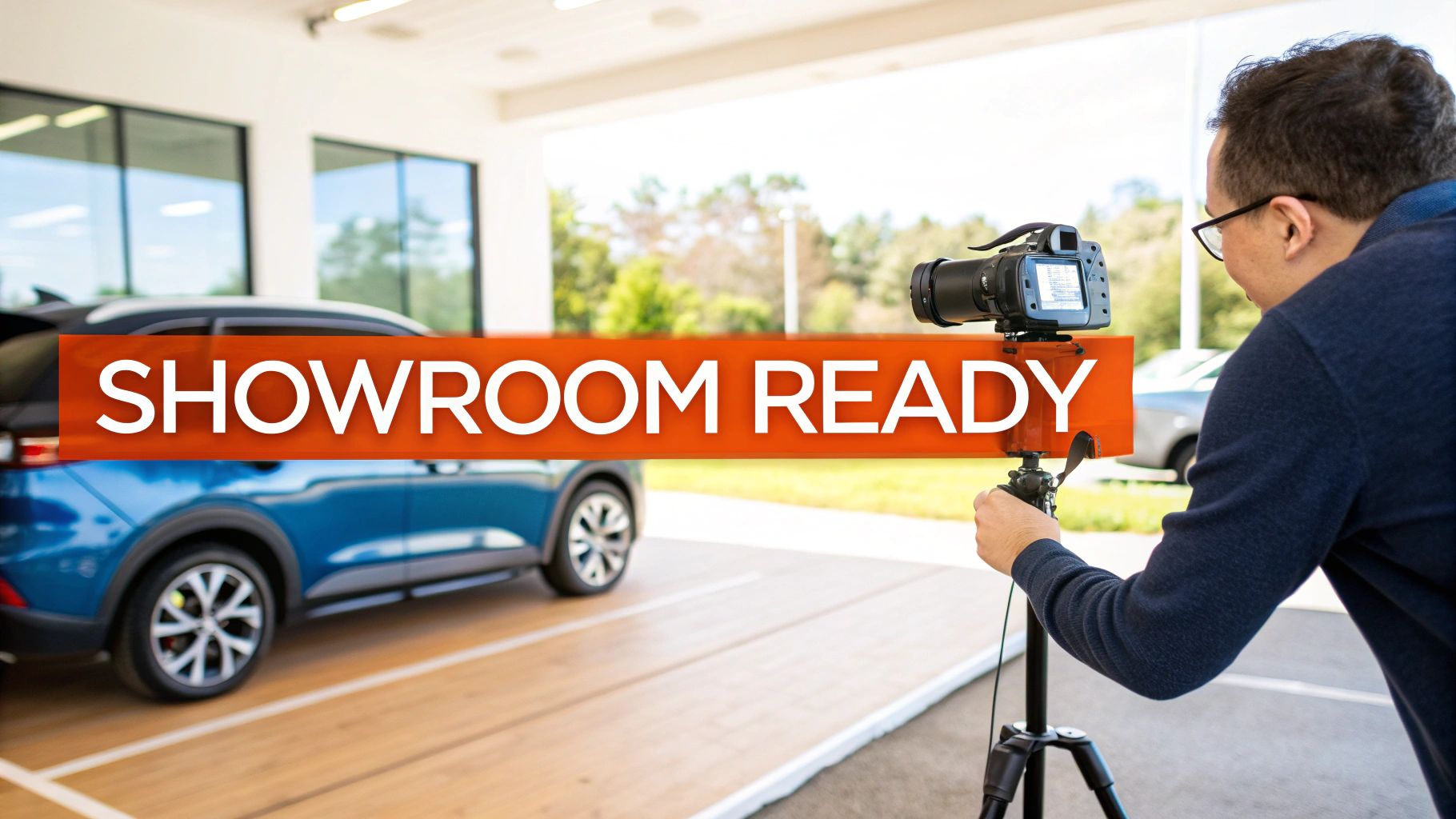
    A man films a blue car on display with a professional camera on a tripod, displaying a "SHOWROOM READY" banner.

    Taking Car Photos That Actually Work

    Good news: you don't need a high-dollar photo studio to take pictures that move metal. What you do need is a consistent process and an eye for what your buyers are looking for. Your smartphone is more than capable, but it’s how you use it that makes all the difference.

    We tell every dealer to create a "photo recipe"—a standard list of shots you take for every single vehicle. This isn’t just about looking professional; it ensures you never miss a critical angle and gives your entire online inventory a clean, uniform look.

    Your shot list should always cover:

    • The Full Tour: Get the front three-quarter view, the rear three-quarter, a direct side profile, and straight-on shots of the front and back.
    • A Look Inside: Show the driver's seat perspective, a clear shot of the dashboard and center console, the front and rear seats, and of course, the trunk space.
    • The Details Matter: Zoom in on the odometer showing the mileage, the tires to show tread depth, the infotainment screen, and any special features like a sunroof or premium sound system.

    Here's a tip that might seem counterintuitive: don't hide the imperfections. A close-up of a small scratch or a scuff on the bumper builds a massive amount of trust. It shows you're being transparent and helps manage buyer expectations—a crucial step for avoiding headaches later.

    Pro Tip: Your best friend for car photography is an overcast day. That soft, indirect light prevents the harsh glares and dark shadows you get from the midday sun, which can easily hide a car's true condition.

    Writing Descriptions That Tell a Story

    Once the photos grab their attention, the description has to hold it. This is your moment to connect with the buyer and sell them on why this specific car is the right choice for them. The trick is to stop listing features and start telling a story.

    A weak description sounds like this: "Used 2018 Honda CR-V, good condition, runs well." It’s boring and unhelpful.

    A compelling description, on the other hand, paints a picture: "This one-owner 2018 Honda CR-V is the perfect reliable SUV for a growing family. With its all-wheel-drive system, you'll have peace of mind in any weather, and the spacious cargo area has plenty of room for sports gear and groceries. We have all the service records, and it's been meticulously maintained."

    See the difference? The second example speaks directly to a potential buyer's needs. It turns a list of specs into a solution for their life.

    The Non-Negotiable Power of VIN Decoding

    Let’s be honest, manually typing in every single feature for every car is a nightmare. It’s slow, tedious, and a single mistake—like listing the wrong trim level—can kill a buyer's trust instantly. This is why accurate VIN decoding is an absolute must-have in your workflow.

    A good VIN decoder automatically fills in the listing with all the correct factory-installed options, from the engine and transmission type to the exact color codes. This doesn't just save a ton of time; it guarantees the accuracy that serious shoppers depend on to compare vehicles.

    Most modern dealership website platforms have this built-in. For example, a system with a VIN Decoder and other website features automates this entire process for you. It turns your VDPs from simple classified ads into professional, data-rich sales tools that build confidence from the very first click.

    Getting Your Cars Priced and Listed to Sell

    https://www.youtube.com/embed/xQWUm_eHjGk

    Alright, you’ve got your inventory looking sharp online. Now comes the real challenge: getting those pristine listings in front of people who are ready to buy. A smart strategy here isn't just about throwing your cars up on a few websites. It's about being strategic—placing them on the right digital shelves, with the right price, at just the right time.

    Think of it as a two-pronged attack. Your own dealership website is your home turf. It’s where you control the entire experience, build your brand, and capture leads without paying referral fees. But you can't just wait for buyers to find you. You have to go where they are, and that means listing your inventory on the big marketplaces like Cars.com, Autotrader, and even Facebook Marketplace.

    Trying to juggle all those listings manually is a nightmare. You’ll end up with mismatched prices, outdated photos, and a massive headache. This is where a good dealership management system, like AutoFire™, becomes your best friend. You load your inventory once, and it automatically syncs it across every channel you use. Consistency is key, and this is how you achieve it.

    Your Secret Weapon: Google Vehicle Listings

    One of the most powerful, and frankly underutilized, tools for independent dealers is Google Vehicle Listings. This isn't just another marketplace—it's a free feature that puts your actual cars directly into Google Search results.

    Imagine a local buyer typing "used Honda Civic near me" into Google. Before they even click a link, Google can show them a picture of your Honda Civic, along with the price, mileage, and your dealership's name. That’s prime digital real estate, and it doesn’t cost you a dime in ad spend.

    Here’s a glimpse of how your cars can show up, grabbing a buyer's attention right away.

    This visual-first approach lets shoppers browse what's available locally without having to jump from site to site. Getting your inventory featured here is a total game-changer for driving high-quality, ready-to-buy traffic straight to your website.

    Stop Guessing and Start Pricing with Data

    Pricing a used car feels like walking a tightrope. Go too high, and the car collects dust. Go too low, and you're leaving cash on the table. The solution? Get out of the guessing game and let data do the heavy lifting.

    This is what we call dynamic pricing. It’s about looking at real-time market data to see exactly what similar vehicles are selling for in your specific area. You need to be looking at:

    • What are the other guys charging? Check competitor pricing for the same year, make, model, and trim.
    • What’s the market supply like? Are there a hundred similar cars for sale, or just a handful? This affects urgency and value.
    • Does the car’s story add value? A clean, one-owner Carfax report can absolutely justify a higher price point.

    When you base your prices on hard data, you can confidently explain your numbers to customers and make smart, strategic adjustments to keep your inventory moving.

    Make Financing the Easy Part

    Let’s be honest: financing is often the biggest hurdle in any car deal. So why wait until the customer is standing on your lot to talk about it?

    One of the smartest moves you can make is to integrate a secure online credit application directly onto your vehicle detail pages. It’s a simple addition that completely changes the game.

    This one step does so much more than just bring in a lead. It turns a casual looker into a qualified buyer who knows their budget. It gets the toughest part of the negotiation out of the way early and dramatically shortens the time it takes to close a deal.

    This whole shift toward handling things online isn't a fad; it's the future. In the U.S., online used car sales are projected to make up 18% of all transactions by 2025—a massive leap from just 9.7% in 2020. You can dig into the numbers yourself over at Statista.com's report on online vehicle sales. This boom is happening for a reason: buyers want the convenience of comparing prices and handling financing from their couch.

    By combining clear, data-backed pricing with powerful free tools like Google Vehicle Listings and easy online financing, you’re not just selling cars online. You’re building a modern, efficient, and customer-friendly dealership that will leave the old-school competition in the dust.

    Turning Online Interest Into Profitable Sales

    An online lead isn't just a name and number—it's the start of a real conversation. And in this business, the speed and quality of your first response can make or break the entire deal.

    The moment a potential buyer hits "submit" on your website or a marketplace listing, the clock starts ticking. They're actively shopping, and if you wait hours to respond, they’ve already moved on to the next dealer’s inventory. Your job is to turn that initial spark of digital interest into a real, human connection that leads to a sale.

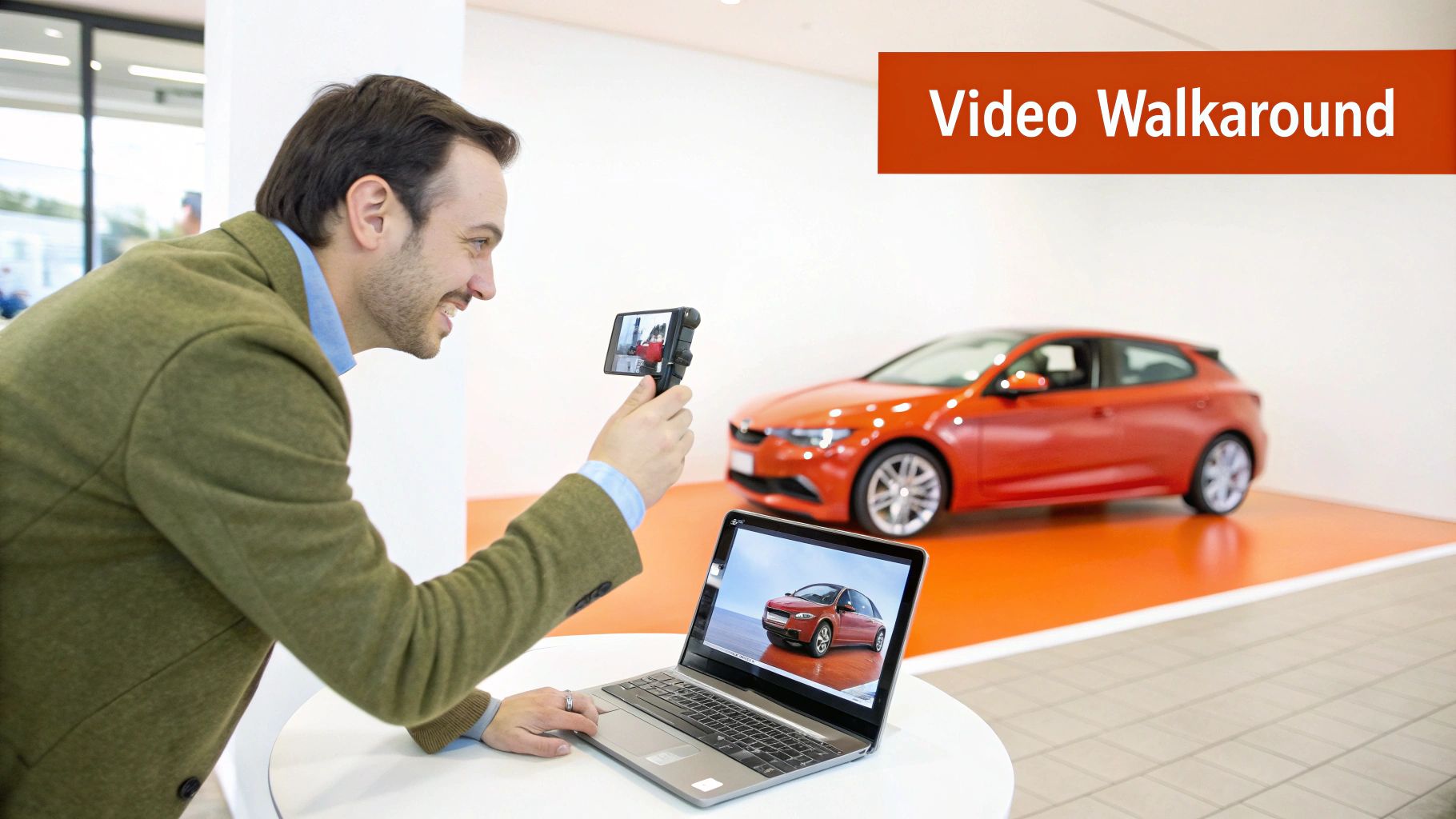
    A man records a video walkaround of a red car in a showroom with a smartphone and gimbal.

    Building Rapport with Proven Scripts

    Let's be real: you need to be fast, but you don't want to sound like a robot. Having a few solid response templates is the key. You can act quickly while still being personal and helpful. The goal is to confirm you have the car they want and immediately ask an open-ended question to get them talking.

    Here’s a simple text message script we’ve seen work wonders:

    "Hi [Customer Name], this is [Your Name] from [Dealership Name]. Thanks for your interest in the [Year/Make/Model]! It’s a great car, and yes, it's still available. What's the most important thing you're looking for in your next vehicle? Feel free to text me back here with any questions."

    This little script does a few powerful things. It's personal, confirms the car is there (which is often their first question), and pivots the conversation to their needs. It opens the door for a real dialogue, not just a yes/no exchange.

    Master the Personalized Video Walkaround

    If you want to build serious trust, especially with out-of-town buyers, the personalized video walkaround is your secret weapon. It’s probably the single most effective tool you have.

    When a lead comes in on a specific vehicle, don't just email back more photos. Grab your phone, walk out to the lot, and record a quick, two-minute video just for them.

    Start it off personally: "Hey, [Customer Name], it's [Your Name] at the dealership. Here's that [Year/Make/Model] you asked about."

    Then, hit these key points in your video:

    • A Cold Start: Nothing builds confidence like hearing that engine turn over cleanly.
    • Feature Tour: Show off the things they'd care about—the touchscreen, the condition of the leather, the trunk space.
    • Transparency is Key: This is huge. Show them the good and the bad. Point out the deep tire tread, but then zoom in on that little door ding you mentioned in the description.

    Making a video just for them shows you're a serious, transparent dealer who is willing to go the extra mile. For an out-of-state buyer, that video can be the one thing that gives them the confidence to say, "Let's do this."

    Using a Simple CRM to Track Everything

    As leads start rolling in from your website, Facebook, and other marketplaces, you can't rely on memory or sticky notes. It’s a recipe for disaster. This is where a simple Customer Relationship Management (CRM) system becomes your best friend.

    You don't need some massive, complicated enterprise software. A lightweight CRM is perfect for a small dealership and helps you:

    1. Log Every Interaction: Keep a running history of every call, text, and email with each customer.
    2. Set Follow-Up Reminders: Never again forget to check in with that promising lead who said, "I'll think about it."
    3. Understand Your Pipeline: See at a glance who's a new lead, who you're actively talking to, and who is ready to buy.

    A good CRM ensures no opportunity falls through the cracks. For a small team juggling everything, it’s not a luxury; it’s your command center for managing every customer relationship effectively.

    By combining lightning-fast responses, personal touches like video walkarounds, and organized tracking in a CRM, you build a system that works. You make every potential buyer feel valued and heard, which is exactly how you turn casual online browsers into profitable sales.

    Streamlining the Digital Deal and Delivery

    Alright, you’ve got a buyer who said “yes.” This is where the rubber meets the road. The next few steps will either lock in a fantastic customer experience or create a frustrating mess of paperwork and payment anxiety. Getting this last part right—finalizing the sale online—is all about having a secure, clear, and efficient process that keeps the trust you've worked so hard to build.

    This is more than just emailing a few scanned documents back and forth. You need a seamless, legally sound, and paperless transaction that makes the buyer feel confident from start to finish. For many people, this is the most nerve-wracking part of buying a car, so making it dead simple is a massive competitive advantage.

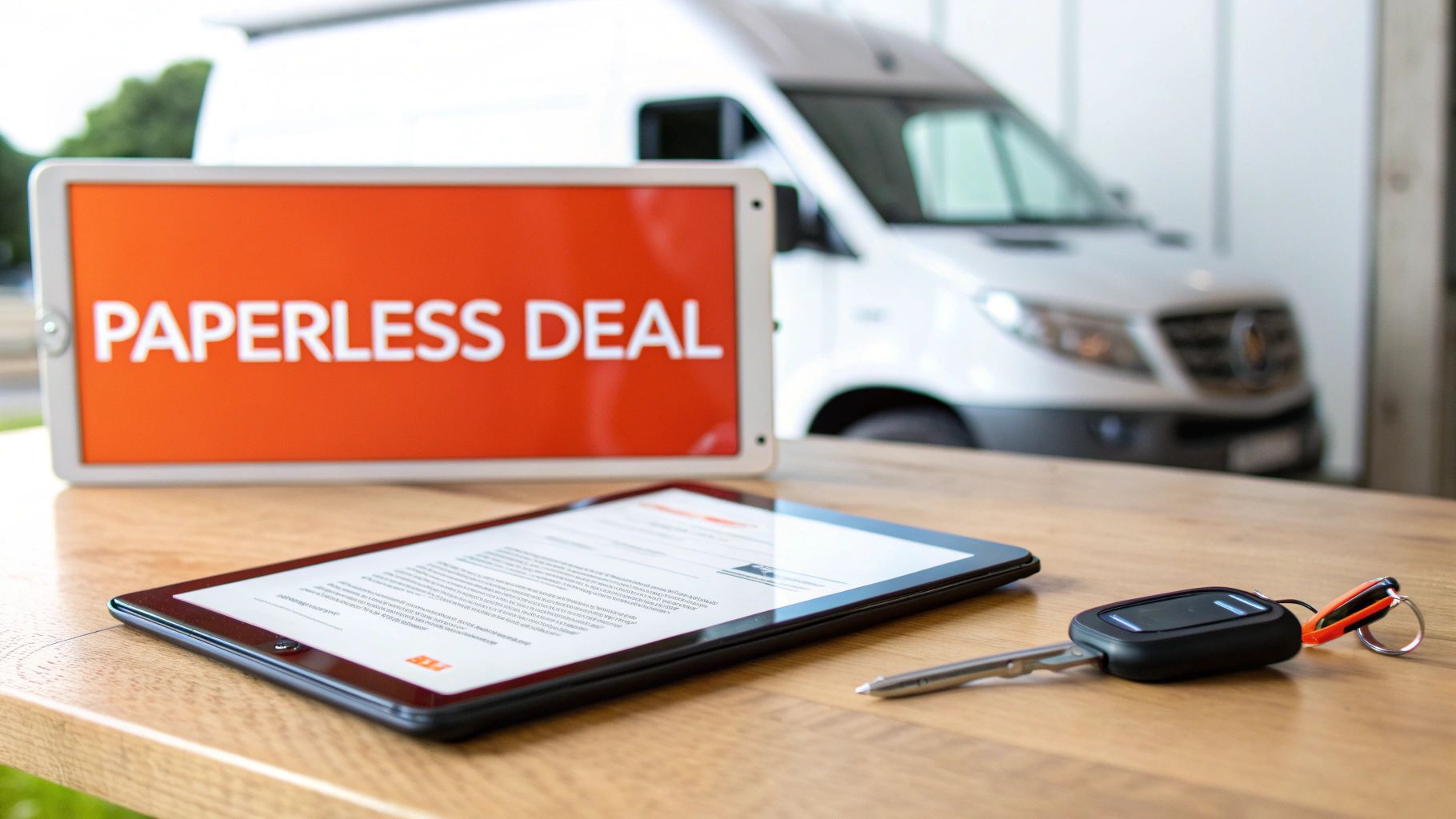
    A 'PAPERLESS DEAL' sign, a tablet displaying a document, and car keys on a table with a van.

    From Handshake to E-Signature

    The modern car deal is closed with a click, not just a handshake. E-signature platforms have totally changed the game for independent dealers, letting you finalize sales agreements and finance docs no matter where your buyer is.

    These tools let you send legally binding contracts straight to a customer's email. They can review and sign right from their phone or computer, which creates a secure, time-stamped record of the whole transaction. Forget printing, scanning, or overnighting huge packets of paper. This speeds up the closing process dramatically.

    That kind of efficiency is a big deal in today’s market. The global car sales industry is a massive market, and according to one global auto sales industry analysis, the sector includes over 471,000 businesses competing for customers. A smooth, fast closing process is a key advantage that smart dealers are using to stand out.

    Securing Payments and Building Confidence

    Asking someone to send you thousands of dollars for a car they've only seen in pictures requires a ton of trust. Your payment process has to feel professional and buttoned-up to calm their natural fears about buying a vehicle sight-unseen.

    A great place to start is with a secure online deposit system. This lets a buyer put down a smaller, refundable amount to hold the vehicle, which gives both of you some peace of mind. When it's time for the full payment, give them clear, easy options:

    • Secure Payment Gateway: Use a trusted third-party service that can handle ACH transfers or credit card payments securely.
    • Wire Transfer: Provide crystal-clear, double-checked wire instructions for direct bank transfers.
    • Financing Payout: Work directly with the lender to make sure the transaction is handled without a hitch.

    Pro Tip: Over-communicate during this stage. Send a quick email confirming their deposit was received. Send another when the final payment clears. This constant reassurance is critical for keeping an out-of-state buyer calm and confident in their purchase.

    Modern dealership platforms can bring all these final steps into one clean workflow. To see firsthand how a system can connect inventory management, lead tools, and closing processes, you can request a demo of the AutoFire platform.

    Coordinating Delivery and the Final Touchpoint

    The last step—getting the car into the customer's hands—is your final opportunity to leave a lasting impression. This moment can turn a happy buyer into a superfan who leaves glowing five-star reviews and sends their friends your way.

    If the buyer is local, setting up a pickup appointment is simple enough. For nationwide sales, however, you need a solid plan.

    • Find Good Shippers: Get to know a few reputable, fully insured auto transport companies. Understand their rates and timelines so you can give customers accurate quotes and ETAs.
    • Set Clear Expectations: Be completely transparent about shipping costs and delivery windows. Make sure the customer understands who is responsible for what while the car is in transit.
    • Create a "Wow" Moment: Whether it’s a local pickup or a cross-country delivery, make it special. The car should be impeccably detailed with a full tank of gas and a temporary tag ready to go. Even a small touch, like a branded keychain, can make a big impact.

    By nailing this final digital handshake and delivery, you're not just closing a deal. You're cementing a relationship and building the kind of reputation that will help you sell more cars online for years to come.

    Your Top Online Car Selling Questions, Answered

    As you gear up to sell cars online, you’re bound to have some questions. It’s only natural. We hear a lot of the same ones from independent dealers just like you, so we’ve put together some straight-to-the-point answers to help you navigate the process.

    Where Should a Small Dealer Focus First?

    If you do only one thing, do this: get obsessed with your photos and vehicle descriptions. Seriously. Your online listing is your new showroom. It’s the very first impression a buyer gets, and you only get one shot.

    Fancy marketing tools and software are great, but they can't make up for a listing with dark, blurry photos or a one-line description. You don't need a professional camera, either—your smartphone is plenty powerful. What matters is having a solid process.

    Come up with a "photo recipe" you follow for every single car. I’m talking 30-50 photos per vehicle, minimum. You need to show it all:

    • Every exterior angle: Get the front, back, sides, and those crucial three-quarter views.
    • The entire interior: Dashboard, front seats, back seats, trunk space—everything.
    • The good, the bad, and the details: Get close-ups of the odometer, the tire tread, and any special features. And—this is huge—don't hide the flaws.

    Show that minor scratch on the bumper. Point out the small scuff on the door. That level of honesty builds instant trust and heads off any nasty surprises when the buyer sees the car in person. It’s the secret to a smooth sale and a genuinely happy customer.

    What's the Real Cost to Start Selling Cars Online?

    The good news is you don’t need a massive bankroll to get started. The costs can be surprisingly lean, especially for a small dealership just dipping a toe in the water. Your main expenses will fall into a few predictable buckets.

    Your biggest investment is your website. A professional, modern site with built-in inventory management is non-negotiable and will likely run you $100 to $500 a month. You'll also need a subscription for vehicle history reports from a service like Carfax or AutoCheck to give buyers the peace of mind they demand.

    After that, it's all about how much you want to spend on advertising. You can actually start with a budget of zero by using free tools like Google Vehicle Listings and posting to social media marketplaces. Once you see what's working, you can start putting money into paid ads on Facebook or boosting your listings on third-party sites.

    A smart starting budget for a small dealership is somewhere in the $300-$800 per month range. This covers your essential tools and leaves a little room to experiment with paid ads to start bringing in traffic.

    Do I Need a Special License to Sell Online?

    This is a really important one: you need the exact same dealer license to sell cars online as you do to sell them from your physical lot. The internet is just another sales channel; it doesn't let you bypass the rules and regulations of the auto industry.

    All the laws around titles, disclosures, taxes, and consumer protection are still 100% in effect. You have to be fully compliant with your state's DMV or regulatory agency. Those rules govern every sale you make, whether it’s in-person or online.

    On top of that, you’ll want to use digital contracting tools that comply with state and federal e-signature laws. This ensures your sales agreements are legally binding. If you have any specific questions about local regulations, it’s always smart to talk to a lawyer who knows the auto industry. Our team can also point you toward some helpful resources if you contact us for more information.

    How Do I Handle Test Drives for Online Shoppers?

    This is probably the most common logistical hurdle we hear about, especially when buyers aren't local. The trick is to be flexible and offer a few different options that make people feel comfortable buying from you.

    Here are a few strategies that work really well:

    1. Scheduled On-Lot Drives: This is the easiest one. For local buyers who find you online, just set up a time for them to come by the dealership for a traditional test drive. It makes them feel valued and ensures the car is prepped and ready to go.

    2. Personalized Video Walkarounds: For out-of-towners, a live video call or a custom-recorded walkaround is your best friend. This isn’t a generic marketing video. You’re recording it just for them, using their name, and zooming in on the things they specifically asked about. It builds a ton of trust.

    3. "At-Home" Test Drives: For serious local buyers who are pre-qualified, offering to bring the car to their home or office can be a game-changer. It’s a premium service that busy customers absolutely love.

    4. A Rock-Solid Return Policy: For someone buying from another state, a clear, fair return policy (like a 3-day or 150-mile money-back guarantee) is the ultimate confidence booster. It removes the risk of buying a car sight-unseen and essentially makes the first few days of ownership their test drive.

    By mixing and matching these options, you can cater to just about any buyer, no matter where they are. You’re not just selling a car; you’re selling a convenient and trustworthy experience.


    Ready to launch a professional, mobile-first dealership website that gets you noticed on Google and turns browsers into buyers? With AutoFire, you can get your inventory online in minutes, not months. Our platform is built for independent dealers who want powerful features like a VIN decoder, Google Vehicle Listings integration, and SEO-optimized pages without any technical headaches. Start selling more cars online today.

    Article created using Outrank