Category: Inventory Management

Vehicle inventory, VIN decoding, listings, and inventory software guidance for independent dealers.

  • Automobile Inventory Management for Modern Dealerships

    Automobile Inventory Management for Modern Dealerships

    Think of automobile inventory management as the art and science of having the right cars on your lot, at the right price, at the right time. For an independent dealer, it’s not just about counting cars—it's about strategically handling your biggest investment to keep cash flowing and profits rolling in. This is the operational engine that powers your entire dealership.

    Why Smart Inventory Management Is Your Dealership's Superpower

    Picture your car lot as a high-end grocery store. The freshest, most sought-after produce—your popular, in-demand vehicles—flies off the shelves at full price. But the older items that linger start to spoil, eventually needing massive discounts just to get them out the door. This is a perfect analogy for automobile inventory management.

    Every single day a car sits on your lot unsold, it's losing value and tying up cash that you could be using to buy fresh, profitable stock.

    Good inventory management isn't something you do once and forget about. It's a constant, active strategy. You're always analyzing market data, hunting for the right vehicles, pricing them to sell, and marketing them effectively to turn them over quickly. When you get this rhythm right, your inventory stops being a static liability and becomes a dynamic, profit-generating machine.

    The True Cost of Inefficient Inventory

    Letting your inventory get stale has real financial consequences that echo through your entire business. A car that doesn't sell isn't just taking up a parking spot; it’s actively costing you money in depreciation, insurance, and financing—what we call holding costs. These costs eat directly into your profit margins.

    On the flip side, a well-oiled inventory system creates a powerful positive cycle:

    • Better Cash Flow: Cars that sell fast free up your capital. That means you can immediately reinvest in the vehicles your local market is screaming for right now.
    • Higher Profit Margins: Selling cars before they get old means you can ask for better prices and avoid those painful, profit-slashing discounts.
    • A Stronger Reputation: When you're known for stocking desirable, well-priced cars, you become the go-to dealer in town. More buyers start coming to you first.

    Navigating Today's Volatile Market

    The recent chaos in the market has made agile inventory strategies more critical than ever. Supply chain hiccups mean you can't rely on the old ways of doing things. Market data shows just how fast things can change, with fluctuations in both new and used vehicle supply being common. This kind of environment rewards dealers who are quick on their feet and guided by data.

    The core principle is simple: your profit is made when you acquire the vehicle, not just when you sell it. A smart acquisition strategy, informed by data, sets the stage for a profitable sale before the car even hits your lot.

    To truly master this, you need a system built on proven and adaptable strategies, like these essential inventory management tactics for growth. It's all about consistently putting the right cars in front of the right buyers, which is what separates the dealerships that thrive from those that merely survive.

    Key Metrics for Automobile Inventory Management Health

    To get a real handle on your inventory's performance, you need to track the right numbers. These Key Performance Indicators (KPIs) give you a clear, data-backed picture of what's working and what's not. Think of them as the vital signs for your dealership's biggest asset.

    Metric What It Measures Why It's Critical
    Days' Supply How long it would take to sell your entire current inventory at the current sales rate. A high number means slow-moving stock and rising holding costs. A low number might mean missed sales opportunities.
    Inventory Turn Rate How many times your entire inventory is sold and replaced over a specific period (usually a year). This is a core measure of efficiency. A higher turn rate means capital is working harder for you and profits are generated faster.
    Stock-to-Sales Ratio The ratio of vehicles in stock versus the number of vehicles sold in a given period. Helps you align your stock levels with actual sales demand, preventing both overstocking and understocking.
    Average Holding Cost The total cost to keep a vehicle in inventory per day (includes financing, insurance, depreciation, etc.). Knowing this number highlights the real, tangible cost of a slow-selling car and adds urgency to your sales process.
    Aged Inventory % The percentage of your inventory that has been on the lot for more than a set period (e.g., 60 or 90 days). This is a direct red flag for potential losses. A high percentage signals problems with acquisition, pricing, or marketing.

    Tracking these metrics isn't just about crunching numbers; it's about gaining the insight needed to make smarter, more profitable decisions every single day.

    The Five Stages of a Winning Inventory Lifecycle

    Every car on your lot takes a journey, from the moment you bring it in to the second it drives off with a new owner. This is its inventory lifecycle, and how well you manage that journey is what separates the top-performing dealerships from everyone else. When you start thinking about this process in distinct stages, you can easily spot weak points and turn them into major strengths.

    Get one stage right, and that success builds momentum for the next. Suddenly, you've got a profit-generating engine, not just a process. It’s not about being perfect at one thing; it’s about being consistently good across the entire lifecycle, making sure every car moves smoothly and profitably from acquisition all the way to the final sale.

    This flow chart boils the whole thing down to its essence: stock the right cars, analyze what’s happening, and turn it into profit.
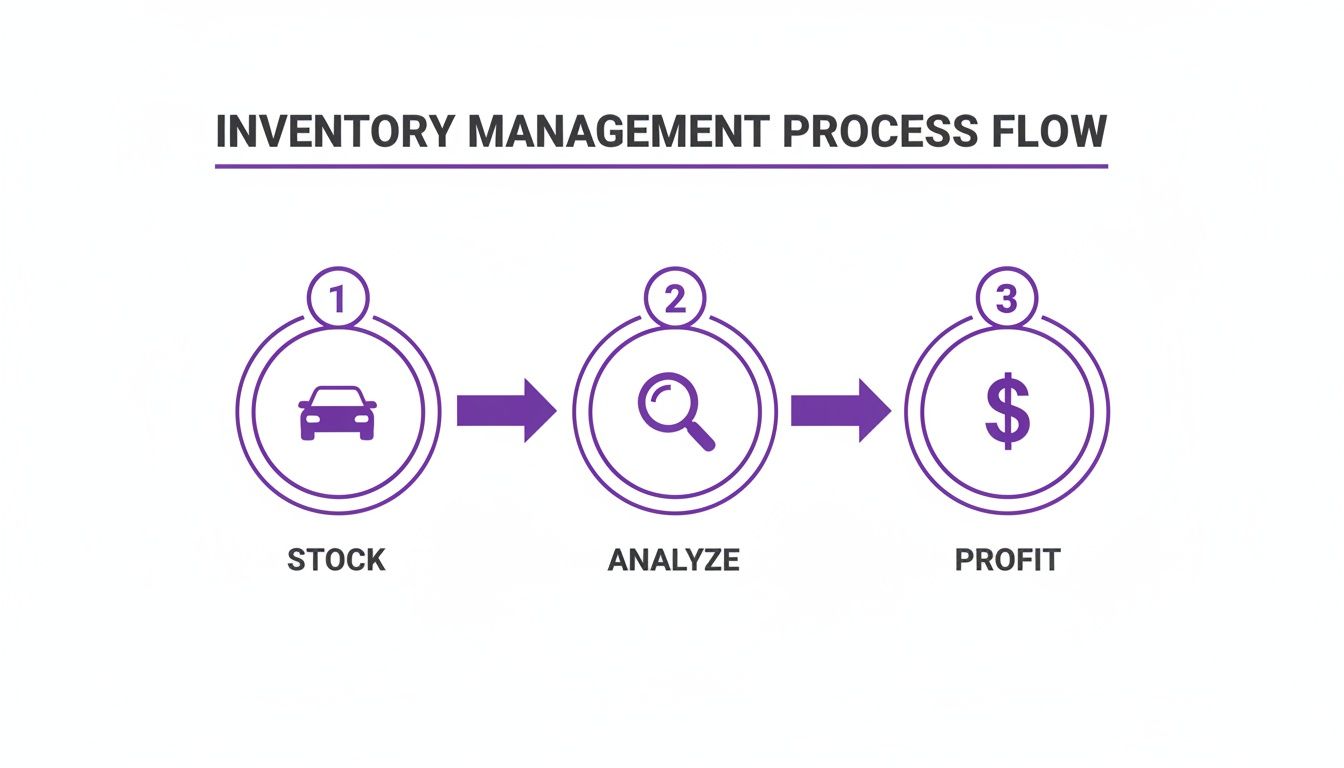
    Inventory management process flow diagram illustrating stock, analyze, and profit steps.

    As you can see, it's a continuous loop. Smart stocking decisions feed into data analysis, which in turn helps you maximize your profitability on every single unit.

    Stage 1: Smart Acquisition

    Here’s a hard truth: you make your money when you buy the car, not just when you sell it. Smart acquisition is the bedrock of the entire lifecycle. This stage is all about finding vehicles that have a high probability of selling fast and for a healthy margin right here in your local market. It means you have to stop relying on gut feelings and start using real data to guide your buying.

    This also means looking beyond the traditional auction block. Think about other sourcing channels like private-party buys, trade-ins, and even partnerships with local service centers. The goal is simple: get your hands on in-demand inventory at a cost that leaves you plenty of room for reconditioning and profit.

    Stage 2: Efficient Reconditioning

    The moment you acquire a car, the clock starts ticking. Loudly. Every single day a vehicle sits in reconditioning is a day it can’t be sold, adding to your holding costs. The reconditioning (or "recon") process has to be a well-oiled machine—fast and efficient, but without ever compromising on quality.

    The best dealers have a streamlined workflow down pat: inspection, mechanical work, detailing, and photography all happen in a quick, coordinated sequence. If there’s a bottleneck anywhere in that chain, it costs you money and kills your inventory turn.

    A well-run reconditioning process is a massive competitive advantage. It gets cars frontline-ready faster, slashes holding costs, and accelerates your path to a profitable sale.

    This kind of efficiency is what keeps the momentum going, ensuring your fresh inventory hits your lot and your website without missing a beat.

    Stage 3: Strategic Pricing

    Pricing is where art meets science. Nailing the price from day one is absolutely critical for attracting serious buyers while still protecting your gross profit. This takes a deep understanding of what the market is doing right now, not what a similar car sold for a month ago.

    Effective automobile inventory management relies on dynamic pricing tools to look at the real-time data:

    • Market Supply: How many similar cars are for sale in your area?
    • Days' Supply: How quickly are those cars actually selling?
    • Consumer Demand: What are local buyers searching for and clicking on online?

    With this data, you can position your car competitively. That doesn’t always mean being the cheapest; it means being the best value for the money.

    Stage 4: Compelling Merchandising

    Let's be honest, your online listing is your real showroom now. Compelling merchandising is how you make a car pop off the screen and stand out from the dozens of others a buyer is scrolling through. This is so much more than just posting a few quick photos.

    You need to create a complete digital package that tells the vehicle’s story. We’re talking high-quality photos from every possible angle, detailed video walkarounds, and sharp, well-written descriptions that sell the car's best features. This is your first—and maybe only—chance to build trust and get a potential buyer excited before they even think about visiting your dealership.

    Stage 5: A Smooth Sale

    This is the final leg of the journey: turning an interested browser into a happy car owner. A smooth, transparent sales process makes sure all your hard work in the other stages pays off. This means having every piece of information—vehicle history reports, service records, and feature lists—ready to go.

    It also means your sales team needs to be armed with the knowledge to answer any question confidently. When a customer is ready to pull the trigger, the process should feel easy and transparent. A great sales experience doesn't just close one deal; it builds your reputation and brings in the repeat business and referrals that keep you growing.

    Building Your Data-Driven Acquisition Strategy

    Ask any successful independent dealer, and they'll tell you the same thing: you make your money when you buy the car, not just when you sell it. Getting away from relying on gut feelings and intuition is the single biggest step you can take to build a dealership that lasts. A data-driven acquisition strategy changes your buying process from a reactive scramble to a proactive, powerful edge over your competition.

    Instead of just guessing what might sell, you'll know—with real confidence—which cars people in your local market are actually looking for. It’s all about systematically stocking vehicles that are set up to sell quickly and for a good margin. Your lot becomes a curated collection of high-demand assets, and that's the core of modern automobile inventory management.

    Analyzing Your Market to Find the Winners

    First things first: you need to become an expert on your local automotive scene. This means digging into the data to see which makes, models, and price points are moving fastest right in your backyard. Your goal is to spot the "hot sellers" and avoid the "lot poison"—those cars that just sit for months, eating away at your profits with every passing day.

    Your analysis should give you clear answers to a few key questions:

    • What's selling right now? Look at sales velocity data for your area to see what's turning over quickly.
    • What's hard to find? Pinpoint vehicles with a low market days' supply but high search volume from customers. These are your golden tickets.
    • What are the pricing trends? Get a handle on current retail and wholesale values so you can be sure you're buying at a number that leaves you room to make a profit.

    When you focus on these data points, you're swapping guesswork for evidence. Every car you bring onto your lot has a high probability of success from day one.

    Crafting Your Ideal Inventory Mix

    Once you have a good feel for your market, it’s time to define your ideal inventory mix. Think of this as the perfect recipe for your dealership's success. It’s a blend of different types of vehicles designed to hit your business goals and match what local buyers want. And this isn't a "set it and forget it" plan; it needs to be flexible enough to adapt to seasonal changes and market shifts.

    For example, your data might show that SUVs and trucks are big sellers from August through November as families get ready for winter. A smart, data-driven strategy would tell you to start acquiring those vehicles in the early summer to meet that predictable wave of demand. This kind of foresight lets you buy smarter when prices might be lower, bumping up your potential return. A solid mix also depends on a Vehicle Identification Number (VIN) analysis, which is a non-negotiable step for checking a car's history and specs. You can learn more about using a VIN decoder to make your acquisition process even stronger.

    Your inventory mix is your dealership's strategic identity. It tells customers what you specialize in and ensures that the cars on your lot are the ones they are actively looking to buy.

    This proactive approach makes sure your capital is always tied up in assets with the best chance for a quick and profitable turn.

    Using Data for Smarter Purchasing Decisions

    Having a data-backed strategy is especially crucial when the market is all over the place, and brand performance can swing wildly. Take recent industry data, for example. In late 2023, Toyota and Lexus were flying off the lots with lean 33- and 34-day supplies, respectively—a sign of incredibly efficient turnover. At the same time, some brands like Dodge and Chrysler were struggling with supplies over 120 days. That massive gap shows just how differently vehicles perform and drives home why you need predictive tools to avoid getting stuck with slow-moving inventory. You can find more insights on how market fluctuations impact new vehicle inventory on coxautoinc.com.

    Don't forget that your own historical sales data is one of your most valuable tools in this process. By looking back at what you've sold, you can spot patterns unique to your dealership and your customers. When you combine that internal knowledge with broader market intelligence, you create a powerful framework for every single buying decision, ensuring your lot is always stocked for maximum profit and sales speed.

    Turning Your Digital Showroom into a Sales Magnet

    In today's market, your most valuable real estate isn't the front row of your physical lot—it's your website and online listings. This digital showroom is where the overwhelming majority of your customers will first lay eyes on your inventory. Getting that online experience right isn't just a nice-to-have anymore; it's a non-negotiable part of solid automobile inventory management.

    To really make it work, you need to nail two things: dynamic pricing that moves with the market and top-notch merchandising that makes every single vehicle look like a must-have.

    A person holds a smartphone displaying a digital car showroom app, with a blue car in the background.

    Price with Precision, Not Just Aggression

    Getting the price right from day one is everything. If you price a car too high, it’s going to sit there, racking up holding costs and becoming another piece of aged inventory. But price it too low, and you're just throwing away gross profit. The real goal isn't to be the cheapest guy in town; it's to offer the best value for what the market will bear right now.

    This is where dynamic pricing comes in. It’s all about using live market data to find that perfect sweet spot where you can maximize both how fast the car sells and how much you make on it. This data-driven approach goes way beyond simply looking up book values.

    To do it right, you need to be watching a few key things:

    • Local Market Supply: How many similar cars are for sale within your local area?
    • Sales Velocity: Are those competing cars actually selling, and how fast?
    • Consumer Demand: What are real shoppers in your area actually searching for and clicking on?

    When you analyze this info, you can place each car in the market strategically to attract real, serious buyers without sacrificing your bottom line. It’s about being smart, not just being cheap.

    The Art of Digital Merchandising

    Once you've got the price dialed in, you need to present the vehicle in a way that stops scrollers in their tracks and builds genuine interest. This is the art of digital merchandising—transforming a basic online listing into a powerful sales tool. High-quality merchandising also gives you a massive boost in search engine optimization (SEO), helping your vehicles show up higher on Google and other sites where your customers are looking.

    A great online listing does more than just show a car; it tells its story. It builds trust and an emotional connection, making a potential buyer feel like they already know the vehicle before they even step onto your lot.

    A well-merchandised car simply moves faster. Period. Think of it as a direct investment in lowering your days' supply and cranking up your inventory turn rate. How a car looks online is just as important as the car itself, and a stunning digital presence is a huge piece of your overall car dealership website design strategy.

    Crafting Listings That Convert

    Creating listings that actually sell cars doesn't require a big marketing budget or a professional crew. Armed with a modern smartphone and a little bit of effort, you can produce merchandising that stands shoulder-to-shoulder with the big franchise stores.

    To help you get every listing right, we've put together a quick checklist.

    The Ultimate Digital Merchandising Checklist

    Use this checklist for every vehicle to ensure your online listings are professional, engaging, and optimized to attract qualified buyers.

    Checklist Item Impact on Buyers Pro Tip
    30+ High-Res Photos Builds trust and shows you have nothing to hide. Allows for a complete virtual inspection. Shoot on an overcast day or during the "golden hour" (early morning/late evening) to avoid harsh shadows and glare.
    Compelling Vehicle Description Moves beyond specs to create an emotional connection and highlights the car's unique story. Instead of "good on gas," try "the perfect, fuel-sipping daily driver for your commute."
    Walkaround Video Increases engagement and offers a dynamic, real-life view that photos can't capture. A simple 2-minute video on your phone is enough. Start the engine so they can hear it run!
    Highlight Key Features & Benefits Answers common questions upfront and showcases the value beyond the price tag. Focus on benefits, not just features. "Heated seats for cold winter mornings," not just "Heated seats."
    Transparency on Imperfections Establishes credibility and reduces surprises (and renegotiations) when they see the car in person. A clear photo of a small scratch shows honesty and manages expectations.
    Clear Call-to-Action (CTA) Guides the shopper on what to do next, turning passive browsing into an active lead. Use direct, simple language: "Schedule Your Test Drive Today" or "Click Here for Financing."

    Following these steps for every car ensures a consistent, professional look across your entire digital showroom, which is key to building your brand and moving inventory. By combining sharp pricing with beautiful, informative merchandising, you transform your online presence from a simple list of cars into a true sales magnet that brings in qualified buyers and helps you turn your inventory faster than ever.

    Automating Your Inventory for Maximum Reach

    Trying to manually keep your inventory updated across a half-dozen different websites is a surefire way to burn yourself out and lose sales. It's a constant, frustrating game of whack-a-mole. To truly connect your physical lot to the digital world, you need a modern game plan, and that plan revolves around automation. This is where inventory syndication comes in—the magic of automatically sending your vehicle listings out to all the online marketplaces where buyers are looking.

    The whole system starts with your own website. It has to be your single source of truth. Think of it as the master file for your entire dealership. Every single car you bring in, recondition, and price gets entered here first. Once it's in your system, that data can be pushed out everywhere else.

    This simple shift solves one of the most frustrating problems in this business: a customer calls about a car you sold yesterday. When your website and third-party listings are out of sync, you waste their time and yours. It’s a terrible first impression that can sour a potential relationship before it even starts.
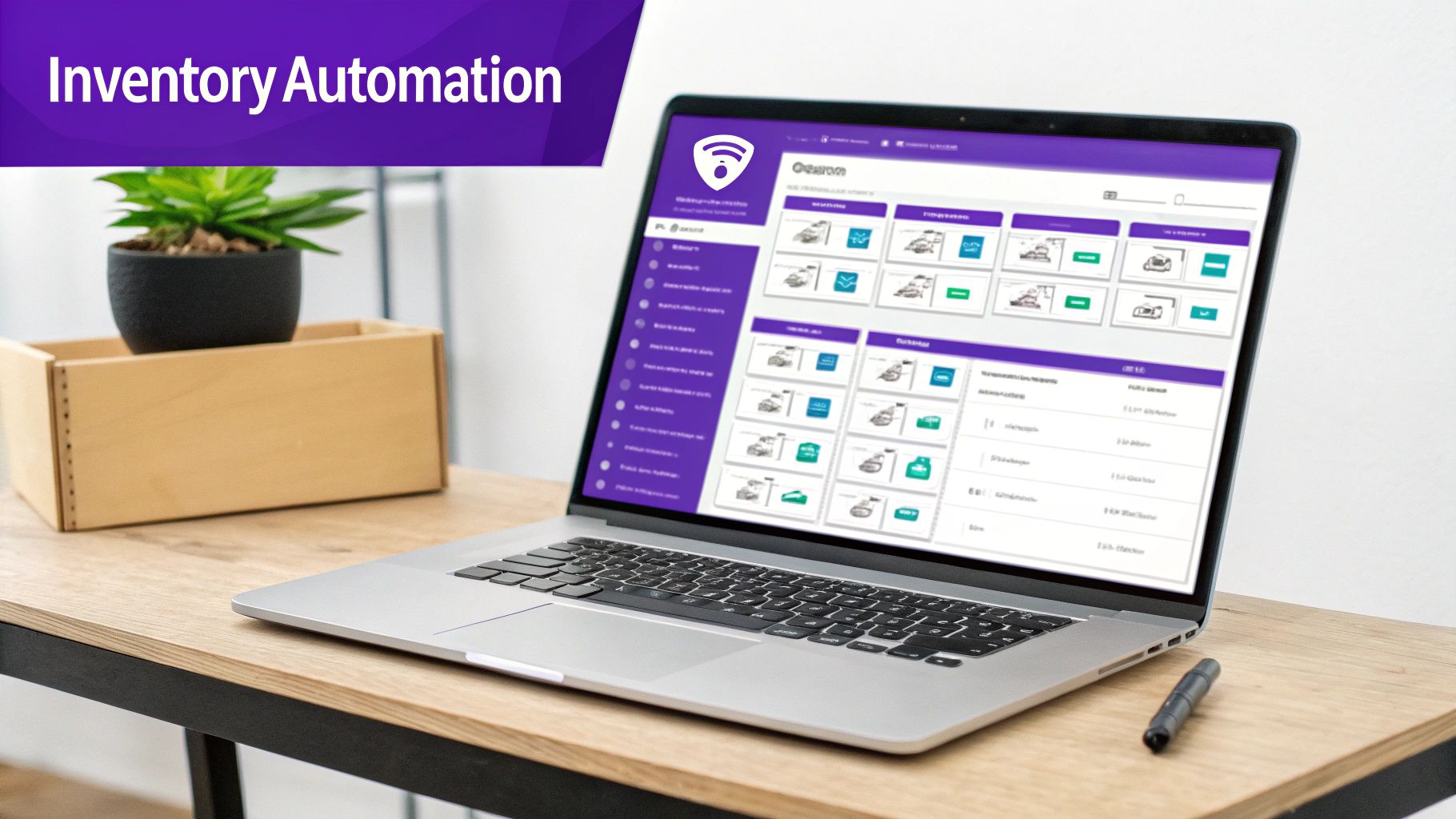
    Modern laptop showcasing inventory automation software for efficient management on a wooden desk.

    This kind of setup, where one central hub pushes your inventory out, is the heart of a smart automation strategy. It's about working smarter, not harder, and saving yourself countless hours of tedious data entry.

    The Power of a Central Hub

    Modern dealership software is built to crush this exact kind of manual work and the costly errors that come with it. A good platform acts like a digital ops manager, handling the entire syndication process automatically and making sure your listings are consistent no matter where a customer finds them.

    Here’s what happens when you add a new car to your website with a system like this in place:

    • An SEO-Optimized Vehicle Detail Page (VDP) is Instantly Created: The system builds a webpage for that specific car designed to show up when local buyers search on Google.
    • Listings are Sent to Marketplaces: Without you lifting a finger, that new car appears on major sites like Cars.com or CarGurus.
    • Updates Happen in Real-Time: The moment you mark a car as sold, it's removed from every single platform at once. No more dead-end phone calls.

    Saving Time and Casting a Wider Net

    The most obvious win here is the sheer amount of time you get back. Forget spending hours every week uploading photos, writing descriptions, and taking down sold listings on five different sites. You do it once, and you're done. That frees you up to do what actually makes money: sourcing cars, talking to customers, and closing deals.

    By automating your listing distribution, you ensure your vehicles are consistently and accurately presented to the largest possible audience of buyers, exactly when they are searching. This transforms your website from a simple digital brochure into a powerful sales engine.

    Platforms like AutoFire™ were built specifically for this. They do the heavy lifting of creating clean, fast, and search-friendly VDPs while pushing your inventory out to the places buyers are already shopping. You can explore various automotive inventory management software options to see what fits your dealership, but the goal is the same: use technology to get your cars in front of the right people at the right time.

    This kind of efficiency isn't just a nice-to-have anymore. It’s a fundamental part of running a successful dealership today.

    Putting Your Modern Inventory System into Action

    So, where do you start? The thought of overhauling your entire process can feel overwhelming, but making the switch to a modern automobile inventory management system doesn't have to be a painful, all-or-nothing project. The smartest way to do it is step-by-step, especially for a busy owner who can't afford to shut everything down.

    The journey begins with an honest look at what you’ve got on the lot right now.

    Forget spreadsheets for a moment and just walk your inventory. How long have some of these cars been sitting here? Now, pull your sales data and see what’s actually moving versus what’s collecting dust. This simple audit gives you a real-world baseline—the starting point for making changes that actually matter.

    Once you know where you stand, you can decide what to measure. Don't get lost trying to track a dozen different things. Just pick two or three metrics that will have the biggest impact on your bottom line. For most independent dealers, those are Days' Supply and Inventory Turnover Rate. If you focus on improving just these two numbers, you’ll naturally make better decisions on everything from buying to pricing.

    Choosing Your Tools and Taking the First Step

    With a clear picture of your inventory's health and your key metrics in hand, you can start looking at tools. The trick is to find something that fits your dealership's size and budget without being overly complicated. Think of your website as the launchpad for this whole strategy.

    A modern website platform designed specifically for dealers can act as your central command center. When you use a service like AutoFire, you're not just getting a website—you're getting an inventory system with powerful, built-in features that handle the heavy lifting of getting your cars online and generating leads from day one.

    The goal is to start small and build momentum. Focus on one or two key improvements—like automating your online listings—to see immediate returns. This creates a positive feedback loop that makes it easier to tackle the next challenge.

    By using a platform that’s easy to set up, you solve several problems at once. Your inventory is automatically discoverable on Google, lead capture is handled for you, and you can get back to focusing on strategy instead of fighting with technology. This approach lets even the smallest teams put a sophisticated system in place without the usual headaches, getting you on the path to smarter inventory management right away.

    Common Questions About Car Inventory Management

    Getting a handle on inventory management always brings up a few questions. Let's tackle some of the most common ones I hear from independent dealers, with straightforward answers to help you sharpen your strategy and fatten your wallet.

    What’s a Good Inventory Turnover Rate for Used Cars?

    Everyone wants a magic number, and you'll often hear that 6 to 8 turns per year is the industry benchmark. But the truth is, the "right" number for your dealership isn't that simple. A great turnover rate for you depends on your business model, your local market, and the kind of cars you sell.

    Before you start chasing an industry average, figure out your own rate. Calculate where you stand right now to get a baseline. From there, you can set a realistic goal that actually makes sense for your cash flow and profit targets. Small, steady improvements are always better than trying to hit some arbitrary number you read online.

    How Can Small Dealerships Compete with the Franchise Giants?

    As a smaller, independent dealer, you have a secret weapon: agility. You're never going to outspend the big franchise stores, but you can definitely out-think and out-hustle them.

    Your edge comes from using your local knowledge and flexibility to find cars where the big guys aren't even looking. That’s the heart of smart inventory management for an independent lot.

    Here are a few ways to build an advantage in acquiring great cars:

    • Go after private-party buys: Make it a priority to buy cars directly from local sellers.
    • Build a referral network: Team up with local mechanics and body shops. They see great cars and potential sellers every day and can send them your way.
    • Own a niche: Become the go-to expert for a specific kind of vehicle. Think classic trucks, unique European models, or super fuel-efficient commuters. The big stores often ignore these specialized markets.

    What Is the Most Important First Step to Take?

    If you do just one thing, start with data clarity. You don’t need fancy software to get going—just a little discipline. Begin by consistently tracking three critical dates for every single car on your lot.

    1. Acquisition Date: The day the title is in your name.
    2. Recon Completion Date: The day it’s officially frontline-ready and ready for a test drive.
    3. Sale Date: The day the deal is done and the car leaves.

    Just tracking these three dates unlocks your Days' Supply, which is the single most important metric for understanding how long your cash is tied up in a vehicle. This simple habit shines a light on your biggest opportunities for improvement and is the foundation for everything else. With the market always shifting—late 2023 reports showed used-vehicle inventory hitting a high of 2.31 million units—keeping a close watch on this data is non-negotiable. You can learn more about how market trends impact used vehicle inventory from CBT News.


    Ready to turn these strategies into sales with a website that actually works? AutoFire builds clean, fast, SEO-friendly websites designed to get your inventory in front of buyers and turn them into real leads. Get started for free today and see how simple it is to build a powerful digital showroom.


  • What is a vin decoder? what is a vin decoder explained

    What is a vin decoder? what is a vin decoder explained

    A VIN decoder is a tool that takes a vehicle’s 17-digit Vehicle Identification Number (VIN) and instantly translates it into a detailed report of its original factory specs, features, and manufacturing history. Think of it as a universal translator for cars—turning a seemingly random string of characters into a powerful sales tool.

    Unlocking a Vehicle's Digital DNA

    So, what is a VIN decoder in practical terms? For any modern dealership, it's a must-have piece of software that cuts out hours of tedious manual data entry and helps you sidestep costly listing mistakes.

    A laptop screen displays 'VIN DECODER' next to a car key and metal key on a wooden desk.

    Just by punching in one code, you can automatically fill out a vehicle's entire online profile with accurate, factory-level details. This doesn't just get your inventory listed faster; it also builds immediate trust with shoppers by giving them transparent, verifiable information right from the get-go. What used to be a dull administrative chore is now a way to speed up your entire business.

    The real power is in the data it provides. A VIN doesn't just identify a car; it tells its entire origin story. This 17-digit code is essentially a vehicle's fingerprint—completely unique and packed with information.

    The Anatomy of a VIN

    Every single character in a VIN has a job. They’re grouped into three main sections, which a decoder instantly translates for you. Getting a feel for this structure helps you appreciate just how much information you're getting with a single scan.

    A single VIN scan provides the foundational data needed to market and sell vehicles effectively. It’s the starting point for accurate listings, customer conversations, and confident sales.

    Let's quickly break down what each part of the code reveals.

    VIN Digits Section Name Information Revealed
    1-3 World Manufacturer Identifier (WMI) The first three digits identify the manufacturer, the country of origin, and the vehicle type. A "1," for example, means the vehicle was built in the United States.
    4-8 Vehicle Descriptor Section (VDS) This section describes the car’s key attributes—think model, body style, engine size, and transmission type. This is where you confirm it’s a V6, not a V8.
    9-17 Vehicle Identifier Section (VIS) The last section is the vehicle's unique serial number. It includes the model year (digit 10), the assembly plant (digit 11), and its production number. The 9th digit is a special "check digit" that verifies the VIN is legitimate.

    Understanding this structure isn't necessary to use a decoder, but it shows how a simple tool can pull such specific and valuable information from one code.

    The Origin Story of the Modern VIN

    To really get why a modern VIN decoder is such a big deal, you have to picture the chaos that came before it. Think of the automotive world before the early 1980s as the Wild West. Every car manufacturer had its own way of numbering vehicles, and none of them matched.

    This free-for-all was a constant source of headaches. Imagine being a mechanic trying to order a part for a 10-year-old car, or law enforcement trying to track a stolen vehicle. With every brand speaking its own language, it was a mess for everyone involved.

    Bringing Order to the Chaos

    Something had to change. The industry desperately needed one single, reliable way to identify every car on the road.

    Finally, in 1981, the National Highway Traffic Safety Administration (NHTSA) stepped in and mandated the 17-digit VIN we use today for all new vehicles. This new format created a standard structure that everyone had to follow. It included a World Manufacturer Identifier (WMI), a Vehicle Descriptor Section (VDS), and even a specific spot for the model year. You can explore more about the evolution of vehicle identification and how this standard came to be.

    Before this mandate, there was no single source of truth for a vehicle's identity. The 17-digit VIN created a universal language for cars, paving the way for the transparency and data-driven tools dealerships rely on today.

    The Foundation of Modern Automotive Data

    This wasn't just some boring administrative update; it was the moment modern vehicle data was born. By forcing everyone to use the same format, the NHTSA laid the groundwork for the powerful tools we have now. That 17-character string of letters and numbers became the key to unlocking a car's entire factory-built identity.

    This universal language made it possible to build the massive databases that connect a specific VIN to its original engine, transmission, trim level, and even the factory it rolled out of. Without this crucial step, a tool like an automated VIN decoder simply couldn't exist.

    The reliability of the 17-digit VIN is what lets you scan a barcode and instantly get accurate, detailed specs for a vehicle listing. It turned a jumble of competing systems into a structured format that now powers a massive data industry and gives every dealer a leg up.

    How a VIN Tells a Vehicle's Story

    A Vehicle Identification Number isn’t just some random string of characters stamped on a dashboard. It's a 17-character story that spells out exactly what a vehicle is, where it was born, and who built it. Think of it as a car's unique fingerprint. Once you understand how to read it, you can see why a VIN decoder is such a powerful tool for pulling up precise details.

    Every VIN is essentially a car's birth certificate, with each section revealing a different part of its identity. This universally standardized format is the master key that unlocks all of a vehicle's original factory specs.

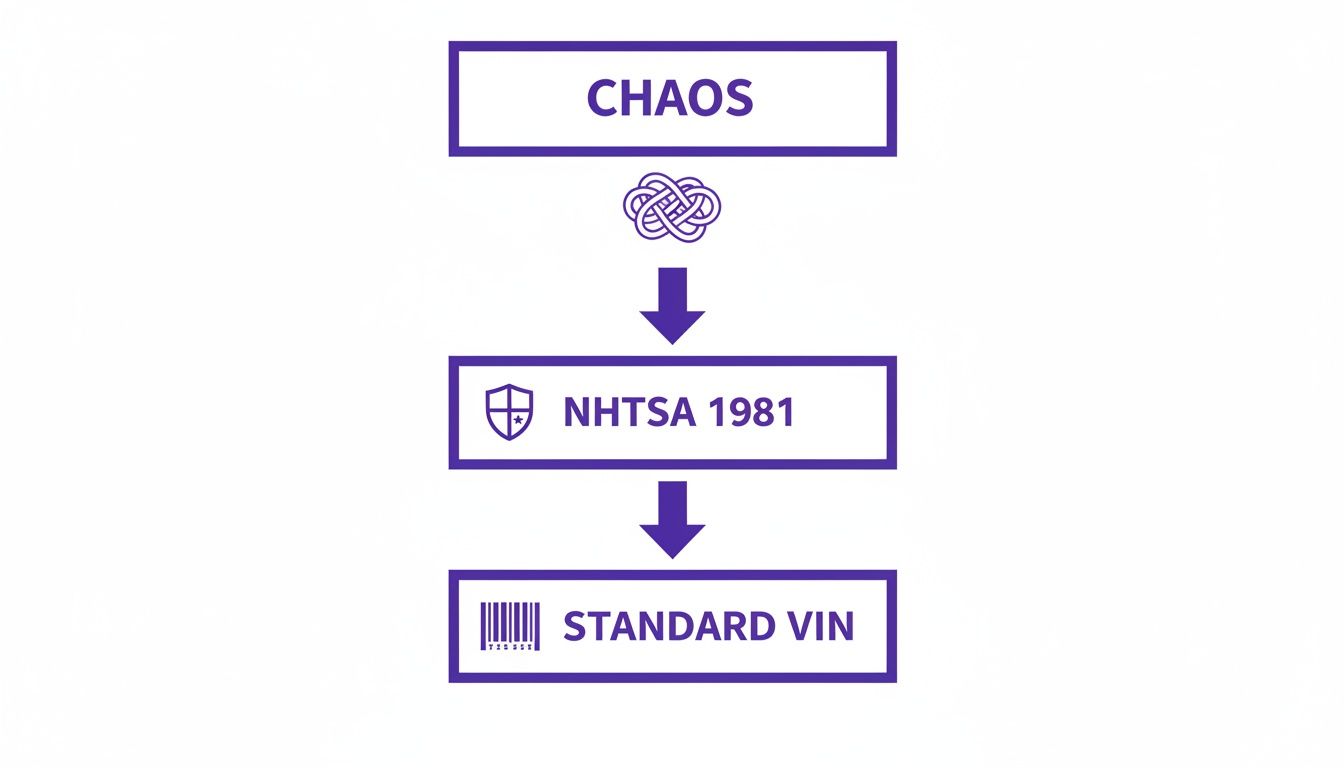
    Before 1981, things were a bit chaotic. Manufacturers had their own systems, making it a nightmare to track vehicles consistently. Then, the National Highway Traffic Safety Administration (NHTSA) stepped in and created the standard we use today.

    Flowchart illustrating the evolution from chaotic vehicle identification to standardized VINs through NHTSA 1981 regulations.

    This simple flowchart shows how the industry moved from messy, inconsistent tracking to the reliable, universal standard we rely on now.

    The Manufacturer's Signature (Digits 1-3)

    The first three characters are what's known as the World Manufacturer Identifier (WMI). This is the manufacturer's official signature, giving you the most basic, yet crucial, information right off the bat.

    • Digit 1: Tells you the country where the vehicle was built. A "1," "4," or "5," for instance, means it rolled off an assembly line in the United States.
    • Digit 2: This points to the specific manufacturer. You'll often see "F" for Ford or "C" for Chrysler.
    • Digit 3: This character narrows it down further, often indicating the vehicle's division or general type, like a car versus a truck.

    These first three digits give you immediate context and set the stage for the nitty-gritty details to come.

    The Vehicle's Blueprint (Digits 4-8)

    Next up is the Vehicle Descriptor Section (VDS), which covers positions four through eight. This is where the VIN lays out the car's core DNA—its functional blueprint. It tells you everything from the specific model and body style to the engine size and transmission type.

    For a dealership, this information is gold. Getting the engine and trim level right is fundamental to pricing a vehicle accurately and writing descriptions that sell. You can learn more about how to turn this data into dollars by crafting compelling car listings.

    The Unique Serial Number (Digits 9-17)

    The final part of the code is the Vehicle Identifier Section (VIS). Digits 10 through 17 are what make the vehicle one-of-a-kind, much like a person’s social security number. This section contains the model year (digit 10), the specific assembly plant (digit 11), and a unique production number that came off the line.

    But what about the ninth digit? That one's special. It's the "check digit," a clever security feature. It's generated by a mathematical formula that uses all the other characters in the VIN to produce a single digit. If the VIN is fake or has been altered, the math won't add up, and the check digit will be wrong.

    By decoding these 17 characters, you get a complete, verifiable story straight from the factory. It can even help clarify original specs, which is useful for understanding the difference between OEM and aftermarket parts when you're looking at repairs or upgrades.

    So, How Does This Actually Help Your Dealership?

    Knowing what a VIN is and how it’s structured is great, but let's get down to brass tacks: how does this 17-digit code actually help you sell more cars and make your life easier? A good VIN decoder isn't just a fancy lookup tool; it's a genuine business asset that sharpens your operations, builds trust with customers, and gets more eyes on your inventory. For an independent dealer, that’s a real competitive edge.

    When you weave VIN decoding into your daily routine, you turn that long string of characters into real results. It impacts everything from how you list a car online to the conversations you have on the lot, making the entire sales process quicker and far more accurate.

    Instantly Flesh Out Your Inventory

    The most obvious win? You can finally say goodbye to mind-numbing manual data entry. Instead of spending precious time hunting down and typing out specs for every new car that lands on your lot, a single scan or VIN entry does the heavy lifting for you. It automatically fills your listings with precise, factory-correct information.

    This is what we call inventory enrichment, and it’s a game-changer for making sure every detail is right, every single time.

    • Engine & Transmission: No more guessing. You get the exact powertrain configuration instantly.
    • Trim Level & Features: Automatically pinpoint the correct trim, which is absolutely critical for pricing the vehicle correctly.
    • Exterior & Interior Colors: Stop relying on your best guess and list the vehicle with its official factory color names.

    This level of automation doesn't just save you hours of work; it prevents the kinds of costly mistakes that can turn away customers or hurt your reputation. This standardization has fueled a massive data industry. In fact, the global Automotive VIN Decoding API market is a multi-billion dollar industry that continues to grow as more dealers plug this tech into their sales process. You can learn more about how this system evolved on marketcheck.com.

    Build Trust and Close Deals Faster

    In the used car world, trust is your most valuable currency. When a customer asks about a specific feature, a fumbled or wrong answer can sink the sale on the spot. A VIN decoder puts the facts right at your fingertips, letting your team answer questions with total confidence.

    By pulling the VIN data, you can instantly confirm a car's original equipment—proving that the V6 is actually a V6 or that it really does have that cold weather package they're looking for. It’s also your first line of defense before ordering a full vehicle history report, giving you a quick heads-up on any potential issues.

    When you can answer a customer’s questions with verifiable, factory-level data, you strip all the doubt out of the conversation. That transparency shows you’re an open book and positions you as an expert, dramatically shortening the path to closing the deal.

    Get Your Cars Seen by the Right People Online

    Finally, all that rich, accurate data you get from a VIN decoder is exactly what search engines and online marketplaces are hungry for. Listings with detailed, correct specs simply perform better everywhere, especially on platforms like Google Vehicle Listings.

    When your online inventory is filled with precise details—right down to the exact trim, engine, and transmission—you make it easy for search algorithms to connect your cars with serious local buyers. A shopper looking for a "2019 Honda CR-V EX-L" has a much better chance of finding your exact car if it's listed correctly, which means more qualified traffic coming straight to your website.

    Using a VIN Decoder to Prevent Fraud and Build Trust

    In the used car business, your reputation is everything. It’s the most valuable asset you have. Every car that rolls onto your lot has a past, and a VIN decoder is your first line of defense in making sure that story is a straight one. Think of it as your primary tool for sniffing out risk, protecting both your inventory and your good name from the moment a potential trade-in shows up.

    Female salesperson helping a customer with paperwork at a car showroom, with a car in the background.

    Simply by running the VIN, you can instantly check for red flags that might otherwise slip through the cracks. This quick, initial check is critical for spotting potential problems before you sink time and money into a vehicle. It helps you dodge the kind of problem inventory that can really damage a dealership’s reputation.

    Spotting Red Flags Instantly

    A VIN decoder is your first step in the due diligence process. It flags inconsistencies that tell you it’s time to pull a full history report and take a closer look. This initial screen helps you weed out cars with common issues that can become major headaches later on.

    A quick VIN check can help you surface key problems like:

    • Title Discrepancies: Does the car have a salvage, rebuilt, or flood-damaged title? A decoder can reveal these brands right away, which drastically impacts a vehicle's value and safety.
    • Potential Odometer Fraud: When the VIN data is compared against service records, it can highlight strange mileage gaps that point to possible odometer tampering.
    • Stolen Vehicle Alerts: The decoder can run the VIN against national databases to see if the vehicle has been reported stolen, saving you from a legal and financial nightmare.

    This proactive approach to managing risk is just smart business. But beyond just avoiding bad cars, using a VIN decoder is a powerful way to build customer trust and manage how people see your dealership. For a deeper dive into this, a solid guide on auto dealer reputation management can provide more great ideas for building a brand people trust.

    Turning Transparency into Sales

    This commitment to being upfront does more than just protect your business—it actually helps you sell more cars. When you can hand a customer a detailed, accurate vehicle profile from the get-go, you remove all the doubt and suspicion from their mind. That confidence is a huge sales accelerator.

    A VIN decoder isn't just an operational tool; it's a sales asset. By building a foundation of trust and proving a vehicle's history and specs upfront, you empower customers, remove uncertainty, and ultimately shorten the sales cycle.

    VIN decoding is a crucial weapon against fraud in the used car world, where a hidden issue can cost a buyer thousands. By providing a clear history and verified specifications, you increase buyer confidence. When a customer sees that the "low miles" claim is backed up by data, it helps them avoid the odometer scams that are unfortunately all too common. This is exactly why a strong strategy for your automotive reputation management goes hand-in-hand with transparent operations.

    Using the VIN Decoder in Your AutoFire Account

    Alright, theory's great, but let's get our hands dirty. Seeing how the VIN decoder works inside your AutoFire™ account is where the real value clicks into place. We’ve built this feature to be quick, painless, and a massive time-saver, so you can ditch the manual data entry and get your cars listed accurately in minutes.

    The whole point is to take that 17-digit string of characters and instantly turn it into a rich, detailed vehicle listing without breaking a sweat. It all happens right from your main inventory screen.

    It's a Simple Three-Step Process

    When you're ready to add a new car to your inventory, this is where the magic happens. Instead of typing out every single detail, you let the platform do the heavy lifting.

    Here’s a look at the 'Add Vehicle' screen you'll see in your dashboard.

    That VIN field is front and center for a reason. It's the key to instantly building out a new vehicle listing.

    Here’s all it takes to decode a VIN:

    1. Head to Your Inventory: From your main dashboard, just click "Add Vehicle" to get started.
    2. Drop in the VIN: Type or paste the car’s full 17-digit VIN into the box.
    3. Hit Decode: Click the "Decode" button. In a flash, AutoFire fills in all the crucial details—year, make, model, engine specs, transmission type, and a whole lot more.

    That’s it. This one simple action makes sure your listings are spot-on from the very beginning, which is huge for building trust with shoppers and making sure your cars show up in the right searches.

    This is just one of the ways we help you get things done faster. You can dig into all the other tools we've built to make running your dealership easier and see our other integrated AutoFire features designed to move more metal.

    Common Questions About VIN Decoders

    Even when you know what a VIN decoder is, some practical questions always pop up when you start using one in your dealership. Let's tackle a few of the most common ones we hear from dealers.

    Decoder Versus History Report

    Is a VIN decoder the same as a vehicle history report?

    No, but they work hand-in-hand. Think of a VIN decoder as a tool that reads a vehicle's "birth certificate." It tells you the facts straight from the factory: the standard equipment, trim level, engine type, and where it was built. It reveals what the car is.

    A vehicle history report from a service like CarFax or AutoCheck uses that same VIN to tell the car's "life story"—any accidents, title problems, or ownership changes. It shows you where the car has been. For a solid workflow, you always start with the decoder to get the basic vehicle data right, then pull its history.

    What a VIN Decoder Can and Cannot Tell You

    Can a decoder identify every single optional feature on a car?

    A good VIN decoder is incredibly accurate for factory-installed equipment. It will nail the year, make, model, and trim every time. But what about options added at the dealership after the car left the factory, like custom wheels or an aftermarket sound system? A standard decoder won't see those.

    Still, for the most critical details you need for a sale—the engine, transmission, and core features—the decoder is your most reliable source, giving you a comprehensive overview in an instant.

    A free online decoder is fine for a one-off lookup, but an integrated one is a different beast entirely. It doesn't just show you the data; it automatically fills out your listings, gets rid of manual entry errors, and keeps your vehicle info consistent everywhere you sell.

    This isn't just about saving time. It’s about preventing the kind of small mistakes that can kill a deal or make a customer lose trust. That accuracy is what gets you noticed online and builds confidence with shoppers who are looking for transparency.


    Ready to stop wasting time on manual data entry and start creating perfect listings in seconds? The integrated VIN Decoder from AutoFire is your solution. See how it works at https://goautofire.com.

  • Boosting Your Dealership Profits with car inventory management

    Boosting Your Dealership Profits with car inventory management

    Think of car inventory management as the master playbook for your dealership. It’s the entire process of how you buy, price, present, and sell vehicles to make the most money while spending the least. It’s the single most important operational skill that determines how fast you can turn your biggest asset—the cars on your lot—into cash in the bank.

    Why Car Inventory Management Is Your Dealership's Engine

    Imagine your dealership is a high-performance race car. Your sales and marketing efforts are the fuel, but your car inventory management strategy is the engine itself. It dictates your power, your efficiency, and whether you end up in the winner's circle. For any independent dealer today, getting this right isn't just a good idea; it's everything.

    This isn't just about having cars to sell; it's a financial discipline. Every single vehicle sitting on your lot is a depreciating asset. It’s a lot like the produce section at a grocery store—a head of lettuce has a very short shelf life before it wilts and becomes worthless. A car's value starts to drop the second it lands in your inventory, making time your greatest opponent.

    The Hidden Costs of Slow-Moving Stock

    When a car sits on your lot for too long, it’s doing more than just taking up a parking spot. It's actively costing you money. This financial bleed comes from a few different places, and it can put a serious dent in your profitability. Recognizing these costs is the first step to plugging the leaks.

    Here are the key ways aging inventory drains your cash:

    • Capital Depreciation: This is the big one. Every day a car goes unsold, its market value ticks down, shrinking your potential profit margin bit by bit.
    • Holding Costs: These are the quiet, ongoing expenses tied to every car. Think insurance, lot maintenance, security, and especially any floor plan interest you're paying.
    • Opportunity Costs: The money you have tied up in a stale, unpopular car is money you can't use to buy a high-demand vehicle that you could flip in a week.

    A great inventory strategy transforms your lot from a static car park into a dynamic, profit-generating machine. The entire game is about keeping your capital moving, getting cars from acquisition to a happy new owner as fast as possible.

    From Inventory to Cash Flow

    The line between your inventory plan and your bank balance is straight and direct. When you manage your inventory well, you ensure a steady, healthy cash flow. That gives you the freedom to jump on good deals, cover your bills without stress, and reinvest in your business.

    On the flip side, poor inventory management leads to cash crunches. You end up making bad decisions out of desperation, like accepting a low-ball offer just to get an old unit off the books.

    A sharp inventory management strategy is what separates the dealerships that thrive from those that just scrape by. It empowers you to stock the right cars, price them to sell, and move them quickly. This whole process involves a series of connected steps, from smart buying to killer online merchandising. To dive deeper, check out our guide on how to sell cars online for more tips. When you treat your inventory as the true engine of your dealership, you pave the way for real, sustainable success.

    Navigating the Five Stages of the Vehicle Lifecycle

    Every car on your lot is on a journey. This journey, its lifecycle, starts the second you buy it and doesn't end until a new owner drives it away. Mastering car inventory management is all about controlling each stage of that journey to cut costs, save time, and squeeze every last drop of profit from each unit.

    Think of it less as a chaotic scramble and more as a five-stage profitability pipeline. When you see your inventory this way, you get a clear roadmap. You can spot the bottlenecks, measure what's working, and make smart decisions at every turn. From the auction block to the final handshake, every step is a chance to either build your margin or watch it disappear.

    Stage 1: Smart Acquisition

    It all starts with the buy. There's an old saying in this business: "You make your money when you buy the car, not when you sell it." That's never been more true. Smart acquisition isn't about just finding cars; it's about sourcing the right cars at the right price.

    This means digging into the data to see which makes and models are actually selling in your neighborhood, not just what looks good on paper. It’s about knowing your market and avoiding the vehicles that are famous for collecting dust. You also have to get good at estimating recon costs before you even raise your hand to bid, so you don't get hit with expensive surprises that kill your profit later on.

    Stage 2: Rapid Reconditioning

    The moment a car is yours, the clock starts ticking. Loudly. The reconditioning (recon) stage is a flat-out race against time. Every single day a vehicle sits in the shop is a day it's not on the front line, ready to be sold. This is where holding costs creep in and silently eat away at your bottom line.

    The mission is simple: get that car "front-line ready" as fast as humanly possible. This demands a tight, disciplined process for inspections, mechanical work, detailing, and paintless dent repair. The best operators live by strict timelines, like a 48-hour or 72-hour turn, to keep cars moving.

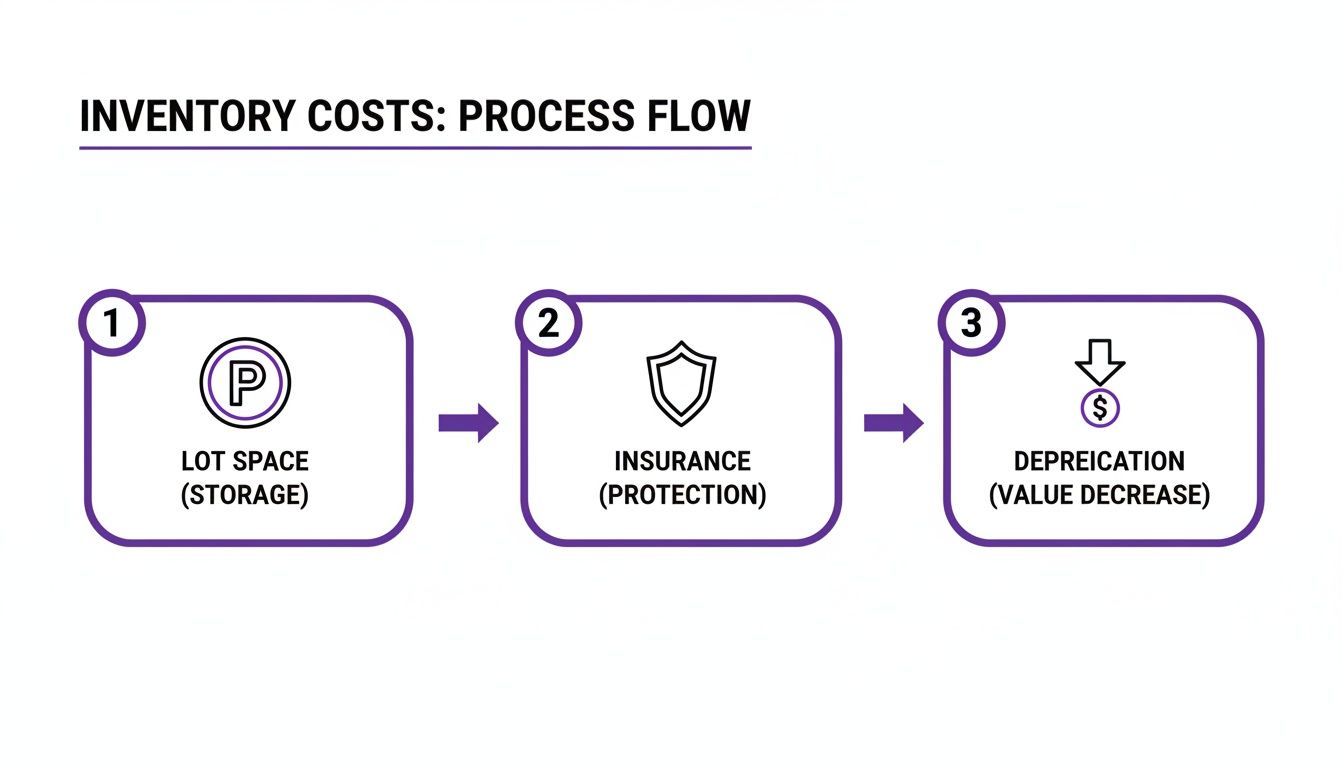
    Process flow diagram outlining inventory costs including lot space (storage), insurance (protection), and depreciation.

    As you can see, the longer a car sits, the more it costs you in lot space, insurance, and the biggest killer of all—depreciation. Speed is profit.

    Stage 3: Data-Driven Pricing

    Once a car is reconditioned and looking sharp, you hit the next critical moment: pricing. This is a delicate balancing act. Price it too high, and it’ll become a birthday car on your lot. Price it too low, and you just gave away your hard-earned profit. In today's market, where values can swing overnight, your gut feeling just isn't enough anymore.

    Smart pricing is driven by data, period. It means looking at live market reports, seeing what similar cars are listed for down the street, and understanding the real-time supply and demand. You have to balance all that external data against your internal numbers—what you paid for it, what you put into it, and the margin you need to hit.

    Pro Tip: Pricing isn't a "set it and forget it" activity. The most successful dealers are constantly watching the market and aren't afraid to adjust prices on aging units to get them sold and keep their inventory fresh.

    Stage 4: Compelling Merchandising

    Let's be honest: your online showroom is way more important than your physical one now. Merchandising is how you present your vehicle online to grab a buyer's attention and make them want to come see it. This is where you create the "I need that car" feeling that generates real, qualified leads.

    Great merchandising comes down to a few key things:

    • High-Quality Photos: Take dozens of bright, clear pictures from every possible angle. Get close-ups of the cool features and be honest about any minor flaws.
    • Detailed Descriptions: Write a story, not just a list of specs. Highlight what makes this car special and answer the questions a buyer would have.
    • Perfectly Accurate Data: Make sure every detail, from the VIN to the trim package, is 100% correct. Nothing kills trust faster than bad information.

    A modern website platform like AutoFire™ is built for this. It automatically generates SEO-friendly vehicle detail pages (VDPs) designed to pop up when customers search on Google, doing a lot of the heavy lifting for you.

    Stage 5: Efficient Sale and Turn

    The final stage is turning all that hard work into a done deal. This is the moment of truth where you lock in the profit you've carefully protected through the first four stages. The goal is to make the transaction smooth and efficient, giving the customer a great experience while you finalize the numbers.

    This is also how you keep score. Your inventory turn rate—how fast you sell your cars—is the ultimate health report for your dealership. A faster turn means your money isn't tied up in aging inventory. It’s working for you, letting you go out and buy more cars to start the profitable cycle all over again.


    To tie it all together, here’s a quick look at how these five stages flow from one to the next, along with the critical actions you need to take at each step.

    Vehicle Inventory Lifecycle Stages and Key Actions
    Lifecycle Stage Primary Goal Key Actions for Dealers
    1. Acquisition Buy the right vehicles at the right price. Use market data to source in-demand models. Accurately appraise trades and forecast reconditioning costs before purchase.
    2. Reconditioning Get vehicles front-line ready as quickly as possible. Establish a streamlined workflow with clear timelines (e.g., 48-72 hours). Prioritize high-impact repairs and detailing.
    3. Pricing Set a competitive price that maximizes profit. Analyze real-time market data, competitor pricing, and internal cost structures. Adjust prices proactively on aging inventory.
    4. Merchandising Create compelling online listings that attract buyers. Take high-quality photos and videos. Write detailed, persuasive vehicle descriptions. Ensure all data is 100% accurate.
    5. Sale & Turn Finalize the sale efficiently and reinvest capital. Provide a smooth customer experience. Track inventory turn rate as a key performance indicator (KPI). Use sales data to inform future acquisitions.

    By mastering these five stages, you move from simply selling cars to systematically building a more profitable, efficient, and sustainable dealership.

    The Essential Metrics That Drive Profitability

    To really get a handle on car inventory management, you have to stop relying on gut feelings and start listening to what the data is telling you. Key Performance Indicators, or KPIs, are the vital signs of your dealership’s health. They turn your inventory from a simple list of cars into a strategic asset, showing you where you’re strong, where you’re bleeding cash, and where your biggest opportunities are.

    These metrics aren't just abstract numbers on a spreadsheet; they're the story of your business. Understanding them is what allows you to make smarter buys, price your cars competitively, and know when it’s time to cut loose an aging unit before it drains your capital. It’s what separates the most consistently profitable dealers from everyone else.

    Inventory Turn Rate

    Your Inventory Turn Rate is one of the clearest indicators of your dealership's operational speed and efficiency. It answers a simple but vital question: how many times do you sell and replace your entire inventory over a set period, usually a year? A high turn rate is a great sign—it means cars are flying off the lot and your capital isn't just sitting there, it's working for you.

    Think of it like running a popular restaurant. The best chefs turn their ingredients over quickly, ensuring everything is fresh and profits are flowing. A kitchen where food sits on the shelf for weeks is wasting money and losing customers. In our world, the inventory turnover ratio is that critical measure of how fresh and profitable your "menu" of cars is.

    Days Supply

    While turn rate gives you the 30,000-foot view, Days' Supply zooms in on the ground level for each vehicle. Sometimes called Days on Lot or Days to Turn, this metric tells you exactly how many days it would take to sell out of your current inventory if you kept selling at your current pace.

    A high Days' Supply for a specific model is a massive red flag. It’s a clear signal that you have too much cash tied up in a car that isn't moving. This is where you have to pay attention to the wider market. For instance, recent industry reports show wide variations in new-vehicle inventory levels. While national averages can fluctuate, the real story is in the details: some brands might carry a lean supply, while others could be dealing with over 100 days of stock. This shows just how critical it is to match what you buy to what your local market actually wants.

    Average Holding Cost

    Every single day a car sits on your lot, it’s costing you money. The Average Holding Cost is the daily expense of keeping a vehicle in your inventory, and it’s a powerful reminder that in the car business, time is literally money.

    What makes up this silent profit killer?

    • Floor Plan Interest: The financing fees you pay for your inventory.
    • Insurance: The cost to keep every single vehicle protected.
    • Lot Depreciation: The natural, steady drop in a car’s market value.
    • Overhead: A slice of your fixed costs—like rent, utilities, and security—divvied up across each car.

    By tracking your holding costs, you see the real financial damage an aging unit can do. A car that sits for 90 days can easily rack up over a thousand dollars in these hidden costs, completely wiping out any profit you hoped to make.

    Gross Profit Per Unit

    At the end of the day, Gross Profit Per Unit (GPU) is the metric that matters most for any single sale. It's simply the difference between the final sale price and your total cost to acquire and recondition the vehicle (your Cost of Goods Sold). Keeping a close eye on your average GPU is fundamental to understanding your dealership's financial health.

    It’s easy to get obsessed with just hitting a high sales price, but smart dealers know that protecting your GPU starts long before the customer walks in. It’s about buying the car right, keeping reconditioning costs in check, and pricing it intelligently from day one. Strong inventory management and a healthy GPU go hand-in-hand. To see how other dealership systems feed into this, take a look at our guide on the best CRM for car dealers.

    When you keep these four metrics front and center, you can finally turn your inventory from a source of stress into a predictable engine for profitability.

    Using Technology to Work Smarter, Not Harder

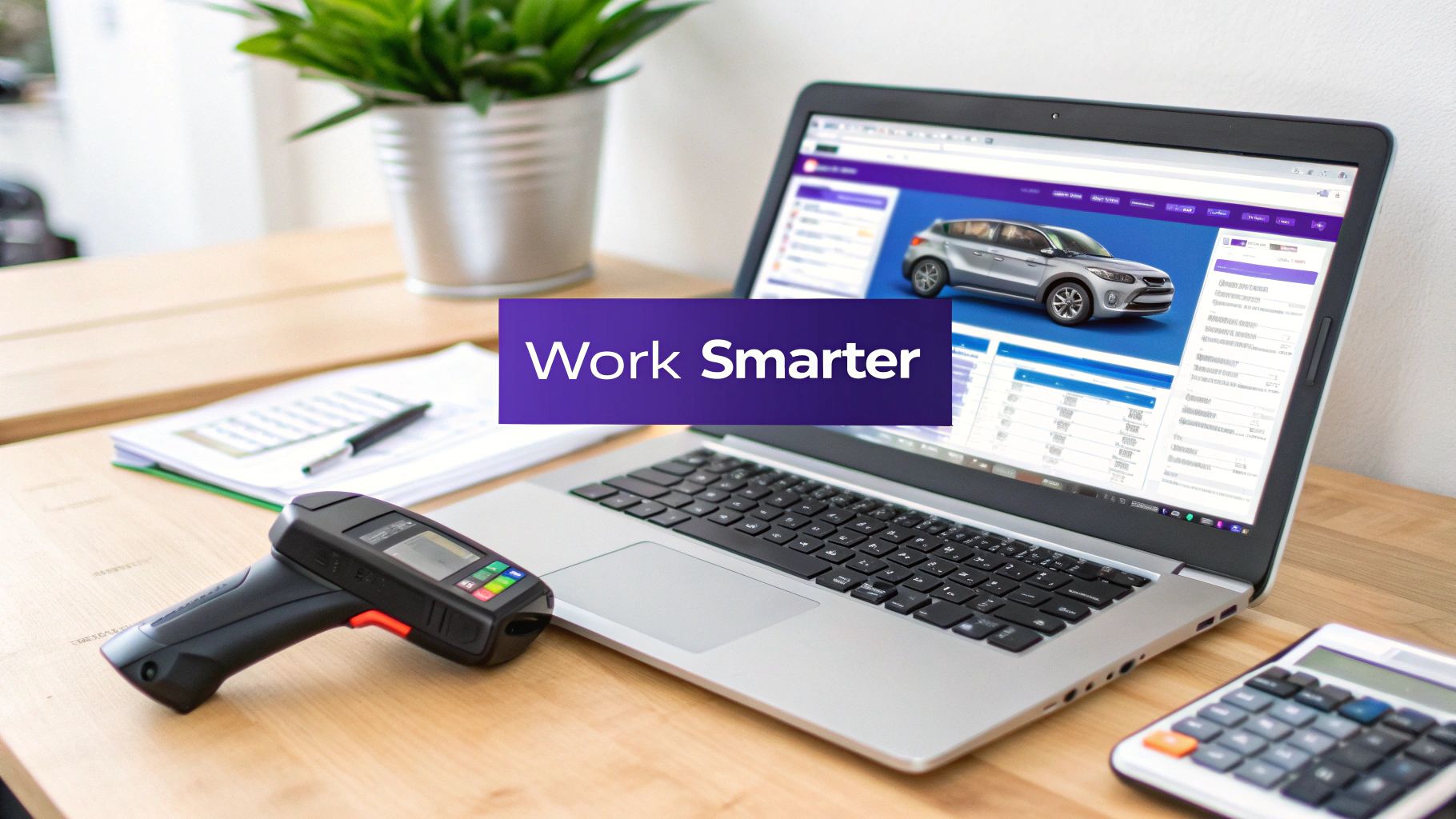
    A desk setup with a laptop displaying car inventory, a scanner, documents, and a calculator, with a 'Work Smarter' banner.

    If you're running a small dealership, trying to manage every car with a stack of paper and a spreadsheet is a surefire way to burn out. It’s not just slow; it’s a minefield of tiny errors that can quietly eat away at your profits. Technology isn't some expensive luxury anymore—it's the fundamental toolkit that lets you work smarter.

    The right tools handle the repetitive, tedious tasks for you, serve up the data you need to make good decisions, and free you up to do what you do best: buy and sell cars.

    The DMS as Your Central Command

    Think of your Dealer Management System (DMS) as the central nervous system of your operation. It's the one place where all your critical information lives—from what you paid for a car and how much you spent on reconditioning to customer details and the final sale price. A solid DMS gets every department on the same page.

    But its real strength comes from integration. Your DMS should be the "single source of truth" that feeds accurate, up-to-date information to all your other systems. This connectivity is the bedrock of modern, efficient car inventory management.

    Essential Tools for a Competitive Edge

    A good DMS is the start, but a few other key technologies can completely change your daily workflow. These are the tools that automate the slow, error-prone tasks that bog you down.

    • VIN Decoders: Nobody has time to type out every last detail of a car. A VIN decoder does it for you, instantly pulling the correct year, make, model, trim, and factory options. No typos, no guesswork—just accurate data for your listings from the get-go.
    • Market Pricing Tools: Pricing cars based on gut feeling is a recipe for disaster. These tools analyze real-time sales data and what your competitors are asking, helping you find that sweet spot between moving metal quickly and maximizing your gross.
    • Modern Photography Solutions: Let's be honest, terrible photos kill online interest. Modern apps let you take fantastic, high-resolution pictures with just your phone, automatically remove the distracting background, and even create 360-degree spins that keep shoppers engaged.

    Together, these tools help you get cars online faster, priced right, and looking great. That’s the entire game right there.

    Your Website: Your Best Salesperson

    Your dealership's website isn't just a digital business card anymore. It's your most important sales tool—a virtual showroom that works for you 24/7, pulling in buyers while you sleep. An integrated website platform is the final, crucial piece of this technological puzzle.

    The goal is simple: automate the entire flow of information from your inventory system to your public-facing website. When you book a new car into stock, it should show up online minutes later—perfectly detailed, beautifully photographed, and ready to sell—without you lifting a finger.

    This is exactly what platforms like AutoFire were built for. We sync directly with your inventory data to create SEO-friendly vehicle detail pages designed to rank high on Google. This automation doesn't just save your team a ton of manual work; it ensures every single car is presented professionally to the widest possible audience. To dig deeper, check out our guide on auto dealer inventory management software.

    Ultimately, technology is what allows you to compete. Take predictive AI, which has become a game-changer for used-car inventory. These tools analyze sales trends to help forecast what a car might be worth 30-60 days from now, preventing you from overpaying at auction today. After all, a car is bought right or not at all. You can learn more about how AI is helping dealers navigate fluctuating prices on cdkglobal.com. By embracing these tools, you build a dealership that's more efficient, data-driven, and ultimately, more profitable.

    Putting Your Car Inventory Management on Autopilot

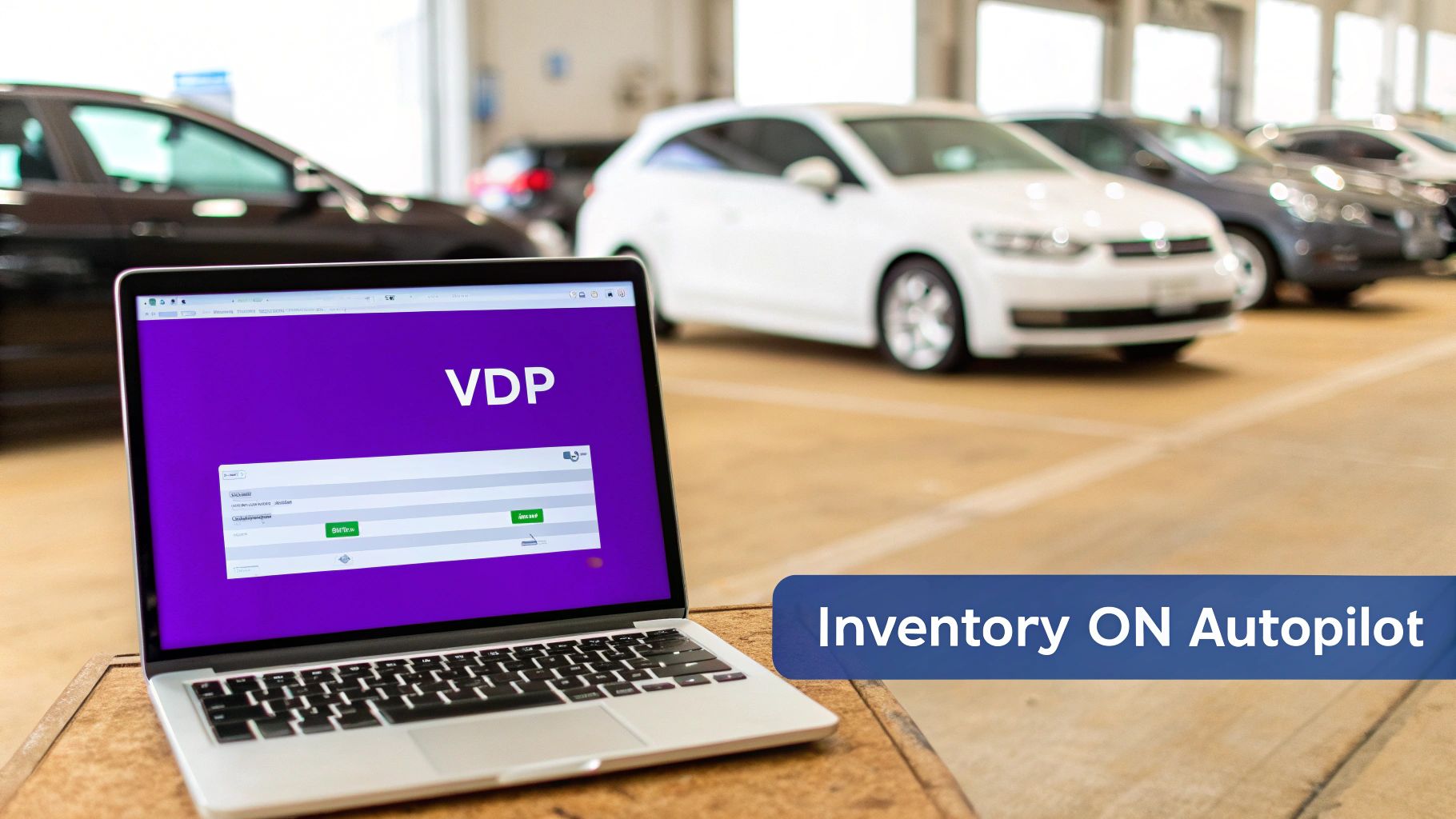
    A laptop displaying VDP software for car inventory, with new cars in a dealership and an 'Inventory ON Autopilot' banner.

    Everything we've covered—all the metrics, workflows, and tech—boils down to a single, powerful idea: turning a chaotic, hands-on process into a smooth, automated system. For an independent dealer, this shift is often the difference between constantly putting out fires and actually having the time to grow the business.

    It’s about making your systems do the heavy lifting so you can get back to what you do best: making deals. This is where the real magic happens—when your website platform stops being a static digital brochure and becomes a dynamic partner in your sales process.

    The Before-and-After Story

    Think about the typical "before" scenario. It’s a reality for so many small dealerships. You acquire a new vehicle, and it kicks off a long, painful checklist. You're stuck manually uploading dozens of photos, painstakingly writing vehicle descriptions from scratch, and triple-checking every last spec to avoid an embarrassing (and costly) data entry mistake. It’s a grind.

    Now, imagine the "after." The moment you add a new car to your Dealer Management System (DMS), it syncs directly to your website. Within minutes, a complete, professional, and search-engine-optimized vehicle detail page (VDP) is live and ready to attract buyers. This isn't some far-off dream; it's exactly how platforms like AutoFire operate today.

    That kind of automation completely reshapes your daily workflow. It frees up hours of your time and kills the potential for human error.

    Turning Your Website into a Sales Engine

    A modern dealership website should be much more than a simple online inventory list. It should be a sales machine, built from the ground up to attract, engage, and convert shoppers 24/7. The right platform connects all the dots, taking your raw inventory data and transforming it into a compelling digital showroom that works even when you're not.

    Here’s how that happens:

    • Built-In VIN Decoding: This is your first line of defense against bad data. A solid VIN decoder ensures the year, make, model, trim, and factory options are pulled correctly every single time. It builds trust from the very first click.
    • SEO-Optimized VDPs: Your vehicle pages are automatically built to rank well on search engines like Google and Bing. When a local buyer searches for a "used Ford F-150," your VDP has a much better shot at showing up—driving organic traffic to your site without you spending a dime on ads.
    • Automated Merchandising: AI-powered tools are quickly becoming essential. They can instantly remove distracting backgrounds from your photos or even generate 360-degree spins, creating a high-end e-commerce experience that keeps shoppers glued to your site.

    When these tools work in concert, they drastically shrink your time-to-market. Every vehicle gets a perfect online presentation almost as soon as it hits your lot.

    Empowering Customers to Close the Deal

    The best inventory systems don't just make your life easier; they empower your customers. When you give buyers all the information they need to feel confident, you shorten the sales cycle and build a foundation of trust.

    An integrated website turns passive browsers into active buyers. It provides the data, comparisons, and transparency needed to move them from online research to an in-person test drive, dramatically increasing your lead quality.

    Take a feature like AutoFire's FireCompare tool, for example. It allows a shopper to see two of your vehicles side-by-side, comparing specs, mileage, and price right on your website. This simple feature stops them from bouncing over to a competitor’s site to do their research. They stay engaged with your inventory, which makes them far more likely to submit a lead or show up on your lot.

    Ultimately, putting your car inventory management on autopilot means building a seamless bridge from your physical lot to your digital showroom. It’s about using smart automation to ensure every car you own is merchandised perfectly, priced intelligently, and discoverable by every potential buyer in your market. That's how you turn your website into your hardest-working salesperson.

    Actionable Best Practices for Independent Dealers

    All the theory and tech in the world won't make you a dime until you put it into practice. For an independent dealer, the real difference between a good month and a great one boils down to disciplined, repeatable processes. This is where you move from thinking about your business to actually building it—with concrete Standard Operating Procedures (SOPs) you can put to work tomorrow.

    These aren't just abstract ideas; they're proven workflows designed to shorten your cash cycle and protect your precious margins. When you create a playbook for your team, you take the guesswork out of car inventory management and build a system that consistently turns metal into money.

    The 48-Hour Recon Rule

    The second you buy a car, the clock starts ticking. It's now in the most critical, pre-sale phase of its life: reconditioning. Every single hour that car spends waiting for an oil change, a dent repair, or a detail is an hour it’s not on your front line, ready to be sold.

    That’s why the 48-Hour Recon Rule isn't a suggestion—it should be a non-negotiable deadline to get a car from acquisition to "front-line ready." This simple SOP forces you to create an efficient, almost assembly-line-like process. It demands clear, constant communication between your buyer, your mechanic, and your detailer, with the single-minded goal of killing dead time.

    Here’s how you get it done:

    1. Pre-Schedule the Work: The moment you win a car at auction or take a trade, it should already be on the schedule for its inspection and initial work. No waiting.
    2. Tackle High-Impact Repairs First: Focus on what makes the car safe and sellable. The fancy stuff can wait; the core mechanical and cosmetic fixes can't.
    3. Use a Checklist: Every car follows the same documented process. This keeps everyone accountable, ensures nothing gets missed, and reinforces the timeline.

    Think about it: slashing your recon time from a week down to just two days can have a massive impact on your turn rate and holding costs.

    The Weekly Aged Inventory Review

    One of the quietest but deadliest profit killers on any lot is aged inventory. A car that hits 60 days on your lot isn't just a problem; it's a financial emergency. The only way to stop these emergencies is to be proactive, which is why a Weekly Aged Inventory Review is so critical.

    Every week, no exceptions, you or your manager needs to sit down with a report of every vehicle approaching—or past—key aging milestones like 30, 45, and 60 days. This isn't just staring at a list. It's a strategy session to decide on a specific action for each one of those aging units.

    A disciplined weekly review shifts your strategy from reactive (panicking at day 90) to proactive (making smart moves at day 30). You stop letting stale cars drain your cash flow and start managing them with intention.

    For each car on that list, you need to be asking tough questions:

    • Is the price still right for today's market, not last month's?
    • Are the online photos and description actually doing their job?
    • Is it buried in the back-forty or parked right up front?
    • Do we need to run a small, targeted promotion on this specific car?

    Market volatility around the world proves how vital this discipline is. When China's auto dealers faced a high inventory coefficient, for instance, experts warned them to manage demand carefully and use promotions to avoid getting buried in old stock. You can find more on how dealers manage inventory in fluctuating markets on autonews.gasgoo.com. That advice is timeless for any dealer, anywhere.

    Your Perfect VDP Checklist

    Your Vehicle Detail Page (VDP) is your digital showroom for that specific car. A lazy VDP is like having a car on the lot with dirty windows and flat tires—it kills a buyer's interest instantly. The Perfect VDP Checklist is a simple SOP that ensures every single one of your online listings is built to turn browsers into buyers.

    This checklist isn't about creativity; it's about consistency and quality across your entire digital lot. It eliminates the sloppy mistakes that make you look unprofessional and guarantees every car is presented in its best possible light.

    At a minimum, your VDP checklist should demand:

    • Photos: No less than 30 high-resolution images. Get every angle, the full interior, the tires, and close-ups of important features. Tell a story with the pictures.
    • Video: A quick walk-around video, even one from a smartphone, dramatically increases engagement and builds trust.
    • Description: A detailed, well-written description that goes beyond the specs. Tell the car’s story, highlight its unique selling points, and answer the questions you know buyers will have.
    • Data Accuracy: A final check to be 100% certain the VIN, mileage, trim level, and all listed features are correct. Nothing kills credibility faster than bad data.

    When you turn these best practices into systems, you escape the chaotic, day-to-day scramble. You start building an operational machine that is efficient, profitable, and ready to grow.


    Ready to put your car inventory management on autopilot? The AutoFire platform was built to make these best practices easier. With automated DMS sync, SEO-optimized VDPs, and a built-in VIN Decoder, we handle the technical details so you can focus on selling cars. See how it works at https://goautofire.com.

  • Auto dealer inventory management software: Streamline inventory and boost sales

    Auto dealer inventory management software: Streamline inventory and boost sales

    Think of auto dealer inventory management software as the central nervous system for your entire operation. It's the system you use to track, manage, and merchandise every single vehicle, from the moment you acquire it to the final sale. It handles the heavy lifting—automating data entry, managing photo uploads, and pushing your listings out to your website and crucial online marketplaces. It’s the operational hub of a modern dealership.

    Why Your Dealership Needs an Inventory Engine

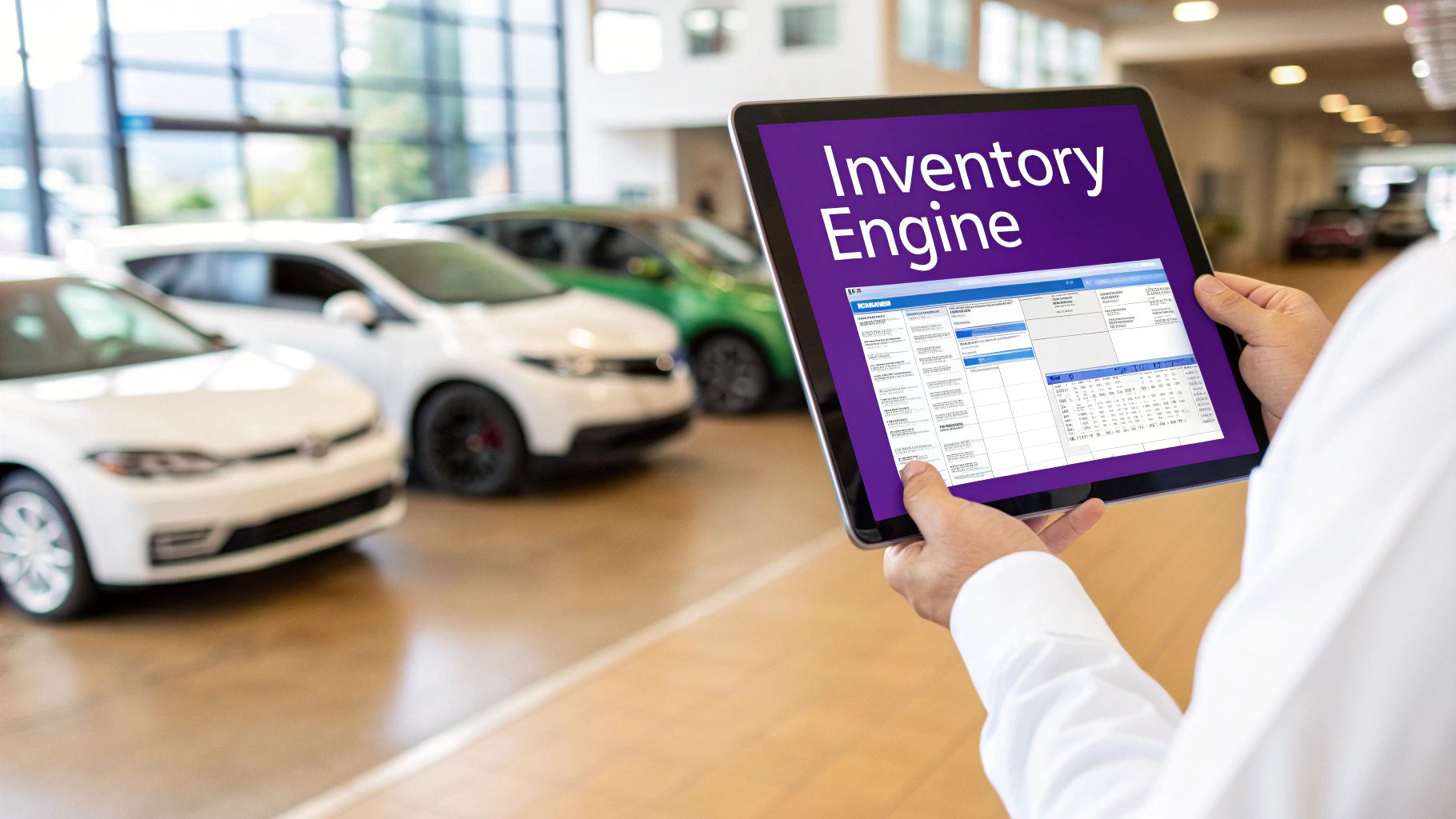
    A person holds a tablet displaying 'Inventory Engine' software in an auto dealership showroom.

    In a market this competitive, smart inventory management is so much more than a back-office chore. It’s the very engine of your sales strategy.

    For independent dealers trying to go toe-to-toe with massive franchise stores, you need more than just great cars—you need sharp, fast, and efficient processes. The right software gives you that edge. It turns tedious manual tasks into smooth, automated workflows, freeing you up to make better stocking decisions and get your vehicles in front of buyers faster than ever. That speed is everything.

    The Power of a Unified Platform

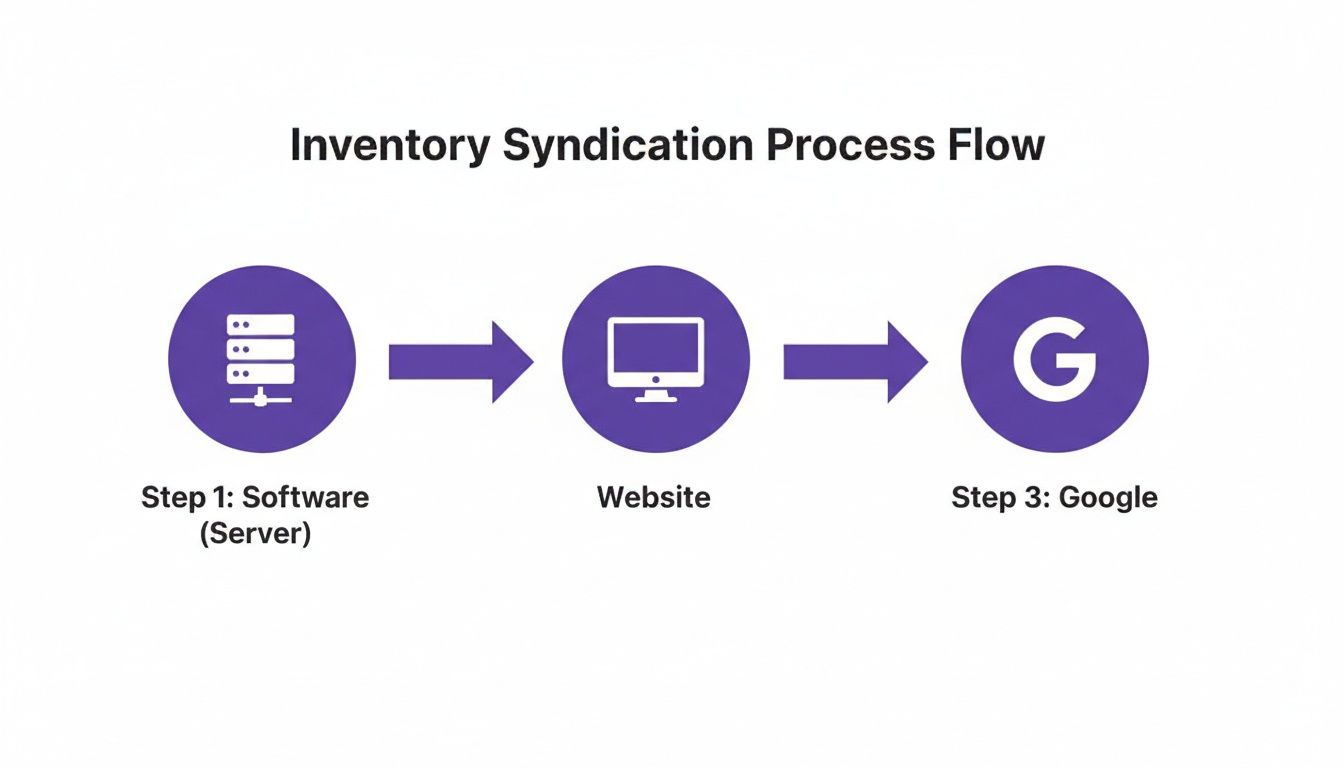
    The real magic of today's auto dealer inventory management software is its ability to serve as your single source of truth. A unified platform creates a direct pipeline from your vehicle data to your dealership website and essential marketplaces like Google Vehicle Listings.

    This seamless data flow—from the second a VIN is scanned to the moment a listing is live online—isn't a nice-to-have anymore. It’s essential for growth.

    An integrated approach pays off in a few critical ways:

    • Fewer Errors: Automating data entry cuts down on the human errors that lead to bad listings and lost opportunities.
    • More Speed: You can get a car from trade-in to online marketplaces in minutes, not days, which maximizes its prime selling window.
    • Total Consistency: It guarantees that your pricing, photos, and vehicle details are identical across every single marketing channel.

    Before we go further, it's helpful to see how these pieces fit together. This table breaks down the core functions that make a modern inventory system so effective.

    Core Pillars of Modern Inventory Management

    Pillar Key Function Business Impact
    Data Acquisition VIN scanning, automated spec decoding, and auction data integration. Dramatically reduces manual entry, ensuring vehicle data is accurate from the start.
    Merchandising Photo management, video uploads, and automated comment generation. Creates compelling, professional listings that attract and engage online shoppers.
    Pricing and Appraisal Integration with market data tools (e.g., KBB, Black Book) for real-time pricing. Helps you price vehicles competitively to maximize profit and accelerate turnover.
    Syndication Automatic distribution of listings to your website, third-party marketplaces, and social media. Guarantees your inventory gets maximum exposure to potential buyers wherever they shop.

    Ultimately, these pillars work together to turn inventory from a simple list of assets into a dynamic sales and marketing machine.

    A well-implemented inventory system is the central nervous system of a dealership. It doesn't just track cars; it connects every part of your business, from acquisition and reconditioning to marketing and sales, ensuring every decision is backed by accurate, real-time data.

    By centralizing these functions, you get a crystal-clear view of your entire operation, empowering you to make the kind of informed choices that directly boost your bottom line. For a more detailed breakdown, check out our guide on mastering inventory management for independent car dealerships. It’s designed to help you evaluate, select, and implement the right software to take your dealership to the next level.

    What Features Actually Move the Needle?

    Person using a smartphone to scan a barcode on a purple car, likely for inventory management.

    It’s easy to get bogged down in a laundry list of software features. The real trick is to zero in on the tools that solve your biggest headaches and actually make you more money. Don't just check boxes on a features list. Ask yourself: which of these will slash my team's busywork, eliminate expensive listing errors, and get my cars in front of buyers faster?

    This mindset shifts you from being a data manager to a true vehicle merchandiser. The right software doesn't just keep your inventory organized; it speeds up your entire sales cycle.

    Core Tools for Turning Inventory Faster

    For most independent dealers, speed is everything. You need tools that shrink the time it takes to get a car from acquisition to a live, shoppable listing. In my experience, three features are absolutely non-negotiable if you want to compete.

    • Automated VIN Decoding: This is your first and best defense against costly mistakes. Manually typing in vehicle options, trim levels, and specs is a recipe for disaster. One wrong detail can mislead a customer and kill a deal instantly. A good VIN decoder pulls the exact factory data in seconds, ensuring your listings are accurate and building trust with shoppers from the first click. It takes a ten-minute data entry chore and turns it into a ten-second scan.

    • High-Resolution Photo Management: Let’s be honest, people buy with their eyes. Your software has to make it dead simple to upload, arrange, and watermark a couple of dozen high-quality photos for every car. The best systems let you snap pictures on your phone and upload them directly to the vehicle record right after it’s been detailed. That visual proof is what convinces a buyer to visit your lot instead of the one down the street.

    • Dynamic Pricing Tools: The used car market changes daily, sometimes hourly. Trying to manually track competitor pricing for every single car on your lot is a full-time job you don't have time for. Look for integrated pricing tools that pull real-time market data. They'll help you set prices that are competitive enough to attract buyers but still protect your profit margins. This data-driven approach means you can make smart pricing adjustments without spending hours glued to classifieds sites.

    These three tools aren't just separate features; they create a powerful, cohesive workflow. Think about it: you scan a VIN as the car rolls off the transport truck, upload photos as it comes out of reconditioning, and set a market-correct price, all from one dashboard. That's how you get a vehicle from your physical lot to your digital showroom in minutes, not days.

    The best inventory management platform is one where every feature flows logically into the next. You don't just want a VIN decoder and a photo tool; you want a unified system that makes the whole process of merchandising a car faster, smarter, and ultimately, more profitable.

    Beyond the Basics: What's Next?

    Once you've nailed the fundamentals, some advanced capabilities can give you a serious edge. AI-powered features, for example, are quickly moving from "nice-to-have" to essential. Some platforms can now write compelling, unique vehicle descriptions for you based on the car's specs, which is a massive time-saver.

    Others offer predictive analytics to help you spot which makes and models are trending in your local market, giving you a huge advantage at the auction. While these might not be day-one priorities for every dealer, they show where the industry is heading. You can explore a full set of modern dealership software features to see what's possible. Embracing the right tech is how you stay a step ahead of the competition.

    How to Choose the Right Software Partner

    Picking the right auto dealer inventory management software is less about a flashy features list and more about finding a true partner. It's a long-term relationship. The right platform grows with you, makes your day-to-day life easier, and flat-out helps you sell more cars. The wrong one? It’s a constant source of friction, a time-sink, and a drain on your bottom line.

    So, how do you get it right? It all starts with asking better questions. When you're sitting through a software demo, don't let them just run through a canned presentation. You need to get specific and push them on how the system handles your dealership's real-world problems.

    Key Questions for Your Software Demo

    Every dealership has its own quirks and processes, so your evaluation has to be about how the software molds to you, not the other way around. Come prepared with a list of practical, scenario-based questions that cut right to the chase.

    Here are a few I always recommend dealers ask:

    • Data Migration: "Look, my current inventory is a total mess in a bunch of spreadsheets. Show me, step-by-step, how you would get that data into your system. What's the support like during that process?"
    • Live Syndication: "Can you pull up a live example of how your platform pushes cars to Google Vehicle Listings? After I add a new car, how long until it's actually live online for customers to see?"
    • Onboarding and Training: "What does training look like for my small team? Do I get a dedicated person to call when we inevitably hit a snag in that first month?"

    Questions like these force a vendor to stop selling and start demonstrating real value.

    A good software partner won't hesitate to show you exactly how their tool solves your biggest operational headaches. If they get vague or can't walk you through a clear workflow for your most common tasks, that’s a massive red flag.

    Understanding SaaS and Modern Platforms

    One of the biggest evolutions in dealership software has been the shift to cloud-based, Software-as-a-Service (SaaS) platforms. Forget the old days of on-premise systems where you had to manage your own servers and deal with manual updates—that was a nightmare.

    Modern SaaS solutions handle all the technical heavy lifting for you. The provider manages security, rolls out updates automatically, and hosts everything on fast, reliable servers. All you have to do is log in through a web browser and get to work. This frees you up to focus on what actually matters: merchandising and selling your inventory. For independent dealers without a dedicated IT guy, this isn't just a feature; it's a lifeline.

    Comparing Pricing Models for Scalability

    Finally, let's talk about money. You need a pricing model that makes sense for your business right now but won't hold you back as you grow. You'll generally run into two common structures: per-listing fees and flat monthly subscriptions.

    • Per-Listing Pricing: This can look cheap upfront, but those costs can get out of control fast as you add more vehicles. It essentially penalizes you for being successful.
    • Flat Monthly Fee: This gives you predictable costs, which makes budgeting a breeze. It’s the perfect model for a growing dealership because your bill stays the same whether you have 10 cars on the lot or 100.

    Always look for a partner with a clear, scalable path. For most ambitious independent dealers, a transparent, flat-fee structure is almost always the smarter long-term play.

    Connecting Your Inventory to Buyers Online

    Let's be blunt: the single most critical job of any modern auto dealer inventory management software is to get your cars in front of people who want to buy them. This isn't about just keeping a list anymore. Your software has to be the central command post that automatically fires your vehicle data out to every important online channel. This is what saves you from the soul-crushing, error-filled grind of manual updates.

    When this is working right, your inventory system stops being a glorified spreadsheet and becomes a powerful marketing engine. Picture this: you add a new car, and within minutes, it’s live on your website and showing up on Google. It has professional photos, the right price, and all the specs a serious buyer is looking for. That’s the real power of smart automation.

    Your Website and Google Vehicle Ads

    You can list your cars in a hundred different places, but two channels consistently deliver the best leads for the least amount of money: your own dealership website and Google Vehicle Listings. These aren't just line items on your marketing spend; they are your most valuable digital assets.

    • Your Dealership Website: Think of this as your digital showroom. Your software needs to automatically build search-engine-optimized (SEO) Vehicle Detail Pages (VDPs) for every single car. A properly built VDP is designed to rank on Google, earn a shopper's trust, and—most importantly—capture their contact information.

    • Google Vehicle Listings (GVL): This is a free program from Google that puts your inventory right in the search results when someone is looking for a car like yours in your area. To make this happen, you need a very specific, structured data feed. Your software should be building and updating this file for you automatically. When you nail this, your cars pop up in front of high-intent buyers the second they start looking.

    The link between your inventory software and your online storefronts isn't just a nice-to-have feature—it’s a competitive requirement. Every hour a car sits on your lot but isn't visible on your site and Google is a lost opportunity to make a sale.

    The Technical Magic Behind the Scenes

    So, how does all this actually work? Your inventory software essentially acts as a universal translator. It takes all the raw data about your cars and reformats it perfectly for each online destination. It creates these clean, structured data feeds that search engines like Google can instantly read, understand, and index.

    This technical process is what makes it possible for your 2019 Ford F-150 to show up immediately when someone down the street searches "used Ford F-150 near me."

    This kind of real-time, automated process is a huge reason why the market for this software is growing so fast. According to one report, the core inventory management software module is projected to grow at a 14.0% CAGR through 2035. This is perfectly in line with the goal of syncing your inventory directly to your website for mobile-first lead capture, which you can read more about in these inventory management software market trends.

    At the end of the day, this synchronization gets your vehicles maximum exposure with minimum effort from your team. Of course, none of this works if your photos don't look great. Many dealers use professional product photo editing services to ensure every listing pops off the screen. This blend of powerful software and a polished presentation is what gets cars sold.

    For more strategies on boosting your digital sales floor, take a look at our guide on how to effectively sell cars online.

    Your Go-Live Plan for a Smooth Transition

    A successful software launch is all about preparation, not perfection. Shifting to a new auto dealer inventory management software can feel like a huge technical hurdle, but it's really just a manageable project when you break it down into clear steps. The whole point is to sidestep the common issues that throw a wrench in your dealership's operations and stress out your team.

    Believe it or not, a smooth transition starts long before you ever "flip the switch." The most common pitfall I see dealers fall into is underestimating just how critical data cleanup is. It’s the old "garbage in, garbage out" principle—if your current inventory data is a mess, migrating it will only amplify those problems in the new system.

    Pre-Launch Data Preparation

    First things first, dedicate some real time to cleaning up your current inventory records. This means hunting down and fixing typos, filling in those missing vehicle options, and standardizing how you list trim levels. This upfront work pays off big time, ensuring your new platform starts with a clean, accurate foundation for all your online merchandising.

    Once your data is tidy, it's time to map out who on your team needs access to what. Think it through:

    • Your sales team probably just needs to view inventory and pricing.
    • The lot manager will need permission to add new cars, upload photos, and change statuses.
    • The owner or GM will need the keys to the kingdom—full admin access to run reports and oversee everything.

    Getting these user accounts and permissions configured ahead of the launch prevents a ton of confusion and helps everyone hit the ground running on day one.

    The Migration and Syndication Process

    Moving your data over is often the part that makes dealers the most nervous. Your software partner should be holding your hand through this, but you can make it a lot smoother by exporting your cleaned-up data into a simple format, like a CSV file. A pro tip: do a small test import with just a handful of vehicles first. This lets you catch any weird formatting issues before you commit to moving your entire inventory.

    The single biggest mistake I see dealerships make during a go-live is failing to test the data sync to their website and Google Vehicle Listings. Don't just assume it will work. Verify that a new vehicle you add shows up online correctly before you fully launch.

    This flow chart gives you a clear picture of how your inventory data travels from the software, to your website, and then out to Google.

    Process flow diagram illustrating inventory syndication from a software server to a website and then to Google.

    This automated syndication is the engine that gets your vehicles in front of buyers with as little manual effort as possible.

    To help you stay on track, I've put together a checklist that breaks the process down into manageable phases.

    Software Migration and Go-Live Checklist

    This checklist is designed to guide you through a smooth, organized implementation process, from the initial prep work to the final launch and beyond.

    Phase Task Key Consideration
    1. Preparation Clean and format existing inventory data Focus on consistency in trim, options, and descriptions.
    Define user roles and permissions Who needs to add/edit vs. who just needs to view?
    Export final data to a CSV file Double-check that all columns and fields are correct.
    2. Migration & Testing Perform a small-batch test import (5-10 vehicles) Verify that all data fields (photos, price, specs) map correctly.
    Test website inventory feed Does the test vehicle appear on your VDPs correctly?
    Test third-party syndication (e.g., Google) Confirm the vehicle shows up in your Google Business Profile.
    Complete the full inventory data migration Schedule this during off-peak hours to minimize disruption.
    3. Go-Live & Training Announce a "go-live" date to your team Ensure everyone knows when the new system becomes the source of truth.
    Conduct hands-on team training Focus on the specific tasks each role will perform daily.
    Decommission the old system Prevent confusion by making the old software read-only or inaccessible.
    4. Post-Launch Monitor data feeds for 24-48 hours Watch for errors in pricing, photos, or vehicle details.
    Review incoming leads and website analytics Are leads flowing in correctly? Is VDP traffic stable?
    Schedule a follow-up call with your software provider Discuss any initial issues and ask clarifying questions.

    Following these steps methodically turns a potentially chaotic process into a structured, predictable project. It ensures that when you finally go live, your team is confident and your online listings are accurate from the very first minute.

    Tracking Performance to Maximize Your ROI

    Computer screen showing 'PERFORMANCE METRICS' with various charts and graphs on a wooden desk.

    Getting your new auto dealer inventory management software up and running is a huge step, but it’s not the finish line. The real power of this tool unfolds when you start using its data to make smarter, more profitable decisions.

    This is where you shift from simply managing inventory to strategically optimizing it. By keeping a close eye on the right numbers, you can pinpoint what’s selling, what’s not, and where you can make changes that directly impact your bottom line.

    Key Metrics That Actually Drive Growth

    To see how your inventory software is truly affecting sales, you have to dig into specific, actionable data points. These numbers tell the real story of your inventory's health and how well your online marketing is performing.

    Here are the essential metrics I always tell dealers to watch:

    • Time-to-Market: How many days pass from the moment you acquire a vehicle to it being live on your site and Google? The faster you get cars online, the faster they sell. Shaving even a day or two off this time can make a huge difference.
    • Leads Per Listing: Are your trucks getting more calls and form fills than your sedans? This data is gold. It tells you exactly what your local market wants, so you can buy smarter at the next auction.
    • Average Turn Rate: How long are specific makes and models sitting on the lot? This helps you identify stale units that might need a price drop or a promotional push before they become a bigger problem.

    Turning Data Into Smarter Decisions

    Once you have this information, you can start asking much more strategic questions. For instance, if you see that SUVs under $20,000 are generating three times the leads of any other category, you’ve just found your new sweet spot.

    This data-driven mindset doesn't just help you sell today; it strengthens your dealership for the long haul. Consistently accurate and detailed inventory data is a major factor in automotive SEO. Google loves fresh, reliable information, which helps you rank higher and pull in more organic traffic over time.

    Your inventory data is more than just a list of cars. It's a real-time snapshot of your business's health and a roadmap for future growth. Use it to refine your strategy, optimize your stock, and turn every vehicle into a real opportunity.

    Ultimately, tracking these metrics creates a clear line from your inventory management to your revenue. If you want to dive deeper into connecting these dots, check out these proven strategies to measure marketing ROI.

  • The Ultimate Guide to Automotive Inventory Management Software

    The Ultimate Guide to Automotive Inventory Management Software

    Automotive inventory management software is the dealership's command center. It’s the engine that automates everything from the moment a car hits your lot to the final sale, transforming chaotic vehicle data into a powerful, well-oiled sales machine. For independent dealers, this isn't a luxury; it's how you save time, slash errors, and compete head-to-head with the big franchise stores.

    What Is Automotive Inventory Management Software?

    A person works at a multi-monitor desk in front of a large video wall and a wall sign 'Inventory Control Hub'.

    Picture your inventory like a fleet of airplanes, each one waiting for its specific destination—a buyer. Trying to manage them without a system is pure chaos. Automotive inventory management software is your air traffic controller, flawlessly guiding each vehicle’s journey from its arrival on your lot to the handshake with a happy new owner.

    This is much more than a digital filing cabinet or a glorified spreadsheet. It’s a purpose-built system designed for the unique, high-stakes world of selling cars. It takes on the tedious, soul-crushing tasks that eat up your day, freeing you to focus on what you do best: selling cars and building relationships.

    Moving Beyond Manual Methods

    For too long, independent dealers have been stuck using spreadsheets, whiteboards, and sticky notes to track inventory. It’s a familiar method, but it’s dangerously prone to human error, wasted hours, and lost sales. A single typo in a VIN or an outdated price can kill a deal on the spot.

    Modern software makes those risks a thing of the past by creating one smooth, automated workflow. Imagine scanning a VIN and instantly populating everything from engine size to factory options. Instead of manually updating five different websites, you publish a new car to every single online channel with one click.

    This jump from manual tracking to an integrated system isn’t just about making life easier—it’s about survival. Poor inventory control can directly cause significant revenue loss from having the wrong cars on the lot.

    Take a look at how daily operations change when you move away from manual methods.

    Manual Spreadsheets vs Automated Software

    Task The Old Way (Manual Spreadsheets) The Smart Way (Automated Software)
    Adding a New Car Manually type in VIN, year, make, model, trim, and features. Look up specs online. Scan the VIN with a mobile app. All specs, options, and features auto-populate in seconds.
    Uploading Photos Transfer photos from a camera to a computer, resize them, and upload them one by one to each website. Snap photos with your phone. The app automatically syncs them to the vehicle record and all listings.
    Updating Prices Log into multiple websites (your site, Autotrader, Cars.com, etc.) and change the price on each one individually. Change the price once in the system. It updates everywhere automatically.
    Writing Descriptions Spend 15-20 minutes writing a unique description for every single car. Generate a compelling, feature-rich description with a single click using AI-powered tools.
    Tracking a Lead A customer calls. You scramble to find the right spreadsheet to see if the car is still available. The customer's info is captured directly from the listing and linked to the vehicle in your CRM.

    The difference is night and day. One path is filled with friction and potential mistakes, while the other is all about speed and precision.

    The Core Purpose And Benefits

    At its heart, this software turns your inventory from a static list of cars into an active, intelligent sales tool. It organizes every single detail—photos, specs, pricing, history reports, and marketing copy—into one central hub. It's no surprise that the market for these tools, valued at USD 3.57 billion in 2023, is expected to skyrocket to USD 9.20 billion by 2032. Dealers using them are simply getting better results.

    The main benefits you'll see almost immediately include:

    • Operational Efficiency: Get hours back every week by cutting down on data entry and automatically sending your listings to third-party sites.
    • Increased Accuracy: No more costly mistakes from mistyped VINs or incorrect feature lists. Your customers see the right info, every time.
    • Enhanced Marketing: Automatically create professional, search-engine-friendly vehicle detail pages that bring in buyers from Google.
    • Better Decisions: Finally get clear, data-driven insights into what's selling, what's not, and which marketing channels are actually working.

    By automating these core jobs, you build a stronger, more profitable dealership. To dive deeper, check out our guide to mastering inventory management for independent car dealerships.

    Essential Features That Drive Dealership Growth

    A tablet showing automotive inventory software with 'VIN Details' and 'ESSENTIAL FEATURES' in a car dealership.

    The right inventory management software is more than just a digital filing cabinet for your lot—it's the engine that powers your growth. The features aren't just flashy add-ons; they are practical solutions to the real-world headaches that slow down independent dealers every single day.

    Let’s dig into the non-negotiable features that make a piece of software your dealership's most valuable player. These are the tools that save you time, cut down on costly mistakes, and get your vehicles in front of as many serious buyers as possible.

    Instant Accuracy with VIN Decoding

    Manually typing in vehicle data is just asking for trouble. One wrong digit in the trim level or a mistake in the options list can mislead a customer and kill a deal before it even starts. That's where a VIN decoder becomes your best friend.

    Think of it as a barcode scanner for cars. You just scan the Vehicle Identification Number (VIN) with your phone, and boom—the software instantly populates the correct year, make, model, trim, engine, and all the factory-installed goodies. What used to take 15-20 minutes of tedious lookup and typing now takes seconds.

    For an independent dealer, this isn't just about saving time; it's about protecting your reputation. It guarantees every vehicle detail page on your website is 100% accurate, building trust with shoppers from their very first click.

    Maximize Your Reach with Automated Syndication

    Okay, the car is prepped and ready to sell. Now what? Manually posting it to your website, Craigslist, Facebook Marketplace, and other listing sites is a mind-numbing, repetitive chore. Automated syndication handles all of it with a single click.

    This feature is your master key for distribution. You enter the vehicle's info, upload the photos, and set the price just once. The system then automatically pushes that listing everywhere it needs to go.

    • Your Dealership Website: The listing goes live instantly with a professional, detailed page.
    • Third-Party Marketplaces: Your inventory gets beamed out to the heavy hitters like Cars.com or Autotrader.
    • Google Vehicle Ads: Your cars show up right in local search results for buyers who are ready to pull the trigger.
    • Social Media: You can create and share posts for platforms like Facebook in a snap.

    This makes sure your inventory is always accurately marketed everywhere your customers are looking, without you having to touch each site one by one.

    Stay Competitive with Dynamic Pricing Tools

    Pricing used cars feels like a tightrope walk. Go too high, and the car becomes a permanent resident on your lot. Go too low, and you're leaving cash on the table. Dynamic pricing tools give you the market intelligence to find that perfect balance.

    These tools pull in real-time market data, showing you exactly what similar cars are selling for in your area. You get a clear picture of competitor pricing, how long cars are sitting, and what's in demand. This intel lets you price your cars competitively from day one, which means a faster turn rate and better profit margins on every single sale.

    In a market that changes this fast, a data-driven approach is essential. The global automotive parts inventory management software market is expected to grow significantly in the coming years. This expansion is fueled by tools that eliminate expensive guesswork, which can hobble smaller operations.

    Turn Clicks into Customers with CRM Integration

    A great-looking website listing is pointless if it doesn't bring you leads. A CRM (Customer Relationship Management) integration is the bridge that connects your online inventory directly to your sales pipeline.

    When a shopper fills out a form on your site—like "Check Availability" or "Schedule Test Drive"—the CRM integration gets to work instantly. It automatically creates a new contact in your system, links them to the exact vehicle they're looking at, and pings your sales team to follow up.

    This seamless connection turns your website into a lead-generating machine that works 24/7. It transforms someone who is just browsing into a real sales opportunity, ensuring no potential buyer ever slips through the cracks. You can see a full breakdown of these capabilities and other essential tools by exploring AutoFire™’s core features.

    How Smart Inventory Management Boosts Your Online Presence

    Your physical car lot is still a big deal, but let's be honest—your digital showroom is where most customers start their car-buying journey today. Good automotive inventory management software does a lot more than just keep your cars organized. It's a powerful marketing engine that builds your online presence and pulls local customers right to your digital front door.

    Think of it this way: without the right software, getting your cars to show up on Google is like trying to wave down a customer in a massive, unlit parking lot. A smart inventory system flips on the floodlights, puts up a giant neon sign, and rolls out the welcome mat, all at once.

    It’s what makes sure that when a local buyer searches for a "used Ford F-150 near me," your truck is sitting right there at the top of the page, waiting for them.

    Turn Your Inventory into SEO Fuel

    Search Engine Optimization (SEO) might sound like a bunch of technical jargon, but its job is simple: connect your cars with the people who are actively looking for them. Modern inventory software handles this for you by automatically building optimized Vehicle Detail Pages (VDPs) for every single car you list.

    Each VDP essentially becomes a perfect little landing page. The software automatically pulls the year, make, model, trim, and VIN and plugs them into the page title, the URL, and the meta description. This is the exact information search engines like Google and Bing need to understand what the page is about and show it to the right people.

    A well-structured VDP is your best online salesperson. It doesn't just list features; it directly answers a searcher's question, which builds instant trust and pulls them from the search results straight to your inventory.

    Instead of paying a fortune for an SEO agency, your inventory tool does the heavy lifting. It translates your vehicle data into search-friendly content, turning your day-to-day operations into a marketing machine that works for you 24/7.

    Dominate Local Search with Google Vehicle Listings

    One of the most powerful features to look for is an integration with Google Vehicle Listings. This is huge. It places your available cars directly inside Google's search results, often in a visual, easy-to-browse carousel right at the top of the page. It's like getting a reserved parking spot in the most visible location online.

    So, how does this actually work?

    • Direct Sync: Your software automatically feeds your inventory to Google. When you add a new car or change a price, the Google listing updates almost instantly. No extra work for you.
    • High-Intent Buyers: The people seeing these listings aren't just kicking tires. They are actively shopping. They see your car, its price, and your dealership's name before they even click.
    • Local Focus: These listings are laser-focused on your geographic area, meaning you’re reaching buyers nearby who are actually in a position to come in for a test drive.

    This direct pipeline to motivated local shoppers is a game-changer, especially for independent dealers. It helps you compete with the big franchise stores without needing a massive advertising budget. To get a deeper understanding of this, you can explore our detailed guide on SEO for automotive dealerships and see how these strategies drive real-world results.

    Convert Browsers into Qualified Leads

    Getting eyes on your website is great, but it's only half the battle. The real goal is to turn those anonymous visitors into actual leads you can talk to. This is where a well-designed VDP with built-in lead capture tools makes all the difference.

    Your inventory software shouldn't just display information; it should encourage shoppers to take the next step. This is done with clear, simple forms and calls-to-action (CTAs).

    You've seen them before:

    • "Check Availability" Button: A simple, no-pressure way to get a name, email, and phone number.
    • "Schedule a Test Drive" Form: For someone who's serious, this form captures their contact info and preferred time to come in.
    • "Get Pre-Approved" Link: This connects interested buyers directly to your financing options, giving you a highly qualified lead.

    When a visitor fills out one of these forms, the best systems instantly shoot that lead over to your CRM or email, along with the details of the exact car they were looking at. This seamless process means you never miss a beat and can follow up immediately while that lead is still hot. It's the final, crucial step that turns online traffic into real sales opportunities.

    Choosing the Right Software for Your Dealership

    Picking the right inventory management software can feel like staring at a wall of options. It’s easy to get lost in feature lists and tech-speak. The trick is to stop focusing on what the software can do and start asking what your dealership actually needs to grow.

    Forget the shiny objects and long lists of bells and whistles for a moment. Think about your day-to-day grind and where you want to be in a year. The best software isn't the one that does the most; it's the one that becomes a genuine partner in your business—solving real problems and opening up new opportunities without making your life more complicated.

    This guide will help you cut through the noise with a practical checklist, focusing on what really moves the needle for a small, independent lot like yours.

    Software Buyer's Quick-Check Guide

    When you're comparing different platforms, it’s tough to keep all the details straight. Use this table as a quick reference to make sure you’re hitting the most important points for your business.

    Evaluation Criterion What to Look For Why It Matters for Your Dealership
    Simplicity An intuitive interface you can figure out in minutes, not days. Simple steps for common tasks like adding a car or changing a price. You don't have an IT department. The software should save you time, not become a second job.
    Scalability Flexible pricing tiers that grow with your inventory. The ability to handle 10 cars now and 50+ later without a massive price jump. You won't outgrow the system in six months. It supports your ambition instead of holding you back.
    Mobile Experience A mobile-first design, not just "mobile-friendly." Fast-loading photos and easy-to-use forms on a smartphone. Most of your customers are shopping on their phones. A bad mobile site is like having a "Closed" sign on your digital front door.
    Pricing Model Clear, upfront monthly costs with no hidden fees. Month-to-month contracts are a huge plus. Predictable expenses are critical for a small business. You need flexibility, not a long-term financial anchor.
    Customer Support Easy access to real, helpful human beings via phone, chat, or email. When you hit a snag, you need a quick solution from someone who understands your business, not a ticket number.

    By keeping these core needs in mind, you can confidently filter out the noise and find a tool that’s a true asset to your dealership.

    Prioritize Simplicity and Ease of Use

    Your time is your most valuable resource. You can’t afford to spend weeks wrestling with a complicated system. The very first question to ask is: can I get this up and running myself, today? The software should feel natural from the moment you log in.

    Look for a clean, simple dashboard. Adding a new vehicle, snapping photos with your phone, and updating a price should be common-sense actions. If a platform requires a thick user manual for basic tasks, it’s going to be a constant source of friction.

    A great platform is one you can launch in an afternoon. You should be able to sign up, add your first few cars, and have a live, professional-looking online showroom within a few hours.

    Making the right software choice has a direct, cascading effect on your business—improving your online visibility, driving local sales, and bringing in more qualified leads.

    Decision tree illustrating the impact of inventory software on SEO, local sales, and leads.

    As you can see, a single good decision here branches out, creating clear pathways to real business growth and better marketing results.

    Ensure It Can Scale With Your Ambitions

    The software that works for your 10-car lot today has to work just as well when you’ve got 50 cars next year. Scalability is non-negotiable. You need a solution that grows with you, not one you’ll outgrow in a few months.

    Check out the pricing plans and feature tiers. Does the company offer a straightforward starting point with an easy upgrade path for more inventory or advanced tools? Avoid providers that try to lock you into an expensive, enterprise-level package from day one. A flexible, tiered structure is a good sign they understand how independent dealers operate.

    Demand a Mobile-First Design

    Let's be clear: the vast majority of your customers will find your cars on their smartphones. If your inventory pages are slow, clunky, or just plain broken on a mobile device, you are losing sales. It’s that simple. The software you choose absolutely must be built with a mobile-first mindset.

    This goes way beyond just having a website that shrinks to fit a small screen. The entire experience has to be seamless. Photos need to load instantly, vehicle details must be easy to scan, and contact forms should be simple enough to fill out with one thumb. Before you even think about signing up, test every potential platform on your own phone.

    Look for Transparent Pricing and Quality Support

    Nothing kills a small dealership’s budget faster than hidden fees and restrictive long-term contracts. Look for providers with clear, transparent pricing. You should know exactly what your bill will be each month, no surprises. Month-to-month plans are ideal because they give you the freedom to pivot if your business needs change.

    Finally, never underestimate the value of quality support. When something isn’t working right, you need to talk to a real person who can actually help you. Find out what their support channels are—email, chat, phone—and what their reputation is like. Good support shows they're a true partner invested in your success. The market for cloud-based inventory software is growing rapidly because it helps businesses streamline operations and reduce errors. You can learn more about inventory management market trends to see how these advancements are reshaping the industry.

    Your Implementation Roadmap from Day One to Done

    A person reviews an "Implementation Roadmap" document and works on a laptop displaying "GO LIVE" with a car.

    The thought of adopting new software can feel like a massive, time-consuming project. Let’s be real, who has time for that? But with modern, cloud-based automotive inventory management software, getting your dealership online isn't some month-long headache. It can honestly be done in a single afternoon.

    This roadmap breaks the whole process down into a few simple, manageable chunks. It’s designed to get you from sign-up to your first online lead, building your confidence at every step. Forget needing a whole tech team—you just need a clear plan.

    Phase 1: The Preparation

    Before you even log into your new system, a little prep work will make everything else go so much faster. Think of this as getting your ducks in a row. It’s the digital version of lining up your best cars on the front row of the lot.

    Your only goal here is to get your vehicle info organized. Don't sweat the small stuff or aim for perfection just yet.

    • Gather Your Photos: Round up the best pictures you have for your current inventory. Get them all in one place on your computer or phone, ready to upload.
    • List Your VINs: Grab the VINs for all the cars you have on hand. This is the key to letting the software do the heavy lifting for you in a minute.

    That’s literally it. A few minutes of prep work means you can hit the ground running as soon as you create your account.

    Phase 2: The System Setup

    Okay, this is where the fun begins. With a good platform, the setup is designed to be super intuitive. You’re looking at less than an hour, from start to finish. The goal is simple: build your digital showroom and get your first few vehicles online.

    This isn't about building a website from scratch. It's more like activating a powerful, pre-built system. Imagine moving into a professionally staged model home—all you have to do is bring in your inventory.

    Here are the key steps:

    1. Create Your Account: Sign up for the service. Platforms like AutoFire offer free plans that let you dive right in with zero upfront cost.
    2. Choose Your Look: Pick a website template that fits your style. Any decent system will give you clean, professional, and mobile-friendly designs right out of the box.
    3. Add Your First Vehicles: Using those VINs you gathered, start adding cars. Scan the VIN with your phone, upload the photos you prepped, set your price, and just watch as the software builds out a beautiful, detailed listing for you.

    This simple, repeatable process becomes the core of your new inventory workflow.

    Phase 3: The Launch

    With your first few cars loaded and your site looking sharp, it’s time to go live. This final phase is all about flipping the switch and connecting your brand-new digital dealership to the world.

    Your focus shifts from setup to actually getting seen. The hard work is done; now it’s time to open the virtual doors.

    • Connect Your Domain: If you have a custom domain name (like yourdealership.com), now's the time to link it to your new site. This gives your business a professional, branded online home.
    • Promote Your Showroom: Start sharing links to your new vehicle listings everywhere! Post them on social media, add your website to your email signature, and list them on local marketplaces.

    By following this straightforward roadmap, you can completely change your dealership’s online presence in a matter of hours. You'll go from having zero online inventory to capturing real leads from a professional, SEO-friendly website—all before you call it a day.

    Answering Your Key Questions

    Alright, let's get down to brass tacks. You've seen what this kind of software can do, but what does it really mean for your dealership day-to-day? It's smart to have questions before you jump in.

    This is where we tackle the big ones—the practical, real-world concerns every independent dealer has before they commit. We'll cover everything from how much time you'll actually get back to whether the price tag makes sense for a smaller operation.

    How Much Time Will I Realistically Save?

    This is usually the first thing dealers ask, and the answer is: a lot. Seriously. Think about your current process for just one car. You have to look up the specs, type out all the details, resize and upload photos, and then write a description that sells. That’s easily 20-30 minutes per vehicle, right?

    With a good system, you scan the VIN, and the software does the heavy lifting. The whole process shrinks to maybe five minutes. Now, do the math. If you're only adding 10 cars a month, you're getting back over four hours. For a busier lot, we're talking about saving dozens of hours every single month—time you can spend talking to customers and closing deals, not stuck behind a keyboard.

    Is This Worth the Investment for a Small Lot?

    Absolutely. In fact, I'd argue smaller lots feel the benefits the most. When you're running a lean operation, every single sale is critical. You can't afford to have your website look stale or miss out on a lead because a car wasn't listed on the right marketplace.

    This isn't like buying a massive, expensive piece of equipment anymore. Most modern software runs on a simple subscription model, making the cost easy to manage.

    For a small lot, this is all about efficiency and reach. The software is your virtual assistant and marketing guru rolled into one. It lets you punch above your weight and compete with bigger dealerships without needing their budget or staff.

    How Difficult Is It to Migrate My Existing Inventory?

    Worried about a massive data entry project? Don't be. Moving your current inventory over is way easier than you think. Modern platforms are built to make this transition as painless as possible, so you won't be re-typing everything from an old spreadsheet.

    It’s usually a simple three-step process:

    1. Export Your Data: If you’re using a spreadsheet, you can almost always save it as a CSV file.
    2. Use an Import Tool: The new software will have a tool that lets you upload that file and match your columns (like 'Make', 'Model', 'Price') to the right fields in the system.
    3. Scan and Verify: If anything is missing, you just grab your phone, use the VIN scanner to fill in the gaps, and give it a quick once-over to make sure it's all correct.

    For most small-to-medium-sized lots, you can have your entire inventory moved over in less than an hour. It’s a one-time setup, not a week-long nightmare.


    Ready to see how a modern, hassle-free platform can transform your dealership? AutoFire delivers a professional, mobile-first website with all the essential inventory tools built right in. Get your dealership online in minutes and start capturing leads today—no contracts, no setup fees. Launch your free dealership website now.

  • Mastering Inventory Management: A Guide for Independent Car Dealerships

    Mastering Inventory Management: A Guide for Independent Car Dealerships

    As an independent car dealership owner, you know that managing your inventory effectively can make or break your business. Balancing the right stock levels, understanding customer preferences, and staying competitive are just a few of the daily challenges you face. In this guide, we’ll delve into the essentials of car dealership inventory management, explore digital tools that can simplify your operations, and share best practices to help you optimize your inventory turnover. Let’s get started on mastering inventory management and setting your dealership up for success.

    Understanding Car Dealership Inventory Management

    Effective car dealership inventory management is more than just keeping track of the cars you have on your lot. It’s about ensuring that you have the right mix of vehicles to meet customer demand while minimizing costs and maximizing profits. Here’s why it’s crucial:

    • Optimizing Resources: Proper inventory management helps you allocate your resources more efficiently, ensuring you have the right cars available at the right time.
    • Enhancing Customer Satisfaction: By offering a variety of vehicles, you can meet diverse customer needs and close sales more effectively.
    • Reducing Costs: Maintaining optimal stock levels means fewer tied-up resources and lower holding costs.
    • Improving Cash Flow: Quick inventory turnover ensures steady cash flow, vital for reinvesting in your business.

    Whether you’re managing a handful of vehicles or a slightly larger fleet, understanding the fundamentals of car dealership stock management is key to your success.

    Leveraging Car Dealership Inventory Management Software

    In today’s digital age, relying solely on manual processes for inventory tracking is no longer viable. The integration of car dealership inventory management software can streamline operations, reduce errors, and save valuable time. Here’s how digital tools can enhance your dealership’s inventory management:

    Automotive Inventory Management Solutions

    Software solutions offer comprehensive features that cater to the unique needs of car dealerships. These tools provide a centralized platform for monitoring stock levels, tracking sales, and analyzing market trends. Some popular features include:

    • Real-time Inventory Tracking: Keep an eye on every vehicle’s status and availability with up-to-date information.
    • Automated Reporting: Generate detailed reports to identify best-selling models and underperforming stock.
    • Integration with Marketing Channels: Ensure your listings are accurate and up-to-date across all online platforms.

    If you’re looking for a solution to establish or enhance your online presence, platforms like AutoFire™ can help you set up a professional website quickly, with features like inventory management and SEO optimization.

    Benefits of Inventory Management for Dealerships

    By implementing a robust dealership inventory control system, you can reap several benefits:

    • Reduced Manual Errors: Automation minimizes human errors, ensuring accuracy in inventory data.
    • Time Savings: Free up time for you and your team to focus on sales and customer service.
    • Better Decision-Making: Access to real-time data empowers informed decision-making regarding purchases and sales strategies.

    Best Practices for Car Inventory Management

    Now that you understand the importance of inventory management and the role of technology let’s explore some best practices for optimizing your operations.

    Optimize Dealership Inventory Turnover

    Maintaining a healthy turnover rate is essential for cash flow and profitability. Consider these strategies:

    • Analyze Market Trends: Stay informed about industry trends and adjust your stock accordingly to meet customer demand.
    • Flexible Pricing Strategies: Adjust pricing dynamically based on market conditions to accelerate sales.
    • Regular Audits: Conduct regular inventory audits to ensure accuracy and identify slow-moving stock.

    Utilizing Digital Tools for Dealership Inventory

    Investing in digital tools for dealership inventory can enhance efficiency and accuracy:

    • Vehicle Identification Number (VIN) Decoders: Quickly gather detailed vehicle information for accurate listings.
    • Online Marketing Integration: Ensure your inventory is visible on platforms like Google Vehicle Listings.
    • Customizable Dealer Portals: Platforms like AutoFire offer dealer portals for comprehensive inventory management.

    Real-World Applications of Inventory Management

    Theories and strategies are great, but how do they play out in the real world? Here are some examples of successful inventory management applications in independent car dealerships:

    Case Study 1: Streamlining Operations with Technology

    A small dealership implemented a car dealership inventory management software and saw significant improvements in operation efficiency. By automating inventory tracking and integrating it with their sales platform, they reduced stock discrepancies by 30% and increased sales by 15% over six months.

    Case Study 2: Optimizing Stock with Data-Driven Decisions

    Another dealership used data analytics to understand which vehicles were in high demand. They adjusted their stock accordingly and adopted flexible pricing strategies. As a result, they optimized their inventory turnover rate and increased their profit margins.

    Conclusion

    Mastering car dealership inventory management is crucial for the success and growth of your independent dealership. By understanding the fundamentals, leveraging technology, and implementing best practices, you can optimize your inventory, enhance customer satisfaction, and improve your bottom line. Embrace the power of digital tools and make informed, data-driven decisions to maintain a competitive edge in the ever-evolving automotive market. Whether you’re a seasoned dealer or just starting, these strategies can help you navigate the complexities of inventory management and drive your dealership towards success.